
How direct property purchase works in New Zealand
TL;DR:Direct property purchases allow fast sales to cash buyers without open homes or agent fees.Offers typically range from 70 to 90% of market value, prioritizing speed and certainty.Ideal for sellers facing financial hardship, estate issues, or needing quick, as-is sales.
Most homeowners assume selling a property means months of open homes, agent negotiations, and waiting for the right buyer to come along. But for many New Zealanders facing financial pressure, a relationship breakdown, or an inherited property they simply need to move on from, that timeline is not realistic. A direct property purchase offers a completely different path. You sell straight to a cash buyer or property investment company, skip the agent entirely, and settle on your own terms. This article breaks down exactly how direct property purchase works, what you gain, what you give up, and how to decide if it suits your situation.
Table of Contents
- What is a direct property purchase?
- How the process works step by step
- What do you get: speed, certainty and trade-offs
- When is direct property purchase the right move?
- The real story behind fast property sales in New Zealand
- Looking for a direct property sale? Here’s a faster way
- Frequently asked questions
Key Takeaways
| Point | Details |
|---|---|
| Fast settlement | Direct property purchase allows sales to complete in as little as 7 days without agent delays. |
| Lower sales price | Offers are typically 10%-30% below agent-sold market values, reflecting speed and risk taken. |
| No repairs needed | You can sell your home as-is with no cleaning, repairs, or open homes needed. |
| Legal protection | A lawyer should always review your contract, even for ‘hassle-free’ private sales. |
What is a direct property purchase?
Now that you know there’s another way, let’s define how direct property purchase actually works.
As defined in the complete guide, a direct property purchase in New Zealand means selling your home straight to a cash buyer or property investment company, without real estate agents, open homes, or public marketing. There are no listing fees, no strangers walking through your home on a Saturday morning, and no waiting for a bank to approve a buyer’s finance.
This approach suits a specific type of seller. You might be:
- Facing mortgage arrears or financial hardship
- Going through a separation or divorce
- Dealing with an estate property after a family member has passed
- Relocating quickly for work or personal reasons
- Holding a property that needs significant repairs you cannot afford
- Simply wanting to avoid the stress and uncertainty of a public sale
In every one of these situations, speed and certainty matter more than squeezing out the last dollar of value. That’s the core trade-off at the heart of direct property purchase.
It’s also worth understanding what this is not. It is not a private treaty sale where you list the home yourself and negotiate with individual buyers. It is not an auction. It is a direct transaction between you and a professional buyer who has cash ready and a clear process in place.
“Selling directly to a cash buyer means no agents, no open homes, and no public exposure. The buyer handles the paperwork, and you choose the settlement date that works for you.”
For homeowners considering selling as-is in New Zealand, this route is particularly relevant. You don’t need to fix the leaky roof, repaint the walls, or tidy the garden. The buyer accepts the property in its current condition, which removes a major barrier for sellers who simply don’t have the time or money to prepare.
How the process works step by step
With the basics defined, see what the journey looks like when you choose this route.
The cash home buying process in New Zealand follows four clear steps. There’s no guesswork, and each stage is designed to keep things moving quickly.
- Submit your property details. You contact the buying company online or by phone and provide basic information about your property, including its location, size, and current condition.
- Receive a cash offer within 24 to 48 hours. The company assesses your property, often without a formal inspection, and presents a no-obligation offer.
- Accept the offer and choose your settlement date. If you’re happy with the offer, you agree to a settlement timeline. This can be as fast as 7 days, or longer if you need more time.
- Complete the sale. The company handles the legal paperwork. You receive your funds on settlement day with no agent commissions or surprise deductions.
Here’s a quick comparison of timelines:
| Stage | Traditional agent sale | Direct property purchase |
|---|---|---|
| Time to receive offer | 4 to 12 weeks | 24 to 48 hours |
| Settlement period | 30 to 90 days | 7 to 30 days |
| Repairs required | Often yes | No |
| Agent commission | 2 to 4% | None |
The role of cash buyers in the New Zealand market is to provide certainty where traditional sales cannot. They remove the conditional clauses, the finance delays, and the back-and-forth that can drag a standard sale out for months.
For sellers with properties in poor condition, this matters even more. You can read more about selling in any condition to understand how buyers assess and price these properties.
Pro Tip: Even in a streamlined direct sale, always engage a property lawyer or conveyancer to review the contract before you sign. The process is designed to be simple, but your legal interests still need protection.
What do you get: speed, certainty and trade-offs
Knowing the steps, it’s essential to weigh up exactly what you gain and give up by choosing a direct purchase.
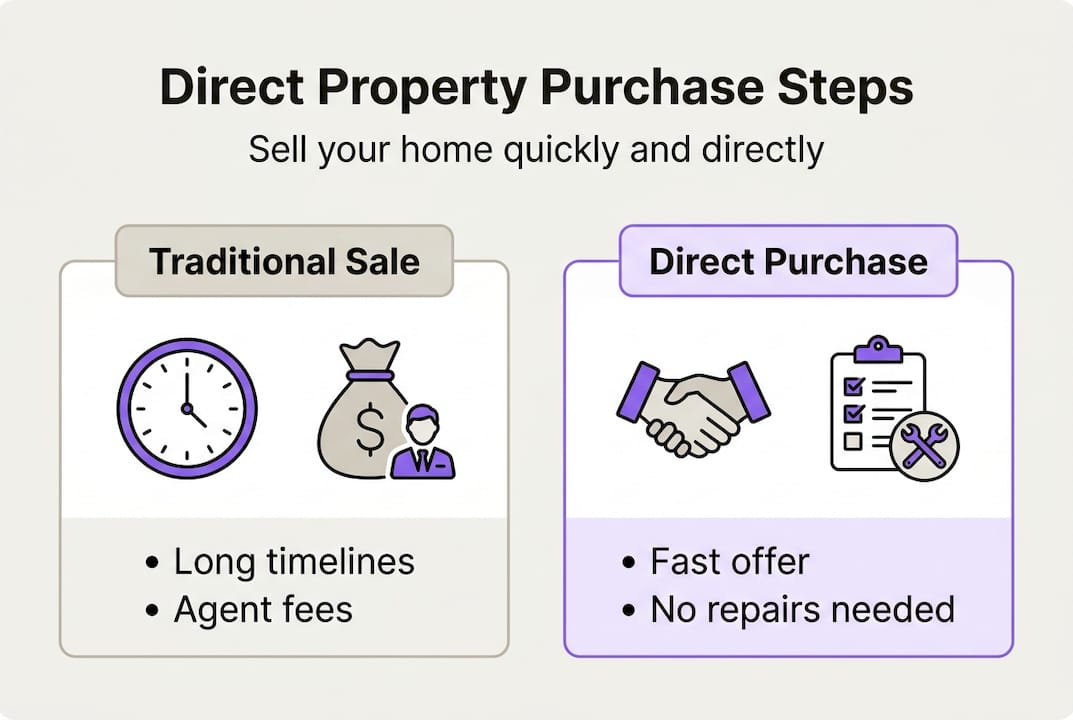
The benefits are real and significant for the right seller. Speed is the most obvious one. Where a traditional agent sale can take three to six months from listing to settlement, a direct purchase can be wrapped up in under two weeks. That matters enormously if you’re facing a mortgagee sale, a court deadline, or simply cannot carry the costs of holding a property any longer.
Certainty is the second major benefit. When a cash buyer makes an offer, it is not conditional on finance approval, building inspections, or a valuation meeting a bank’s threshold. The offer is what it is, and the sale proceeds without those common points of collapse.
You also save on agent fees. In New Zealand, private property sale benefits include avoiding commissions that typically run between 2% and 4% of the sale price. On a $700,000 home, that’s $14,000 to $28,000 back in your pocket.
However, the trade-off is price. Offers are typically 70 to 90% of market value, calculated as the after-repair value minus repair costs and the buyer’s margin. That discount exists because the buyer is taking on risk, providing speed, and planning to resell for a profit.
Here’s how the key factors compare:
| Factor | Traditional sale | Direct purchase |
|---|---|---|
| Sale price | Closer to full market value | 70 to 90% of market value |
| Speed | Months | Days to weeks |
| Certainty | Variable | High |
| Fees | Agent commission applies | No commission |
| Condition required | Presentable | Any condition |
For sellers exploring quick home sale options, the maths often still work in their favour once you factor in holding costs, agent fees, and the emotional toll of a prolonged sale.
Key point: If your property is worth $650,000 and a direct offer comes in at $550,000, that gap feels large. But subtract $20,000 in agent fees, $15,000 in repairs to prepare for market, and three months of mortgage payments, and the real difference narrows considerably.
When is direct property purchase the right move?
After understanding the pros, cons, and framework, ask yourself: is this actually the right path for your own situation?
Direct property purchase is genuinely well-suited to certain circumstances. It is not a universal solution, and being honest with yourself about your priorities will help you decide.
It’s likely the right move if you:
- Need to sell within weeks, not months
- Are dealing with a distressed, damaged, or heavily dated property
- Want to avoid the stress and exposure of public listings
- Are managing an estate or inherited property from another city or country
- Face financial hardship and need funds quickly to resolve debt
- Are separating from a partner and need a clean, fast resolution
It’s probably not the right move if you:
- Have the time and flexibility to wait for the best possible price
- Have a well-maintained property in a high-demand area
- Are not under any financial or personal pressure to sell quickly
Direct purchases prioritise speed and convenience over maximising price, and that is a fair and honest trade for sellers in the right circumstances. The key is knowing which category you fall into before you commit.
For homeowners weighing up selling your house for cash, the decision often comes down to one question: what is your time worth, and what is certainty worth to you right now?
Pro Tip: Always have a conveyancer or property lawyer review any sale and purchase agreement before signing, even if the company says the process is straightforward. This protects you from unfavourable conditions buried in the fine print.
The real story behind fast property sales in New Zealand
Every process has industry spin and real-world consequences, and direct property purchase is no exception.
Here’s what often goes unsaid: the companies making these offers are not doing it out of goodwill. They are professional investors buying at a discount to resell at a profit. That is a legitimate business model, and it genuinely helps sellers in urgent situations. But you should go in with clear eyes.
Many sellers underestimate the true size of the discount. A 10 to 20% reduction sounds manageable in the abstract, but on a $700,000 property, that is $70,000 to $140,000. For some sellers, that trade-off is absolutely worth it. For others, it is not.
It’s also worth noting that companies self-promote high acceptance rates without independent benchmarks from established sources like REINZ. That doesn’t mean the service isn’t valuable, but it does mean you should compare at least two offers before accepting one.
The simplified quick sale steps are real and they do work. But ‘easy’ does not mean ‘risk-free.’ Read every clause, ask questions, and make sure you understand what you’re agreeing to before you sign anything.
Looking for a direct property sale? Here’s a faster way
If you’ve read this far and recognise your own situation in what we’ve described, you’re already better informed than most sellers who reach out to us.
At easySale.co.nz, we make it straightforward to find out what your property is worth to a direct buyer. There are no open homes, no agent commissions, and no obligation to accept. You can sell your house as-is, in any condition, and choose a settlement date that works for your timeline. Whether you need to settle in 7 days or 60 days, we work around you. Submit your property details today and receive a fair cash offer within 48 hours.
Frequently asked questions
How quickly can I sell my house with a direct property purchase in New Zealand?
You can receive an offer within 24 to 48 hours of submitting your details and settle in as little as 7 days, depending on your preferred timeline.
Will I get full market value for my property?
Direct offers are typically 70 to 90% of market value, which reflects the speed, certainty, and no-fee nature of the transaction rather than any unfairness in the process.
Do I have to repair or clean my house before selling directly?
No. You can sell completely as-is with no repairs, cleaning, or staging required. The buyer accounts for the property’s condition in their offer.
Is selling direct safer than a traditional agent sale?
It offers more speed and certainty, but you should always have a lawyer review your contract before signing to ensure your interests are fully protected.
Recommended
