
How to navigate an urgent property sale in NZ

For most Kiwi homeowners who need to sell fast, the two realistic options are a time-bound sale method (auction, deadline sale, or tender) or a vetted cash offer. If you have several weeks and a property in reasonable condition, a time-bound method will usually get you closer to market value. If you need settlement in under two weeks, or your property has damage or complications, a cash offer is the more certain path.
Your first 24–48 hours matter more than anything that follows. Here is what to do immediately:
- Secure your documents. Locate your certificate of title, council records, LIM report (if you have one), and any consent documentation for building work.
- Call a lawyer or conveyancer. Do this before you advertise or agree to anything. The New Zealand Government’s guidance is clear: sellers must disclose known property issues and should have legal support in place from the start.
- Contact your lender. If there is a mortgage, confirm the payout figure and any break fees. This number affects your bottom line on any offer.
- Get a quick market sense. Check recent comparable sales on Trade Me Property and ask a local agent for a free appraisal. You need a realistic price range before you can evaluate any offer.
- Write basic property notes. A short summary of the property’s features, chattels included, and any known issues helps buyers make decisions faster and reduces back-and-forth.
Two risks to avoid right now: advertising the property before your disclosures are in order, and agreeing to any terms verbally without a written agreement. Both can cost you time, money, or worse.
Key takeaways
Selling a property fast in New Zealand requires matching your sale method to your actual deadline, getting legal support in place within the first 48 hours, and understanding that speed and certainty usually come at some cost to the final sale price.
| Point | Details |
|---|---|
| Act in the first 48 hours | Secure documents, call a lawyer, contact your lender, and get a market appraisal before advertising. |
| Speed costs price | Cash offers settle in 7–30 days but typically carry a 10–20% discount to market value. |
| Staging pays off | Simple fixes and professional photos can raise perceived value by roughly 10–15% and speed buyer interest. |
| Match method to timeline | Auctions and deadline sales suit sellers with 2–4 weeks; cash buyers suit those who need settlement sooner. |
| Easysale for fast certainty | Easysale provides no-agent, as-is cash offers with flexible settlement timelines across New Zealand. |
Table of Contents
- What counts as an ‘urgent’ property sale in New Zealand?
- Speed, certainty, and sale price: the trade-off you need to understand
- Get your legal disclosures and property documents in order
- Which sale pathway suits urgent sellers best?
- Realistic timelines and price outcomes in NZ markets
- How to protect yourself when contracts move fast
- Prepare the property fast: what actually moves buyers
- How Easysale works for Kiwi sellers who need speed
- How to choose the right pathway for your situation
- An honest note from someone who has seen these sales up close
- A fast cash offer from Easysale: what to prepare and how to get started
- Sources
What counts as an ‘urgent’ property sale in New Zealand?
In practical NZ terms, a sale is urgent when you need to reach an unconditional agreement within roughly 7–30 days, or when a hard external deadline is forcing the timeline. That is a meaningfully shorter window than a standard agent-led campaign, which typically runs 4–8 weeks from listing to unconditional.
Common triggers include:
- Mortgage default or lender pressure. A mortgagee sale process can begin quickly once a lender issues a formal notice. Selling before that point preserves more of your equity and your credit record.
- Sudden relocation. A job transfer or family emergency that requires you to be elsewhere within weeks leaves little room for a drawn-out campaign.
- Property damage. Storm, flood, or fire damage can make a property difficult to insure and hard to present. Buyers with standard finance often cannot get approval on a damaged property, which limits your pool.
- Estate or probate deadlines. Executors sometimes face court-imposed or beneficiary-agreed timelines that require a settled sale within a fixed period.
- Conditional purchase of another property. If you have already gone unconditional on a new home, your settlement date on that purchase becomes a hard deadline for your sale.
Each trigger compresses the timeline differently. A relocation might give you three weeks; a mortgagee notice might give you less. Understanding which trigger applies to your situation tells you which sale method is even possible, and which ones you can rule out immediately. For a fuller breakdown of common reasons Kiwi sellers need to move quickly, this overview of urgent sale triggers covers the most frequent scenarios.
Speed, certainty, and sale price: the trade-off you need to understand
The direct truth is this: faster sales almost always mean a lower sale price or meaningful concessions, while slower routes aim for market value but carry real delay risk. You cannot optimise all three axes at once.
Think of it as three dials. Turn up speed, and certainty can improve but price tends to drop. Turn up price ambition, and you usually need more time and accept more uncertainty about whether the deal will complete.
According to Easysale’s blog, quick cash offers typically settle within 7–30 days and commonly carry a 10–20% discount to market value. That discount reflects the buyer’s risk, the speed of settlement, and the as-is condition of the purchase. For a seller facing mortgage default or a hard relocation deadline, that trade-off is often worth it. For a seller who can wait 6–8 weeks, it usually is not.
A practical heuristic: if your debt or deadline means you cannot afford a failed sale, prioritise certainty over price. A conditional offer that falls through at week five costs you more than accepting a modest discount upfront.
Get your legal disclosures and property documents in order
The single most common reason urgent sales stall is incomplete or incorrect disclosure. Buyers and their lawyers will ask questions, and if you cannot answer them quickly and accurately, conditional periods stretch out or deals collapse.
Start by collecting these documents immediately:
- Certificate of title (available from Land Information New Zealand via your lawyer)
- LIM report (Land Information Memorandum from your local council, which covers rates, consents, and known hazards)
- Building consents and code compliance certificates for any work done on the property
- Body corporate records if the property is a unit or apartment
- Insurance documentation, particularly if there has been any weather-tightness or water damage claim
NZ disclosure rules require you to tell buyers about known defects. This covers weather-tightness issues (leaky building syndrome remains a significant concern in NZ), unconsented building work, easements or covenants on the title, and any disputes with neighbours or the council. Failing to disclose can cause a sale to fall over at settlement or, worse, result in court action after the fact.
Settled recommends matching your sale method to your property’s readiness. If your disclosures are incomplete, a time-bound method like an auction puts you under pressure to resolve them quickly. A cash buyer who purchases as-is can sometimes absorb more uncertainty, but you still need to be honest about what you know.
Your first professional call should be to a lawyer or conveyancer. They can review your title, flag any issues that need resolving before launch, and prepare the sale and purchase agreement. If you are using a licensed real estate agent, they are also bound by the Real Estate Authority’s licensing and disclosure rules and can help you identify what needs to be declared.
Pro Tip: Ask your lawyer to prepare a basic vendor disclosure statement before you list. Handing this to buyers upfront shortens the due diligence period and signals that you are a serious, organised seller.
Which sale pathway suits urgent sellers best?
Settled.govt.nz advises matching your sale method to your timeline and property readiness. For urgent sellers, the fastest unconditional outcome usually comes from a cash buyer or a well-run deadline sale. Here is how the main pathways compare across the dimensions that matter most when time is short.
| Pathway | Speed to unconditional | Certainty | Likely price outcome | Costs and fees | Effort required | Legal/disclosure risk |
|---|---|---|---|---|---|---|
| Auction | 2–4 weeks to auction day | High if sold under the hammer | Close to market | Agent commission (typically 2–4%) | High (prep, marketing, open homes) | Standard; must be ready on auction day |
| Deadline sale | 2–3 weeks | Moderate to high | Near market | Agent commission | Moderate | Standard; disclosure must be complete before launch |
| Tender | 3–5 weeks | Moderate | Near to above market | Agent commission | Moderate to high | Standard |
| Private sale | Variable (days to months) | Low to moderate | Below to near market | Low (no commission, legal fees only) | High (self-managed) | Higher if seller lacks experience |
| Cash buyer (as-is) | 7–30 days | Very high | 10–20% below market | No agent commission | Low (no prep or open homes) | Lower; buyer accepts as-is |
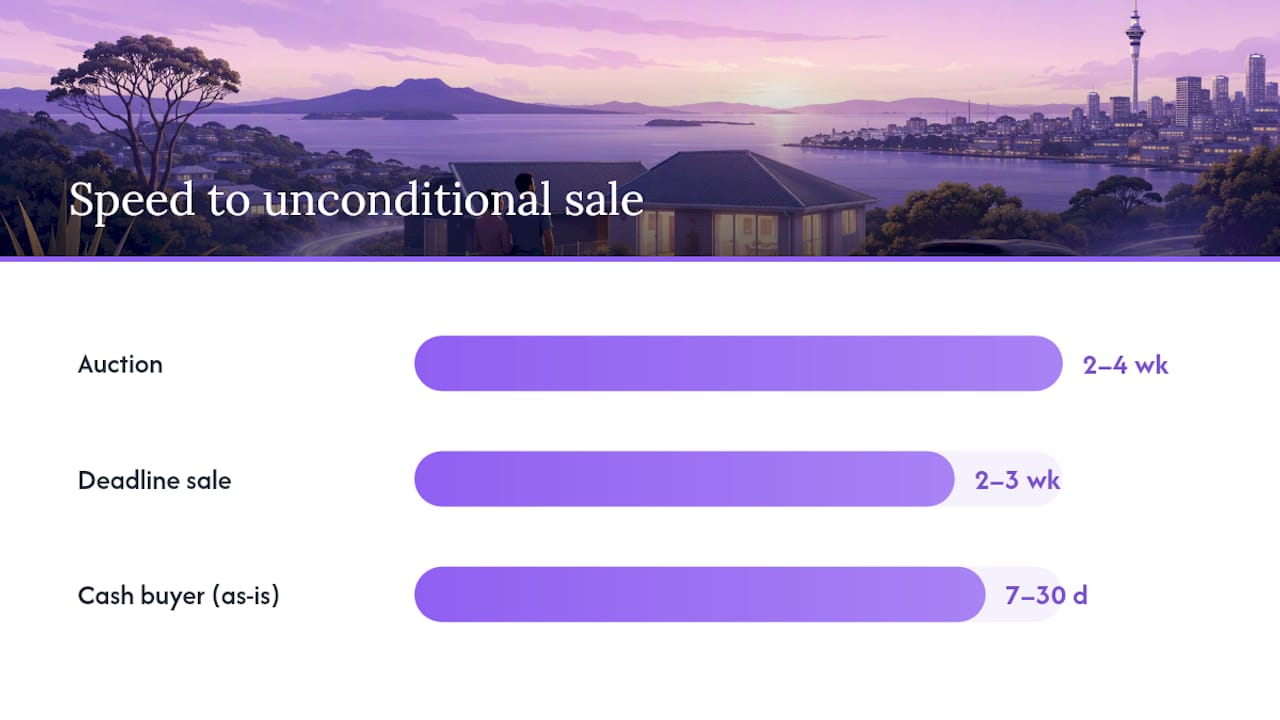
For most urgent sellers, the practical strategy is to pursue two paths simultaneously: launch a short deadline sale campaign while getting a cash offer as a fallback. If the campaign produces a strong offer, take it. If it does not, you have a certain exit ready. For a deeper look at how these methods work in NZ fast-sale contexts, this guide to types of property sales is worth reading before you commit to a pathway.
One important note on private sales: if you have an active agency agreement with a licensed agent, that agent may still be entitled to commission even if you find a buyer yourself. Review any agency agreement carefully before attempting to sell privately.
Realistic timelines and price outcomes in NZ markets
Here is what sellers can realistically expect across the main pathways, based on current NZ market conditions.
| Pathway | Typical time to unconditional | Typical settlement after unconditional | Usual price outcome |
|---|---|---|---|
| Auction | 2–4 weeks | 30 days | Market to slightly above |
| Deadline sale | 2–3 weeks | 30 days | Near market |
| Agent-led private sale | 4–8 weeks | 30 days | Near market |
| Cash buyer (as-is) | 7–30 days | Flexible, can be faster | 10–20% below market |
Several factors push these timelines longer. Buyer finance approval is the most common culprit: a conditional offer with a 10-working-day finance condition can stall a sale if the buyer’s bank takes longer than expected. Property condition matters too. A well-presented home in a high-demand suburb will attract more buyers and move faster than a damaged or tenanted property in a slower market.
Trade Me’s seller guide recommends getting a current market appraisal before launching, so you can set a realistic price range rather than anchoring on an outdated figure. Overpricing in an urgent sale is a costly mistake: you lose the first two weeks of peak buyer interest and then have to reduce, which signals desperation to the market.
To evaluate a cash offer quickly, compare it against your net proceeds from a market sale. The gap between a cash offer and a market sale is often smaller than the headline discount suggests.
How to protect yourself when contracts move fast
Conditional offers and finance conditions are the most frequent causes of settlement failure in urgent sales. The goal is to reduce open conditions where possible, but always get legal advice before waiving any condition on your behalf or accepting unusual terms.
Before signing anything, confirm these items with your lawyer:
- Deposit amount and handling. The deposit should be held by a solicitor or in a trust account, not paid directly to you. Standard NZ deposits are typically 10% of the purchase price.
- Settlement date. Make sure it aligns with your actual deadline. A settlement date that is too early or too late creates its own problems.
- Chattels list. Specify exactly what is included (whiteware, light fittings, curtains) to avoid disputes at settlement.
- Conditional clauses. Finance, building inspection, and LIM conditions all extend the timeline. Understand what each condition allows the buyer to do if they are not satisfied.
- Pre-settlement inspection rights. Buyers are entitled to a pre-settlement inspection. Know when this is scheduled and what standard it applies.
Red flags to walk away from: any buyer or intermediary who is not a licensed real estate agent under the Real Estate Authority but is acting as one, requests for unusual upfront fees, pressure to sign without time to get legal advice, or refusal to use a standard ADLS/REINZ sale and purchase agreement. The REINZ publishes market data and professional standards that give you a useful reference point for what normal looks like.
Common settlement failures stem from finance falling through, pre-settlement inspection surprises, or slow legal handling. Having your lawyer engaged from day one, with a clear deposit process agreed in writing, materially reduces the chance of a deal collapsing at the last moment.
Prepare the property fast: what actually moves buyers
Small, targeted fixes and professional photography deliver the best return on a tight timeline. Do these before you launch, even if it means delaying by 48 hours.

Staging and simple repairs can raise perceived value by roughly 10–15% and materially speed buyer interest. That is a significant return on what is often a modest investment in decluttering, a coat of paint, and a few hours of garden tidying.
A practical staging checklist for urgent sellers:
- Remove personal items, excess furniture, and clutter from every room
- Clean thoroughly, including windows, kitchen surfaces, and bathrooms
- Fix obvious visual defects: dripping taps, broken handles, scuffed walls
- Improve kerb appeal with a mowed lawn and a clean front entrance
- Let in as much natural light as possible for photography
For photography, hire a professional. Listings with quality photos attract significantly more online enquiries, and in an urgent sale, you need serious buyers to find you in the first week. Include a floorplan if possible. Buyers who cannot visualise the layout often skip the listing entirely.
On marketing: list on Trade Me Property as a minimum. If you are using an agent, confirm they will also push the listing through their database and social channels in the first 48 hours. For urgent sales, private viewings by appointment often work better than open homes, which can attract curious neighbours rather than qualified buyers.
Pro Tip: Set a clear viewing window in your listing description (for example, “viewings available Tuesday and Thursday, 5–7 PM”) rather than leaving it open-ended. This creates a sense of limited access and tends to attract more committed buyers.
For sellers dealing with a property that needs more significant presentation work, this guide on selling hard-to-present homes covers practical low-cost options worth considering before launch.
How Easysale works for Kiwi sellers who need speed
Easysale provides no-agent, as-is cash offers with settlements possible in days to weeks. It is the right path when speed and certainty matter more than achieving top market price, and when the property has complications that make a standard campaign difficult.
The process is straightforward:
- Submit your property details. Provide basic information about the property, its condition, and your preferred timeline via the Easysale website. No obligation at this stage.
- Receive a no-obligation cash offer. Easysale assesses the property and provides a written offer. You are not committed to accepting it.
- Accept and settle on your timeline. If the offer works for you, settlement can be arranged to suit your deadline, whether that is two weeks or six.
Easysale suits sellers facing mortgage distress, urgent relocation, significant property damage, or estate situations where a quick, clean settlement is the priority. It is less suited to sellers who have the time and a well-presented property to run a full market campaign, since cash offers typically carry a 10–20% discount to market value in exchange for speed and certainty.
When vetting any cash buyer, including Easysale, take these steps:
- Ask for written offer terms before committing to anything
- Confirm that settlement will be handled through a solicitor
- Request references or examples of recent purchases if you want additional reassurance
- Have your own lawyer review the sale and purchase agreement before signing
This article provides general information only and is not a substitute for legal or financial advice. Consult a qualified lawyer or conveyancer before signing any property agreement.
For more on how fast-sale options compare in NZ, this detailed breakdown of urgent sale pathways covers the practical differences clearly.
How to choose the right pathway for your situation
Score each pathway against four criteria before you commit: your hard deadline, your tolerance for a price discount, your need for certainty that the deal will complete, and your capacity to prepare the property.
A short checklist to work through with each professional you speak to:
Ask a licensed agent:
- What sale method do you recommend given my timeline, and why?
- What is a realistic price range based on recent comparable sales?
- How many active buyers do you have on your database for this property type?
Ask your lawyer or conveyancer:
- Are there any title or consent issues that could delay or derail a sale?
- What deposit arrangement do you recommend for a fast sale?
- How quickly can you turn around the sale and purchase agreement?
Ask a cash buyer representative:
- Is your offer subject to any conditions, or is it unconditional?
- Who handles the legal side of settlement, and what are the costs?
- Can you provide written confirmation of the offer and timeline today?
Red flags that should stop you in your tracks: a buyer or intermediary who refuses to use a standard sale and purchase agreement, anyone who asks for an upfront fee before making an offer, and any pressure to sign without a cooling-off period or legal review. If something feels off, it usually is.
The fallback strategy that works well for many urgent sellers: run a short deadline sale campaign while simultaneously getting a written cash offer. If the campaign delivers a strong result, you take it. If it does not, you have a certain exit ready rather than starting from scratch.
An honest note from someone who has seen these sales up close
The sellers who come out of urgent sales in the best position are almost never the ones who held out longest for a higher price. They are the ones who made a clear-eyed decision early, got legal advice within the first 48 hours, and chose a pathway that matched their actual deadline rather than an optimistic one.
The most common regret I see is waiting too long to accept a realistic offer, then being forced into a worse position two weeks later when the deadline is even tighter and the options are fewer. Certainty has real value when you are under pressure. A deal that settles cleanly at a modest discount is almost always better than a deal that falls over at the last moment.
Get your lawyer involved early. Not after you have agreed to something, but before. That one step prevents more problems than any other piece of advice in this guide.
A fast cash offer from Easysale: what to prepare and how to get started
If you have read this far and know that a fast, certain settlement is what you need, Easysale can provide a no-obligation cash offer and flexible settlement on short notice, with no agent fees and no requirement to repair or stage the property.

Before you reach out, have these ready: your certificate of title or property address, a clear sense of your preferred settlement date, a brief note on the property’s condition (including any known damage or unconsented work), and your solicitor’s contact details if you have one engaged already.
Easysale buys properties as-is across New Zealand, including damaged, tenanted, and complicated properties that are difficult to take to market. The process starts with a simple enquiry and a written offer, with no pressure to accept. Visit Easysale to submit your property details and get a cash offer started today.
This is general information only. Before accepting any offer, speak with a qualified lawyer or conveyancer to confirm the terms suit your situation.
Sources
- Settled
- Selling your house | New Zealand Government
- How To Sell A House Quickly | Tips For A Fast Sale
- Selling a house in NZ: A complete guide (Trade Me)
Recommended
