
Selling property in financial distress: your NZ guide

TL;DR:Selling property in financial distress involves urgent sales to relieve debt before lenders take control. Homeowners in New Zealand have legal protections under the Credit Contracts and Consumer Finance Act and the Property Law Act that allow for hardship relief and voluntary sales. Act early and prepare your documents to maximize control, speed, and minimize financial loss during the process.
Selling property in financial distress is defined as an urgent property sale made to relieve financial pressure before a lender takes control of the process. For New Zealand homeowners, this situation is more common than many realise, and knowing your rights under the Credit Contracts and Consumer Finance Act (CCCFA) and the Property Law Act 2007 can mean the difference between a controlled exit and a costly mortgagee sale. The good news is that you have real options, including hardship relief, voluntary sales to cash buyers, and legal protections that give you time to act.
What legal rights do homeowners have when selling property in financial distress?
Your rights as a distressed homeowner in New Zealand are stronger than most people expect. The CCCFA gives you the right to apply for hardship relief directly with your lender. Under this legislation, hardship relief may include reduced repayments, a pause in payments, or a loan extension. That means your bank is legally obligated to consider your application before pushing toward a forced sale.
Before a mortgagee sale can proceed, your lender must follow a formal process under the Property Law Act 2007. This includes issuing a default notice and allowing a remedial period of at least 20 working days before any sale can occur. That window is your opportunity to act, whether that means applying for hardship relief, listing the property voluntarily, or engaging a cash buyer.
Key protections you should know:
- Hardship application right: You can formally request modified loan terms from your lender at any time during financial difficulty.
- Default notice requirement: Your lender must issue a written default notice before taking any enforcement action.
- Remedial period: You have at least 20 working days after a default notice to remedy the default or arrange an alternative.
- Lender obligation to engage: Lenders generally prefer to avoid mortgagee sales and will often negotiate hardship arrangements such as term extensions or interest-only payments.
Pro Tip: Contact your lender the moment you anticipate difficulty with repayments. Acting early and communicating clearly increases your chances of hardship relief and keeps you in control of the sale timeline.
How can you sell voluntarily to manage financial pressure quickly?
A voluntary sale is the most effective path for homeowners facing financial hardship in real estate. You retain control over the price, the timeline, and the condition of the property. A mortgagee sale, by contrast, is run entirely by the lender with your interests as a secondary concern.

The fastest voluntary route is selling to a cash buyer. A cash buyer can provide an offer within 24 hours and settle in as little as 7 to 18 days. The trade-off is a price that typically sits below market value, but for many homeowners under pressure, speed and certainty outweigh a higher price that takes months to achieve.
Steps to prepare for a quick voluntary sale
- Gather your documents early. Collect your title, rates notices, and mortgage statements. Having these ready prevents delays once an offer is accepted.
- Assess the property condition honestly. Cash buyers purchase properties as-is, so you do not need to spend money on repairs. However, knowing the condition helps you set realistic expectations.
- Engage a solicitor or conveyancer. Property transfer must be handled by a licensed professional using Landonline. DIY conveyancing is not a practical option for legal title transfer in New Zealand.
- Confirm your settlement readiness. Settlement timing depends heavily on your ability to vacate and provide documents, not just the buyer’s offer speed. Plan your move before you accept an offer.
- Notify your lender of the pending sale. Your bank needs to be informed so they can prepare discharge of mortgage documentation in time for settlement.
Pro Tip: If you need to sell your house fast, confirm your moving timeline before signing a sale and purchase agreement. A fast offer means nothing if settlement is delayed because you are not ready to vacate.
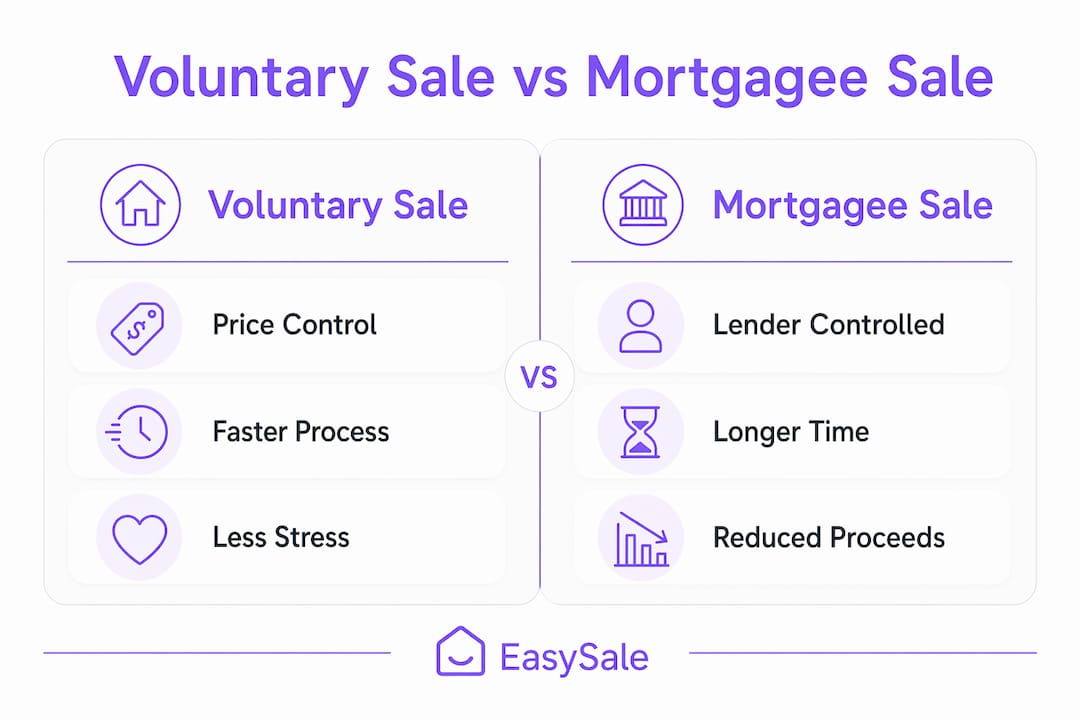
Voluntary sale vs mortgagee sale: a direct comparison
| Factor | Voluntary sale | Mortgagee sale |
|---|---|---|
| Price control | You set or negotiate the price | Lender controls the process |
| Timeline | Can settle in 7–18 days with a cash buyer | Unpredictable, often months |
| Condition flexibility | Cash buyers purchase as-is | Property sold as-is by lender |
| Personal liability risk | Lower, if sale covers mortgage | Higher, shortfall liability remains |
| Emotional stress | Manageable with preparation | Significantly higher |
What happens when your mortgage is more than your property is worth?
Being “under water” means your property is worth less than the amount you owe on your mortgage. This situation directly complicates any property sale for financial difficulties because the sale proceeds may not cover your debt. Banks will not lend more than the current property value, which means a buyer cannot simply take over your mortgage at the original amount.
If you are in negative equity, you have three realistic paths:
- Negotiate with your lender. Some lenders will accept a short sale, where they agree to release the mortgage even if the sale price falls short of the full debt. This requires written lender approval before settlement.
- Apply for hardship relief and hold the property. If the market is likely to recover, pausing repayments through a hardship arrangement may give you time to regain equity.
- Bring additional cash to settlement. If you have savings or can access funds from family, you can cover the shortfall and complete the sale. This clears the debt and removes ongoing financial pressure.
Professional financial advice is not optional in this situation. A financial adviser or mortgage broker who understands the New Zealand market can help you model each path and choose the one that limits your long-term exposure. Title due diligence is equally critical. Registered interests beyond the mortgage can affect your net proceeds and complicate settlement, so your solicitor needs to check the title thoroughly before you proceed.
What should you know about mortgagee sales and how to avoid them?
A mortgagee sale is a forced property sale initiated by your lender after you default on your mortgage. It is the outcome most homeowners in financial hardship want to avoid, and with good reason. Mortgagee sales often result in a lower sale price and fewer protections for sellers compared to voluntary sales.
The legal process under the Property Law Act 2007 requires your lender to issue a formal default notice before taking any action. You then have a remedial period to address the default. Only after that period expires without resolution can the lender proceed with a sale. This process exists to protect you, but it only helps if you use the time it provides.
Risks of a mortgagee sale you need to understand:
- Lower sale price. The lender’s goal is to recover the debt, not to maximise your return. Properties sold under mortgagee conditions frequently sell below market value.
- Personal liability for shortfall. If the mortgagee sale does not cover the debt and sale costs, you remain personally liable for the remaining amount. This debt does not disappear with the property.
- Loss of control. You have no say in the marketing, timing, or final price once the lender takes over.
- Credit record impact. A mortgagee sale is recorded and can affect your ability to borrow in the future.
“The best time to explore alternatives to a mortgagee sale is before the default notice arrives. Once the process starts, your options narrow quickly.”
Engaging your lender early is the single most effective step you can take. Most lenders would rather work out a hardship arrangement or support a voluntary sale than manage a mortgagee process. If you are already in default, contact your lender immediately and ask about property foreclosure help and voluntary sale options before the remedial period expires.
Key takeaways
Selling property in financial distress requires early action, clear communication with your lender, and a deliberate choice between voluntary sale and mortgagee sale before the decision is made for you.
| Point | Details |
|---|---|
| Know your legal rights | The CCCFA gives you the right to apply for hardship relief before any forced sale can proceed. |
| Act before default | Engaging your lender early keeps more options open and increases the chance of a negotiated outcome. |
| Voluntary sale beats mortgagee sale | You retain price control, timeline flexibility, and lower personal liability risk with a voluntary sale. |
| Cash buyers offer speed | A cash buyer can settle in 7–18 days, but your settlement readiness is just as important as the offer speed. |
| Negative equity needs professional advice | If your mortgage exceeds the property value, a financial adviser or solicitor must be involved before you proceed. |
What I have learned from watching homeowners sell under pressure
The homeowners who come out of financial distress with the least damage are almost always the ones who acted before they had to. That sounds obvious, but the reality is that most people wait. They hope the situation will improve, they avoid the difficult conversation with their lender, and they lose weeks or months of options in the process.
The legal protections under the CCCFA and the Property Law Act 2007 are genuinely useful, but only if you use them. A 20-working-day remedial period sounds like a long time when you are reading about it. When you are living it, it disappears fast. The paperwork, the solicitor appointments, the moving logistics, the lender negotiations: all of it takes longer than you expect.
The other thing I have seen consistently is that homeowners underestimate how much their own readiness affects the outcome. A cash buyer can make an offer in 24 hours. But if you are not ready to vacate, if your documents are not organised, or if your solicitor is not briefed, that fast settlement becomes a slow one. The speed of the buyer means nothing if the seller is not prepared.
My honest advice is this: treat the moment you first feel financial pressure as the moment to act. Not when the default notice arrives. Not when the lender calls. Right now. The earlier you engage, the more control you keep.
— Aaron
How Easysale helps homeowners sell fast and fairly
Homeowners facing financial hardship in real estate need a clear, fast path to settlement. Easysale offers exactly that.

Easysale buys residential properties across New Zealand in any condition, with no agent fees, no open homes, and no repairs required. You submit your property details, receive a fair cash offer within 24 hours, and settle on a timeline that works for you, from 7 to 30 days. There are no commissions and no surprises. For homeowners who need to move quickly and cleanly, Easysale provides a direct, private sale option that puts you back in control of the process.
FAQ
What does selling property in financial distress mean?
Selling property in financial distress means completing an urgent property sale to relieve financial pressure, typically before a lender initiates a mortgagee sale. It includes voluntary sales, cash buyer sales, and hardship-supported exits.
How long does a mortgagee sale process take in New Zealand?
The Property Law Act 2007 requires a formal default notice and a remedial period of at least 20 working days before a mortgagee sale can proceed. The full process typically takes several months from first default to settlement.
Can I sell my house if I owe more than it is worth?
Yes, but you will need lender approval or additional funds to cover the shortfall at settlement. A solicitor and financial adviser should be involved before you proceed with any sale in negative equity.
What is the fastest way to sell a distressed property in New Zealand?
Selling to a cash buyer in New Zealand is the fastest option, with offers possible within 24 hours and settlement in as little as 7 to 18 days. Your own readiness to vacate and provide documents directly affects how quickly settlement completes.
Do I need a lawyer to sell my house privately in New Zealand?
Yes. Property title transfer in New Zealand must be completed by a licensed solicitor or conveyancer using Landonline. DIY conveyancing is not a legal option for completing a property sale.
Recommended
