
Understanding sale conditions in NZ property sales

TL;DR:Understanding sale conditions in New Zealand is crucial, as they govern the sale timeline and legal obligations of both parties.Managing and tracking condition deadlines precisely can help sellers avoid stressful delays and potential deal cancellations.
When you sign a Sale and Purchase Agreement in New Zealand, you are not simply agreeing to sell your home. You are entering a legally binding contract governed by a series of conditions that can delay, renegotiate, or completely derail your sale. For homeowners under financial pressure or dealing with personal challenges, understanding sale conditions is not optional. It is the difference between a smooth, timely settlement and weeks of stressful uncertainty you did not plan for.
Table of Contents
- Key takeaways
- What sale conditions actually mean
- Common types of sale conditions in NZ
- How to manage conditions and speed up your sale
- After conditions are met: unconditional and settlement
- Common pitfalls when you need a quick sale
- My perspective on selling under pressure
- How Easysale can take the pressure off
- FAQ
Key takeaways
| Point | Details |
|---|---|
| Conditions govern your sale timeline | Conditional periods typically run 10–15 working days and determine when your sale becomes binding. |
| Unconditional status is the real milestone | Track condition deadlines, not just settlement dates, to avoid surprise deal failures. |
| Tight condition wording protects sellers | Tighter timeframes and clear evidence requirements reduce renegotiation and cancellation risk. |
| Disclosure obligations never disappear | Even in quick or cash sales, failing to disclose known issues can lead to legal claims. |
| Cash buyers remove conditional risk entirely | Selling to a direct buyer like Easysale eliminates most conditions and speeds up the process significantly. |
What sale conditions actually mean
The Sale and Purchase Agreement controls all rights and obligations from the moment it is signed. It is not just paperwork. It sets the price, deposit amount, settlement date, chattels, and every buyer condition with specific deadlines attached.
Conditional means the agreement is in place but the sale is not fully committed. The buyer has the right to walk away, or in some cases renegotiate, if their conditions are not satisfied within the agreed timeframe. Unconditional means those conditions have been met or waived, and both parties are legally bound to complete the transaction.
For sellers, this distinction matters enormously. You may believe you have sold your home the moment the contract is signed. But if the agreement is conditional, you are still in a risk window. The earliest unconditional date depends entirely on when conditions expire, not when you want to settle.
Pro Tip: Ask your lawyer to highlight every condition deadline on a single page before you sign. Having a visual summary of all expiry dates makes it far easier to track where your sale is at any given point.
Understanding contract clauses around conditions is not about learning legal language. It is about knowing what controls your timeline and what risks remain open until those conditions are resolved.
Common types of sale conditions in NZ
Most Sale and Purchase Agreements in New Zealand include one or more of the following buyer conditions. Each carries a different level of risk and a different likely timeframe for resolution.
| Condition type | What it means for sellers | Typical timeframe |
|---|---|---|
| Finance | Buyer must get formal loan approval; can cancel if denied | 5–10 working days |
| LIM report | Council records checked for consents and hazards | 5–10 working days |
| Building inspection | Structural report may trigger renegotiation | 5–10 working days |
| Sale of another property | Buyer must sell their own home first | Weeks to months |
The finance condition is one of the most common. It is separate from pre-approval. The buyer’s lender must formally approve the loan against your specific property. If they do not, the buyer can cancel the agreement without penalty. From your side as a seller, this means the deal is genuinely at risk until you receive written confirmation that finance has been approved.

The LIM report condition is often misunderstood. A Land Information Memorandum contains council records about your property, including whether building work was consented, whether there are hazards noted, and whether rates are up to date. If a buyer discovers unconsented work through a LIM, they can cancel the agreement. If you know there are issues, it is far better to disclose them upfront than to wait for them to surface mid-conditional period.
The building inspection condition is where renegotiation risk is highest. Buyers routinely use inspector reports to request price reductions. You are not obligated to accept these, but if you refuse and the buyer walks, you are back at square one. The sale of another property condition is the riskiest for sellers needing speed. There is no fixed deadline on when the buyer’s sale will succeed.
Pro Tip: If a buyer requests a sale-of-another-property condition, ask for a short deadline or a “kick-out” clause. This allows you to continue marketing and accept a better offer if the buyer’s sale stalls.
How to manage conditions and speed up your sale
If you need your sale to move quickly, the conditional period is where your attention should be focused. The quickest reliable sale timeline runs until the agreement goes unconditional. Tracking only the settlement date while ignoring condition expiry dates is one of the most costly mistakes sellers make.
Here is a practical approach to managing your sale agreement terms during the conditional period:
- List every condition and its exact deadline. Write them down on a single page with dates. Do not rely on memory or assume your agent is tracking them for you.
- Communicate directly with your lawyer, not just your agent. Agents manage relationships. Lawyers manage your legal rights. Both are necessary, but different conversations.
- Ask buyers to provide evidence before requesting deadline extensions. If a buyer wants more time on their finance condition, ask what the lender has said so far. Vague extension requests with no context are a yellow flag.
- Provide information proactively to reduce buyer delays. Having your own LIM report, a recent building inspection, or council documentation ready before the buyer asks can cut days off the conditional period. Early evidence provision speeds up how quickly buyers can satisfy their conditions.
- Avoid vague condition wording. Clauses that say “subject to the buyer’s satisfaction” with no measurable criteria give buyers too much latitude. Your lawyer can tighten this language before you sign.
- Know your response to renegotiation attempts. Decide in advance what discount, if any, you would accept based on a building report. Having a number in mind means you can respond quickly rather than losing days to indecision.
For a clearer picture of NZ sale timelines, understanding each phase from offer to settlement helps you stay ahead of what is coming rather than reacting to it.
Pro Tip: Request that all condition satisfaction notices are given in writing. Verbal confirmation from a buyer or their agent is not legally sufficient and creates ambiguity about whether a condition has been formally waived.
After conditions are met: unconditional and settlement
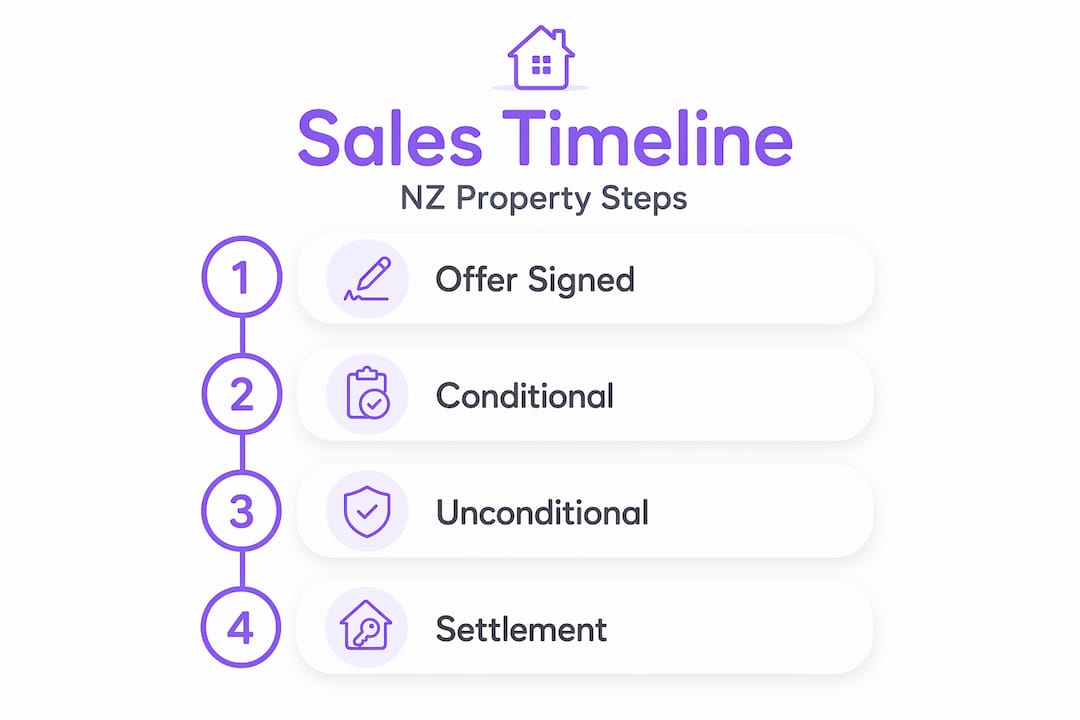
When all conditions are satisfied or waived, the agreement becomes unconditional. This is the most significant legal milestone in your sale. From this point, both parties are locked in, and withdrawing carries serious financial and legal consequences.
Here is what happens from unconditional through to settlement:
- Deposit payment. The 10% deposit is typically paid when the agreement becomes unconditional. It sits in the agent’s trust account until settlement, so it does not immediately improve your cashflow but it does confirm the buyer’s commitment.
- Settlement date preparation. Settlement is usually 30–90 days after the agreement is signed, though this is negotiable. You need to arrange vacating the property, moving logistics, and any mortgage discharge with your bank in advance.
- Final inspection. Buyers are entitled to a final walkthrough before settlement, typically within 24–48 hours. The property must be in the same condition as when it was agreed, with all chattels listed in the contract still present.
- Legal transfer. Your lawyer and the buyer’s lawyer exchange documents and funds. The title transfers to the buyer once payment clears.
- Possession. You hand over keys on the agreed possession date, which is usually the same day as settlement.
One point sellers often overlook: the unconditional date and the settlement date are not the same thing. The gap between them can be weeks. During that time you still have obligations, and any damage to the property or removal of agreed chattels can result in claims at settlement.
Common pitfalls when you need a quick sale
Sellers under time pressure make predictable mistakes. Knowing them in advance means you can sidestep them.
- Not tracking condition deadlines. You assume the deal is progressing because you have heard nothing. But silence from a buyer during the conditional period is not confirmation. Sellers who only track settlement date risk being blindsided by a late cancellation.
- Skipping legal review before signing. A lawyer reviewing your agreement before you sign costs a fraction of what a bad clause can cost you later. Buyers have professionals on their side from the start.
- Accepting vague or extended conditional periods. The longer the conditional window, the more risk you carry. A 20 working day finance condition when 10 days is standard gives the buyer twice the time to renegotiate or walk away.
- Not clarifying chattels. Disputes over what is included in the sale are surprisingly common. Fixtures, appliances, curtain rods and heat pumps all need to be listed clearly. Ambiguity here creates conflict at settlement.
- Ignoring disclosure obligations. Speed does not reduce your duty to disclose known issues. Failure to disclose can result in claims even after settlement is complete.
- Underestimating renegotiation during the conditional period. Buyers use conditions as a negotiation tool. Knowing this in advance means you can set clear boundaries and prepare responses rather than feeling pressured into reactive decisions.
Pro Tip: If you are facing genuine financial urgency, consider whether a traditional sale with conditional periods is the right path at all. A direct cash buyer removes most of these conditions and gives you a certain, fast outcome.
My perspective on selling under pressure
I have seen a lot of property transactions where the seller’s biggest problem was not the market or the buyer. It was not understanding which part of the contract actually controlled their timeline.
Most sellers focus on the settlement date as the finish line. But the finish line is really unconditional status, and everything before it is genuinely uncertain. I have watched sellers plan their finances around a settlement date while a finance condition was still open, only to have the buyer cancel in week two.
The small stuff matters more than people realise. A condition deadline that says “10 working days” versus one that says “15 working days” is five days of additional risk exposure. A clause that requires written evidence of a building issue before any price reduction is considered is worth more than most sellers appreciate when the moment comes.
My advice to anyone selling under time pressure is this: get your lawyer involved before you sign, not after something goes wrong. Know every deadline by heart. And if the uncertainty of the conditional period feels unmanageable given your situation, there are faster options worth considering.
— Aaron
How Easysale can take the pressure off
If you have read this far and realised the conditional period is the last thing you need right now, you are not alone. Many Kiwi homeowners facing financial pressure, relationship changes, or the need to downsize simply cannot afford weeks of uncertainty while a buyer’s finance condition plays out.

Easysale works differently. As a direct New Zealand property buyer, Easysale removes the conditional period from the equation. There are no real estate agents, no commissions, and no waiting for a buyer’s lender to approve their loan. You receive a fair cash offer, and settlement happens on a timeline that suits your situation. For homeowners considering a retirement or downsizing sale, Easysale offers dedicated support to make the process straightforward and stress-free. If speed and certainty matter to you, reach out to Easysale at easysale.co.nz and get a no-obligation offer today.
FAQ
What are sale conditions in a New Zealand property agreement?
Sale conditions are clauses in a Sale and Purchase Agreement that must be satisfied or waived before the sale becomes unconditional and legally binding. Common conditions include finance approval, LIM reports, and building inspections.
How long does a conditional period usually last in NZ?
Conditional periods typically run 10–15 working days from the date the agreement is signed, though this varies depending on the conditions negotiated between buyer and seller.
Can a buyer cancel during the conditional period?
Yes. A buyer can cancel the agreement if their conditions are not satisfied within the agreed timeframe, without penalty. This is why understanding and tracking each condition deadline is critical for sellers.
What happens when a sale goes unconditional?
Once unconditional, both parties are legally committed to completing the sale. The deposit is paid, and withdrawing carries serious consequences including potential loss of deposit and legal action.
How can I speed up the conditional period as a seller?
Providing information upfront, such as a current LIM report or recent building inspection, reduces delays. Working with a lawyer to tighten condition deadlines and require written evidence for any renegotiation requests also helps move the process along faster.
Recommended
