
Advantages of cash house sales for NZ homeowners

TL;DR:Cash house sales offer a faster, more certain transaction process by removing financing contingencies and reducing costs. They are ideal for sellers facing financial pressure, damaged properties, or urgent situations, but may yield offers 5–20% below market value. The decision depends on prioritizing speed and certainty over maximum sale price, with legitimate buyers providing proof of funds promptly.
A cash house sale is defined as a property transaction where the buyer purchases with verified, immediately available funds, requiring no mortgage approval or lender involvement. For New Zealand homeowners facing financial pressure, property damage, or a major life change, the advantages of cash house sales are straightforward: you get a faster settlement, fewer conditions, and a much higher chance the deal actually goes through. Services like Easysale have made this process accessible to Kiwi sellers who need certainty over a drawn-out process. This article breaks down exactly what you gain, what you give up, and how to decide if a cash sale is right for your situation.

1. How cash house sales deliver a faster settlement
Speed is the defining benefit of cash home sales. Cash transactions close in roughly two weeks, while financed deals typically take 30–45 days or more due to mortgage approval processes. That gap matters enormously when you need funds quickly or want to move on with your life.
With a cash buyer, there is no bank underwriting, no lender valuation, and no waiting on a mortgage committee. The paperwork is simpler, the parties involved are fewer, and the settlement date is set on your terms. Easysale, for example, can make an offer within 24–48 hours of a property assessment, with settlements possible in as little as seven days.
| Step | Cash sale timeline | Financed sale timeline |
|---|---|---|
| Offer received | 24–48 hours | 3–10 days |
| Conditional period | None or minimal | 10–20 days |
| Mortgage approval | Not required | 10–20 days |
| Settlement | 7–18 days | 30–45+ days |
Pro Tip: Ask your cash buyer to confirm their settlement timeline in writing before you accept. A genuine cash buyer will have no hesitation committing to a specific date.
2. Greater certainty that the sale will actually complete
The biggest hidden risk in a traditional sale is that it can fall apart weeks after you thought it was done. Cash offers eliminate financing contingencies and appraisal problems that commonly derail financed deals, giving sellers far stronger confidence the transaction will complete.
With a financed buyer, the bank has the final say. If the buyer’s mortgage is declined, or if the lender’s valuation comes in below the agreed price, the deal can collapse at the last moment. That leaves you back at square one, often weeks or months down the track.
The certainty benefits of cash buyers are especially critical in these situations:
- Financial distress: When you need funds by a specific date to meet obligations, a deal falling through is not an option.
- Damaged properties: Lenders often refuse to finance properties with significant structural or weather-tightness issues, making cash buyers the only realistic option.
- Deceased estates: Beneficiaries often need a clean, quick resolution without the risk of a sale collapsing.
- Divorce settlements: Both parties typically want a definite outcome, not an open-ended process.
Proof of funds letters are commonly requested to verify a buyer’s capacity to complete the purchase. Banks typically provide these within one to two business days. Always request one before accepting any cash offer.
3. Fewer conditions and less renegotiation
Cash home sales generally involve fewer contingencies such as inspection, appraisal, or financing clauses. Fewer conditions mean fewer exit points where a buyer can walk away or use a clause to push the price down after you have already committed.
In a traditional sale, a buyer might use a building inspection report to renegotiate the price by tens of thousands of dollars, even on a property in reasonable condition. With a cash buyer purchasing “as is,” that renegotiation lever is largely removed. The offer you accept is the price you receive.
This simplicity is not just convenient. It removes a significant source of stress during an already difficult period.
4. No agent commissions or marketing costs
Selling through a real estate agent in New Zealand typically costs between 2% and 4% of the sale price in commission, plus GST and marketing fees. On a $700,000 property, that is $14,000–$28,000 before you factor in advertising, photography, and open home preparation.
A direct cash sale removes most of these costs entirely. There is no agent, no listing fee, and no marketing budget required. The benefits of cash home buyers extend directly to your bottom line, even before you account for the time savings.
Common costs avoided in a cash sale include:
- Real estate agent commission: Typically 2%–4% plus GST
- Marketing and advertising: Photography, online listings, print
- Staging and presentation: Furniture hire, cleaning, landscaping
- Holding costs: Mortgage payments, rates, and insurance during a prolonged sale period
- Repair and renovation costs: Often required to satisfy lender conditions in financed sales
Pro Tip: When comparing a cash offer to an agent-listed price, subtract the full cost of commissions, marketing, and any required repairs from the agent’s estimated sale price before making your comparison. The gap is usually smaller than it first appears.
5. Sell your property as is, without repairs or preparation
Cash buyers purchase properties “as is, where is”, meaning you are not required to fix anything before settlement. This is one of the most practical advantages of cash home buyers for sellers whose properties have damage, deferred maintenance, or compliance issues.
Getting a property ready for the open market can cost $10,000–$50,000 or more, depending on its condition. For a homeowner already under financial pressure, that upfront spend is simply not possible. A cash buyer removes that barrier entirely.
Selling “as is” does require honest disclosure. You are still obligated to inform the buyer of known defects, and a reputable cash buyer will factor those into their offer rather than use them as a post-acceptance renegotiation tool. Easysale’s approach, for instance, is to assess property condition upfront and price accordingly, so there are no surprises at settlement.
6. What are the financial trade-offs of a cash offer?
Cash offers may come in 5–20% below market value, and that is the primary trade-off you need to weigh. The certainty and speed of a cash sale justify this discount for many sellers, but not for all.
Think of the price difference as a “certainty premium.” You are paying for a guaranteed outcome, a fast timeline, and freedom from the costs and stress of a traditional sale. Whether that premium is worth it depends entirely on your circumstances.
| Situation | Cash sale likely better | Traditional sale likely better |
|---|---|---|
| Urgent financial need | Yes | No |
| Damaged or hard-to-sell property | Yes | No |
| Divorce or estate settlement | Yes | Sometimes |
| Healthy property, no time pressure | No | Yes |
| Maximising sale price is the priority | No | Yes |
Cash sales are generally best when you prioritise speed and reduced contingencies. Financed offers may yield higher prices but come with more uncertainty and longer timelines. The right choice depends on what you value most right now.
7. Who benefits most from selling a house for cash?
Knowing when a cash sale suits your situation is as important as understanding the benefits. The reasons to sell for cash are strongest when time, certainty, or property condition are the deciding factors.
- Homeowners under financial pressure. If mortgage arrears, debt, or an impending mortgagee sale is the driver, speed is everything. A cash sale can resolve the situation in days rather than months.
- Owners of damaged or non-standard properties. Leaky homes, earthquake-prone buildings, and properties with unpermitted work are difficult to sell on the open market. Cash buyers specialise in exactly these situations.
- People going through divorce. A clean, fast sale removes the property from the equation and lets both parties move forward without prolonged negotiation.
- Executors managing a deceased estate. Beneficiaries often live in different cities or countries. A cash sale removes the complexity of managing an open-market campaign remotely.
- Homeowners relocating for work. When you have already committed to a new location, carrying two properties is expensive. A fast cash sale removes that burden.
- Sellers with tenanted properties. Managing open homes around tenants is difficult and legally constrained in New Zealand. Cash buyers typically do not require vacant possession before settlement.
If none of these situations apply to you and you have time on your side, a traditional sale through a licensed agent is likely to return a higher price. The benefits of cash home sales are most compelling when your circumstances make speed and certainty more valuable than the last dollar of sale price.
Pro Tip: Before accepting any cash offer, request a proof of funds letter and confirm the buyer’s settlement process in writing. Legitimate cash buyers will provide both without hesitation.
Key takeaways
Cash house sales deliver the most value when speed, certainty, and a simple process matter more than achieving the highest possible sale price.
| Point | Details |
|---|---|
| Speed of settlement | Cash sales settle in 7–18 days versus 30–45+ days for financed transactions. |
| Deal certainty | No financing contingencies means far fewer late-stage cancellations or renegotiations. |
| Cost savings | Sellers avoid agent commissions, marketing fees, and repair costs in most cash transactions. |
| Price trade-off | Cash offers typically come in 5–20% below market value, which is the primary financial trade-off. |
| Best-fit situations | Cash sales suit urgent sellers: financial distress, damaged properties, divorce, or estate settlements. |
My honest view on cash sales for Kiwi homeowners under pressure
I have seen a lot of homeowners agonise over the price difference between a cash offer and what they believe their property is worth on the open market. That comparison is understandable, but it often misses the full picture.
The open market price is a theoretical number. It assumes your property presents well, that a motivated financed buyer appears within a reasonable timeframe, that their mortgage is approved, and that nothing goes wrong between offer and settlement. In a stressed situation, every one of those assumptions is a risk.
What I have found is that the sellers who regret a cash sale are usually those who had more time and options than they realised. The sellers who regret not taking a cash sale are those who held out for a higher price, watched the process drag on, and ended up in a worse financial position months later.
The most practical advice I can offer is this: get a cash offer first, then compare it honestly against the true net proceeds of a traditional sale after all costs. You might be surprised how close the numbers actually are. And if your situation is urgent, the certainty of a completed sale is worth more than a higher number that may never materialise.
— Aaron
How Easysale helps NZ homeowners sell quickly for cash
If you are facing a situation where speed and certainty matter, Easysale offers a straightforward path forward. You submit your property details, receive a no-obligation cash offer within 24 hours, and settle on a timeline that works for you. There are no agent fees, no repair requirements, and no drawn-out open home campaigns.
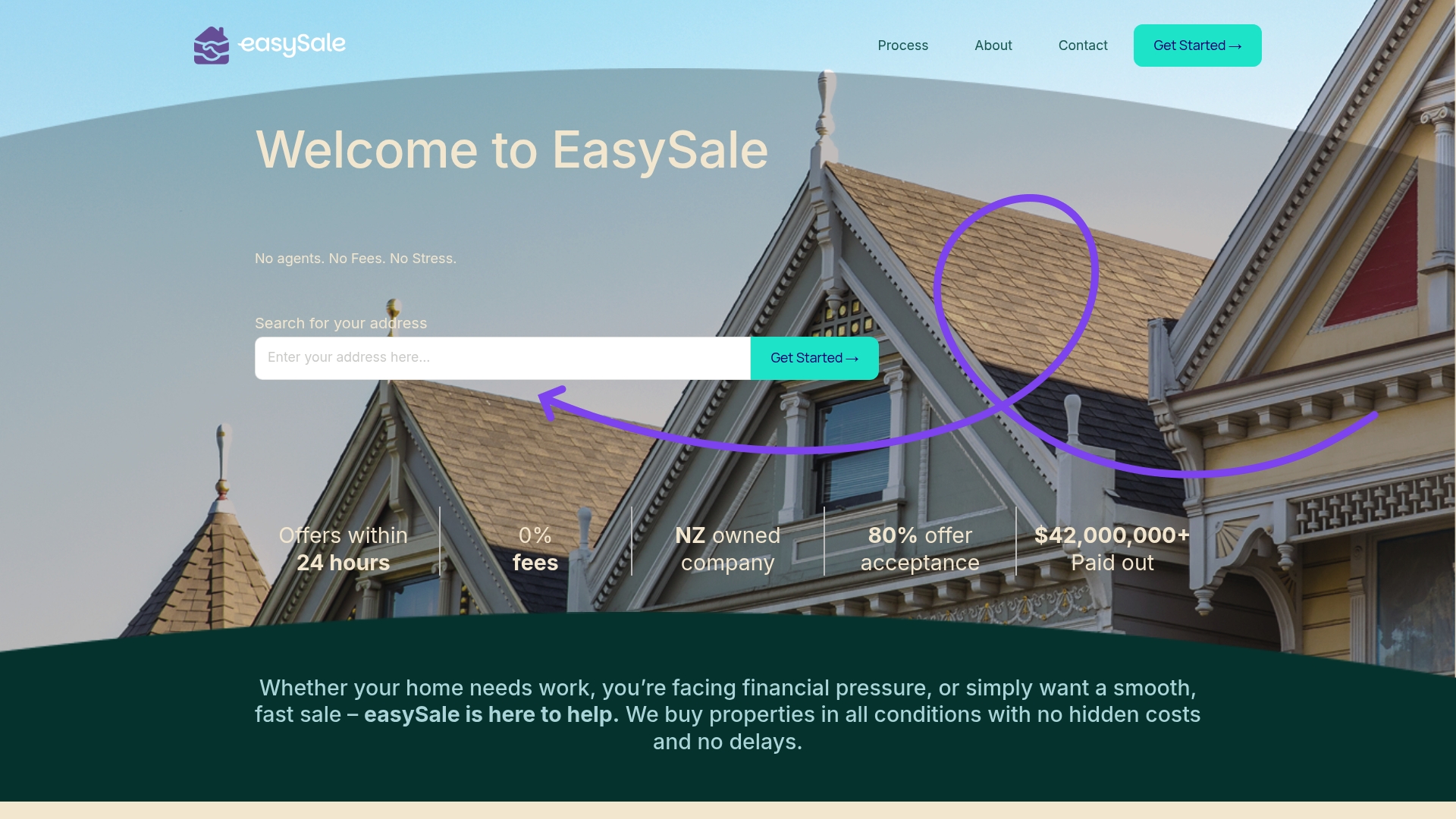
Easysale buys properties in any condition across New Zealand, including damaged or hard-to-sell homes that the open market struggles to absorb. If you want to sell your house privately and get a fair cash offer without the stress of a traditional sale, Easysale is worth a conversation. The process is transparent, the offer is obligation-free, and the timeline is yours to choose.
FAQ
How quickly can a cash house sale settle in New Zealand?
Most cash sales in New Zealand settle within 7–18 days from offer acceptance. This compares to 30–45 days or more for a financed sale, depending on mortgage approval timelines.
Will I get less money selling my house for cash?
Cash offers typically come in 5–20% below open market value. However, when you subtract agent commissions, marketing costs, repair expenses, and holding costs from a traditional sale price, the actual difference is often smaller than it appears.
Do I need to fix my property before a cash sale?
No. Cash buyers purchase properties “as is, where is,” meaning you are not required to carry out repairs or renovations before settlement. You are still required to disclose known defects to the buyer.
How do I know a cash buyer is legitimate?
Request a proof of funds letter from the buyer’s bank before accepting any offer. Reputable cash buyers provide this quickly, usually within one to two business days, and will confirm their settlement process in writing.
Is selling your house for cash a good idea if I am not in a hurry?
If you have time and your property is in good condition, a traditional sale through a licensed agent will likely return a higher price. Cash sales are best suited to sellers where speed, certainty, or property condition make a conventional sale difficult or impractical.
Recommended
