
Why Sell Before Auction: Faster, Stress-Free Outcomes

Unexpected financial pressure or sudden life changes often leave New Zealand homeowners needing immediate solutions, not long countdowns and public bidding. The stress and uncertainty of a traditional auction—where the outcome depends entirely on meeting a reserve price and contracts are unconditional once the hammer falls—only adds to the pressure. If you want control over your property sale and need speed without costly agent fees, understanding how pre-auction offers work gives you a practical and stress-free path to a result you can rely on.
Table of Contents
- Selling Before Auction Explained
- Why Pre-Auction Sales Happen
- The Traditional Auction Process
- Comparing Your Options
- How Pre-Auction Offers Work in NZ
- How the Process Unfolds
- What Makes These Offers Binding
- Why Buyers Make These Offers
- Risks and Drawbacks of Auction Sales
- What Can Go Wrong
- The Unconditional Contract Problem
- Financial and Legal Exposure
- The Stress Factor
- Financial Benefits of a Fast Sale
- Immediate Cost Savings
- Tax Implications Matter
- Improved Cash Flow and Certainty
- Risk Reduction
- Comparing Auctions With Private Cash Sales
- How Auctions Work
- How Private Cash Sales Work
- The Real Differences That Matter
- Which Approach Suits Your Situation
Key Takeaways
| Point | Details |
|---|---|
| Pre-Auction Sales Offer Certainty | Accepting an offer before auction ensures a sale without the uncertainty of auction day. |
| Cost Benefits of Selling Early | Selling before auction avoids significant marketing and auctioneer fees, reducing overall costs. |
| Flexibility with Timelines | Pre-auction sales allow sellers to set their settlement dates according to personal circumstances. |
| Reduced Stress Levels | Bypassing the auction process eliminates public bidding pressure, creating a less stressful selling experience. |
Selling Before Auction Explained
Auctions aren’t the only way to sell. In fact, many Kiwi homeowners find selling before auction offers genuine advantages that match their circumstances far better than waiting for auction day.
An auction is a public bidding event where properties sell to the highest bidder after meeting a reserve price. Vendors often list properties with “unless sold prior” language, which means pre-auction sales are entirely possible—and increasingly common.
Why Pre-Auction Sales Happen
Selling before auction simply means accepting an offer from a buyer before the scheduled auction date. Your real estate agent or property buyer approaches you with a genuine offer, and you decide whether to accept it rather than wait.
Many vendors do this because:
- Certainty arrives early. You know the sale is happening rather than hoping the auction attracts sufficient bidders.
- Costs drop significantly. Auction preparation, marketing, and auctioneer fees add up. Selling privately beforehand avoids these expenses entirely.
- Stress reduces dramatically. No countdown to auction day, no public bidding pressure, no risk of the reserve not being met.
- Timeline becomes flexible. You set the settlement date that suits your situation, whether that’s weeks or months away.
Selling before auction means you control the outcome, rather than hoping market conditions align on auction day.
The Traditional Auction Process
A property auction involves prospective buyers bidding publicly on a set day. The vendor establishes a reserve price, and once the highest bid exceeds that amount, the sale becomes legally binding. Auctions happen fast, often in minutes, and they’re entirely unconditional—the buyer receives no cooling-off period.
This pace suits some sellers but overwhelms others. If your circumstances require speed and certainty without the public auction event, selling beforehand offers a clearer path.
Comparing Your Options
You essentially have three routes: traditional auctions, open listing with private offers, or approaching a property buyer directly who specialises in fast sales, like easySale.
Each approach carries different timelines, costs, and stress levels. Understanding various property sale options available to you helps you choose the method that genuinely fits your needs rather than defaulting to what you think you “should” do.
Selling before auction simply bypasses the public event entirely. You negotiate with a serious buyer, agree on terms, and settle when you’re ready. No countdown. No public scrutiny. No crossed fingers.

Pro tip: If you receive a solid offer before your scheduled auction, run the numbers comparing settlement costs, fees, and timeline benefits against waiting for auction day—the early offer often wins when you account for total expenses and peace of mind.
Here’s an overview of how pre-auction sales, traditional auctions, and private cash sales differ in practical terms:
| Aspect | Pre-Auction Sale | Auction Day Event | Private Cash Sale |
|---|---|---|---|
| Offer Flexibility | Can negotiate price and conditions | No negotiation, highest bid wins | Full negotiation possible |
| Sale Certainty | High once accepted, before auction | Uncertain until reserve is met | High, agreed by contract |
| Cost Impact | Lower marketing and agent fees | Auction ads and auctioneer fees | Minimal upfront costs |
| Privacy Level | Discreet, fewer people involved | Public event, all bids visible | Private between parties |
How Pre-Auction Offers Work in NZ
Pre-auction offers are straightforward: a buyer makes you an offer before your scheduled auction date, and you can accept it outright. If you do, the auction gets cancelled, and you proceed directly to settlement.
This happens more often than many Kiwi homeowners realise. Potential buyers can make pre-auction offers to sellers before the scheduled auction, and these offers are considered if received and accepted by the seller.
How the Process Unfolds
When your property is listed “unless sold prior”, buyers know they can approach you with an offer before auction day. Your real estate agent presents these offers to you, and you decide whether to accept.
The basic steps look like this:
- Property is listed with an auction date scheduled.
- A buyer makes a pre-auction offer to your agent.
- You review the offer and decide to accept or negotiate.
- If accepted, binding sale and purchase agreements are created prior to auction.
- The auction is cancelled immediately.
- Legal work begins straight away to complete the sale.
What Makes These Offers Binding
Once you accept a pre-auction offer, it becomes a legal contract. This isn’t a casual handshake—it’s a binding agreement that commits both you and the buyer to proceed with the sale.
Your conveyancer gets involved early to handle the legal checks. This includes title searches, LIM reports, and confirming the buyer’s finance is in order. Getting these sorted before auction day reduces risk for everyone involved.
The offer itself must be clear about conditions. Some pre-auction offers are unconditional (like auctions), while others include conditions around finance or inspection. Make sure you understand exactly what you’re agreeing to before signing.
Pre-auction offers create real, binding agreements—not tentative arrangements that can vanish before settlement day.
Why Buyers Make These Offers
Serious buyers make pre-auction offers because they want certainty. They know the seller is prepared to sell and they’re willing to skip the auction process entirely to secure the property.
They’re also willing to meet your timeline. Some buyers can settle in weeks, others need more time. Pre-auction offers let you negotiate settlement dates that genuinely suit your situation rather than accepting whatever the auction brings.
Understanding how the wider property selling process works in New Zealand helps you see where pre-auction offers fit into your overall options.
Pro tip: When you receive a pre-auction offer, ask your agent to provide the buyer’s proof of funds or finance approval—this tells you immediately whether they’re genuinely serious and capable of settling.
Risks and Drawbacks of Auction Sales
Auctions sound appealing until you understand what can go wrong. For Kiwi sellers, the risks are real and worth considering before you commit to auction day.
The biggest concern: your property might not sell at all. If bidding doesn’t reach your reserve price, the property gets “passed in”—meaning it’s returned unsold, and you’ve paid auction fees for nothing.
What Can Go Wrong
Auctions in New Zealand carry risks for both buyers and sellers. Sellers face the property not reaching the reserve price, resulting in no sale at all. When that happens, you’ve invested time, money, and stress with zero outcome.
Other auction drawbacks include:
- Tight timelines create pressure. You must prepare everything quickly—legal documents, marketing, inspections—all compressed into weeks.
- Market exposure varies. Bad weather, poor marketing, or unfortunate timing can result in weak buyer turnout on the day.
- Costs add up fast. Marketing, auctioneer fees, legal preparation, and administration fees reduce your final proceeds.
- No second chances. If the reserve isn’t met, you can’t renegotiate—the auction simply fails.
The Unconditional Contract Problem
Once the hammer falls at auction, the contract becomes unconditional and binding immediately. The buyer must pay a deposit right away and proceed with settlement without any cooling-off period or inspection contingencies.
This speed works against sellers too. Buyers who win auctions often haven’t completed full due diligence. They may discover property issues after purchase, but they’re locked in regardless.
Auction sales are final the moment the gavel comes down—there’s no backing out or renegotiating terms.
Financial and Legal Exposure
The Property Law Section Guidelines caution about auction risks including lack of buyer due diligence and potential financial exposure due to unconditional contracts. If something goes wrong post-settlement, you may face liability even though you’ve already moved on.
Your legal protections may not apply fully compared to private sales. Auction terms are strict, and variations can leave gaps in your protection.
Comparing various property sale options available to you shows you don’t have to accept these risks. Private sales, pre-auction offers, or working with a property buyer eliminates many of these concerns entirely.
The Stress Factor
Auction day brings real psychological pressure. You’re watching strangers bid on your home in real time. If bidding is weak, the stress of seeing your property passed in can be devastating.
Many sellers discover they prefer the certainty of a pre-auction offer or private sale to the gamble of auction day.
Pro tip: Before committing to auction, ask your agent for data on comparable properties in your area and how many actually sold at auction versus being passed in—this gives you realistic odds before you decide.
Financial Benefits of a Fast Sale
Selling quickly isn’t just about reducing stress—it directly impacts your bank account. Fast sales create real financial advantages that most homeowners don’t fully appreciate until they’ve already committed to a slower process.
The most obvious benefit: you stop paying holding costs immediately. Every day your property sits on the market, you’re paying rates, insurance, maintenance, and utilities. These costs add up fast.
Immediate Cost Savings
When you sell before auction or through a quick private sale, you eliminate weeks of ongoing expenses. Consider what you’re currently paying:
- Rates and councils charges. These continue regardless of whether your home is occupied.
- Insurance premiums. Home and contents insurance keep running until settlement.
- Maintenance and repairs. A vacant property often requires attention—lawn care, pest control, security checks.
- Utilities. Power, water, and internet bills continue throughout the listing period.
- Potential rental costs. If you’ve moved already but haven’t sold, you may be paying rent or mortgage elsewhere.
A fast sale means these costs stop sooner. If you’re selling a property that’s been vacant or problematic, those savings compound quickly.
The following table summarises the main holding costs you can reduce by selling quickly:
| Ongoing Cost Type | Description | Financial Impact if Delayed Sale |
|---|---|---|
| Council rates | Charged monthly regardless of status | Adds up each month |
| Insurance premiums | Home and contents ongoing | Extra payments until settlement |
| Utilities | Power, water, internet running | Bills continue till sale completed |
| Maintenance/repairs | Lawn, pest, general upkeep | Costs rise with empty properties |
Every week your property takes to sell costs you money—money that comes directly out of your final proceeds.
Tax Implications Matter
Property sold within New Zealand’s Bright-line test period faces additional tax on gains. If you’ve owned your residential property for less than two years, gains may be taxable. Selling quickly after the two-year mark means you escape this tax liability entirely.
For example, if you purchased two years ago and are now selling, completing the sale fast matters. The difference between selling before or after that two-year date could save you thousands in tax.
Improved Cash Flow and Certainty
Fast sales before auction provide sellers with immediate cashflow benefits and reduce uncertainty. When you accept a pre-auction offer, you know your sale is happening. Settlement arrives on a fixed date, and funds arrive in your account.
This certainty lets you plan ahead. You can commit to purchasing your next home, paying down debt, or managing urgent financial situations without wondering whether your property will actually sell.
Market exposure also matters. Properties listed for extended periods sometimes face price reductions. Buyers sense desperation and negotiate harder. A quick sale at fair value beats a slow sale at a reduced price.
Risk Reduction
Longer holding periods create financial exposure. Property damage, market fluctuations, or changing circumstances can erode value. Selling fast eliminates this risk entirely.
Understanding why accepting a fast offer makes financial sense helps you see the bigger picture beyond just the sale price itself.
Pro tip: Calculate your total holding costs over the next three months, then compare that number against any difference between a fast offer and what you might get from a slower auction—often the fast offer wins when you include all the hidden costs.
Comparing Auctions With Private Cash Sales
Auctions and private cash sales serve different purposes. Understanding how they compare helps you choose the method that actually fits your situation rather than defaulting to auction because you think that’s what you’re supposed to do.
Both approaches have genuine advantages, but they create very different experiences for sellers. Let’s break down what separates them.
How Auctions Work
Auctions are public, fast-paced events where buyers bid competitively on your property. Auctions provide an open, public bidding process with potential for competitive pricing, but once the hammer falls, the sale becomes unconditional and immediate.
Key auction characteristics:
- Speed is built in. Everything happens on one day—bidding, winning, committing.
- Unconditional contracts lock in immediately. No cooling-off period, no conditions, no renegotiation.
- All-or-nothing outcome. Either your reserve is met and you’ve sold, or the property is passed in with zero result.
- Public exposure. Everyone in the room knows your reserve price and bidding activity.
- Upfront costs. Marketing, preparation, auctioneer fees all happen before auction day.
How Private Cash Sales Work
Private cash sales allow buyers and sellers more control over conditions and timing compared to auctions. You receive an offer, you review it, you negotiate if needed, and you decide on your own timeline.
Key private sale characteristics:
- Flexibility with conditions. Finance, inspections, and other contingencies can be negotiated.
- Negotiable price and terms. Nothing is locked in until you agree to it.
- Controlled timeline. You set settlement dates that work for your circumstances.
- Less pressure. No public bidding, no countdown clock, no audience watching.
- Reduced legal risk. Time to review agreements properly before committing.
Private sales give you control; auctions give you speed and hope the market shows up on the day.
The Real Differences That Matter
| Factor | Auction | Private Sale |
|---|---|---|
| Timeline | Fixed auction date | Flexible, you decide |
| Certainty | All-or-nothing risk | Agreement before commitment |
| Conditions | Unconditional | Can be conditional |
| Price negotiation | Highest bid wins | You can negotiate |
| Stress level | High on auction day | Generally lower |
| Upfront costs | Significant | Minimal before agreement |
| Settlement timing | Typically 6-8 weeks | Negotiable (weeks to months) |
Which Approach Suits Your Situation
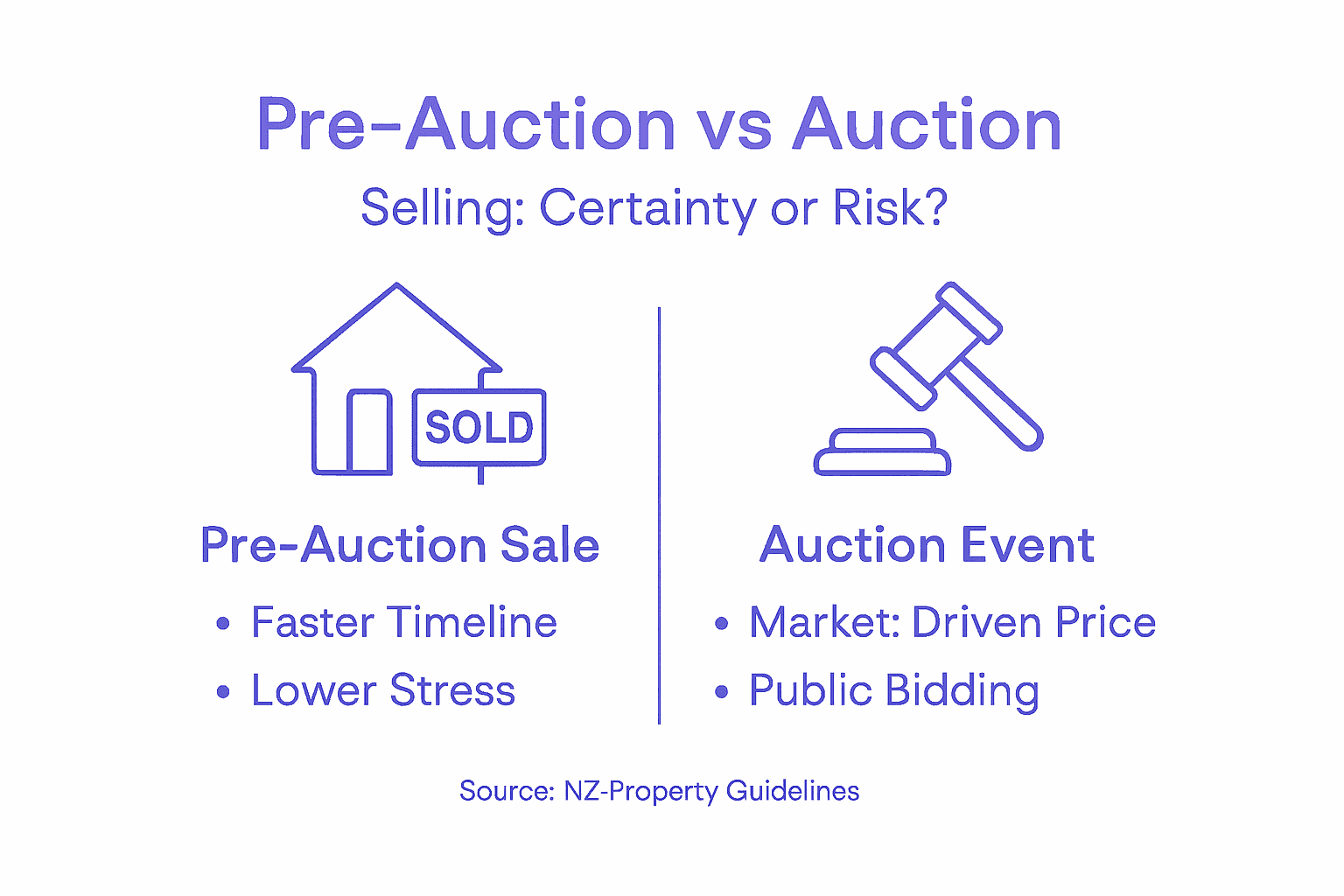
Choose auctions if you want market-driven pricing and can handle the risk that your property might not sell. Choose private sales if you need certainty, flexibility, and lower stress.
Many Kiwi sellers discover private cash sales or pre-auction offers align better with their actual needs. You get a genuine offer, you know the sale is happening, and you control the details.
Pro tip: If you’re considering which path to take, ask yourself: would you rather have certainty with a fair offer now, or gamble on auction day with upfront costs and the risk of being passed in?
Discover Stress-Free Selling Before Auction With easySale
The article highlights common challenges Kiwi homeowners face with auctions including uncertainty, high costs, and stressful timelines. If you want certainty without waiting for auction day or risking your property being passed in, easySale offers a fast and transparent alternative. With no real estate agents, no commission fees, and the ability to sell your property in any condition, easySale brings the peace of mind you need by providing a fair cash offer quickly and letting you settle on your preferred timeline.
Stop worrying about auction risks and holding costs. Visit easySale today to submit your property details. Get a no-obligation offer and skip the public auction gamble. Learn more about how property sale options work in New Zealand and explore why so many sellers choose a fast, fair offer and settlement through easySale. Take control of your sale now and enjoy faster, stress-free outcomes that suit your situation.
Frequently Asked Questions
What are the benefits of selling before auction?
Selling before auction offers several advantages, including higher certainty of sale, reduced costs associated with auction preparation, lower stress levels, and the ability to set a flexible timeline for settlement that suits your needs.
How does the pre-auction offer process work?
The pre-auction offer process involves a buyer making an offer before the auction date. If the seller accepts, the auction is cancelled, and they proceed directly to settlement with a legal contract in place.
What should I consider before accepting a pre-auction offer?
Before accepting a pre-auction offer, consider the financial implications, potential holding costs, and compare the offer to the expected results from waiting for auction day. Ensure the offer aligns with your circumstances and goals.
Can I negotiate terms in a pre-auction sale?
Yes, in a pre-auction sale, you have the flexibility to negotiate price and terms with the buyer, unlike the auction process where the highest bid wins without negotiation.
Recommended
- How to Prepare House for Quick Sale and Maximise Offers
- 7 Smart Home Selling Options List for Fast, Stress-Free Sales
- Property Sale Options Explained: Fast, Fair Choices NZ
- Need to Sell My House Quickly: A Step-by-Step Guide
- Why Hire Buyer’s Agent? Understand the Benefits Clearly - ULI & LISA Mallorca Property Blog
- ReliaBotAI™ | Instant Enquiry Handling for Estate Agencies
