
Why Sell to Investors in New Zealand – Speed and Certainty

Sudden financial pressure or property damage can transform selling your New Zealand home into a stressful experience few expect. For homeowners seeking a quick, hassle-free sale without the burden of agent commissions or endless inspections, selling directly to property investors brings a unique set of benefits. This guide unpacks the investor approach, reveals why speed and certainty set it apart, and highlights what you need to know to protect your interests every step of the way.
Table of Contents
- Selling To Property Investors Explained
- Types Of Investors And Cash Sales Process
- Key Benefits For Motivated Homeowners
- Potential Costs, Risks, And Alternatives
- Comparing Your Options
- Legal Protections And Avoiding Scams
Key Takeaways
| Point | Details |
|---|---|
| Selling to Investors is Fast | The process typically takes only 2 to 6 weeks, eliminating the lengthy traditional sale timeline. |
| Certainty of Sale | Investors provide firm cash offers, reducing the risk of sales falling through due to financing issues. |
| Lower Costs | Selling to an investor saves on real estate agent commissions and marketing expenses, potentially resulting in more money in hand. |
| Transparency is Essential | Providing clear, honest details about the property condition helps build trust and leads to stronger offers without renegotiation. |
Selling to Property Investors Explained
When you sell to a property investor, you’re dealing with a buyer who approaches the transaction differently than owner-occupiers or traditional real estate agents. Property investors purchase homes as financial assets, meaning they evaluate your property through the lens of return on investment, cash flow potential, and development opportunities. This fundamental difference shapes how they value your home, what they’re willing to pay, and crucially, how quickly the entire process moves. Unlike agents who list your property on the open market and wait for the right buyer to come along, investors make direct offers based on their own assessment of the property’s worth and their investment criteria.
The process of selling to an investor is straightforward because it removes several layers of complexity inherent in traditional sales. You won’t navigate lengthy marketing campaigns, open homes with dozens of strangers, or negotiations with finicky buyers who demand building inspections and finance conditions. Instead, you’ll engage directly with the investor or their team, provide them with honest information about your property’s condition, and receive a no-obligation cash offer. Understanding property investor roles helps you appreciate why they can move so quickly. Investors have capital ready to deploy, they understand the market dynamics, and they’ve already done their due diligence on countless properties. Your role is simply to provide accurate details about your home’s current state, any maintenance issues, and your desired settlement timeline. From there, the investor conducts their own assessment, makes their offer, and you decide whether it meets your needs.
What makes this approach attractive for many Kiwi homeowners is the certainty factor. Once an investor presents an offer, that offer is typically firm. There’s no subject to finance approval, no building inspector finding structural issues that renegotiate the price, and no risk of the sale falling through weeks later. Legal responsibilities during property sales remain the same regardless of whether you sell traditionally or to an investor, so you should still engage a lawyer or conveyancer to guide you through contracts and settlement. However, the investor path compresses what might normally take 3 to 6 months into just a few weeks. You maintain control over your settlement date, meaning you can coordinate the sale with your moving timeline rather than scrambling to vacate by someone else’s deadline. This combination of speed, certainty, and control is why selling to investors appeals to homeowners facing financial pressure, property damage, or life circumstances that demand a swift resolution.
Pro tip Request a written offer from the investor that clearly outlines the purchase price, settlement date, and any conditions—even though investor offers are typically unconditional, having clarity in writing eliminates confusion and protects both parties throughout the transaction.
Types of Investors and Cash Sales Process
Property investors come in several distinct varieties, each with different motivations and purchasing timelines. Residential landlords buy properties to generate ongoing rental income and long-term capital appreciation. They typically focus on properties in areas with strong tenant demand and analyse potential returns carefully before committing. Property developers and renovators purchase homes specifically to improve them and resell for profit, making they keen on distressed properties that owner-occupiers won’t consider. Owner-occupier investors include people buying a home to live in whilst also viewing it as a financial asset. Then there are cash buyers, who are often professional investors or investment firms with capital reserves ready to deploy immediately. Understanding the role of cash buyers helps you recognise why these transactions move so quickly. Each investor type values properties differently based on their investment strategy, but they all share one critical advantage: they can purchase without finance contingencies. This means no delays waiting for bank approvals, no risk of lending conditions falling through, and no uncertainty about whether the sale will actually complete.
The cash sales process in New Zealand is deliberately streamlined compared to traditional agent-assisted sales. Once you decide to sell to an investor, the first step involves providing accurate details about your property’s condition, any known defects, and required repairs. Clear property disclosures and accurate marketing are essential for building trust and ensuring the transaction proceeds smoothly. The investor conducts their own valuation and assessment, considering factors like location, structural integrity, rental potential, and renovation costs. They then present a written offer that reflects their evaluation. Unlike traditional sales where you might wait weeks for inspections and negotiations, cash investors typically provide offers within days. Once you accept an offer, settlement can occur anywhere from 2 to 6 weeks depending on your preference and the investor’s capability. There are no finance conditions to satisfy, no building inspections that might renegotiate the price, and no gazumping scenarios where another buyer swoops in with a higher offer. The investor brings their own legal team or conveyancer, though you should still engage your own legal representation to ensure your interests are protected throughout the process.

What makes the cash sales process particularly attractive for Kiwi homeowners in difficult circumstances is the absolute certainty of completion. When an investor presents a firm cash offer, that’s binding. You’re not racing against the clock wondering if finance approval will come through, and you’re not left scrambling if a buyer’s loan application gets rejected. This certainty allows you to plan your next move with confidence, whether that’s relocating for work, downsizing, addressing financial difficulties, or simply moving on from a property that requires extensive repairs. The speed and reliability of cash sales remove enormous stress from an already demanding situation.
Pro tip Provide investors with recent photographs of your property’s condition, a list of any structural issues, and information about utility systems—the more transparent you are upfront, the stronger the final offer and the fewer delays during the purchase process.
Key Benefits for Motivated Homeowners
If you’re facing a situation where selling quickly matters, the investor route offers tangible advantages that traditional sales simply cannot match. The most obvious benefit is speed. Whilst a conventional agent-assisted sale might take 3 to 6 months from listing to settlement, selling to an investor typically compresses this into 2 to 6 weeks. There’s no extended marketing period, no weeks of open homes with curious neighbours peering through your windows, and no waiting for the right owner-occupier to appear. Investors make decisions rapidly because they’ve already done their homework on property values and investment potential. For homeowners facing financial pressure, divorce, relocation for work, or property damage, this acceleration is genuinely life-changing. You can move forward with your next chapter rather than remaining stuck in property limbo.
Another critical benefit is certainty. When an investor presents a cash offer, that offer is firm and binding. Financial risks from sale collapses are substantially reduced because there are no finance contingencies hanging over your head. You won’t experience the anxiety of a buyer’s bank rejecting their mortgage application weeks into the process, nor will you face gazumping where another buyer swoops in with a better offer. The deal either happens or it doesn’t, and if it happens, you know exactly when settlement will occur. This certainty allows you to plan your life with confidence. You can book a moving company, arrange your new accommodation, notify your employer of your departure date, or restructure your finances knowing your home sale is locked in.
Cost savings represent another meaningful advantage. Selling to an investor eliminates real estate agent commissions, which typically range from 3 to 4 percent of the sale price. On a NZD 400,000 property, that’s NZD 12,000 to 16,000 staying in your pocket. You won’t incur advertising costs, open home staging expenses, or professional photography fees. Whilst investors will factor their lower offer price into their own business model, the net result is often more money in your hands compared to agent sales after commissions are deducted. Additionally, you maintain control over your settlement timeline. Rather than scrambling to vacate by someone else’s deadline, you coordinate the settlement date around your circumstances.
For homeowners with distressed properties—homes requiring significant repairs, structural issues, or cosmetic problems—investors are genuinely interested buyers. Owner-occupiers might reject your home outright, but investors see potential profit in renovation. This means you don’t need to spend thousands fixing problems before selling. You can sell the property as-is and let the investor handle restoration.
Pro tip Document your property’s current condition with photographs and make a list of any known issues, recent repairs, and maintenance history to provide investors upfront—transparency builds trust and often results in stronger offers without renegotiation later.
Potential Costs, Risks, and Alternatives
Whilst selling to investors offers genuine advantages, it’s important you understand the potential drawbacks before committing. The most obvious consideration is that investor offers are typically lower than what you might achieve through traditional open-market sales. Investors factor in renovation costs, holding periods, and their profit margin when calculating their offer price. On a property valued at NZD 500,000, an investor might offer NZD 420,000 or less, depending on the repairs required. However, when you subtract agent commissions, marketing costs, and legal fees from a traditional sale, the net difference often shrinks considerably. You’ll still need to engage a lawyer or conveyancer to handle the legal side of the transaction, which typically costs between NZD 1,500 and NZD 3,000. Unlike agent sales where these costs are sometimes negotiable, investor sales involve straightforward legal work with fixed pricing.
Risks do exist when dealing with any private buyer arrangement. The primary risk involves working with an investor who lacks genuine capital or credibility. Whilst cash sales eliminate finance contingencies, a dishonest operator might claim to be a cash buyer without actually possessing the funds, wasting your time and delaying your sale. This is why you should always verify an investor’s credentials before proceeding. Request proof of funds, ask for references from previous purchases, and confirm they’re registered with appropriate authorities. Understanding settlement delays and contract disputes helps you navigate potential complications that might arise during the transaction. Another consideration involves property valuations. If you significantly underestimate your property’s value, you might accept an offer that’s unfairly low. Get an independent valuation done beforehand so you understand your home’s fair market worth and can evaluate any offer with confidence.
If you’re hesitant about the investor route, alternatives exist. Traditional agent sales offer the potential for higher sale prices but require patience and involve commission costs. Private sales let you sell directly to owner-occupiers without agent involvement, saving commissions but requiring you to handle marketing and buyer negotiations yourself. Auctions provide certainty of sale by a fixed date and can generate competitive bidding, though they also carry upfront costs and don’t guarantee you’ll receive your desired price. Rent-to-sell arrangements allow you to lease your property whilst seeking a buyer, generating income during the selling period. The right choice depends entirely on your circumstances, timeline, and financial needs.
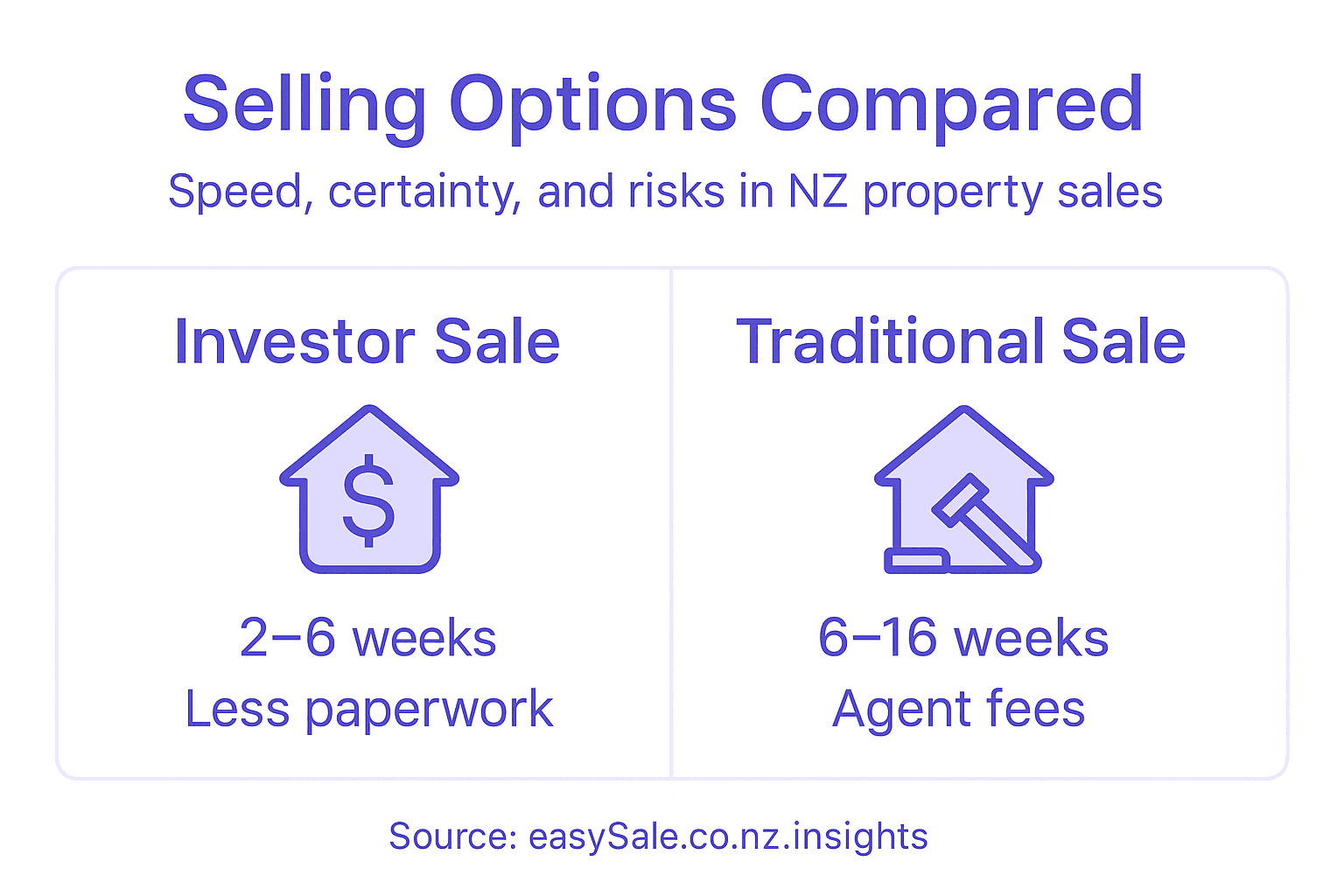
Here’s a quick comparison of common property sale methods for New Zealand sellers:
| Sale Method | Typical Timeline | Main Potential Cost | Control Over Settlement |
|---|---|---|---|
| Investor Cash Sale | 2–6 weeks | Legal fees only | Full control |
| Traditional Agent Sale | 3–6 months | 3–4% commission, marketing | Limited control |
| Private Sale | 1–4 months | Advertising, legal fees | Moderate control |
| Auction | 1–2 months | Auctioneer fee, marketing | Sale date fixed |
| Rent-to-Sell Arrangement | Several months+ | Ongoing costs, legal fees | Flexible settlement |
Comparing Your Options
Consider what matters most in your situation. If you value speed and certainty above all else, investor sales make sense. If maximising sale price is your priority and you can wait several months, traditional agent sales might suit you better. If you want to avoid commissions and have time to manage the process yourself, private sales or auctions could work. There’s no universally correct answer.
Pro tip Obtain written offers from multiple investors and compare not just the price but also settlement timeline, any conditions, and the investor’s track record—comparing options helps you make an informed decision rather than accepting the first offer presented.
Legal Protections and Avoiding Scams
When you’re selling property to an investor, protecting yourself legally is non-negotiable. The foundation of this protection is engaging a qualified lawyer or conveyancer early in the process. Your legal representative reviews all contracts, ensures terms are fair, verifies the investor’s identity and capacity to settle, and protects your interests throughout the transaction. This is not an optional expense—it’s a critical safeguard. A lawyer costs between NZD 1,500 and NZD 3,000, which is genuinely modest compared to the value of your property and the peace of mind gained. Your lawyer will explain your obligations as a vendor, outline any potential liabilities, and ensure all documentation is legally compliant before you sign anything.
Property scams targeting sellers do exist in New Zealand, though they’re relatively uncommon when you take precautions. The most common fraud involves someone impersonating a legitimate investor, collecting deposits or fees upfront, then disappearing. To protect yourself, verify everything independently. Request written proof of funds from any investor before proceeding—not vague promises or verbal assurances, but actual documentation showing they have capital available. Ask for references from previous property purchases and contact those references to confirm the investor’s legitimacy. Check whether the investor is registered with the Real Estate Authority if they claim to have agent credentials. Legitimate investors operate transparently and welcome verification requests. Red flags include pressure to move quickly, reluctance to provide written documentation, requests for fees before settlement, or unwillingness to involve lawyers.
Legal conveyancing procedures protect all parties by ensuring contracts are properly drafted, identities are verified, and settlement occurs through secure channels. Never conduct property sales outside formal legal channels or hand over money directly to a buyer. All funds must flow through a lawyer’s trust account or a registered settlement service, which provides a paper trail and protects against fraud. Your lawyer handles settlement on your behalf, ensuring nothing proceeds until all conditions are met and funds have cleared. This system has been refined over decades specifically to prevent fraud and protect vendors.
The following table outlines key risks of selling directly to an investor, and essential mitigation strategies:
| Risk Type | Description | How to Mitigate |
|---|---|---|
| Unverified Buyer | Fake cash buyer not able to settle | Demand proof of funds, references |
| Undervalued Offer | Offer below true market value | Get an independent valuation |
| Legal Exposure | Incomplete or unfair contract terms | Have lawyer review documents |
| Scam/Inappropriate Payment | Upfront fees or direct payment to buyer | Use lawyer’s trust account only |
Red Flags to Watch
Be cautious if an investor:
- Pressures you to make quick decisions without time for legal review
- Refuses to provide written documentation or proof of funds
- Asks you to cover costs upfront or accept payment methods outside legal channels
- Claims to be a licensed agent but you can’t verify their credentials
- Offers significantly above market value without legitimate reason
- Won’t allow your lawyer to review contracts before signing
- Requests personal financial information unrelated to the property sale
Trust your instincts. If something feels wrong, it probably is. Take time to verify, ask questions, and insist on proper legal procedures.
Pro tip Have your lawyer review the purchase agreement before you sign anything, regardless of how straightforward the investor claims the deal is—this one step eliminates most potential legal problems and gives you complete clarity on your rights and obligations.
Experience Fast and Certain Property Sales with easySale.co.nz
If you are looking for a way to sell your property quickly without the usual stress and uncertainty described in the article Why Sell to Investors in New Zealand – Speed and Certainty, easySale.co.nz offers exactly what motivated homeowners need. Whether facing financial pressure, urgent relocation, or dealing with a home in poor condition, our simple property buying service provides fast, fair cash offers with no commissions or hidden fees. We understand the importance of certainty and control over your settlement timeline so you can move forward confidently.
Don’t let lengthy marketing periods or unpredictable buyers hold you back. Take advantage of our proven three-step process: submit your property details, get a no-obligation offer, and settle on your preferred date. Selling to an investor with transparent terms and a reliable cash offer has never been easier. Start a hassle-free sale now by visiting easySale.co.nz and get the certainty you deserve.
Discover more about how our service addresses key concerns raised in the sale process and why we are a trusted choice for Kiwi sellers: understanding property investor roles and the role of cash buyers.
Frequently Asked Questions
What are the main advantages of selling to property investors?
Selling to property investors offers speed, certainty, and cost savings. The process typically takes 2 to 6 weeks, eliminating lengthy marketing campaigns and buyer negotiations. Investors provide firm cash offers, reducing the risk of sales falling through due to finance issues.
How do property investors determine their offers?
Property investors evaluate potential purchases based on return on investment, cash flow, and renovation costs. They’ll assess your property’s current condition, location, and market dynamics before making a written offer.
Are there any risks involved in selling to investors?
Yes, risks include receiving lower offers compared to market sales and the potential of dealing with unverified buyers. It’s essential to verify an investor’s credibility by requesting proof of funds and having a lawyer review contracts.
How can I ensure a smooth selling process to an investor?
To facilitate a smooth process, provide accurate details about your property condition, address any known issues, and engage a lawyer or conveyancer to review the sale documents and protect your interests.
Recommended
