
The emotional stages of selling a house, and how to get through each one

Selling a house moves through six fairly predictable emotional stages: anticipation as you prepare, attachment and nostalgia once the listing goes live, anxiety through showings, decision fatigue during negotiation, contract stress waiting for the deal to hold, and a mix of relief and grief at closing and moving day. The single most useful thing you can do before any of that starts is get your paperwork sorted and decide, in advance, who in your household handles which conversations. That one step removes a surprising amount of the panic that hits later.
Kiwi industry voices describe this as an “emotional return on investment” question, not just a financial one, and that framing matters because it gives you permission to plan for the feelings, not only the sale price, as Harcourts Gold notes. A local seller-focused podcast puts it plainly too: expectation management and a named support contact are the simplest levers against the emotional rollercoaster every seller hits.
Before you list, get moving on:
- LIM reports, building reports and title documents, gathered early so nothing stalls the process later
- A simple house rule for who talks to the agent, who talks to buyers, and who makes the final call
- A short list of three price outcomes, so an offer doesn’t catch you off guard emotionally
Key Takeaways
Managing the emotional stages of selling a house comes down to naming each feeling as it arrives and having a practical response ready before it hits.
| Point | Details |
|---|---|
| Six predictable stages | Anticipation, attachment, showing anxiety, negotiation fatigue, contract stress and closing relief follow the sale timeline. |
| Prepare paperwork early | Gather your LIM, building report and title documents before listing to avoid delay-driven stress. |
| Set decision rules upfront | Agree on three price bands and a trusted adviser before any offer lands. |
| Watch for coexisting emotions | Nostalgia and relief showing up together is normal, not a contradiction. |
| Consider a direct cash sale | Easysale’s three-step process shortens the emotional window by removing showings and a long contract period. |
Table of Contents
- The emotional stages of selling a house, mapped to your timeline
- What emotions come up when you sell a house, and why
- How to cope with selling your home at each stage
- How do you manage family disagreements when selling a shared home?
- When should you get extra support during a house sale?
- Does a direct cash sale change the emotional timeline?
- A faster route through the hardest stages
- Sources
The emotional stages of selling a house, mapped to your timeline
Every stage of a sale carries its own emotional weight, and knowing which one you’re in helps you respond instead of just reacting.
1. Preparation. This is where anticipatory optimism and low-grade anxiety sit side by side. You’re excited about the next chapter but nervous about the workload. Get your LIM, building report and title paperwork sorted now, because missing documents are one of the most common causes of delay in private sales, and delay is what turns manageable stress into prolonged stress. Start a memory archive here too, even a simple folder of photos on your phone, so depersonalising the house later doesn’t feel like erasing it.
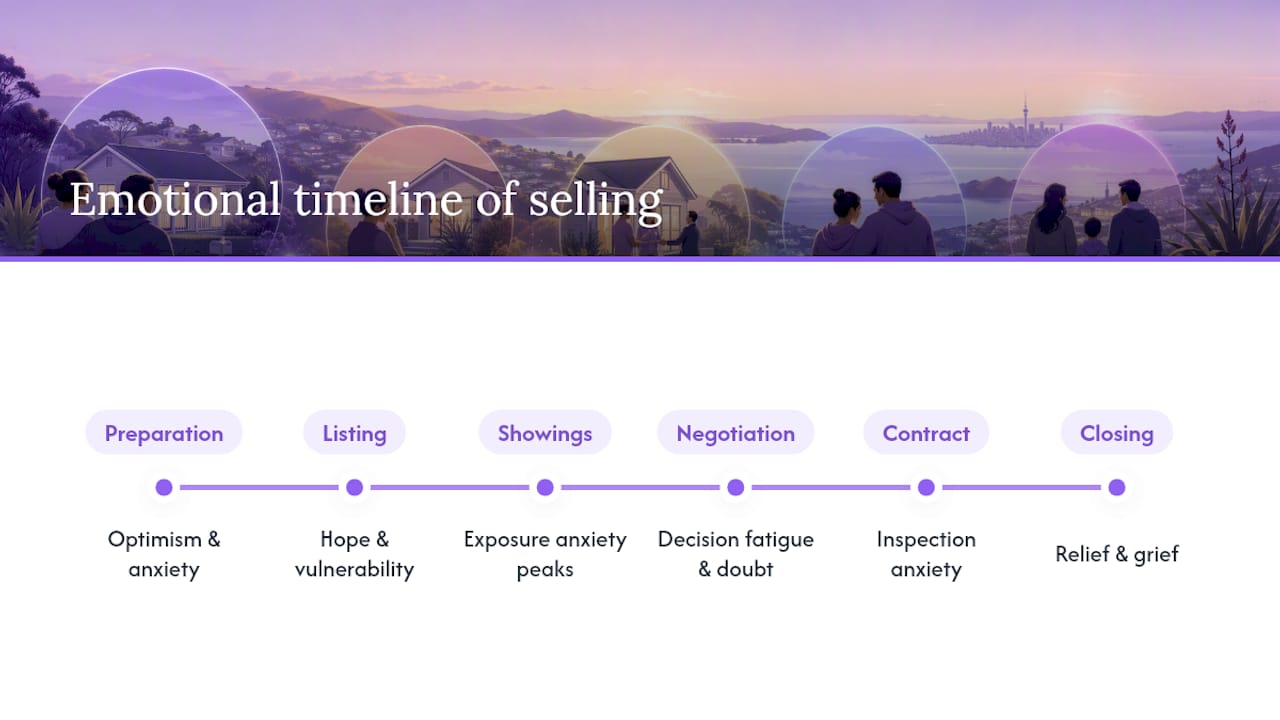
2. Listing. Hope and vulnerability show up together the moment your home goes public. Set boundaries early: decide your open-home hours, agree on what “reasonable notice” looks like for private viewings, and write it down so you’re not negotiating your own comfort mid-campaign.
3. Showings and open homes. This is where exposure anxiety peaks, having strangers walk through your bedrooms, judge your kitchen, open your cupboards. Build a quick tidy routine you can run in fifteen minutes, and plan somewhere to be during viewings so you’re not lingering nearby, listening for feedback.

4. Negotiation. Decision fatigue and second-guessing dominate here. Preset price bands, agreed before an offer lands, stop you from making a panicked call under pressure. Loop in a trusted adviser, a solicitor, a level-headed friend, whoever keeps you grounded, and agree beforehand that you’ll run every serious offer past them.
5. Contract period. Inspection anxiety and a nagging fear the buyer will pull out are common here. Prepare your responses to likely contingencies (builder’s reports, finance conditions) before they arise, and ask your agent for a realistic timeline so unexplained silence doesn’t read as bad news.
6. Closing and moving. Relief and grief often turn up at the same time. Build in a small closure ritual, a last walk through the empty rooms, a photo on the front step, before you hand over the keys.

Pro Tip: Write your three price bands (jumping for joy, toast-worthy, rock-bottom) on paper before the first open home. Reading them off a page under pressure is far easier than inventing them on the spot.
Practical, staged preparation, decluttering gradually, archiving memories, pacing tasks rather than cramming them into one weekend, is one of the most consistently recommended ways to keep a sense of control, according to Qestral’s seller guidance. If your energy is running low by stage three, that’s the moment to slow down, not push harder.
What emotions come up when you sell a house, and why
Selling a family home rarely produces one clean feeling. Most sellers cycle through several at once, and recognising each by name makes them easier to manage.
- Grief shows up around the loss of a physical space tied to memory, milestones, and identity.
- Nostalgia surfaces at unexpected moments, a mark on a doorframe, a garden you planted, a room you painted.
- Anxiety tends to spike around showings and inspections, when the house is being judged rather than lived in.
- Anger occasionally appears when a lowball offer feels like it undervalues more than just the building.
- Shame can creep in for sellers moving due to financial pressure, even though it’s an entirely ordinary reason to sell.
- Relief typically lands once contracts go unconditional, often alongside guilt for feeling relieved at all.
New Zealand-based research into moving and stress consistently finds that homeowners often report bigger stress increases around a move than renters do, likely because ownership carries more identity investment and disrupts more established routines. That helps explain why sellers who’ve lived somewhere fifteen years often feel this more intensely than someone who’s rented the same length of time.
Nostalgia and relief coexisting isn’t a contradiction. It’s the normal shape of a big life transition, and providers who work with older sellers and downsizers see this pairing constantly, noting that accepting the sadness rather than fighting it is what actually eases the shift, per Ryman Healthcare’s guidance on downsizing.
How to cope with selling your home at each stage
Coping well isn’t about suppressing feelings. It’s about having a plan ready before the feeling arrives, so you’re acting on preparation rather than adrenaline.
- Build a pre-listing checklist. Gather your LIM report, building report and title documents first, then set your three price bands: the offer that thrills you, the one you’d happily accept, and the floor you won’t go below.
- Depersonalise deliberately, not all at once. Take a full digital photo tour or short video walkthrough before you pack anything away, so the memory exists independently of the physical space. This property selling checklist is a useful reference for what to sort first.
- Protect your energy during showings. Leave the house for viewings, run a fast tidy routine beforehand, and resist the urge to ask the agent for blow-by-blow feedback after every single one.
- Lean on your decision rules during negotiation. When an offer lands, check it against your preset bands and your trusted adviser before responding, not after a stressed phone call.
- Give yourself a closure ritual before moving day. A final walk-through, a last photo, a cup of tea in the empty lounge, whatever marks the ending on your terms.
Pro Tip: Pack your memory box, the physical keepsakes you can’t digitise, on day one of preparation, not the week before settlement. Doing it early turns it into a calm task instead of a rushed, tearful one.
Sellers who pace these tasks rather than compress them into the final fortnight consistently report feeling more in control, a pattern backed up by broader guidance on reducing stress during a home sale. Simplifying the process wherever you can, fewer open homes, clearer timelines, less back-and-forth, also helps; there’s more detail on that in these tactics for simplifying a Kiwi home sale.
How do you manage family disagreements when selling a shared home?
A shared sale, with a partner, siblings, or an inherited property, adds a second layer of emotional negotiation on top of the sale itself. The fix is structure, not avoidance.
- Hold one proper family meeting early, agree on shared goals (timeline, minimum price, who signs off on offers), and write the decisions down so nobody’s relying on memory later.
- Prepare a simple script for saying yes or no to an offer: “We’ve agreed as a family that anything below X needs everyone’s sign-off before we respond.”
- If children or older relatives are affected, explain the timeline plainly and early, uncertainty is usually harder on them than the move itself.
- For sales after a bereavement or separation, or with inherited property, get one person nominated as the main point of contact for the agent or buyer, so instructions don’t arrive from multiple directions at once.
When should you get extra support during a house sale?
Some stress during a sale is normal. Persistent inability to function day to day, recurring panic attacks, or insomnia lasting more than a couple of weeks are signs it’s time to bring in professional help, not just push through.
- A GP or counsellor can help if stress is affecting sleep, work, or relationships for more than a fortnight.
- A mediator is worth engaging early if family members disagree on price, timing, or whether to sell at all, before positions harden.
- Brief any counsellor or mediator specifically on the sale-related stressor (timeline pressure, shared ownership, financial strain) so the support is targeted rather than generic.
- Your solicitor or a trusted agent can also absorb a lot of the logistical anxiety simply by being asked directly: “Can you handle all buyer communication so I don’t have to?”
| Signal | What to do |
|---|---|
| Ongoing sleep disruption or panic | Speak with a GP or counsellor about sale-related stress specifically |
| Family disagreement on price or timing | Bring in a mediator before positions harden |
| Overwhelmed by buyer or agent contact | Ask your solicitor or agent to become the single point of contact |
Does a direct cash sale change the emotional timeline?
Skipping showings and a drawn-out contract period removes two of the most emotionally taxing stages outright, exposure anxiety during open homes and inspection anxiety during the contract window. That’s the practical effect of a direct cash sale: the emotional runway shortens because there’s no ongoing parade of strangers through your home and no lengthy wait on finance or building conditions.
easySale’s process runs in three steps: you submit your property details, receive a no-obligation cash offer, and settle on a timeline that suits you. Sellers who go this route often report feeling calmer through what would normally be the contract stage, because the negotiation and inspection back-and-forth simply isn’t part of the process.
Before accepting any direct cash offer, check:
- Whether the settlement date genuinely matches what works for you, not just what’s fastest for the buyer
- That the offer is no-obligation and clearly explained, with no hidden conditions attached
- Whether the property’s condition (damaged, tenanted, unconsented) is being factored fairly into the offer
Pro Tip: Ask any cash buyer to put the settlement date and offer conditions in writing before you make a decision, verbal reassurance isn’t the same as a documented offer. If your property needs work you can’t face doing, selling an uninhabitable house as-is is a legitimate option worth understanding fully first.
One seller’s experience, and one habit worth copying
A seller once told her agent she wasn’t ready for the first open home, not because the house wasn’t presentable, but because she hadn’t packed away her late father’s reading chair yet. She spent one evening photographing it, wrote down why it mattered, then let it go to a secondhand shop the next morning. That’s the habit worth copying: pack your memory box, physically or digitally, on day one, before the anticipation stage tips into the harder ones. It won’t remove the grief, but it gives it somewhere to live that isn’t the open-home schedule.
— Aaron
A faster route through the hardest stages
Easysale is the practical alternative to the traditional showings-and-negotiation cycle for Kiwi sellers who want the sale process itself to take less of an emotional toll. Where a standard campaign stretches anxiety across weeks of open homes and a contract period full of inspection worries, easySale buys properties directly, in any condition, damaged, tenanted, unconsented or inherited, without agent commissions or repair demands.
That matters most if you’re already stretched thin: facing financial pressure, dealing with a property that needs work you can’t manage, or trying to settle an estate without dragging the process out for months. The three-step process, submit your details, receive a no-obligation cash offer, choose your settlement date, means you’re not waiting on buyer finance or building reports to fall through at the last minute. If a fast, private sale sounds like the better fit for your circumstances, you can check your options for a fair cash offer and see what easySale would offer for your property before deciding which route suits you.
Sources
- Beyond the sale: understanding the emotional returns in real estate | Harcourts Gold Resources
- Selling your home can feel overwhelming | Qestral
- The emotional side to downsizing | Ryman Healthcare
Recommended
