
Selling an uninhabitable house in New Zealand: your practical guide
Yes, you can sell an uninhabitable house in New Zealand. The two fastest compliant routes are a direct cash sale with full disclosure, or an auction or deadline sale with transparent vendor disclosures prepared upfront. What controls which route will actually work for you is not the condition of the property itself — it is whether your insurance, EQCover, and Natural Hazards Commission (NHC) claim history is documented and ready to hand over.
If you are holding a fire-damaged, flood-affected, structurally compromised, or condemned property right now, here is what to do in the next 24–72 hours:
- Gather every insurance document you have: claim numbers, assessor reports, scope of works, and any settlement letters.
- Contact your insurer and ask for a written summary of open or settled claims.
- Request your NHC/EQCover claim information directly from the Natural Hazards Commission — allow up to 20 working days for that official information request.
- Get a basic safety sign-off from a builder or engineer before allowing any buyer inspections.
- Call a property lawyer. Do this before you sign anything or accept any offer.
- Decide whether you want to assign your insurance or NHC claim to the buyer, or settle it yourself first.
The single biggest mistake sellers make is assuming “as-is” means they can stay silent about known damage. It does not. Disclosure is mandatory regardless of how the property is marketed.
Key takeaways
Selling an uninhabitable property in New Zealand is achievable, but disclosure and claim documentation are what determine how smoothly and safely the sale proceeds.
| Point | Details |
|---|---|
| Disclosure is mandatory | You must disclose all known defects, claims, and unconsented work regardless of how the property is marketed. |
| Price realistically | Uninhabitable homes typically sell at a 50% discount to comparable habitable properties; factor in any assignable claim value. |
| Assign claims formally | Use a Deed of Assignment for any NHC or insurance claim transfer; request claim information early as it can take up to 20 working days. |
| Get legal advice first | Engage a property lawyer before listing; they should review as-is clauses, the Deed of Assignment, and any contract conditions. |
| Easysale buys as-is | Easysale purchases properties in any condition across New Zealand, with no agent fees and settlement on your preferred timeline. |
Official New Zealand resources to check during your sale
These are the primary sources to consult for authoritative rules, forms, and guidance:
- Govt — covers legal obligations, the role of lawyers and agents, and the general process for selling residential property in New Zealand.
- Rea — specific guidance for agents and vendors on disclosure duties, claim documentation, and listing damaged properties.
- Naturalhazards — explains how to request claim information, how the Deed of Assignment works, and what buyers and sellers need to do to transfer claim rights.
- Settled — practical consumer-focused advice on disclosure, assigning claims, and seeking legal advice before an as-is sale.
- Legislation — the statutory basis for code compliance certificate requirements and restrictions on transferring certain household units before a CCC is issued.
Table of Contents
- What you must legally disclose when selling a damaged property in New Zealand
- How to price an uninhabitable property realistically
- Which buyers can purchase uninhabitable homes, and which sales route suits you?
- What to prepare before you start marketing the property
- How to negotiate offers and transfer insurance or NHC claims
- Should you repair first or sell as-is? A simple decision framework
- How long will it take, and what will it cost you?
- What to do after settlement to protect yourself
- What does your local council require before you can sell?
- How zoning and land use restrictions affect your ability to sell
- Tax implications of selling a damaged property in New Zealand
- How to verify a buyer’s credibility and reduce fraud risk
- Selling your damaged property without the usual delays
- Sources
What you must legally disclose when selling a damaged property in New Zealand
Under New Zealand guidance, sellers and their agents must disclose relevant information about a property to buyers — including weather-tightness issues, unconsented work, boundary disputes, and natural hazard damage. Failing to disclose known defects can lead to legal action or sale cancellation after settlement.
What makes a property ‘uninhabitable’?
A property is generally considered uninhabitable when it cannot safely be lived in. Common causes include fire or smoke damage, flood or storm damage, structural failure (cracked foundations, subsidence), health hazards such as asbestos or mould, and formal condemnation by a council or building authority. The label matters less than the underlying condition: if you know about a defect, you must disclose it.
What you must tell buyers
The Real Estate Authority (REA) is clear that vendors in areas affected by natural events must gather NHC/EQCover claim details, scope of works, and evidence of completed or planned repairs. Your disclosure should cover:
- Weather-tightness history and any leaky-home remediation.
- Unconsented building work and any outstanding consent applications.
- Boundary disputes or easements affecting the property.
- All natural hazard damage and the status of any related insurance or NHC claim.
- Any council notices, building warrants of fitness issues, or condemnation orders.
Your document checklist
Pull these together before you go to market:
- Insurance claim numbers and correspondence.
- NHC/EQCover assessment reports and claim history.
- Scope of works (completed and outstanding).
- Builder or engineer receipts and sign-off letters.
- Building consents and code compliance certificates (CCCs).
- Any council notices or enforcement orders.
Pro Tip: Request your NHC claim information as early as possible. Official information requests can take up to 20 working days, and buyers will want this before they commit.
One practical enforcement point worth knowing: the REA recommends that agents cease acting for sellers who instruct them to hide defects, as explained in What Is Disaster Remediation? Solutions for Property Recovery - PuroClean of Northeast Sacramento. If your agent is asked to conceal known damage, they are required to stop acting for you. Do not put them in that position — and do not put yourself at risk of post-settlement litigation.
Settled.govt.nz notes that failing to disclose insurance claims is one of the most common causes of post-settlement disputes, and that sellers often misunderstand ‘as-is’ to mean they can withhold information. It does not. You must still be honest and provide supporting documents when asked, even when selling after a natural disaster.
How to price an uninhabitable property realistically
Pricing a damaged home requires a different starting point than a standard appraisal. Market guidance for New Zealand suggests uninhabitable homes typically sell at a significant discount compared to comparable habitable properties in the same area, though the actual discount depends on the extent of damage, the status of any insurance claim, and whether the buyer will need to fund repairs themselves.
A simple formula to estimate your net sale position:
- Find two or three comparable habitable sales in your suburb (ask an agent or check recent sales on homes.co.nz).
- Apply the discount range: multiply the comparable price by 0.50–0.70 to get a realistic uninhabitable sale range.
- Subtract any outstanding liabilities: unpaid rates, council levies, or costs you have agreed to cover.
- Factor in claim adjustments: if you are assigning an NHC or insurance cash settlement to the buyer, that value may partially offset the discount.
- The result is your realistic net proceeds range before legal and agent fees.
For example: if comparable homes sell at $700,000 and your property has significant structural damage, you might price the sale considerably lower, with an adjustment for any NHC cash settlement assigned to the buyer, because they are receiving the claim value alongside the property.
Pro Tip: Get a written repair estimate from a licensed builder or structural engineer before setting your price. Even a rough figure gives you a defensible basis for your discount and reduces the chance of buyers using unknown repair costs to negotiate you down further.
The status of your insurance claim matters significantly here. A settled cash payment you can assign is worth more to a buyer than an open claim with an uncertain outcome. If your claim is still active, get written confirmation of the assessed value from your insurer before going to market.
Which buyers can purchase uninhabitable homes, and which sales route suits you?
Most standard home buyers cannot purchase an uninhabitable property because banks will not lend on homes that cannot be occupied. That narrows your buyer pool considerably, but it does not make a sale impossible.
Buyer categories for uninhabitable properties:
- Cash buyers and direct property buyers (such as Easysale): no finance conditions, fastest settlement, buy in any condition.
- Renovation investors: experienced buyers who price in repair costs; may negotiate hard but can move quickly.
- Developers: interested when the land value justifies demolition or redevelopment; less focused on the building itself.
- Specialised finance buyers: rare, but some buyers use non-bank lenders for damaged properties; expect longer due diligence periods.
When to choose each route:
- Choose a cash buyer when you need speed, have an open NHC claim to assign, or cannot afford repairs before sale.
- Choose an agent listing when you have time, the property has partial habitability, and you want maximum market exposure.
- Choose auction or deadline sale when the land or location is strong and you want competitive tension among investors.
- Choose private sale when you already have a known buyer (a neighbour, investor, or family member) and want to minimise fees.
For a deeper look at the practical and market benefits of selling without renovation, the guide on why sellers choose not to renovate before selling covers the decision criteria in detail.
What to prepare before you start marketing the property
A failed sale on a damaged property often comes down to one thing: the buyer’s solicitor asks for documents during due diligence and the seller cannot produce them. Preparing your disclosure pack upfront prevents this.
Document checklist for your vendor disclosure pack:
- NHC/EQCover claim history and assessment reports.
- Private insurer claim details and any cash settlement letters.
- Scope of works (both completed and outstanding).
- Builder and trades receipts with sign-off confirmation.
- Building consents and code compliance certificates.
- Engineer reports (structural, geotechnical, or both if relevant).
- Photos documenting damage, hazard areas, and safety barriers.
- Any council notices, enforcement orders, or condemnation letters.
- Land Information Memorandum (LIM) from your local council.
Photography and access for inspections:
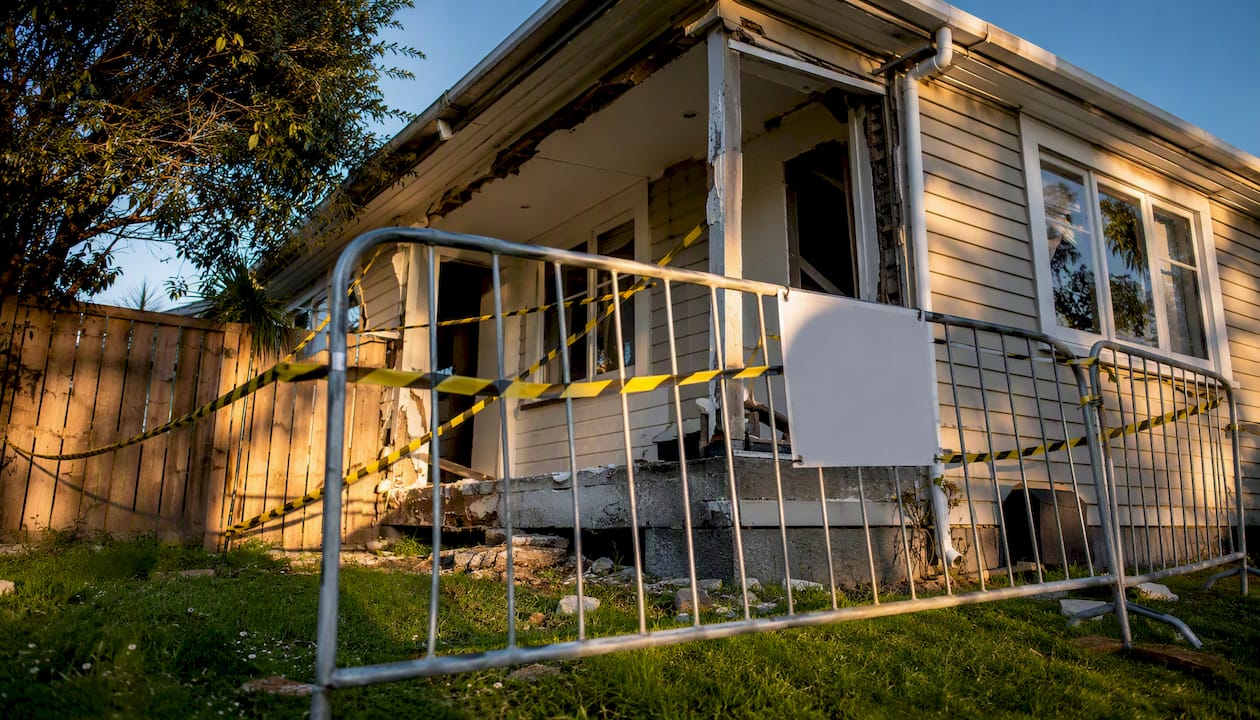
Photograph all damage clearly and honestly. Buyers and their lawyers will inspect the property, and photos that downplay damage create legal risk. For genuinely unsafe areas (unstable floors, exposed wiring, asbestos-containing materials), install physical barriers and include a note in your listing that certain areas are restricted for safety reasons. Provide a hard hat and appropriate footwear guidance for any inspection.
Pro Tip: When writing your listing description, state the condition plainly: “Sold as-is, where-is. Property has sustained [describe damage]. Full disclosure pack available on request. Inspections by appointment with safety requirements in place.” Plain language reduces buyer uncertainty and attracts serious enquiries.
Whether you sell privately or through an agent, your disclosure obligations are identical. An agent cannot reduce your legal exposure by omitting known defects from the listing. For a practical walkthrough of how to market an as-is property, the step-by-step guide to selling as-is in New Zealand covers listing language and disclosure steps in detail.
How to negotiate offers and transfer insurance or NHC claims
Negotiation on a damaged property moves faster when you have already done the groundwork: verified your claim status, assembled your documents, and decided which claims (if any) you will assign to the buyer.
Negotiation checklist:
- Verify buyer funds before entering exclusive negotiations. Ask for proof of funds or a finance pre-approval letter.
- Set your walkaway price before you receive any offer. Emotional pressure during negotiation is real, and a pre-set floor keeps you rational.
- Use clear “as-is, where-is” contract language. Your solicitor should draft or review this clause.
- State explicitly in the agreement which claims transfer to the buyer and which you retain.
- Include a condition precedent for claim assignment if the transfer of an NHC or insurance claim is a material part of the deal.
Deed of Assignment checklist:
When an NHC or insurance claim is being transferred to the buyer, a Deed of Assignment is the standard mechanism. It should include:
- Full property address and legal description.
- Claim numbers for every claim being assigned.
- Precise scope of what is being assigned (full claim rights, or specific components).
- Effective date of assignment (usually settlement date).
- Signatures of both parties, witnessed.
- Copies delivered to the relevant insurer and the NHC.
The Natural Hazards Commission emphasises that formal assignment via a Deed of Assignment prevents later disputes about who controls claim rights. Without it, both parties may believe they hold the same claim — and neither can act on it effectively.
Pro Tip: Do not add assignment clauses to a sale and purchase agreement without a lawyer reviewing the wording. A poorly drafted clause can leave the claim in limbo or expose you to liability if the buyer later disputes the scope of what was assigned.
Buyers will often include conditions in the agreement requesting a full statement of NHC claims and may request assignment as a condition of settlement. This is standard practice and not a red flag — it is a sign the buyer has done their homework.
Should you repair first or sell as-is? A simple decision framework
This is the question most sellers spend too long on. Here is a structured way to answer it quickly.
- Get a repair estimate. Ask a licensed builder or structural engineer for a written quote. Do not rely on guesses.
- Estimate the post-repair sale price. Ask a local agent for a current market appraisal of the property in repaired condition.
- Calculate the net uplift. Subtract repair costs, consent fees, holding costs (rates, insurance, mortgage payments during the repair period), and any tax advice costs from the post-repair sale price. Compare this to your current as-is sale estimate.
- Check your insurance position. If your insurer is funding repairs, the cost calculation changes. If you are funding repairs yourself, the bar for repair being worthwhile is much higher.
- Factor in time. Repairs on a seriously damaged property can take 12–24 months. An as-is sale can settle in weeks.
Example scenario:
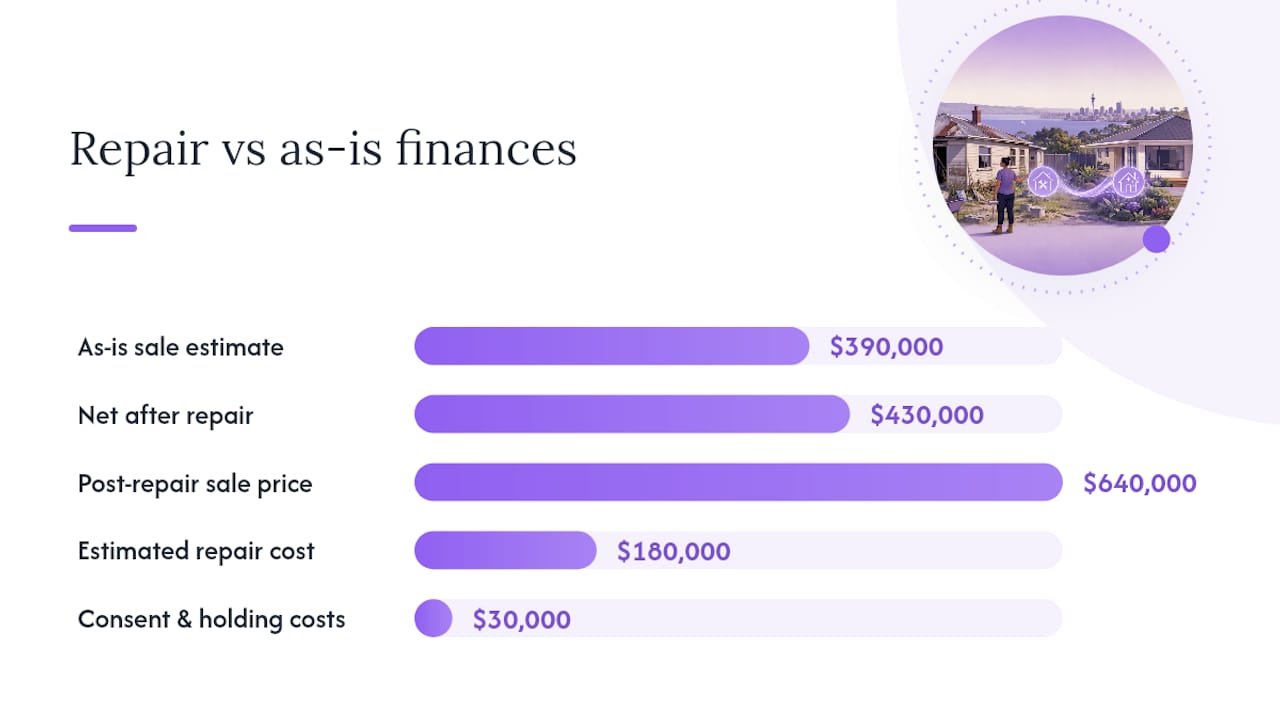
- Comparable habitable sale price: $650,000
- As-is sale estimate (40% discount): $390,000
- Estimated repair cost: $180,000
- Consent and holding costs during repair: $30,000
- Post-repair sale price: $640,000
- Net proceeds after repair: $640,000 − $180,000 − $30,000 = $430,000
In this scenario, repairing adds roughly $40,000 in net proceeds but requires 12–18 months of work, council consents, and significant personal involvement. For many sellers, the time and stress cost makes the as-is route the better choice.
When selling as-is is clearly the right call:
- You need to sell urgently (financial pressure, relationship breakdown, relocation).
- The repair cost exceeds or approaches the value uplift.
- You have an open NHC or insurance claim you can assign, which partially compensates the buyer for the discount.
- Council consent for repairs is uncertain or complex.
- You simply do not have the capacity to manage a building project.
For a detailed breakdown of the reasons sellers choose this path, the guide on selling property without renovation in NZ is worth reading before you decide.
How long will it take, and what will it cost you?
Typical timelines by sales route:
- Cash buyer (direct sale): 1–4 weeks from offer to settlement.
- Private sale: 3–8 weeks, depending on buyer due diligence and claim transfer complexity.
- Agent listing (as-is): 6–16 weeks, including marketing period, negotiation, and due diligence.
- Auction or deadline sale: 4–8 weeks from listing to auction day, plus settlement period.
Costs to budget for:
- Legal fees: typically $1,500–$3,500 for a straightforward sale; more if claim assignment or complex conditions are involved.
- Agent commission: 2–4% of sale price if using a licensed agent.
- Marketing costs: $1,000–$5,000 for photography, listing, and signage (agent-managed sales).
- Engineer or builder reports: $500–$2,500 depending on scope.
- Consent rectification: highly variable; get a quote before committing to this path.
- Tax advice: $300–$1,500 if your situation involves the bright-line test or other tax considerations.
To accelerate your sale:
- Pre-pack your disclosure documents before listing. Buyers who receive a complete pack on day one move faster.
- Request your NHC claim information early — the 20-working-day processing time is fixed, so start the clock immediately.
- Have your lawyer prepare the sale and purchase agreement template (including as-is clauses) before you receive an offer, so you are not scrambling when one arrives.
What to do after settlement to protect yourself
Settlement is not the end of your obligations. A few post-sale steps close out the process properly and reduce the chance of future disputes.
Post-sale checklist:
- Retain copies of all disclosure documents, correspondence, and the signed Deed of Assignment for at least seven years.
- Deliver signed copies of the Deed of Assignment to both the buyer and the relevant insurer (NHC and/or private insurer) on or immediately after settlement day.
- Notify the NHC in writing that the claim has been assigned, providing the new owner’s contact details.
- Confirm with your private insurer that the claim has been formally transferred and that your policy is cancelled or amended as of settlement date.
- Keep records of all pre-sale communications with buyers, agents, and lawyers in case a disclosure dispute arises later.
On tax: selling a damaged property may trigger obligations under New Zealand’s bright-line rules or other tax provisions depending on how long you have owned the property and how it has been used. Get specific advice from a tax professional or accountant before settlement, not after. This guide does not constitute tax or legal advice.
What does your local council require before you can sell?
Your local council and the Building Act both impose obligations that can affect when and how you can transfer a damaged property.
Under the Building Act 2004, a commercial on-seller must not complete a sale or allow a purchaser to take possession of a household unit before a code compliance certificate is issued, with limited exceptions. For private sellers, the position is more nuanced, but outstanding consents and uncertified work will appear on the LIM and will concern any buyer’s solicitor.
Before listing, contact your local council to:
- Confirm whether any building consents are open or expired on the property.
- Check whether any notices to fix or enforcement orders have been issued.
- Understand what is required to close out open consents or obtain a CCC for completed work.
- Ask whether the property has been formally condemned or whether any access restrictions are in place.
If unconsented work exists, you have two options: rectify it before sale (which takes time and money) or disclose it fully and price accordingly. Attempting to conceal unconsented work is a disclosure failure with serious legal consequences.
How zoning and land use restrictions affect your ability to sell
Zoning does not prevent you from selling a damaged property, but it does affect who will buy it and at what price.
If your property sits in a residential zone, developers will assess whether the land can support higher-density redevelopment under the relevant district plan. Properties in areas affected by natural hazard overlays (flood plains, coastal erosion zones, liquefaction-prone land) may carry additional restrictions that limit what a buyer can build or rebuild. These overlays appear on the LIM and are publicly searchable through your local council’s GIS mapping tools.
Properties in areas subject to managed retreat or buyout programmes (such as those affected by Cyclone Gabrielle in Hawke’s Bay) may have specific restrictions on future use or development. If your property is in such an area, get specific legal advice about what can and cannot be sold, and what obligations transfer to the buyer.
Zoning information is a material fact that must be disclosed. If you know the property sits in a hazard overlay or is subject to a council buyout programme, that information goes into your disclosure pack.
Tax implications of selling a damaged property in New Zealand
New Zealand does not have a general capital gains tax, but the bright-line property rule can apply to residential property sales. Under current rules, if you sell a residential property within the bright-line period and it is not your main home, you may owe income tax on any profit.
For a damaged or uninhabitable property, the “profit” calculation can be complex: insurance payouts, NHC settlements, and repair costs all affect the numbers. The interaction between an insurance cash settlement and the bright-line test is not straightforward, and the rules around what counts as “income” versus a capital receipt can vary depending on your circumstances.
Get advice from a tax professional or accountant before settlement. This is not an area to navigate alone, and the cost of a one-hour consultation is small compared to an unexpected tax bill. This article provides general information only and is not a substitute for professional tax or legal advice.
How to verify a buyer’s credibility and reduce fraud risk
Uninhabitable properties attract a wide range of buyers, and not all of them are genuine. A few straightforward steps protect you from wasted time and, in rare cases, fraud.
- Ask for proof of funds upfront. A genuine cash buyer will provide a bank statement or solicitor’s confirmation without hesitation. If a buyer resists this request, treat it as a warning sign.
- Verify the buyer’s identity. Your solicitor will conduct anti-money-laundering (AML) checks as part of the conveyancing process. Do not bypass this step, even in a private sale.
- Use a solicitor for all contracts. Never sign a sale and purchase agreement prepared solely by the buyer’s party without your own lawyer reviewing it.
- Be cautious with unusual settlement structures. Offers involving complex deferred payments, third-party funders, or unusual conditions warrant extra scrutiny.
- Check the buyer’s track record. For investors or developers, ask for references from previous transactions or evidence of completed projects.
A genuine buyer who wants to purchase your damaged property quickly will understand and accept these steps. Anyone who pushes back hard on basic verification is not a buyer you want to deal with.
What sellers of damaged homes actually need to hear
Selling a damaged or uninhabitable property is stressful in a way that a standard sale is not. You are often dealing with the aftermath of something that has already been difficult — a flood, a fire, a structural failure — and the sale process adds another layer of complexity on top of that.
The sellers who get through it most cleanly are the ones who prioritise two things above everything else: disclosure and documentation. Not price. Not speed. Those matter, but they are secondary. If your disclosure is complete and your documents are in order, the rest of the process becomes manageable.
Do not hide claims. Do not assume “as-is” gives you cover. And do not try to manage the legal and claim-transfer steps without a property lawyer. The cost of getting those things wrong is far higher than the cost of getting them right.
Selling your damaged property without the usual delays
If you are holding a property that needs significant work and you want to move on without the months of marketing, negotiation, and repair management that a traditional sale involves, Easysale offers a direct alternative.

Easysale buys residential properties across New Zealand in any condition, including fire-damaged, flood-affected, and structurally compromised homes. The process is straightforward: submit your property details, receive a no-obligation cash offer, and settle on a timeline that works for you. There are no agent commissions, no open homes, and no requirement to repair or present the property before sale. Easysale can also work with sellers who have open NHC or insurance claims, handling the documentation that comes with an as-is purchase.
For sellers who need speed and certainty over maximum price, this is a practical route that removes most of the friction from the process. Get a free, no-obligation cash offer and find out what your property is worth to a direct buyer today.
Sources
The three official bodies that matter most when selling a damaged property in New Zealand are the Natural Hazards Commission Toka Tū Ake, the Real Estate Authority, and the relevant local council or building authority.
The Natural Hazards Commission’s guidance on buying or selling a home with previous claims states that anyone can request official claim information, and that assignment of claims to a new owner is commonly done using a Deed of Assignment. Official information requests can take up to 20 working days, so submit yours as early as possible in the sale process.
The REA’s guidance on natural disaster damage is the clearest statement of what agents and vendors must do: gather claim details, scope of works, and evidence of repairs; disclose all known defects; and never instruct an agent to conceal information. Agents who receive such instructions must stop acting for the vendor.
Practical next steps anchored to official guidance:
- Selling your house | New Zealand Government
- Natural disaster damage | The Real Estate Authority
- Buying or selling a home with previous claims | Natural Hazards Commission Toka Tū Ake
- Settled
- Building Act 2004 No 72 (as at 15 January 2026), Public Act Offence by commercial on-seller – New Zealand Legislation
Recommended
