
Selling to a cash buyer: will you pay commission?

If you sell directly to a cash buyer in New Zealand, you normally do not pay an agent commission. The main exception is an active agency agreement or a buyer the agent already introduced. Check your paperwork first, get any prior agreement cancelled in writing, then a cash sale can proceed cleanly and quickly.
TL;DR:Selling privately to a cash buyer in New Zealand can save sellers approximately 3 to 4% of the sale price in agent commission costs.Sellers must cancel any active agency agreements in writing before proceeding to avoid potential commission claims from agents.Commission can still be owed if the agent introduced the buyer during an active agreement or if cancellation records are verbal or incomplete.A typical cash sale process takes a few days to weeks, with most buyers providing quick offers and verifying title and agency agreements beforehand.Net proceeds from a no-commission sale are usually higher than a traditional sale after deducting legal, settlement, and administrative costs.
Table of Contents
- How much is commission for selling a house through an agent versus privately?
- When you might still owe commission (common exceptions and legal traps)
- How to confirm you won’t owe commission (step-by-step checks to do today)
- Typical savings and other costs to expect when selling commission-free
- How selling to a cash buyer works: steps, timeline and what to expect
- Is a cash buyer right for you? pros, cons and best-fit situations
- How commission rates vary by region or market conditions
- Comparison between fixed-fee and percentage-based commission structures
- How commission is split between listing and buyer’s agents
- Negotiating commission rates with real estate agents
- Impact of commission on net proceeds vs. listing price
- Examples of alternative selling methods with different or no commission
- Author perspective: practical tips from our experience
- How Easysale can help with a commission-free house sale
- Sources
How much is commission for selling a house through an agent versus privately?
When you list with an agent, commission is a percentage of your sale price, sometimes structured in tiers, and it comes straight out of the deposit at settlement. The agency sets that fee out in writing before you sign, and it is negotiable, according to guidance from the Real Estate Authority. A private sale to a cash buyer skips this entirely, because there is no agency agreement and no agent standing between you and the buyer.
The difference shows up in a few practical ways:
- Agent-mediated sale: the agency’s fee is deducted before you receive your proceeds, and it typically covers marketing, negotiation, and open homes.
- Private cash sale: you deal directly with the buyer or buyer’s representative, so there’s no percentage fee to deduct at settlement.
- Grey zone: if you had an agent at any point, Settled notes you still need to check whether that relationship is properly closed before you assume you owe nothing.
When you might still owe commission (common exceptions and legal traps)
Selling privately doesn’t automatically wipe the slate clean if an agent was ever involved. A handful of situations catch sellers out every year, and they’re worth ten minutes of your attention before you sign anything.
- Sole or general agency still running. If your agency agreement hasn’t expired or been cancelled, the agent can usually still claim commission on a sale that happens during that period, even one you arrange yourself.
- Agent-introduced buyer. The Real Estate Authority confirms that if the eventual buyer was introduced by the agent during the agreement term, the agent can still make a valid commission claim, sometimes months later.
- Poor cancellation records. Verbal cancellations are weak evidence. Without a written cancellation, an agent who later shows they introduced the buyer has a reasonable case.
- Overlapping agreements. Sellers who signed with a second agent without properly ending the first can end up liable for two commissions on one sale, a costly and entirely avoidable mistake.
- Disclosure gaps. Failing to tell a new buyer or lawyer about a past agency arrangement can delay settlement while everyone works out who is owed what.
How to confirm you won’t owe commission (step-by-step checks to do today)
Before you accept an offer from a cash buyer, spend a day confirming your position. It’s a short list, but each item matters.
- Dig out any agency agreement you’ve signed, even an old one, and check its expiry date and cancellation clause.
- If it’s still active or unclear, request written cancellation from the agency, not a phone call or a text.
- Ask the agent, in writing, for a list of any buyers they introduced to your property during the agreement term. Settled.govt.nz recommends keeping this request on file.
- If there’s any doubt at all, get a conveyancer or lawyer to review the agreement before you settle.
- Keep a simple log: dates you first spoke with your cash buyer, how they found the property, and any emails or texts that show the sale was arranged independently.
Sample wording for the agent request could read: “Please confirm in writing that our agency agreement dated [X] has been cancelled, and provide a list of any prospective buyers introduced to the property during the agreement period.”
Pro Tip: Ask for that written cancellation the same week you decide to sell privately. A cancellation dated well before your cash buyer’s offer is far stronger evidence than one signed after the fact, and it can save a messy dispute months down the track.
Typical savings and other costs to expect when selling commission-free
Easysale estimates that Kiwi sellers who avoid the usual agent commission save roughly 3 to 4% of their sale price, a figure that reflects standard agency fee ranges rather than a fixed rule for every listing.
On a $650,000 sale, a 3 to 4% commission saving works out to somewhere between $19,500 and $26,000 kept in your pocket instead of paid out at settlement.
That saving doesn’t mean a commission-free sale is entirely cost-free. You’ll still typically budget for:
- Conveyancing or legal fees, which handle the title transfer and settlement paperwork regardless of how you sell.
- Settlement adjustments, covering rates, water, or insurance apportioned between buyer and seller.
- Minor administrative costs, such as LIM reports or certificate of title copies, if you don’t already have them on hand.
Even after those costs, a commission-free sale usually leaves a meaningfully larger net figure than a comparable agent-listed sale at the same headline price.
How selling to a cash buyer works: steps, timeline and what to expect
A commission-free cash sale follows a straightforward path, and Easysale’s own process is a useful template for what to expect from most reputable cash buyers.
- Submit your property details. You provide the address, condition, and your reason for selling, whether that’s a tight timeline, a property needing repairs, or simply wanting a clean exit without open homes.
- Receive a no-obligation offer. Most cash buyers, including Easysale, aim to turn this around within days rather than weeks. “No-obligation” means you can walk away with no cost or penalty if the number doesn’t work for you.
- Settle on your preferred timeline. Once you accept, settlement can often move faster than a traditional sale, sometimes within days, or you can negotiate a longer date if you need time to organise your next move.
Behind the scenes, most buyers will run basic verifications, confirming title details, checking for any existing agency agreements, and reviewing council records before finalising an offer. This isn’t unusual scrutiny. It protects both sides and helps the sale settle without last-minute surprises.
Is a cash buyer right for you? pros, cons and best-fit situations
A cash sale suits some situations far better than others, so it pays to weigh the trade-offs honestly rather than assume it’s the right move by default.
- Speed and certainty: no waiting on bank finance approvals from a buyer, which is one of the most common reasons traditional sales fall through late.
- Sell as-is: damage, deferred maintenance, or unconsented work generally doesn’t stop a cash sale the way it can deter finance-dependent buyers.
- No agent fees: the commission that would normally come off your settlement figure simply isn’t part of the transaction.
- Trade-off on price: a cash offer is typically lower than a top result from a competitive, agent-run campaign with multiple bidders.
- Less competitive tension: without an open market process, you won’t benefit from buyers bidding against each other.
Before accepting any offer, ask the buyer how long they’ve been purchasing property in New Zealand, whether they can provide proof of funds, and what happens if you need to change your settlement date.
How commission rates vary by region or market conditions
Agent commission structures aren’t uniform across New Zealand, and understanding this variation helps explain why a commission-free sale can be worth more in some areas than others. Regional agencies often set their own percentage bands, and those bands can shift with local market heat. In a fast-moving seller’s market, some agencies hold firm on standard rates because demand for their services is high. In quieter regions or slower conditions, agencies may be more open to negotiating lower percentages just to win the listing.
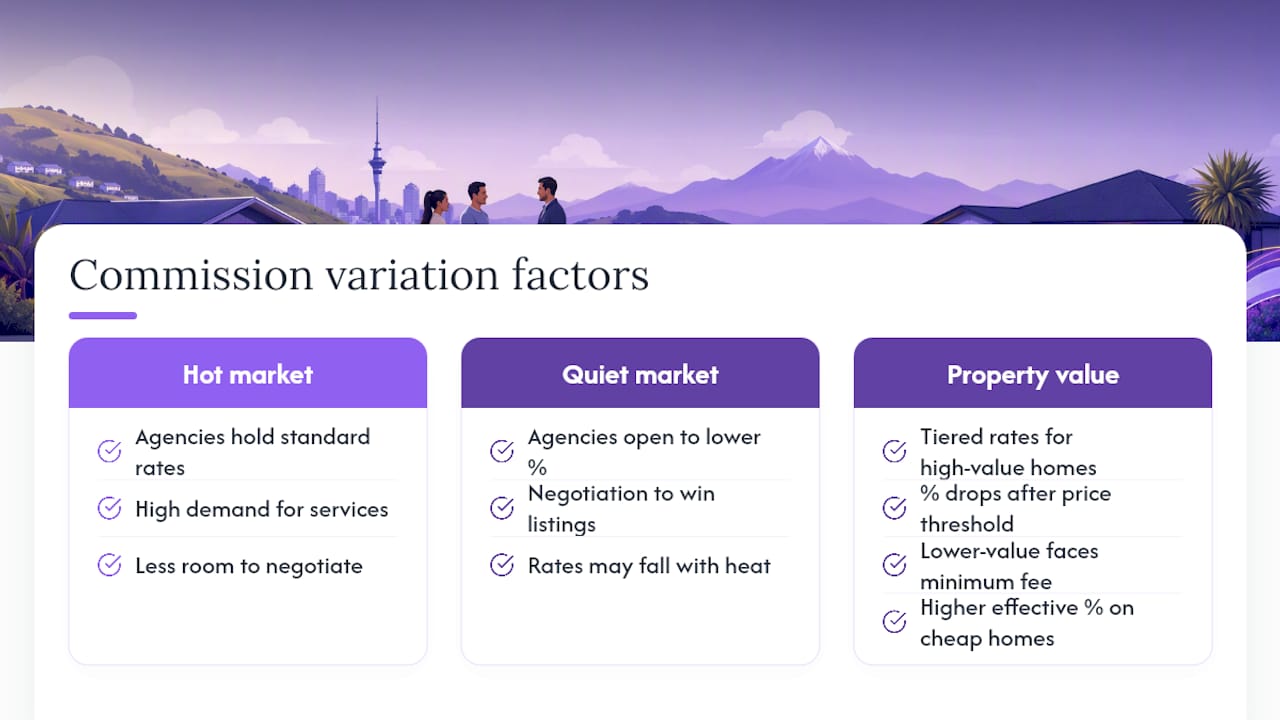
Property value itself plays into this too. Higher-value homes sometimes attract tiered commission structures, where the percentage drops slightly once the sale price crosses a certain threshold, since the dollar amount at the higher end still delivers a solid fee for the agency. Lower-value properties, meanwhile, can sometimes carry a higher effective percentage because agencies build in a minimum fee to make the listing worthwhile for them.
This regional and market-driven variation is exactly why there’s no single universal answer to what commission “should” cost. Your actual saving depends on what your local market and property value would have attracted in agent fees had you listed traditionally. A conveyancer familiar with your region can usually give you a realistic sense of what local agencies are charging if you want a direct comparison point before deciding how to sell.
Comparison between fixed-fee and percentage-based commission structures
Most New Zealand agencies charge a percentage-based commission, calculated against the final sale price. This structure means the agency’s earnings rise and fall with your result, which in theory aligns their motivation with getting you the best possible price. In practice, though, the percentage gap between a mediocre offer and a great one is often small relative to the agency’s total fee, so the alignment isn’t always as strong as it sounds.
A smaller number of agencies offer fixed-fee arrangements, charging a flat dollar amount regardless of sale price. This can suit sellers with higher-value homes, where a percentage fee would otherwise translate into a very large dollar figure. Fixed fees offer certainty from the outset. You know the exact cost before you sign, rather than watching a percentage shift with the final negotiated price.
Neither structure removes the fee entirely; both assume an agent is involved in marketing, negotiating, and managing the sale. That’s the fundamental difference from a private cash sale, where there’s no agency structure at all, fixed or percentage-based, because there’s no agent in the transaction. If you’re weighing a traditional listing against a direct cash sale, the real comparison isn’t fixed versus percentage. It’s whichever agency fee structure against paying nothing at all and accepting a different kind of trade-off on price and process.
How commission is split between listing and buyer’s agents
In a traditional agent-mediated sale, the total commission collected at settlement isn’t necessarily kept entirely by the agency that listed your property. Depending on how the sale unfolds, a portion can be shared with a buyer’s agent, particularly if that agent brought the eventual purchaser to the table through their own client relationships.
This split arrangement is one reason commission percentages can feel higher than sellers expect. You’re not just paying for the marketing and negotiation your own listing agent provides. You may also be indirectly funding the buyer-side agent’s work in finding and representing the purchaser, even though you never engaged that second agent yourself.
For sellers weighing a private cash sale, this split is largely irrelevant; there’s no listing agent and no buyer’s agent, so there’s nothing to divide. It’s worth understanding the split only so you have a clear picture of where a traditional commission fee actually goes if you’re comparing that route against a direct, agent-free sale. Knowing the fee isn’t a single simple payment to one party can also help explain why some agencies resist reducing their percentage even under negotiation. Part of that fee may already be earmarked to share.
Negotiating commission rates with real estate agents
Commission rates in New Zealand are not fixed by regulation, and agencies expect some sellers to negotiate before signing an agency agreement. The Real Estate Authority’s guidance confirms agencies must provide a clear written estimate of commission upfront, which gives you a concrete figure to negotiate against rather than a vague verbal quote.
Sellers with higher-value properties, homes in high-demand areas, or multiple agencies competing for the listing generally have more negotiating leverage. Asking two or three agencies for their commission structure before choosing one is a reasonable, common practice, and it can surface meaningful differences in what agencies are willing to charge for comparable work.
That said, negotiation has limits. An agency operating on thin margins in a competitive local market may have little room to move, and a lower headline percentage sometimes comes paired with reduced marketing spend or less experienced staff handling your sale. If avoiding commission altogether is the goal rather than simply reducing it, a private sale to a cash buyer removes the negotiation entirely, because there’s no percentage fee to discuss in the first place.
Impact of commission on net proceeds vs. listing price
The listing price on your property is never the number you actually receive. Commission comes off the top at settlement, along with any other fees, and the gap between listing price and net proceeds can be larger than sellers expect, particularly once GST on agency services and other deductions are factored in.
This matters because a slightly higher agent-negotiated sale price doesn’t automatically translate into a better outcome once commission is deducted. A property that sells for a strong headline figure through a competitive agent campaign might still net the seller a similar, or in some cases a lower, final amount compared to a direct cash sale at a lower headline price with no commission attached.
Sellers weighing their options should always compare net proceeds, not listing price, when deciding between a traditional sale and a commission-free route. It’s the only number that reflects what actually lands in your account, and it’s the number worth running the maths on before committing to either path.
Examples of alternative selling methods with different or no commission
Beyond a traditional agent listing, New Zealand sellers have a handful of other routes, each with a different cost structure. Auctions typically still involve an agency and its usual commission, though the campaign leading up to auction day can sometimes command a premium price that offsets the fee. For Sale By Owner (FSBO) removes agent commission entirely, similar to a private cash sale, but it puts the full weight of marketing, negotiation, and paperwork on the seller, which can be demanding without legal or conveyancing support.
Tender sales run through an agency in most cases and carry standard commission structures, just with a different buyer submission process than open-market listings. Private treaty sales, where a seller and buyer agree terms directly without a public campaign, can be commission-free if no agent is involved, but sellers still need to manage due diligence and contract details carefully.
A direct cash sale to a buyer or property-buying service sits closest to FSBO in terms of avoiding commission, but it typically comes with more structure and support around the paperwork than a fully independent FSBO sale, since the buyer’s side usually has established processes for verifying title and handling settlement.
Author perspective: practical tips from our experience
Three things separate sellers who confirm they’re commission-free from those who get an unwelcome invoice months later. First, check your agency agreement status before you do anything else, even if you’re certain it’s expired. Second, get any cancellation in writing, never just a verbal assurance. Third, once you’re confident you’re clear, a no-obligation offer from a buyer like Easysale, built around a straightforward three-step process, gives you a genuine number to compare against without cost or pressure.
Where I’d push back on conventional advice: too many guides treat agency cancellation as a formality. It isn’t. The Real Estate Authority’s own guidance exists precisely because agent-introduced-buyer disputes happen often enough to warrant a dedicated framework. When you’re unsure, get a conveyancer to look at the paperwork before you sign anything else.
— Aaron
How Easysale can help with a commission-free house sale
Easysale gives you a direct route to a cash sale without the percentage fee that comes with a traditional agency campaign, and without the DIY burden of a full FSBO process. The three-step process is simple: you submit your property details, receive a no-obligation cash offer, and settle on a timeline that suits you, whether that’s days or several weeks out.
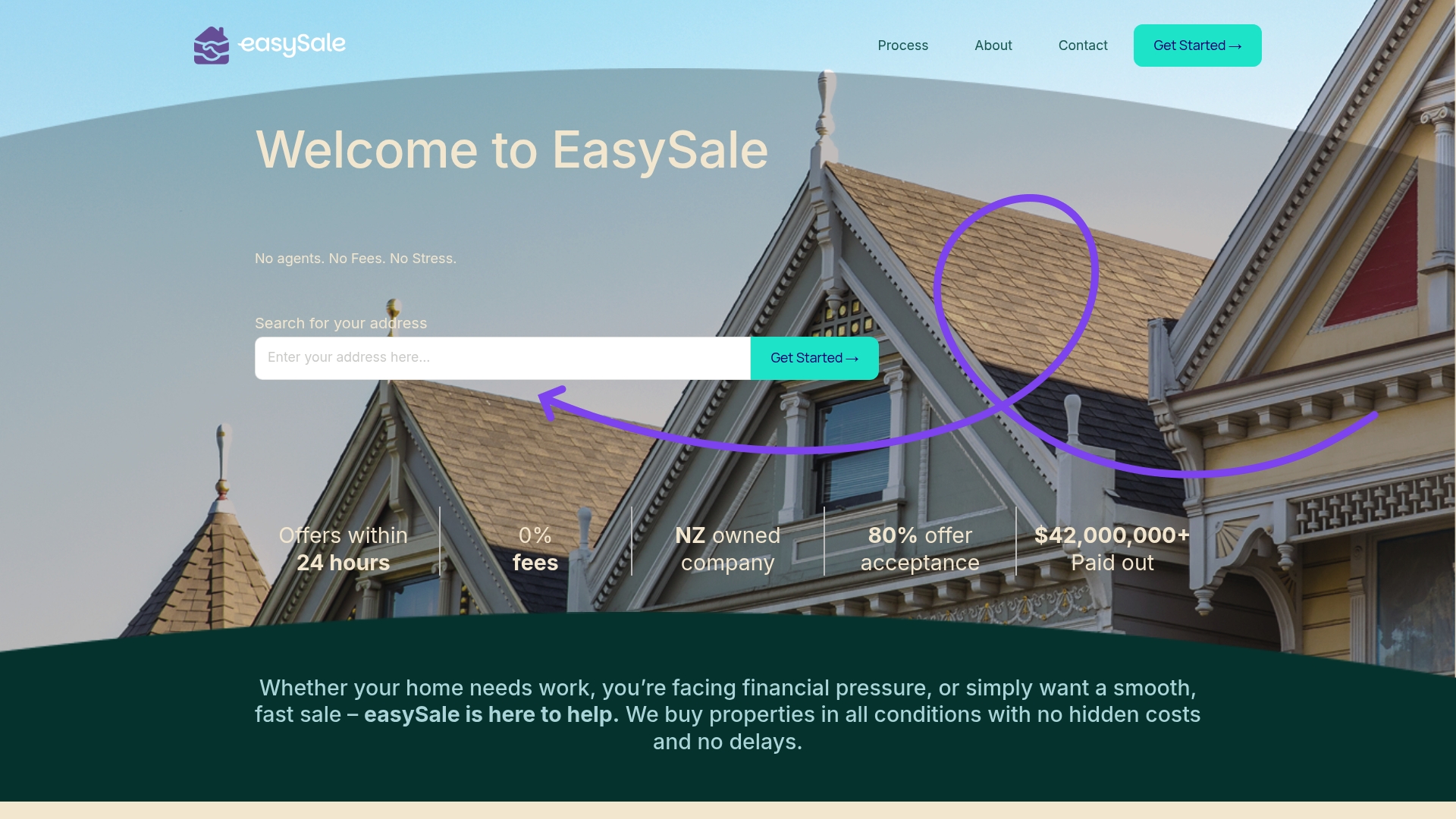
Easysale purchases homes in a wide range of conditions, including properties needing repairs, unconsented work, tenanted homes, and inherited properties where a fast, private sale is often the easiest path forward. Whether you’re dealing with financial pressure, a property that needs work you can’t fund, or simply want a straightforward exit without agent involvement, the process is built to move at your pace. If you’re weighing up whether a private cash sale makes sense for your situation, get a free, no-obligation offer and see the actual number before deciding anything.
This article is general information, not a substitute for advice from a qualified financial advisor. Consult a qualified financial professional about your own circumstances before acting on anything here.
Recommended
