
How to Get a Cash Property Offer in NZ: Step by Step


To get a cash offer on your home, you give a direct buyer the details of your property, receive a no-obligation offer, and settle on the date that suits you. There is no agent, no commission and no need to repair anything first. At easySale, that is the whole process, and it is built for owners who need a sale to be quick and private: a damaged house, a tenanted rental, an inherited home, a separation or money pressure.
This guide walks through each stage, what to prepare, what a fair offer looks like and what to confirm in writing before you say yes.
EasysaleA simpler path to a cash offerSubmit your property details, receive a no-obligation offer, then settle on a timeline that suits you, without an agent or commission.1Submit your property details2Receive a no-obligation offer3Settle on your preferred timelineVisit
TL;DR
- A cash offer means the buyer is not relying on a bank loan to buy your home, so the sale does not hinge on lender approval.
- The process has three steps: submit your property details, receive a no-obligation offer, settle on your preferred timeline.
- Know your home’s likely market value before you read any offer, so you can judge what “fair” means for your situation.
- Get the price, the settlement date, who pays what and any conditions in writing, and have your own lawyer review the agreement.
- We buy properties in any condition, including damaged, unconsented, tenanted or inherited homes.
Table of Contents
- What a cash offer actually is
- Who a cash offer works well for
- Step 1: Gather your property details
- Step 2: Work out what your home is likely worth
- Step 3: Submit your details and request your offer
- Step 4: Read the offer properly
- Step 5: Have your lawyer review the agreement
- Step 6: Settle on your timeline
- Common mistakes that cost sellers money
- Our view on cash offers
- Ready to request your offer?
- FAQ
- Sources
What a cash offer actually is
A cash offer is an offer from a buyer who pays for the property with their own funds rather than a mortgage. For a seller, that removes the most common reason a normal sale falls over: a buyer who cannot get finance in time. You can read our own explanation in what a cash offer means for fast house sales in NZ.
The other difference is who you are dealing with. In a standard sale you pay a real estate agent, prepare the house for open homes and wait for a buyer who may or may not be able to settle. With a direct cash buyer there is one party making you one offer on the property as it stands today.
That is why a cash sale suits specific situations better than others. If your house is in good shape, you have months to spare and you want to test the open market, a traditional listing may be what you want. If you need certainty and speed, or the house is not in a state to show, a direct offer is usually the more practical route.

Who a cash offer works well for
The people who contact us tend to have one thing in common: the usual way of selling does not fit their circumstances. Typical examples:
- Owners under financial pressure. Mortgage arrears or rising costs make a long marketing campaign unrealistic. A known settlement date lets you plan.
- Owners of damaged or uninhabitable homes. Fire, flood, storm or long-term neglect can make a house hard to sell through open homes. We buy as-is, so you do not pay for repairs first.
- Landlords with tenant-damaged rentals. Fixing a rental and re-letting it, or staging it for sale, costs time and money. A direct sale lets you move on.
- People separating or divorcing. A private sale keeps the process low-key while you and your former partner sort out the next step.
- Families handling an inherited home. An estate property often needs clearing, and the people involved may live in different cities. A simple, single-buyer process reduces the workload.
- Owners relocating or downsizing. A fixed timeline helps when you have a move date, a new job or a retirement plan.
If one of these is you, the dedicated pages explain the details: selling fast, damaged homes as-is, divorce or separation, inherited and estate homes, relocation and retirement and downsizing.
Step 1: Gather your property details
The first step is simple, but the quality of your information shapes the quality of the offer. Before you submit anything, collect:
- The address and legal ownership. Know whose names are on the title. For an estate sale, know who the executor is. For a separation, know whether both owners agree to sell.
- The basics. Bedrooms, bathrooms, land size, parking, age of the house.
- The honest condition. Note any damage, leaks, mould, unconsented work, fire or flood history, and what tenants have done to the property if it is a rental.
- Whether it is tenanted. If tenants live there, say so, along with the type of tenancy.
- Your timeline. Do you need to be out in a few weeks, or do you want months? Tell us the date that works for you.
- Anything owing. Know roughly what is owed on the property, such as a mortgage, so you can see what you would have left after the sale.
Being upfront about problems is the best way to get an offer that holds. A buyer who learns about hidden damage late has reason to change the price. A buyer who knew from the start has already allowed for it.
Step 2: Work out what your home is likely worth
Before you read an offer, form your own view of the value. You do not need a perfect figure, only a realistic range. Three practical ways to do it:
- Look at recent sales of similar homes in your suburb: size, age, condition and land.
- Use the online estimates that property websites publish, treating them as a rough guide only.
- Consider the condition of your house honestly. A damaged home does not sell for the same figure as an identical tidy one next door.
Then think about what the number means for you, not just the headline price. A traditional sale carries agent commission, marketing costs, the cost of any repairs or tidying and weeks or months of holding costs such as mortgage interest, rates and insurance. A direct cash sale with no agent fees, no commission and no repairs changes that arithmetic. The comparison that matters is what you keep and when you receive it.
A worked example makes it concrete. Say a house has a likely market range in your suburb, but needs a new roof and has water damage. In a normal sale you would pay for the repairs or accept a lower price from a buyer who factors them in, and you would also pay commission and carry costs for however long it takes. With a direct offer, the buyer prices the condition once, and you take that single figure without paying a commission. You then compare that figure with your own estimate after the costs you would otherwise face.
Step 3: Submit your details and request your offer
You send your property details to us through the website. There is no charge to ask, and the offer carries no obligation. Our Sell House Privately page describes the direct cash buyer route, with a fair offer within 24 hours.
There are no open homes, photographers or viewings by strangers. For anyone selling during a separation, after a death or while a tenant is in residence, that privacy is often the point.
If you want to understand the overall flow before you submit, our guides on the property selling process in NZ and the step-by-step guide to a fast cash sale lay out each stage.
Step 4: Read the offer properly
When the offer arrives, take the time to read it as a plan, not just a number. A good offer answers these questions clearly:
| What to check | Why it matters |
|---|---|
| Purchase price | This is the figure you compare with your own estimate and your costs avoided. |
| Settlement date | Settlement is the day ownership transfers and you are paid. It should match the timeline you gave. |
| Conditions | Any conditions attached should be listed and understood. Fewer conditions mean more certainty. |
| Costs | Confirm what, if anything, you are expected to pay, and that there are no commission or repair charges. |
| Possession | The date you must hand over the keys, and what you need to leave or clear. |
| Chattels | Which fixtures and items stay with the house, and which you keep. |
Ask for everything to be put in writing. A verbal comfort is not a contract. If something in the document does not match what you were told, raise it before you sign.
What “fair” means
A fair cash offer is not the same as the highest possible price on a perfect day. It is a price that reflects the real condition of the property, the speed and certainty it gives you, and the costs you avoid. Ask yourself three things:
- Does the price make sense against my own value range and my real condition?
- After the commission, repairs and holding costs I avoid, am I better off or comfortable with the difference?
- Does the settlement date solve the problem I actually have?
If the answer to all three is yes, the offer is doing its job. If you need more time to think, take it. A no-obligation offer means you can decide in your own time.
Step 5: Have your lawyer review the agreement
When you accept, you sign a sale and purchase agreement. This is the contract that sets out the price, the settlement date and the terms. Have your own lawyer or conveyancer read it before you sign. They also handle the legal transfer of the title, and they can explain anything in the agreement you are unsure about.
This matters most when the circumstances are complicated:
- Estate sales. The executor or administrator needs the authority to sell, and your lawyer will confirm the paperwork is in order.
- Separations. Both owners usually need to sign, and your lawyer can advise how the proceeds are handled in your situation.
- Tenanted properties. Your lawyer can explain your obligations to the tenant under the tenancy agreement and what happens to it on sale.
- Unconsented work. Tell your lawyer about it early so it is dealt with in the agreement rather than discovered later.
Step 6: Settle on your timeline
Settlement is when the buyer pays and the property changes hands. With a cash buyer there is no lender to wait for, which is why our fastest option is aimed at a sale within 7 days for sellers who need it. But fast is not compulsory. Many owners prefer a longer runway, for instance so a family can finish clearing a home, a tenant can move out or children can finish a school term. The date is something you agree, not something imposed on you.
In the lead-up to settlement:
- Arrange to disconnect or transfer power, internet and water accounts.
- Remove your belongings, or agree in writing what stays.
- Update your insurer, your lender and your mail redirection.
- Give your lawyer your forwarding details for the final paperwork.
On the day, your lawyer arranges the transfer and the funds are paid in line with the agreement.
Common mistakes that cost sellers money
Hiding the condition. Undisclosed damage tends to come out eventually and can lead to a changed offer or a delayed sale. Tell the buyer everything up front.
Skipping the numbers. Looking only at the headline price ignores the commission, repairs and carrying costs you avoid, and the cost of waiting.
Agreeing without it in writing. Price, settlement date, conditions and costs should all be on paper.
Not involving your lawyer early. Especially in an estate, a separation or a tenanted sale, early legal advice prevents delays.
Rushing a decision you do not need to rush. A no-obligation offer gives you room to think. Use it.
Our view on cash offers
We started easySale because too many New Zealand homeowners were stuck with a house they could not sell the usual way. A damaged roof, a tenant who left a mess, a relationship ending, an estate with no one nearby to manage it: each of these makes open homes and agent campaigns a poor fit.
Our approach is to make the process short and plain. You send us the property details, we come back with a fair cash offer, and you choose the settlement date. No agent fees, no commission, no repairs, and no obligation to accept.
What we care about most is that you understand each step before you commit. That is why we explain the offer, the timeline and the paperwork in ordinary language, and why we handle every enquiry privately. We buy properties in any condition, and we treat each seller’s situation with respect, because behind every sale is a person making a hard decision.
If you are weighing up your options, start by being clear about what you need most: speed, privacy, certainty or simplicity. A direct cash sale delivers all four.
Aaron
Ready to request your offer?
If your home is damaged, tenanted, inherited or simply needs to be sold on a short timeline, our Direct Private Sale service is designed for exactly that. You submit your property details, receive a no-obligation offer and settle when it suits you, with no agent, commission or repair costs.
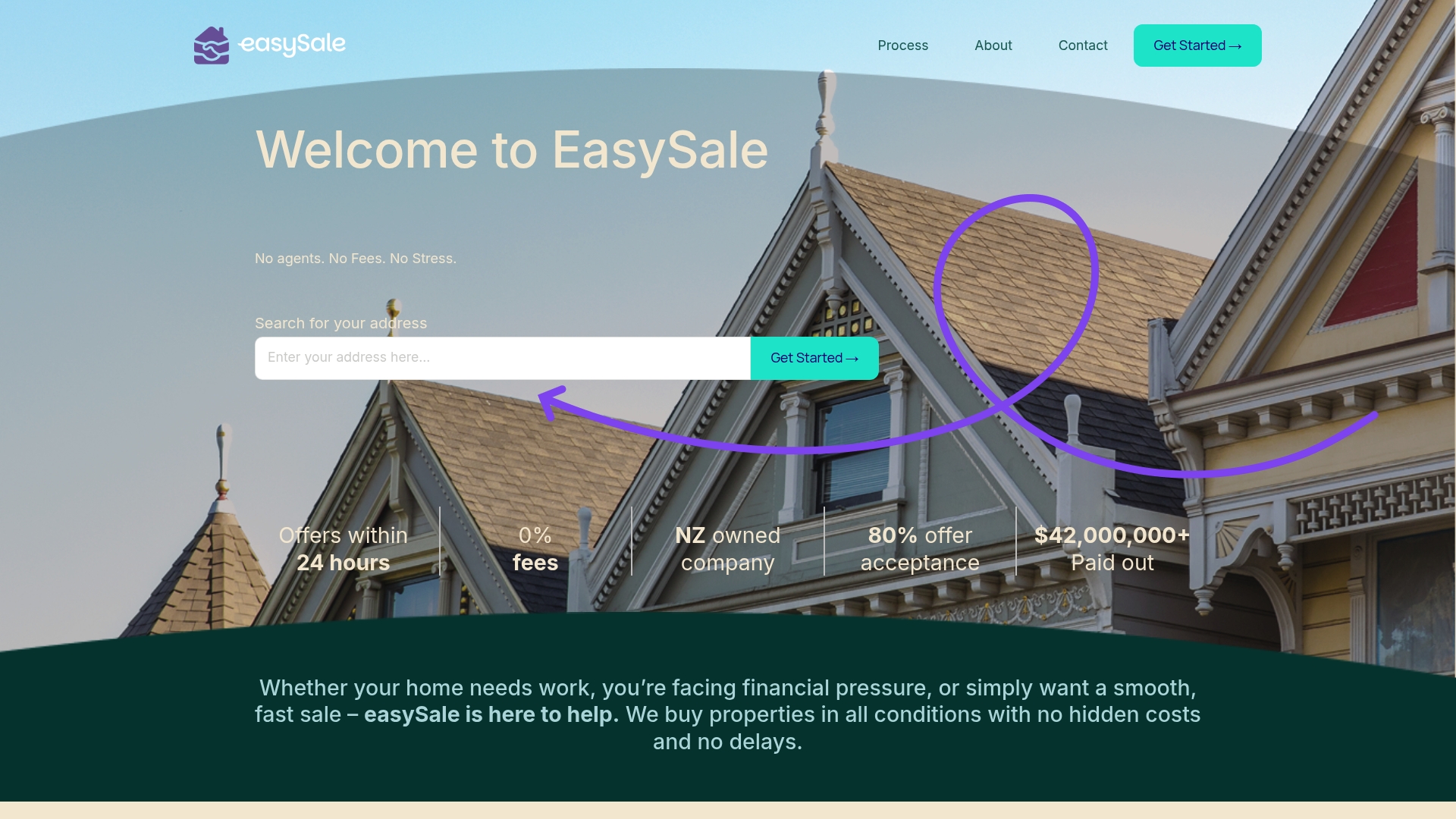
You can start on the easySale homepage or read more about the advantages of cash house sales for NZ homeowners first.
FAQ
How do I get a cash offer on my house?
Submit your property details through our website, including the address, condition and your preferred timeline. We then give you a no-obligation offer. If you accept, your lawyer reviews the agreement and you settle on the date you chose.
Is a cash offer a fair price?
A fair cash offer reflects the real condition of your home and the benefits of a quick, certain sale. To judge it, compare it with recent sales of similar homes nearby, then take off the commission, repair and holding costs you would face in a traditional sale. Because the offer has no obligation, you can weigh it at your own pace.
Can I sell a damaged or tenanted house for cash?
Yes. We buy properties in any condition, including damaged, unconsented, tenanted and inherited homes, and you do not need to repair anything first. Describe the condition honestly when you submit your details so the offer matches what the buyer will see.
Do I pay commission or fees to get an offer?
No. There are no real estate agent fees, no commission and no repair requirements with our direct sale. You should still ask for all costs to be set out in writing in the agreement, and your lawyer can confirm them before you sign.
How long does a cash sale take?
It depends on the timeline you choose. Our fastest option is designed for a sale within 7 days, and many sellers choose a longer date to suit a move, a tenancy or an estate. You agree the settlement date as part of the offer.
Sources
- Property Selling Process NZ: Quick Sale Steps Simplified
- Step by Step Home Selling Guide for Fast Cash Sale
- What a cash offer means for fast house sales in NZ
- Advantages of cash house sales for NZ homeowners


