
How to sell your house by owner to a cash investor in NZ
Yes, you can sell your house by owner directly to a cash investor in New Zealand and complete the whole transaction without a real estate agent. The outcome: a fast, no-commission sale where you receive a cash offer, your lawyer manages the deposit and settlement, and the title transfers through LINZ on a timeline you agree to. The catch is that the legal steps are non-negotiable, regardless of how you sell.
Three things make a safe, fast private sale possible:
- Proof of funds from the buyer, confirmed before you sign anything
- Solicitor-held deposit in a trust account to protect both parties
- Clear disclosure of known defects, as required under New Zealand law
Selling privately to a cash investor is legal and practical in New Zealand, but mandatory seller disclosure applies regardless of sale method. Get a lawyer involved before you sign any offer.
Key takeaways
Selling your house by owner to a cash investor in New Zealand is legal, practical, and fast when you have a lawyer involved, your documents ready, and a vetted buyer with confirmed funds.
| Point | Details |
|---|---|
| Instruct a lawyer first | Engage a lawyer before accepting any offer so they can hold the deposit and review terms immediately. |
| Prepare your due-diligence pack | Title, LIM, CCCs, and a chattels schedule upfront cuts investor review time significantly. |
| Verify proof of funds | Always request a bank statement or solicitor confirmation before proceeding with any buyer. |
| Expect a below-market price | Cash offers reflect investor margin and speed; know your baseline valuation before negotiating. |
| Easysale as a ready option | Easysale buys NZ properties in any condition with offers within 24 hours and seller-chosen settlement dates. |
Table of Contents
- How do you sell your house by owner to a cash investor, step by step?
- What must you disclose when selling privately in New Zealand?
- How do cash offers and contract terms actually work in NZ?
- What price should you expect on a fast cash sale?
- How do you vet a cash buyer and spot red flags?
- What paperwork do you need and what does your lawyer do?
- How fast can a cash sale actually settle?
- Tax, trusts, and special cases to check before you sign
- Why Kiwis choose a direct cash sale and what the trade-offs feel like
- Easysale makes a fast cash sale straightforward for NZ sellers
- Sources
How do you sell your house by owner to a cash investor, step by step?
Follow this checklist in order. Each step has a realistic timing guide so you know what to expect.
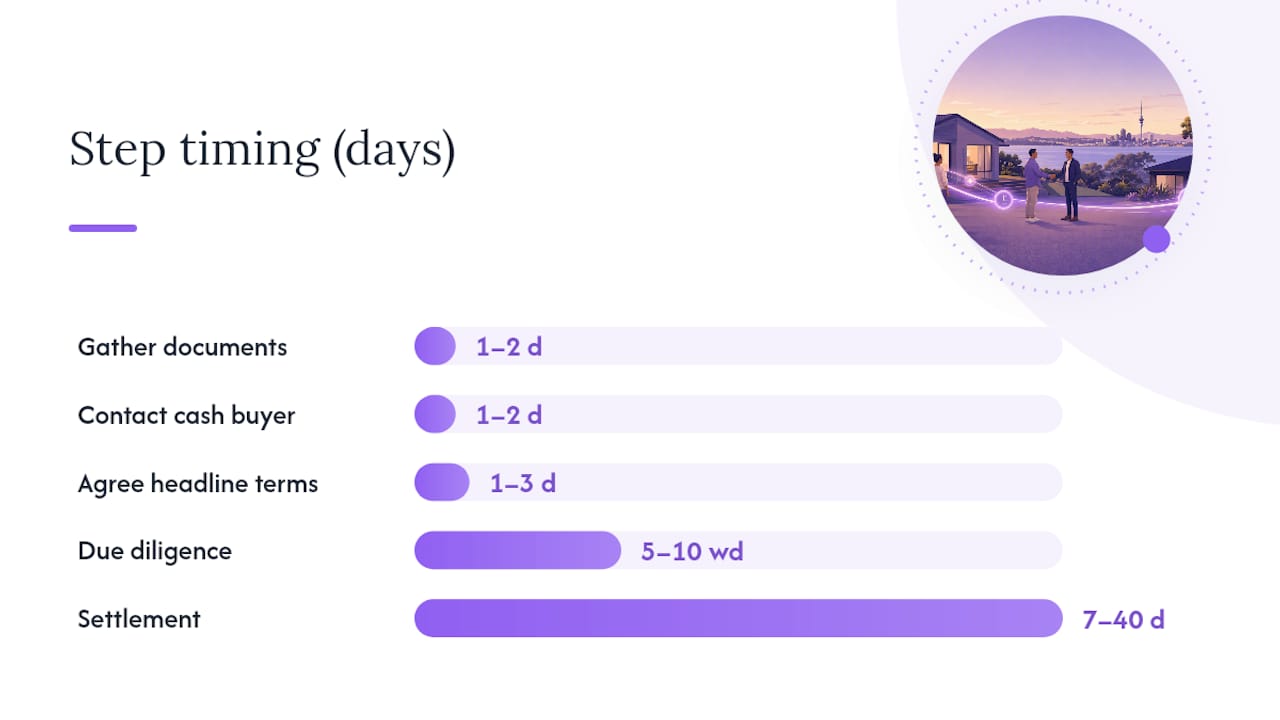
- Gather your documents (title, LIM report, Code Compliance Certificates, building consents) — do this before you contact any buyer; 1–2 days
- Contact a cash buyer such as Easysale and submit your property details — offer typically within 24–48 hours
- Verify proof of funds — request a bank statement or solicitor confirmation from the buyer before proceeding — same day
- Instruct a lawyer or conveyancer — do this before accepting any offer so they can review terms immediately — 1 business day to engage
- Agree headline terms — price, settlement date, and any conditional windows — negotiate within 1–3 days
- Accept the offer and hold deposit in trust — your lawyer holds the deposit in a solicitor trust account — 1–3 business days
- Complete disclosure and due diligence — provide your due-diligence pack and respond to any buyer queries — 5–10 working days
- Settlement — lawyer registers the title transfer with LINZ and funds are released — 7–40 days depending on mortgage discharge
Pro Tip: Prepare a due-diligence pack upfront: record of title, LIM, CCCs, a chattels schedule, and recent photos. Handing this to the buyer on day one cuts back-and-forth by days and signals you are a serious seller.
What must you disclose when selling privately in New Zealand?
Disclosure obligations apply to every sale, whether you use an agent or sell directly to a cash investor. Govt.nz guidance is clear: withholding known defects can expose you to breach-of-contract claims or court action after settlement.
You must disclose:
- Weather-tightness issues (leaky home history or suspected moisture damage)
- Unconsented building work (additions, garages, or alterations without council consent)
- Boundary disputes or encroachments
- Known natural hazard risks (flood zone, liquefaction, coastal erosion)
- Material defects that would affect a buyer’s decision
Urgency does not remove this duty. If you are selling under financial pressure or because of property damage, document every known issue in writing and keep that record. Your lawyer should draft the Sale and Purchase Agreement to include these disclosures formally, which protects you post-settlement.
Keeping a clear email trail of what you disclosed and when is your best protection if a buyer raises a dispute after settlement.
Settled reinforces that sellers who go it alone must understand these risks and have a lawyer check the agreement.
How do cash offers and contract terms actually work in NZ?
A cash offer sounds simple, but the contract can still include conditions. Understanding the terms before you sign is what keeps a “fast” sale actually fast.
Common headline terms in a cash offer:
- As-is/where-is clause — buyer accepts the property in its current condition
- Purchase price — usually below registered valuation; more on that below
- Deposit amount — typically 5–10% held in solicitor trust
- Settlement date — agreed upfront; binding once unconditional
- Due-diligence or inspection window — the main risk to speed
The critical point: cash offers can still include due-diligence conditions, and a buyer can use an open-ended window to renegotiate or walk away. If speed matters to you, push for a defined short window of 3–5 working days, or request an unconditional offer from the outset.
Negotiable points to tighten:
- Shorten or remove inspection periods
- Set a firm deposit deadline (within 2 business days of acceptance)
- Define any finance or consent conditions with hard expiry dates
- Confirm the deposit goes directly into your lawyer’s trust account
Reserve Bank LVR rules mean investors often fund purchases through equity rather than standard mortgages, which can actually speed settlement once terms are agreed.
What price should you expect on a fast cash sale?
Speed and certainty come at a cost. Cash investors price offers to account for their margin, holding costs, and the risk they take buying without extended due diligence. Expect an offer below what you would achieve through a full market campaign.
Factors that reduce the offer price:
- Property condition — damage, deferred maintenance, or unconsented work all lower the number
- Urgency of your timeline — a 7-day settlement gives the buyer more leverage than a 30-day one
- Market depth in your area — thin markets mean fewer competing buyers and lower investor bids
- Investor margin requirements — driven partly by LVR lending rules and return expectations
Pro Tip: Get a quick registered valuation or pull recent comparable sales from your local council’s property records before taking offers. Knowing your baseline means you can negotiate from a position of knowledge rather than guesswork.
To narrow the gap between a cash offer and market value, consider offering a flexible settlement window, accepting an as-is price, or limiting buyer conditions. Each concession you make on terms can support a modest price improvement. For more on pricing a fast private sale, the Easysale blog covers NZ-specific valuation approaches.
How do you vet a cash buyer and spot red flags?
Not every buyer who calls themselves a “cash investor” is ready, willing, or honest. Vetting takes less than a day and protects you from delays and worse.
Vetting checklist:
- Request proof of funds — a recent bank statement or written confirmation from their solicitor
- Verify buyer identity — photo ID and, for companies or trusts, an entity search on the Companies Office register
- Confirm clear contact details and a referee (their lawyer or accountant)
- Check that the deposit will be held in a solicitor trust account, not paid directly to the buyer’s own account
Red flags to watch for:
- Low or no deposit offered
- Requests for lengthy or open-ended due-diligence periods
- Pressure to sign quickly without lawyer review
- Requests for side deals or unusual settlement arrangements
- Post-inspection renegotiation attempts not covered in the original contract
Lock protections into the agreement from the start. Your lawyer can insert clauses that make renegotiation after the conditional period difficult and that tie the deposit release to specific milestones. For privacy and ID-verification considerations, this guide covers what sellers should know.
What paperwork do you need and what does your lawyer do?
Your lawyer is not optional in a private cash sale. Property lawyers handle disclosure advice, offer review, mortgage discharge, settlement statements, and LINZ registration. Instructing them before you accept an offer means they can move immediately when terms are agreed.

Essential documents for a fast cash sale:
| Document | Purpose | Who provides it |
|---|---|---|
| Record of title | Confirms ownership and encumbrances | LINZ / your lawyer |
| LIM report | Council records, zoning, hazards | Local council |
| Code Compliance Certificates | Confirms consented work was completed | Council / seller |
| Building consents | Records of approved work | Council |
| Chattels schedule | Lists what is included in the sale | Seller |
| Evidence of repairs | Supports as-is pricing and disclosure | Seller |
Your lawyer’s tasks at settlement: hold deposit in trust, prepare the Sale and Purchase Agreement, obtain mortgage payout figures, prepare the settlement statement, and register the title transfer with LINZ.
How fast can a cash sale actually settle?
The fastest clean cash sale can settle in under two weeks if the buyer is ready and your lawyer is already instructed. Most transactions land somewhere in the middle.
| Scenario | Offer to settlement |
|---|---|
| Fast (unconditional, no mortgage) | 7 days |
| Typical (short conditions, mortgage discharge) | 20–30 days |
| Slower (complex title, buyer due diligence) | 30–40 days |
Factors that shorten the timeline:
- Buyer has funds confirmed and ready
- Seller’s lawyer is already instructed
- No mortgage to discharge (or payout figures obtained quickly)
- Due-diligence pack provided upfront
- Simple, clean title with no encumbrances
Factors that lengthen it:
- Mortgage discharge delays from the seller’s bank
- Complex title issues or outstanding remedial work
- LINZ processing queues
- Buyer due-diligence requests not covered by the upfront pack
For investor-visa buyers purchasing properties over NZ$5 million, LINZ guidance suggests allowing approximately 20 working days for consent in conditional agreements.
Tax, trusts, and special cases to check before you sign
A fast sale does not mean a tax-free one. New Zealand’s bright-line rules can treat a property sale as taxable income depending on how long you have owned the property and how it has been used. This is not a comprehensive tax guide, but these are the questions to ask your lawyer before you exchange.
Key issues to check:
- Bright-line exposure — if you have owned the property for less than the applicable bright-line period, the gain may be taxable as income
- GST — if the property has been used for a taxable activity (short-term rental, commercial use), GST may apply to the sale
- Income treatment — properties bought with the intention of resale may be treated as income regardless of the bright-line period
- Trust or company title — if the property is held in a trust or company, additional steps are needed at settlement and specialist legal advice is required early
Ask your lawyer to confirm bright-line exposure and GST status before you accept any offer. Getting this wrong after settlement is expensive to fix.
Why Kiwis choose a direct cash sale and what the trade-offs feel like
Selling directly to a cash investor is rarely the first plan. Most sellers who go this route are dealing with something that makes the standard 60-day listing campaign feel impossible: a job relocation with a hard start date, a relationship breakdown, a property that needs significant work, or financial pressure that makes carrying costs unsustainable.
The relief most sellers describe is not about the price. It is about certainty. Knowing the sale will complete, on a date you agreed to, without the anxiety of open homes and conditional offers falling over, has real value that does not show up in the sale price comparison.
The trade-off is honest: you will almost certainly receive less than a full market campaign would achieve. That gap is the cost of speed and certainty. For sellers in the situations above, it is often the right call.
Easysale’s process maps directly to this: submit your details, receive a no-obligation offer, and settle on your timeline. The testimonials on the site reflect sellers who valued that clarity above a higher price that might never have arrived.
Easysale makes a fast cash sale straightforward for NZ sellers
If you have read this far and your situation calls for speed, Easysale is a direct cash buyer operating across New Zealand that buys properties in any condition, no agent required. Submit your property details and receive a no-obligation offer within 24 hours. From there, you agree a settlement date that works for you, and Easysale coordinates with your lawyer to handle the handover.
The process is built for sellers who need certainty: no open homes, no commission, and no conditional offers that drag on for weeks. Whether your property needs work, you are facing a tight timeline, or you simply want to sell your house privately without the stress of a traditional campaign, Easysale’s high acceptance rate and nationwide reach mean most NZ sellers get a workable offer fast. If your property has damage or needs significant repairs, the damaged property service covers as-is purchases directly.
Get your no-obligation offer from Easysale today, then instruct your lawyer before you sign anything.
Sources
Official and vetted resources for sellers going through a private cash sale:
- Selling your house | New Zealand Government
- Selling privately | Settled
- Selling a house | Legal steps, conditions & settlement guide
- Detailed information for investor visa holders buying a house in New Zealand
This article is general information, not a substitute for advice from a qualified lawyer. Consult a qualified legal professional about your own circumstances before acting on anything here.
Recommended
