
How to sell your house as is in New Zealand

Yes, you can sell your house as is in New Zealand. You do not need to repair a single thing before settlement. What you do need is honest disclosure, a formal Sale and Purchase Agreement, and a property lawyer. Get those three things right and you can move from decision to settled sale in a short period, sometimes within a few weeks.
Before you take any offer, do two things: assemble your key documents and get legal advice. Then, if speed and certainty matter most, request a no-obligation cash offer.
- You must disclose known defects even when marketing the property as is
- A Sale and Purchase Agreement is legally required for every NZ property sale
- Cash buyers can often settle quickly, bypassing the longer open-market timeline.
- Selling as is trades some price for speed and certainty, not for legal shortcuts
Table of Contents
- What are your options for selling an as-is property?
- Step-by-step checklist to sell your house as is
- What does NZ law require when selling as is?
- What do cash buyers look for and how do they calculate offers?
- What price, timeline, and costs should you expect?
- How to present your property to get the best as-is offer
- Red flags and scams to watch for when selling quickly
- Key takeaways
- A note on why Easysale buys houses as they are
- How Easysale works if you want a fast, no-agent cash sale
- Useful NZ sources and further reading
What are your options for selling an as-is property?
Four main routes exist, and the right one depends on whether you prioritise speed, price, or simplicity.
| Route | Speed to settlement | Certainty | Typical price | Agent fees | Condition accepted |
|---|---|---|---|---|---|
| Direct cash buyer | Fast settlement | High (no finance condition) | 10–30% below market value | None | Any condition |
| Private sale | Several weeks to a few months | Medium | Closer to market | None | Varies |
| Agent listing (as is) | Several weeks to a few months | Medium | Closer to market | Typical commission | Varies |
| Auction or tender | A month or two | Medium–high | Market-dependent | Agent fees apply | Varies |
Direct cash buyer suits sellers facing mortgage arrears, an inherited property, or a tight relocation deadline. Cash buyers bypass third-party financing entirely, which removes the most common reason deals fall through.
Private sale gives you more control and saves on commission, but you carry the legal and marketing workload yourself. It works well when you have time and a clear idea of your property’s value.
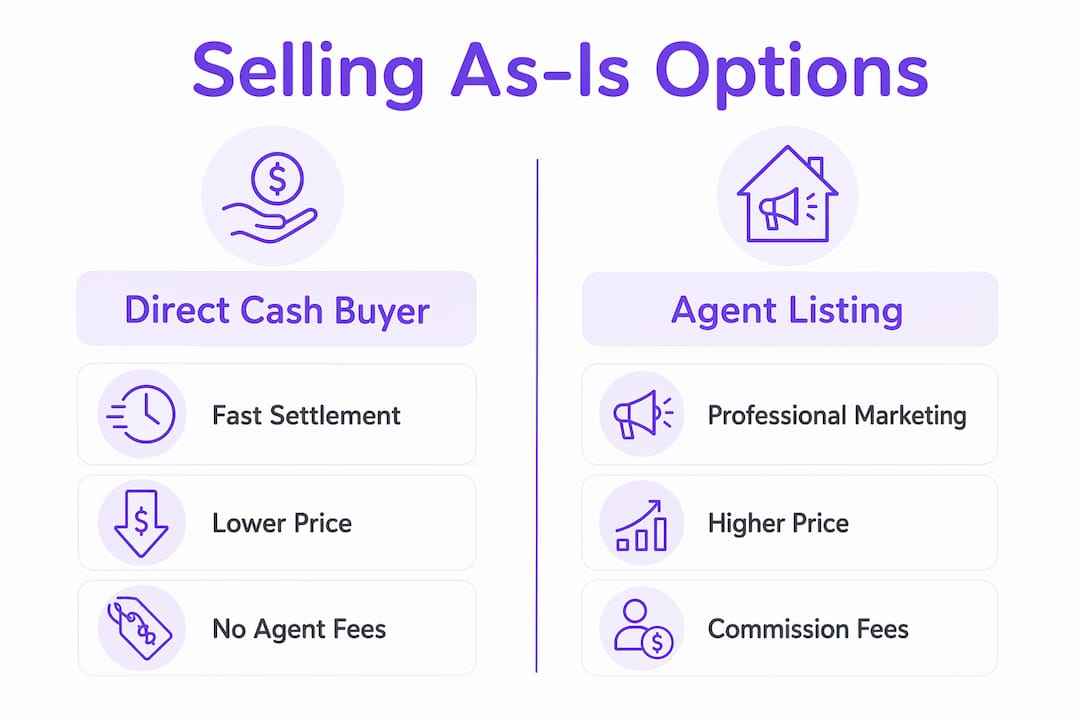
Agent listing as is puts a licensed professional in charge of marketing and negotiation. The trade-off is commission and a longer timeline, though a good agent can still attract competitive offers on a property in poor condition.
Auction or tender creates urgency and can produce strong results in a competitive market. For a property with obvious defects, though, buyer hesitation often limits the field.
Pro Tip: If repairs would cost a notable portion of your expected sale price, selling as is is often the smarter financial decision. Get a rough renovation quote before you commit to any route.
Step-by-step checklist to sell your house as is
Follow this sequence and you will avoid the most common delays.
- Assess the property honestly. Walk through every room and note known defects: leaks, unconsented work, structural issues, tenancy arrangements. You will need to disclose these regardless of the sale method.
- Assemble your documents. Gather the Certificate of Title, Land Information Memorandum (LIM), building consents, code compliance certificates, any existing building or engineering reports, tenancy agreements, insurance documents, and Natural Hazards Commission (NHC) claim history.
- Engage a property lawyer or conveyancer early. Do this before you accept any offer. Your lawyer drafts the Sale and Purchase Agreement, holds the deposit in trust, and manages the title transfer.
- Request cash offers. Contact one or more cash buyers and provide your document pack upfront. Proactively sharing reports reduces perceived risk and often speeds up negotiations.
- Review and negotiate. Compare offers on price, settlement date flexibility, and any conditions attached. A cash offer with no finance condition is worth more certainty than a higher conditional offer.
- Sign the Sale and Purchase Agreement. Your lawyer checks the clauses, including any “as is, where is” wording, before you sign.
- Settlement. Your lawyer coordinates the title transfer, pays out any mortgage, and deposits the balance into your account.
Pro Tip: Ask your lawyer to confirm that the “as is, where is” clause in the agreement is correctly drafted. A poorly worded clause does not protect you from misrepresentation claims.
What does NZ law require when selling as is?
Selling as is does not mean selling without obligations. Under New Zealand law, vendors must disclose known defects even when the property is marketed as is, and failing to do so can lead to legal action for misrepresentation or breaches of the Fair Trading Act.
The NZ Government lists the following as mandatory disclosures:
- Weather-tightness issues (leaky home syndrome)
- Unconsented building work
- Boundary disputes
- Natural hazard damage or risk
- Tenancy issues that affect the buyer’s use of the property
A formal Sale and Purchase Agreement is legally required for all property sales in New Zealand. Sellers are strongly advised to engage a property lawyer or conveyancer to prepare it.
The Real Estate Authority (REA) is clear: “Your disclosure obligations still apply when selling ‘as is, where is’. You must still disclose known defects and make enquiries where it seems likely there may be hidden or underlying defects.” — REA guidance on natural disaster damage
For properties affected by natural events, sellers should consult their insurer and legal adviser. Buyers can request previous NHC claim information directly from the Natural Hazards Commission, so withholding it gains you nothing and risks a dispute post-settlement.
What do cash buyers look for and how do they calculate offers?
Cash buyers and investors assess three things before making an offer: repair cost, compliance risk, and location relative to comparable sales.
- Repair cost estimate: Buyers price in every visible defect plus a contingency for hidden issues. The more documentation you provide, the smaller that contingency tends to be.
- Compliance risk: Unconsented work, outstanding council notices, or unresolved NHC claims all increase a buyer’s perceived risk and reduce their offer.
- Market comparables: Buyers check recent sales of similar properties in your area to set a ceiling on what the renovated property would be worth.
The offer calculation typically works like this: estimated post-renovation value, minus repair costs, minus holding costs during the work, minus a risk margin, minus the buyer’s required return. That arithmetic is why cash offers sit below open-market prices.
You can narrow that gap. Providing a LIM, building reports, and consent documentation upfront reassures buyers and reduces the risk margin they apply. Sellers who prepare reports and present clear documentation attract faster, cleaner offers.
What price, timeline, and costs should you expect?
Cash offers are typically 10–30% below market value to account for repair costs, holding costs, and investment risk. That discount is the cost of speed and certainty.
| Factor | Cash buyer | Agent listing (as is) |
|---|---|---|
| Time to offer | A couple of days | 2–6 weeks |
| Time to settlement | Within a few weeks | 6 weeks |
| Agent commission | None | 2–4% of sale price |
| Legal fees | Standard conveyancing | Standard conveyancing |
| Price vs. market | 10–30% below market value | Closer to market |
Legal fees and mortgage payout costs apply regardless of the sale method. In a direct cash sale, you save on agent commission and often on marketing costs. Many sellers incorrectly assume they must complete repairs before selling; as-is sales are designed for those short on time or funds, trading some price for certainty and speed.
How to present your property to get the best as-is offer
Good presentation is not about renovating. It is about reducing the buyer’s uncertainty.
- Provide the full document pack upfront: LIM, title, building consents, code compliance certificates, any builder’s or engineering reports, tenancy agreements, and NHC claim history.
- Clear the property of personal items and rubbish so buyers can assess the structure clearly.
- Fix genuine safety hazards (exposed wiring, broken steps) where the cost is minimal. These are not cosmetic repairs; they affect insurability.
- Take clear, honest photos that show the property’s actual condition. Buyers who arrive expecting worse than reality are more likely to proceed.
- Disclose known defects in writing, in the listing and in the agreement. Transparency speeds up due diligence and reduces the chance of a buyer pulling out after inspection.
Pro Tip: Have your builder’s report, engineering assessment, and LIM ready before you contact any buyer. Doing so prevents negotiation delays and signals that you are a prepared vendor.

Red flags and scams to watch for when selling quickly
Fast cash sales attract a small number of bad actors. Knowing the warning signs protects you.
Watch for these red flags:
- Verbal offers only, with no written Sale and Purchase Agreement
- Pressure to sign quickly or bypass your lawyer
- No proof of funds or vague answers about financing
- A deposit that is too small or held outside a lawyer’s trust account
- Requests to transfer the title before settlement funds clear
Protect yourself with three practical steps. First, insist on a formal Sale and Purchase Agreement for every offer. Second, require proof of funds before you proceed past the offer stage. Third, have your lawyer hold the deposit in their trust account until the sale goes unconditional. Settled.govt.nz confirms that once a Sale and Purchase Agreement is signed, the deposit must be held in a lawyer’s or conveyancer’s trust account.
This article provides general information, not legal or financial advice. Confirm your obligations with a qualified property lawyer or the relevant authority for your specific situation.
Key takeaways
Selling your house as is in New Zealand is legal, practical, and often the smartest financial decision when repairs would cost more than the value they add.
| Point | Details |
|---|---|
| Disclosure is mandatory | You must disclose known defects even when selling as is; the Fair Trading Act still applies. |
| Legal agreement required | A formal Sale and Purchase Agreement and a property lawyer are required for every NZ property sale. |
| Cash buyer timeline | Cash buyers typically offer within a couple of days and can settle quickly. |
| Expect a price discount | Cash offers are typically 10–30% below market value to cover repair costs and risk. |
| Easysale for speed | Easysale buys NZ properties in any condition, with no agent fees and settlement on your timeline. |
A note on why Easysale buys houses as they are
Selling a property under pressure is stressful enough without being told you need to spend money you do not have on repairs you cannot afford. That is the reality for a lot of Kiwi homeowners, and it is exactly why Easysale exists.
The process is straightforward: you submit your property details, receive a no-obligation cash offer, and settle on a date that works for you. No agent fees, no open homes, no waiting on a buyer’s finance approval. Every property is assessed on its actual condition, not an idealised version of what it could be after a renovation.
Speed and transparency matter here. Sellers deserve to know what they are getting and why, without pressure or confusion. That is the standard Easysale holds itself to on every transaction.
How Easysale works if you want a fast, no-agent cash sale
If speed and certainty are your priorities, Easysale offers a direct path. Submit your property details online, receive a fair cash offer within 24 hours, and settle on a timeline that suits you. There are no agent commissions, no open homes, and no finance conditions to wait on.

Easysale buys residential properties across New Zealand in any condition. The three-step process handles the legal and settlement coordination, so you are not managing it alone. You should still engage your own property lawyer to review the Sale and Purchase Agreement and protect your interests.
Ready to find out what your property is worth as is? Get a no-obligation cash offer and have a figure in hand within 24 hours.
Useful NZ sources and further reading
| Resource | What it covers |
|---|---|
| NZ Government: selling your house | Legal obligations, disclosure requirements, Sale and Purchase Agreement basics |
| Settled.govt.nz: selling privately | Private sale process, lawyer and conveyancer roles, deposit handling |
| REA: natural disaster damage disclosures | As-is disclosure obligations, NHC claim requirements |
| Settled.govt.nz: selling after a natural disaster | Insurer and legal adviser guidance for disaster-affected properties |
| Easysale blog: benefits of selling as is | Practical advantages and decision factors for NZ sellers |
For council-level information, request a Land Information Memorandum (LIM) from your local council. For NHC claim history on your property, contact the Natural Hazards Commission directly at nhc.govt.nz.
Recommended
