
Kiwi Sellers: Avoid Deposit Timing Failures When Buying a Home

The safest approach is to sell first wherever you can, banking the proceeds before you commit to a new purchase. If your situation forces a buy first move, lock in mortgage pre-approval and a backup funding plan before you sign anything. Simultaneous settlement works, but only with tight legal and lender coordination, and bridging finance or a cash sale can take the timing pressure off entirely.
TL;DR:Selling first provides cash and negotiation leverage, but may require temporary housing and result in a longer search period.Buying first keeps your desired property secure but risks carrying two mortgages if your current home delays sales.Simultaneous settlement is efficient but demands tight legal and financial coordination, making delays costly if any link fails.Bridging finance is short-term, interest-only, and depends on your peak debt capacity, with open loans costing more due to increased risk.Guaranteed cash sales eliminate timing risks entirely but typically offer less top-dollar compared to open market options.
Table of Contents
- How do you sell your house and buy a new one at the same time?
- How does bridging finance work for Kiwi homeowners?
- Legal steps and settlement risks you can’t afford to miss
- Your step-by-step timeline from pre-approval to moving day
- What to do if your settlement falls through
- Why a guaranteed cash sale removes the timing risk entirely
- Removing the guesswork with Easysale
- Sources
How do you sell your house and buy a new one at the same time?
Coordinating a sale and a purchase comes down to three practical routes, and picking the wrong one for your circumstances is where most Kiwi homeowners come unstuck. Guides on the New Zealand property process point to sell first, buy first, or attempt simultaneous settlement, each with its own risk profile.
Selling first gives you cash in hand and real negotiating power when you go house hunting, and you avoid carrying two mortgages at once. The trade off is you might need temporary accommodation, and a longer search for the right new home while you’re technically homeless in the meantime.
Buying first suits homeowners who’ve found the right property and don’t want to lose it. It works when your offer is conditional on the sale of your existing home, but if your house takes longer to sell than expected, you’re carrying two mortgages and the stress compounds fast.
Simultaneous settlement sounds ideal on paper. In practice it demands:
- Your lawyer coordinating both settlement dates to the day
- Your lender confirming funds are ready to move on schedule
- No last-minute finance hiccups from either buyer or seller in your chain
When every link holds, it’s efficient. When one doesn’t, you’re stuck without a house or a place to put your furniture.
How does bridging finance work for Kiwi homeowners?
Bridging finance covers the gap when you need to buy before your current home sells. Banks in New Zealand typically offer these as short term, interest only loans running for six to twelve months, charged at the floating mortgage rate plus a premium.
There are two structures worth understanding:
- Closed bridging loans have a confirmed sale date already locked in, which makes them lower risk for the lender and usually cheaper for you.
- Open bridging loans have no confirmed sale yet, so the bank charges more to cover its exposure.
Lenders assess what’s called your peak debt, meaning the total debt you’ll be carrying while you own both properties simultaneously. Serviceability at that peak, not at your eventual end debt, is usually the hurdle that trips people up. If a bank won’t approve bridging finance, look at loan portability with your existing lender, a short term overdraft, or a family loan as backup.
Legal steps and settlement risks you can’t afford to miss
Using one solicitor to handle both your sale and your purchase is one of the simplest ways to reduce coordination errors. A single lawyer managing both files can align settlement dates far more easily than two separate firms working in isolation.
Deposit timing catches out more sellers than almost anything else. Agents commonly hold sale deposits for ten working days, and once commission comes out, what’s left often falls short of what you need for your own purchase deposit. Negotiating an early release clause before you accept an offer can be the difference between a smooth handover and a scramble for funds.
Same-day settlement is riskier than most sellers realise. Most settlements happen between 11am and 3pm, but bank and LINZ cut-off times can be as early as 2pm, meaning a small delay anywhere in the chain pushes your settlement to the next day. Auction purchases add another layer: you generally need the deposit ready in cash immediately, with no cooling off period.
On settlement day itself, your lawyer will typically:
- Confirm funds have cleared with both banks
- Register the transfer with Land Information New Zealand
- Release keys once title has formally changed hands
Pro Tip: Ask your solicitor for a written settlement day timeline a week out, including every bank and LINZ cut-off that applies to your chain, so you know exactly when things could go wrong.
Your step-by-step timeline from pre-approval to moving day
- Get mortgage pre-approval first. This tells you your real buying power and lets you make offers with confidence rather than guesswork.
- Engage a mortgage broker and a lawyer early, ideally the same solicitor for both transactions, so timing and paperwork stay aligned from day one.
- Prepare your home for sale while gathering purchase documents like the LIM report and building report on any property you’re eyeing, so both processes run in parallel rather than one after the other.
- Negotiate settlement dates strategically. Ask for an early release deposit clause, or offer a longer settlement period to your buyer if you need more runway on your own purchase.
- Confirm bank cut-off times, book movers who can flex their schedule by a day, and arrange a pre-settlement inspection the day before, not the morning of.
Each step feeds the next, and skipping the pre-approval stage in particular tends to unravel everything that follows.
What to do if your settlement falls through
If a chain breaks or funds are delayed, speed matters. Call your solicitor first, then your lender, then your real estate agent, in that order, and get written confirmation of next steps from each.
- Short term overdraft covers a gap but usually carries a higher interest rate than a bridging loan.
- Family loan can be fast and flexible, though it needs clear terms in writing to avoid awkwardness later.
- Bridge extension through your existing lender might be possible if the delay is only days, not weeks.
Check your insurance for temporary accommodation cover, and keep a written record of every call and email. Pro Tip: Screenshot every text and email exchange with your agent and lawyer during a settlement dispute. If penalties or delays end up disputed, that record is what protects you.
Why a guaranteed cash sale removes the timing risk entirely
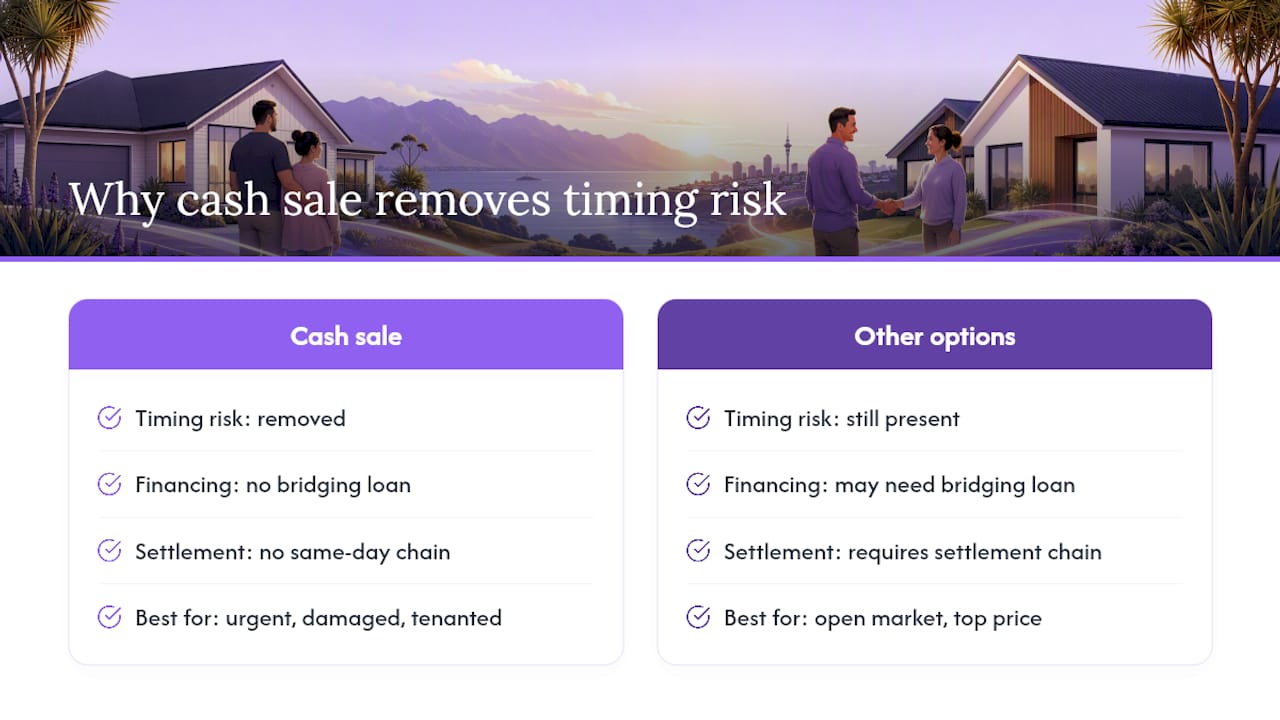
Every strategy above still carries some chance of a hiccup, whether that’s a bridging loan falling through underwriting or a settlement chain snapping at the worst possible moment. A guaranteed cash sale sidesteps all of it, because there’s no bridging finance to arrange and no same-day settlement chain to coordinate with strangers you’ve never met.
This suits a specific set of situations well: homeowners who need to sell urgently, properties that are damaged or difficult to finance conventionally, tenanted homes where a traditional sale process gets complicated, and anyone determined to avoid carrying two mortgages at once. It won’t always deliver the top dollar an open market campaign might, and that trade off is worth weighing honestly against how much timing risk you can actually absorb.
— Aaron
Removing the guesswork with Easysale
There are alternatives to bridging finance for homeowners who want to avoid the risk of a broken settlement chain, offering a fixed cash offer and a settlement date you actually choose.

The service works for properties in any condition, including damaged homes that traditional buyers avoid, tenanted properties, and inherited homes that need a straightforward sale without repairs or real estate commission eating into your proceeds. If you’re weighing this against a bridging loan, the comparison in principle is simple: bridging finance keeps your options open but adds interest cost and approval risk, while a cash sale trades some upside for near total certainty on timing. For readers who want more detail on how bridging structures work before deciding, Easysale’s guide to bridging finance breaks down the lender side further, and homebuyers still building their deposit picture might find Sorted Home Solutions’ first home buyer guide useful too.
Getting started with some services typically involves submitting property details online, receiving a no-obligation cash offer, then choosing a settlement date that suits your move. If timing risk is the thing keeping you up at night, that’s worth checking out before you commit to a bridging loan you might not need.

This article is general information, not a substitute for advice from a qualified financial advisor. Consult a qualified financial professional about your own circumstances before acting on anything here.
Sources
- A complete guide to bridging finance | Mortgages NZ
- Buying and selling a property | New Zealand Law Society
- The process for buying & selling a residential property in New Zealand | LegalPath
- Deposit details: what you must know before buying residential property in New Zealand | Harkness Henry
Recommended
