
Property sale timeline guide for Kiwi homeowners
TL;DR:Selling a property quickly in New Zealand involves understanding a process that typically takes three to four months from preparation to settlement. Properly preparing documents, pricing accurately, and managing conditional periods efficiently can significantly shorten the timeline and reduce costly delays. EasySale offers homeowners a faster, agent-free option with cash offers and flexible settlement, ideal for those needing certainty in their sale.
Selling your home quickly is rarely as simple as putting up a listing and waiting for offers. If you’re facing financial pressure, a relationship change, or a sudden need to relocate, navigating a property sale timeline guide that accounts for every stage becomes essential. Many New Zealand homeowners underestimate the full process, confusing “time on market” with the total time it takes to legally transfer a property. This guide breaks down every phase, from preparation to key handover, so you know exactly what to expect and how to move faster without making costly mistakes.
Table of Contents
- Understand the full property sale timeline
- Prepare thoroughly to speed up your sale
- Manage the offer and conditional period efficiently
- Navigate settlement and key handover with confidence
- Selling your property privately: tips for speed and success
- What most sellers get wrong about selling fast in NZ
- How EasySale helps Kiwi homeowners sell faster without agent fees
- Frequently asked questions
Key Takeaways
| Point | Details |
|---|---|
| Two-part timeline | Selling a house involves time to secure a buyer plus legal settlement stages, which add weeks beyond market listing time. |
| Preparation matters | Early organisation of documents and hiring a lawyer speeds up conditional checks and avoids delays. |
| Conditional period is crucial | Buyers conduct inspections and finance checks here; prompt responses help move to unconditional faster. |
| Settlement typically 4–6 weeks | Most private sales in NZ settle within this timeframe after going unconditional, with key handover on settlement day. |
| Private sales need effort | Skipping agents saves commission but requires managing marketing, disclosures, and negotiations yourself to avoid pitfalls. |
Understand the full property sale timeline
The most common misconception in the property selling process is treating it as a single event. In reality, it is a sequence of distinct stages, each with its own timeframe and potential for delay. Understanding property sale timelines means recognising that the clock starts well before a listing goes live and keeps ticking long after an offer is accepted.
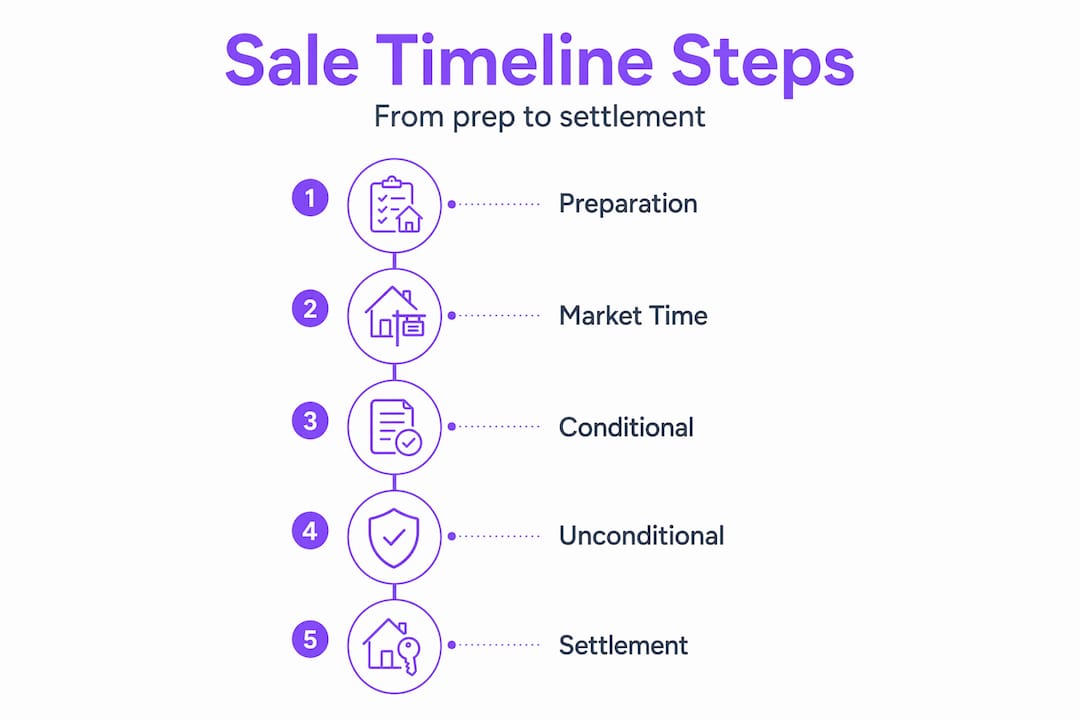
The four core stages of a home sale timeline are:
- Preparation: Gathering documents, legal checks, pricing research, and property presentation. This stage alone can take two to four weeks if you are starting from scratch.
- Market time: The period your property is actively listed and you are waiting for a suitable buyer.
- Conditional period: The buyer’s due diligence window after an offer is accepted, covering finance, inspections, and legal checks.
- Settlement: The legal transfer of ownership, coordinated by lawyers on both sides.
REINZ reports median time-on-market of about 56 days nationally, but that figure only covers how long your listing sits before an offer is accepted. Add preparation, the conditional period, and a typical six-week settlement, and you are realistically looking at three to four months for a standard sale.
| Stage | Typical duration |
|---|---|
| Preparation | 2–4 weeks |
| Market time | 4–8 weeks (median 56 days nationally) |
| Conditional period | 1–3 weeks (5–15 working days) |
| Settlement | 4–6 weeks |
| Total | Approximately 3–4 months |
Several factors shorten or extend this timeline. Pricing accuracy matters enormously. Overpriced properties sit longer on the market and attract fewer serious buyers. Sale method also plays a role: auction campaigns run on fixed four-week cycles, while private treaty sales are more open-ended. For rental properties, tenancy obligations and access arrangements add additional layers of scheduling. For a fuller breakdown of what drives each stage, the property sale process explained resource covers the legal mechanics in plain language.
Prepare thoroughly to speed up your sale
Preparation is the stage most sellers rush or skip, and it is where timelines most often blow out later. Getting organised before your listing goes live compresses every subsequent stage because buyers have fewer reasons to ask questions, request delays, or renegotiate.
Follow these steps to prepare effectively:
- Set a realistic price. Research recent comparable sales in your suburb. An accurately priced property generates more enquiries within the first two weeks, which is the period of highest buyer interest.
- Engage a lawyer or conveyancer early. Do not wait until you have an offer. Your lawyer will review the title, flag any easements or encumbrances, and prepare the sale and purchase agreement in advance.
- Order your LIM report. A Land Information Memorandum (LIM) from your local council confirms permitted uses, consents, and any outstanding issues. Having this ready removes a major buyer condition upfront.
- Commission a pre-sale building inspection. Buyers will likely order their own, but having yours available signals transparency and reduces the chance of surprise renegotiations after their inspection.
- Resolve obvious maintenance issues. Leaking taps, cracked cladding, and damaged fencing are the first things buyers flag as bargaining chips. Fixing them costs less than the discount they invite.
- Prepare tenancy documents if the property is tenanted. You will need written evidence of any fixed-term agreements and compliance with notice requirements under the Residential Tenancies Act.
Gathering documents early and working with a lawyer from the start helps avoid delays during conditional due diligence. This is especially important for private sales where no agent is managing the paperwork on your behalf.
Pro Tip: Order the LIM report and instruct your lawyer before you even set a listing date. The council can take up to 10 working days to issue a LIM, and waiting until a buyer asks for it adds unnecessary time to your conditional period.
For a complete walkthrough of the private selling process, the selling privately guide covers every legal requirement in detail. If you want to cut weeks off your total timeline, the fast-track property sale timeline guide identifies where most sellers lose time and how to recover it.
Manage the offer and conditional period efficiently
Once a buyer makes an offer and both parties sign the sale and purchase agreement, the conditional period begins. This is the stage most sellers treat as a waiting game, but your behaviour during this window directly affects how long it lasts.
Due diligence usually takes 5–15 working days and includes building inspections, LIM reports, finance approval, and legal title review. Common conditions in New Zealand property sales include:
- Finance approval: The buyer’s bank confirms their mortgage. This is the most frequent source of delays because lenders can request additional documentation.
- Building inspection: An independent inspector assesses the property’s condition. If issues arise, buyers may request repairs or a price reduction.
- LIM report review: The buyer or their lawyer reviews the council’s LIM for any compliance issues.
- Lawyer’s title review: Confirms the title is clear and the sale agreement meets legal requirements.
- Sale of existing property: Some buyers have a condition tied to selling their own home first, which introduces significant uncertainty.
Sellers who have all documentation ready at the start of the conditional period typically experience shorter turnarounds. Delays most often occur when a buyer requests a document the seller scrambles to locate, or when a building inspector finds something the seller knew about but did not disclose.
Pro Tip: Create a shared folder with your lawyer containing your LIM, building inspection, title document, and any council consents before the listing goes live. When a buyer’s lawyer emails requesting documents, you can respond within hours instead of days.

For a step-by-step breakdown of managing this stage, the selling home privately steps guide covers how to handle buyer queries, negotiate repairs, and keep the process on track. The private sale tips resource offers practical advice for sellers managing their own negotiations.
Navigate settlement and key handover with confidence
Settlement is the final legal transfer of your property. It sounds straightforward, but it involves coordinated action between your lawyer, the buyer’s lawyer, and both parties’ banks. Misunderstanding what happens on settlement day is one of the most avoidable sources of last-minute stress.
Settlement typically takes 4–6 weeks after going unconditional for private sales, with lawyers coordinating title and funds transfer, and keys handed over on settlement day. Cash sales and auctions can settle faster, sometimes in as little as two to three weeks.
| Settlement type | Typical timeframe after going unconditional |
|---|---|
| Private treaty sale | 4–6 weeks |
| Auction sale | 2–4 weeks |
| Cash buyer purchase | 1–3 weeks |
Here is what typically happens in the lead-up to and on settlement day:
- Your lawyer receives the purchase funds from the buyer’s lawyer or bank.
- The title is transferred and registered with Land Information New Zealand (LINZ).
- Your mortgage, if any, is discharged.
- Keys are handed over once funds are confirmed received, usually by midday.
- The pre-settlement inspection, which the buyer is entitled to carry out in the 24 hours before settlement, confirms the property is in the agreed condition.
Be available on settlement day. Your lawyer may need identity verification or a quick decision on a minor query. Sellers who are travelling or uncontactable on this day can delay the entire transfer.
Pro Tip: Confirm your bank account details with your lawyer at least one week before settlement day. Wrong account numbers cause fund transfer failures that can push settlement to the next business day, creating potential penalty interest liability.
For a detailed walkthrough of the final legal steps, the selling process steps guide explains what your lawyer handles and what you are responsible for.
Selling your property privately: tips for speed and success
Selling without an agent saves you commission, typically two to four percent of the sale price in New Zealand. On a $750,000 property, that is $15,000 to $30,000 staying in your pocket. But those savings come with real responsibilities that unprepared sellers often underestimate.
Private sale saves commission but shifts work and disclosure burden to the seller. Early lawyer involvement and accurate pricing are critical to avoiding costly mistakes. Here is what successful private sellers do well:
- Invest in professional photography. Listings with quality photos generate significantly more online enquiries. This is not an area to cut costs.
- Write a detailed, honest listing description. Include recent improvements, council rates, and known features. Buyers appreciate specificity.
- Disclose known issues in writing. Legally, you must not misrepresent the property’s condition. Disclosing issues upfront also reduces the chance of buyers using them as leverage during the conditional period.
- Respond to enquiries within 24 hours. Slow communication frustrates buyers and can push them toward other listings.
- Understand the legal requirements for your sale agreement. Your lawyer drafts this document. Do not use a template you found online without legal review.
Pro Tip: Set a clear process for conducting open homes. Have printed information packs ready with the LIM, title summary, and rates information. Buyers who can answer their own questions on the spot are more likely to make an offer.
For information on commission costs and whether they are worth paying, the agent commission explained guide breaks down what agents charge and what you actually receive in return.
What most sellers get wrong about selling fast in NZ
Here is the reality most property guides avoid saying directly: speed in a property sale is not about getting an offer fast. It is about getting an unconditional sale across the line quickly, and those are very different things.
Many sellers focus on getting an offer quickly but underestimate how conditional period delays and settlement logistics extend the full sale timeline. An offer that comes in on day ten of your listing is worth very little if it sits conditional for six weeks and falls over on finance.
The sellers who consistently achieve fast, clean sales share a few habits. They price accurately from day one rather than testing the market high and reducing later. They have their documentation ready before buyers ask for it. They stay engaged and responsive during the conditional period instead of assuming the sale is done.
There is also a common misunderstanding about private sales and speed. Selling privately does not automatically mean selling faster. Without agent marketing reach, your listing may attract fewer buyers, which extends market time. The advantage of a private sale is cost savings, not necessarily speed, unless you pair it with strong marketing and genuine preparation.
The sellers who run into trouble are those who rush pricing or skip legal steps to save money. Underpriced properties do sell faster, but they leave value behind. Properties with incomplete disclosures or missing documentation attract conditional buyers who then renegotiate or withdraw. Both outcomes defeat the purpose of wanting a quick, clean result.
If you want to build a timeline that actually works, the fast-track sale timeline guide identifies the specific decision points where sellers gain or lose weeks.
How EasySale helps Kiwi homeowners sell faster without agent fees
If managing the stages of property selling feels overwhelming, or if your timeline simply cannot accommodate months of preparation, open homes, and conditional waiting periods, there is a more direct path available.
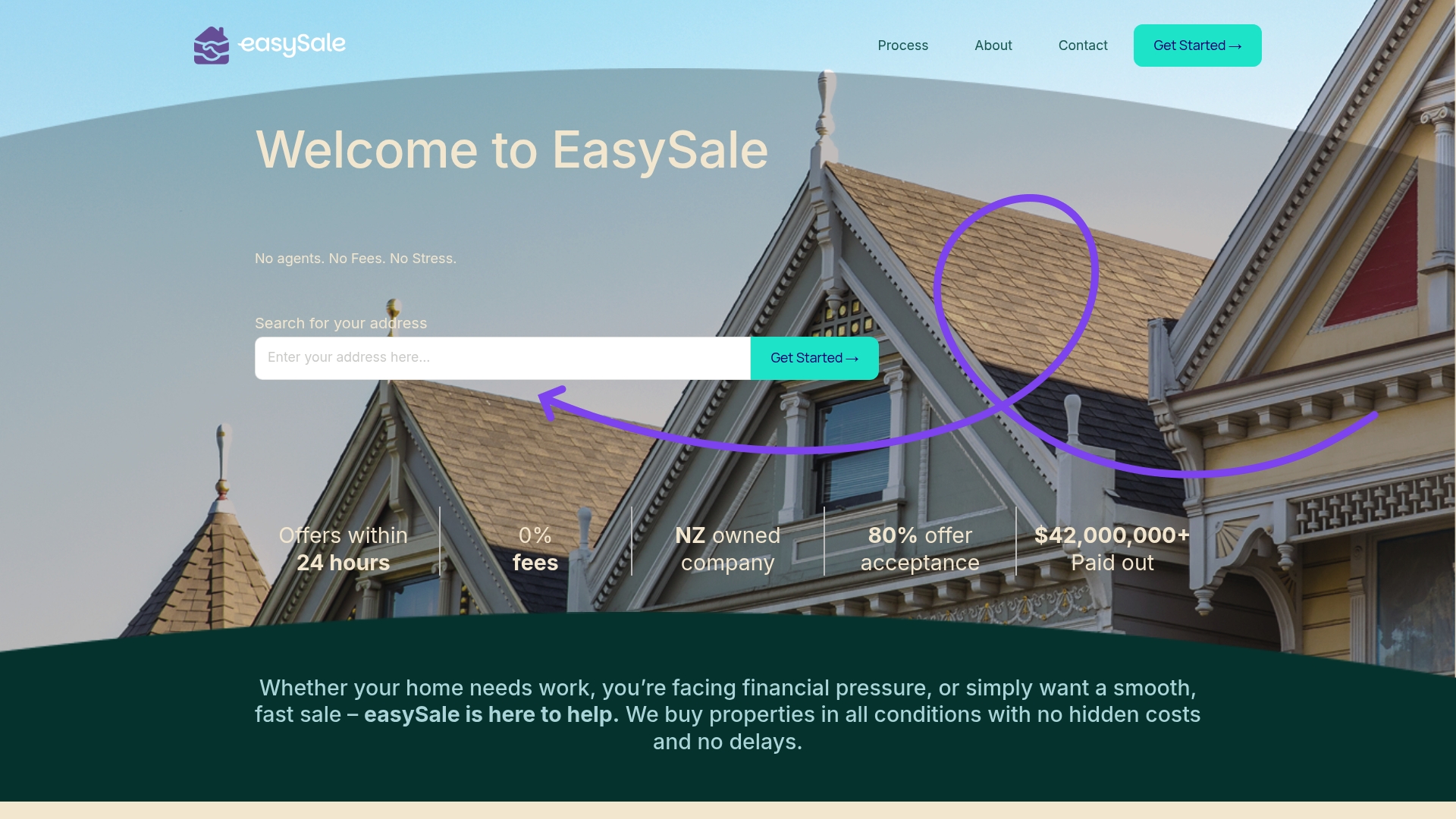
EasySale provides New Zealand homeowners with fast, fair cash offers and no agent commission. The process is designed for people who need certainty and speed, whether you are dealing with financial pressure, a damaged property, a relationship breakdown, or a retirement decision. If you are considering a retirement and downsizing house sale or need to sell a property that needs significant repairs, EasySale also buys damaged houses as-is, meaning you avoid costly pre-sale work entirely. There are no open homes, no lengthy conditional periods, and no commission fees eating into your proceeds. You submit your property details, receive a no-obligation offer, and settle on a timeline that suits your situation.
Frequently asked questions
How long does it usually take to sell a house in New Zealand?
On average, it takes about 56 days to find a buyer nationally, but completing the full sale including legal processes often adds several weeks beyond that. Timing varies depending on the property, location, and sale method you choose.
What is the conditional period in a property sale?
It is the timeframe when the buyer completes checks like finance approval, building inspections, LIM reports, and legal review. Conditional due diligence typically lasts 5–15 working days, and having documents ready from the start helps keep it on the shorter end.
Can I sell my property privately without a real estate agent in New Zealand?
Yes, and many Kiwis do successfully. Private selling requires legal work and owner-managed marketing, so engaging a lawyer early and pricing accurately are both essential to avoiding costly delays.
How long does settlement usually take after going unconditional?
Private sale settlement generally spans 4–6 weeks from when the sale becomes unconditional to the final funds transfer and key handover, with cash sales often completing faster.
What are the risks of selling a house quickly without an agent?
You take on all marketing, negotiation, and disclosure responsibilities yourself. Private sales shift marketing and disclosure burden to sellers and carry a risk of a lower sale price or delays if preparation and legal compliance are not handled carefully.
Recommended
