
Buying and selling houses at the same time in NZ

Yes, you can buy and sell a house at the same time in New Zealand, but doing it safely means getting your finances confirmed before you get emotionally attached to either transaction. The order you tackle things in matters more than most homeowners realise. Before you list, make an offer, or sign anything, three moves cut your risk dramatically:
- Get mortgage pre-approval so you know your real budget and borrowing limit.
- Book a consultation with a solicitor to review contract wording before you sign.
- Decide your route: sell first, buy first with a condition, or use a bridging loan (open or closed).
Get these three sorted and you’re negotiating from a position of strength, not scrambling to catch up once an agreement is already signed.
Key Takeaways
Buying and selling houses at the same time works best when mortgage pre-approval and a solicitor review happen before any contract gets signed.
| Point | Details |
|---|---|
| Pre-approval comes first | It fixes your budget and strengthens your negotiating position before you list or offer. |
| Closed bridging beats open bridging | Lenders approve closed bridging more readily because the sale date is confirmed. |
| Match your contract dates | Align condition, unconditional, and settlement dates across both agreements. |
| Build a contingency fund | Set aside cash for penalty interest or temporary housing if settlements misalign. |
| Consider Easysale for certainty | A cash offer from Easysale removes settlement timing risk entirely for sellers under pressure. |
Table of Contents
- Can you buy and sell houses at the same time? Three routes to choose from
- How do lenders assess bridging finance and pre-approval?
- What settlement timeline should you plan for?
- What happens when a simultaneous settlement goes wrong?
- What’s the week-by-week plan for buying and selling together?
- When does a guaranteed sale beat waiting on the market?
- Why the safest plan isn’t always the popular one
- Sell now instead of juggling two settlements
- Frequently asked questions
- Sources
Can you buy and sell houses at the same time? Three routes to choose from
There’s no single “right” way to buy and sell houses at the same time. Which route suits you depends on your risk tolerance, your equity, and how tight the local market is.
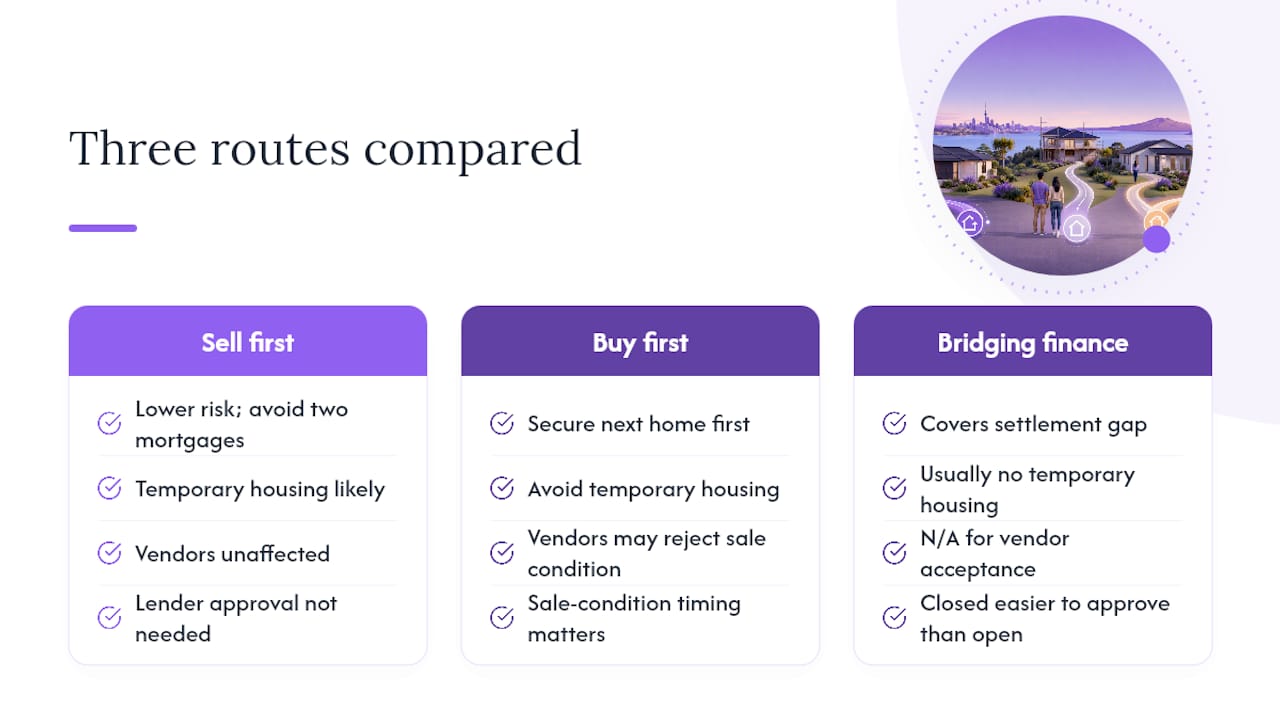
Selling first is the lower-risk option. You know exactly what you’ve got to spend, and you avoid carrying two mortgages. The trade off is you might need temporary housing, whether that’s staying with family, renting short term, or negotiating a longer settlement with your buyer to give yourself breathing room.
Buying first with a sale condition lets you secure your next home before letting go of your current one. You write a condition into the purchase agreement stating the deal only proceeds once your existing property sells by a set date. Vendors don’t always love this clause, especially in a hot market, so timing the condition period tightly matters.
Bridging finance covers the gap when you need to settle a purchase before your sale settles. Closed bridging (where your sale date is confirmed) is far easier to get approved than open bridging, where the sale date is still unknown, according to MoneyHub’s bridging finance guide. Read more on what a bridging offer looks like in practice before you commit.
Pro Tip: Ask your agent to negotiate a longer settlement on your sale (say, six weeks instead of four) rather than a shorter one on your purchase. Extra time on the sale side is usually easier to win than extra time on the purchase side.
How do lenders assess bridging finance and pre-approval?
Pre-approval should be your very first call, not an afterthought once you’ve found a house. It fixes your budget and turns you into something close to a cash buyer at the negotiating table, which the team at Buddy Mortgages point out makes a real difference when you’re up against other buyers.
Lenders in New Zealand look hard at whether you can service both loans at once, even if only for a short period. That’s the serviceability check, and it’s where a lot of bridging applications stall.
- Closed bridging (confirmed sale date) is treated as lower risk and is easier to get approved.
- Open bridging (no confirmed sale date) faces tighter scrutiny and is often declined outright, per MyMortgage’s 2024 overview.
- Bridging loans are typically interest-only, which keeps repayments lower but means the principal is still sitting there waiting to be cleared.
Pro Tip: A mortgage broker can model exactly how many months you could sustain two loans before it becomes financially painful. Ask for that number before you sign anything.
Both ASB and BNZ publish guidance confirming this: banks want to see you can genuinely meet repayments on both loans, not just one. If the numbers don’t stack up comfortably, that’s your signal to lean toward selling first instead.
What settlement timeline should you plan for?
Private sales in New Zealand typically settle four to six weeks after going unconditional. Auction sales move faster, often three to four weeks, while extended settlements can stretch two to three months or longer, according to Lifetimes’ property settlement guide.
The trick to coordinating both transactions is matching key dates across your sale and purchase agreements: conditions due, going unconditional, and settlement day. Solicitors consistently recommend aligning these deadlines rather than leaving a gap between them, as outlined by Collins and May Law.
In the final six weeks before settlement, work through this order:
- Confirm loan documents are signed and finalised with your bank.
- Instruct your solicitor to prepare transfer documents for both properties.
- Book your pre-settlement inspection on the property you’re buying.
- Submit any KiwiSaver first-home withdrawal paperwork early, it takes longer than people expect.
- Confirm moving day logistics and lock in a removalist.
- Reconfirm settlement figures with your solicitor two to three days out.
- Keep your agent and solicitor updated the moment either contract date shifts.
- Build in at least a few days’ buffer between your sale settlement and purchase settlement if the contract allows it.
Getting to settlement day fast matters just as much as getting there safely. There’s a full checklist for settling property quickly in New Zealand if you want the granular version.
What happens when a simultaneous settlement goes wrong?
Contemporaneous settlement, selling and buying on the same day, is where things get genuinely risky. If the chain breaks anywhere (a delayed bank transfer, an overseas buyer’s funds arriving late, a solicitor’s error), you can be left holding two unsettled transactions at once.
Davenports Law documented a New Zealand case where penalty interest accumulated at roughly $961 a day after a settlement chain failed. That’s not a hypothetical scare story. It’s what happens when the money you’re relying on from your sale doesn’t land in time to fund your purchase.
A single link failing anywhere in the chain, whether it’s your buyer’s finance, an overseas transfer, or a solicitor’s processing delay, can trigger daily penalty interest on both sides of the deal until the mess is sorted.
Practical mitigations that actually work:
- Keep a contingency fund set aside specifically for penalty interest or short-term accommodation.
- Ask your solicitor whether using the same solicitor for both transactions is appropriate. It can help coordinate timing, though you’ll need to check for any conflict of interest first.
- Avoid agreeing to same-day settlement unless your buyer’s finance is rock solid and confirmed in writing.
- If the numbers or timing feel shaky, pause and consider selling first instead. It’s a slower path, but a far safer one.
What’s the week-by-week plan for buying and selling together?
Break the process into three stages rather than trying to hold the whole timeline in your head at once.
Week 0 to 1: Get mortgage pre-approval sorted, instruct a solicitor, and get a realistic appraisal of what your current home will sell for. This is the foundation everything else sits on.

Week 2 to 4: List your property or make an offer on your next one. Set matching condition and settlement deadlines across both contracts. If you need bridging finance, confirm terms with your lender now, not later.
Week 4 to 6: Sign loan documents, finalise transfers with your solicitor, and lock in movers and short-term housing if there’s any gap between settlement dates.
Pro Tip: Keep a minimum contingency fund equal to a few weeks of double mortgage repayments plus moving costs. If you can’t comfortably set that aside, that’s your cue to slow down or switch to selling first.
When does a guaranteed sale beat waiting on the market?
Bridging finance and conditional contracts work well when your numbers are solid and your timing has some flexibility. But if you’re under mortgage pressure, relocating urgently for work, dealing with a property that needs repairs you can’t afford, or going through a separation, waiting on a traditional sale process adds risk you may not be able to absorb.
This is where Easysale offers a genuinely different option. Rather than juggling open home schedules, buyer finance conditions, and an uncertain settlement date, you get a cash offer on your property as is, with no agent commissions and a settlement date that suits your timeline, not the market’s.
- No repairs, staging, or waiting on buyer finance to fall through.
- Settlement can be arranged around your purchase timeline instead of the reverse.
- Works for damaged, tenanted, unconsented, or inherited properties that traditional buyers often avoid.
| Point | Details |
|---|---|
| Certainty over speed of market | A cash offer removes the guessing game around when your home will actually sell. |
| Fits urgent situations | Suits sellers facing mortgage pressure, relocation, or property condition issues. |
| No agent fees or repairs | You sell as is, without commission costs eating into your proceeds. |
Weigh this against bridging finance by asking one honest question: can you comfortably service two loans for two to three months if your sale drags on? If the answer is no, a guaranteed cash sale might beat the uncertainty of the open market. You can see how a fast cash sale works in practice if you want to compare it against your current options.
Why the safest plan isn’t always the popular one
Most advice on buying and selling houses at the same time treats bridging finance as the default clever move. It isn’t. The research here points to something plainer: closed bridging works because it removes uncertainty, not because bridging itself is smart. Open bridging exists mostly on paper, lenders are wary of it for good reason, and chasing it wastes weeks you don’t have.
What gets underweighted is the psychological cost of a contemporaneous settlement. The $961-a-day penalty interest case from Davenports Law isn’t rare because the mechanics are unusual, it’s rare because most people never plan for the chain to break. Build the contingency fund before you need it, not after.
If there’s one thing worth prioritising above all else, it’s getting your solicitor to review both agreements before either gets signed. Everything else, the pre-approval, the settlement dates, the bridging terms, sits downstream of that one check. Skip it and you’re negotiating blind.
Sell now instead of juggling two settlements
If the bridging finance, matching contract dates, and contingency planning above feel like more risk than you want to carry, there’s a simpler path. Easysale buys your property directly, in whatever condition it’s in, without agent commissions or repair demands. That means no waiting on a buyer’s finance to clear, no open homes competing with your own moving schedule, and a settlement date built around when you actually need to move, not when the market decides.
This suits Kiwis dealing with mortgage pressure, urgent relocation, or a property that’s simply too hard to sell the traditional way. Get in touch with Easysale for a no-obligation cash offer and find out your settlement date within days, not months.
Frequently asked questions
Can you buy a new house before selling your current one in NZ? Yes, using a bridging loan or a purchase condition tied to your existing sale. Closed bridging, where your sale date is confirmed, is far easier to get approved than open bridging.
How long does bridging finance last? Bridging loans are short term and interest only, typically covering the gap between settling your purchase and settling your sale, which is usually a matter of weeks rather than months.
What happens if my sale falls through after I’ve bought a new house? This is the scenario contingency planning exists for. Keep a cash buffer for extended bridging costs or penalty interest, and talk to your solicitor about extension clauses before you sign anything.
Is it better to sell first or buy first? Selling first is lower risk because you know your exact budget and avoid carrying two loans. Buying first suits people confident in their sale prospects and comfortable with some financial exposure in the meantime.
Does Easysale help if I need to sell fast to buy elsewhere? Yes. A cash offer settles on a timeline you choose, which removes the uncertainty of waiting on a traditional buyer’s finance or a drawn-out market sale.
This article is general information, not a substitute for advice from a qualified financial advisor. Consult a qualified financial professional about your own circumstances before acting on anything here.
Sources
- Bridging finance explained — MoneyHub
- 3 key benefits of getting a pre-approval — Buddy Mortgages (NZ)
- Bridging finance in New Zealand — MyMortgage
- Buying and selling a property on the same day — Collins and May Law
Recommended
