
24–48 hour offers, 7 days to settle: NZ stages to sell a house as is

If you need a fast, as-is sale, the process runs through three clear stages: submit your property details, accept a no-obligation cash offer, and settle on a timeline that suits you. Offers typically arrive within 24–48 hours, and settlement can take as little as a week. Before you sign anything, you still need to disclose known issues and use a lawyer or conveyancer to prepare the Sale and Purchase Agreement.
TL;DR:Cash sale offers typically arrive within 24–48 hours, with settlement possible in as little as seven days if both parties agree.Sellers should disclose any known issues and use a proper legal agreement to protect against future liabilities, even in a quick sale.A genuine cash offer rarely has conditions, with price and settlement date being the key components, offering certainty over maximum value.Proper legal review and early coordination with a lawyer are essential to manage risks and ensure the buyer’s funds are secure in trust accounts.The discounted price reflects repair costs, holding costs, and risk premium, making it suitable when speed, certainty, or minimal effort outweigh top-dollar in value.
EasysaleSell Your Property With Less HassleEasysale helps New Zealand homeowners receive a fast, fair cash offer and choose a settlement timeline that suits their circumstances.Submit your property details
Table of Contents
- What are the stages of buying and selling a house to a cash buyer?
- Stage 1: what to prepare before you submit your property
- How do you compare and evaluate a cash offer?
- What legal steps protect you in a private cash sale?
- What happens on settlement day?
- Why are cash offers discounted, and when is it worth accepting?
- What questions should you ask a cash buyer before signing?
- Managing the legal and settlement process on a tight deadline
- What risks come with a fast cash sale, and how do you manage them?
- Why this route suits sellers who need certainty over top dollar
- How easySale fits into a fast, as-is sale
- Primary sources and practical further reading
- Sources
- FAQ
What are the stages of buying and selling a house to a cash buyer?
The traditional home sale drags through weeks of marketing, open homes and drawn-out negotiations. A cash, as-is sale strips that back to six practical stages, each one faster than its market equivalent.
- Initial enquiry — you submit your address, photos and a brief description of the property’s condition.
- Assessment — the buyer reviews your details, checks the title, and may arrange a short call or site visit.
- Offer — you receive a no-obligation cash price, usually within 24–48 hours.
- Negotiation and acceptance — you ask questions, clarify terms, and accept if the numbers work.
- Legal documentation — your lawyer or conveyancer prepares and checks the Sale and Purchase Agreement.
- Settlement — funds transfer, title changes hands, and you hand over the keys.
You handle the first and fourth stages directly. Your lawyer carries most of the weight in stages five and six. The flexibility shows up in timing: some sellers want settlement in a week, others need six weeks to organise a move, and a genuine cash buyer will work around either.
Stage 1: what to prepare before you submit your property
Cash buyers move quickly because they don’t need a full listing package, but they still need enough information to make an informed offer. The clearer your submission, the faster the assessment.
- Address and basic details — full address, land size, and number of bedrooms and bathrooms.
- Clear photos — recent images of each room, the exterior, and anything that needs repair.
- Condition summary — a short, honest note on structural issues, weathertightness concerns, or deferred maintenance.
- Mortgage and tenancy status — whether the property is mortgaged, tenanted, or vacant.
- Reason for timeline — relocation, separation, estate settlement, or simply wanting speed.
Most assessments start with a photo review and a title check, followed by a short phone call. A site visit usually only happens if the buyer needs to confirm something specific, like the extent of water damage or an unconsented addition.
Pro Tip: Pull together your rates notice, title documents, and a basic chattels list before you submit. It shaves days off the assessment because the buyer isn’t chasing paperwork after the fact.
How do you compare and evaluate a cash offer?
A genuine cash offer has three components: the price, the settlement window, and any conditions attached. Most direct-buyer offers carry few or no conditions because there’s no finance clause to satisfy. That’s the core difference between this route and a mortgage-backed buyer, who might still need bank approval weeks after you’ve accepted their offer.
- Price — a firm figure, not subject to a bank valuation or last-minute renegotiation.
- Settlement window — a proposed date, often flexible to suit your circumstances.
- Deposit terms — how much is paid and when, and where it’s held.
- Conditions (if any) — genuine cash offers usually have none, or very few.
An “as is, where is” sale means you’re not offering warranties about the property’s condition. The buyer takes on the due diligence risk instead of asking you to fix things first, which is exactly why the price sits below market value.
The trade-off comes down to certainty versus size. A market sale might net a higher headline figure, but it can take months, fall through at finance stage, or demand thousands in repairs before it ever reaches an open home. A cash offer trades some of that upside for a fixed number and a fixed date. If your priority is knowing exactly what you’ll have and when, that trade usually makes sense.
What legal steps protect you in a private cash sale?
New Zealand law doesn’t relax your disclosure duty just because you’re selling privately and quickly. If you know about a problem, you need to say so.
- Disclose known issues. Sellers must tell buyers about anything they’re aware of that affects the property, including weathertightness and structural defects. Failing to disclose known issues can lead to legal action after settlement, even in a fast, as-is deal.
- Use a proper agreement. An ADLS template or a lawyer-prepared Sale and Purchase Agreement sets out price, chattels, and settlement date clearly, so there’s no ambiguity later.
- Deposit in trust. Your lawyer or conveyancer holds the buyer’s deposit in a trust account rather than handing it to either party directly.
- Identity and title checks. Conveyancers verify identity and manage the title transfer, which protects both sides from fraud.
Selling privately still carries commission-free savings, but the legal and conveyancing fees remain your responsibility — budget for them rather than assuming a cash sale means zero costs.
The most common pitfall isn’t a dishonest buyer. It’s a seller who skips proper legal review because the process feels informal, then discovers a clause they didn’t understand after settlement’s already happened.
What happens on settlement day?
Settlement is the mechanical end point: the buyer’s funds move, the title transfers into their name, and you hand over the keys. Your lawyer coordinates the money side; you handle the physical handover.
Cash buyers commonly settle within 7 to 30 days of an accepted offer, though a genuine buyer will negotiate a later date if you need more time to pack up or find your next place.
Before the day arrives, work through a short checklist:
- Take final meter readings for power, gas and water.
- Do a last walkthrough to confirm the property matches what was agreed.
- Gather every set of keys, garage remotes and access fobs.
- Cancel or transfer homeowners insurance, and redirect your mail.
- Confirm with your lawyer that settlement funds have cleared before you vacate.
Why are cash offers discounted, and when is it worth accepting?
Cash buyers price in three things: the cost of any repairs, the carrying cost of holding the property while they resell or renovate it, and a margin for the risk they’re taking on. That’s why an as-is offer sits below what a fully renovated home might fetch on the open market.
- Repairs and holding costs come straight off the top of the offer.
- A renovation-and-relist strategy only pays off if you have the time, cash flow and appetite for the disruption.
- Selling as-is suits situations where speed, certainty or minimal effort outweigh chasing the last few dollars of value.
A simple way to test whether a cash offer works for you: estimate what repairs would cost, add the holding costs of a longer market campaign, and compare that total against the gap between the cash offer and a realistic market price. If the repair-and-time bill eats most or all of that gap, the as-is sale is usually the smarter move.
Pro Tip: Don’t just compare the cash offer to your rateable value. Compare it to what you’d actually pocket after repairs, agent commission, and months of mortgage or holding costs on a traditional sale.
What questions should you ask a cash buyer before signing?
Not every buyer offering “cash for houses” operates the same way, and a few sharp questions separate the legitimate ones from the ones chasing a quick signature.
- Ask for proof of funds. A genuine buyer can show they have the money ready, not just a verbal promise.
- Ask where the deposit will sit. It should go into a solicitor’s trust account, never directly to the buyer.
- Ask who covers legal fees. Some buyers contribute toward your conveyancing costs; confirm this before you commit.
- Ask about settlement flexibility. A buyer who won’t budge on the date at all may be more rigid than they first appeared.
- Get everything in writing. Price, settlement date, included chattels and any exclusions should all sit in the signed agreement, not a text message.
Red flags worth walking away from include pressure to sign within hours, resistance to using a solicitor’s trust account, or contract wording that’s vague about the final price. A buyer confident in their offer won’t rush you past your lawyer’s review.
Managing the legal and settlement process on a tight deadline
Speed is the whole point of an as-is cash sale, but speed without coordination creates its own problems. The fix isn’t cutting corners. It’s lining up the right people before you need them.
Engage your lawyer or conveyancer the moment you’re seriously considering an offer, not after you’ve accepted it. A lawyer briefed early can safeguard your deposit, verify the buyer’s identity, and check the agreement’s terms while the offer is still being finalised, rather than scrambling once a settlement date is already locked in.
Set a shared timeline with your buyer and your lawyer at the same time, so everyone is working from the same dates. If you’re also coordinating a move, notify utility providers, insurers and, where relevant, Kāinga Ora or your bank early, since these steps often take longer than the sale itself.

Keep a single point of contact on each side. In a fast transaction, confusion over who’s responsible for what, tenancy notices, insurance cover, or final inspections, causes more delay than any legal complexity. If your settlement date is genuinely tight, tell your lawyer up front so they can flag any step that risks slipping, rather than discovering it three days out.
A well-run fast sale usually looks calm from the outside because the coordination happened early, not because nothing complicated came up.
What risks come with a fast cash sale, and how do you manage them?
The speed that makes a cash sale attractive also means less time to catch problems, so it pays to know where the real risks sit.
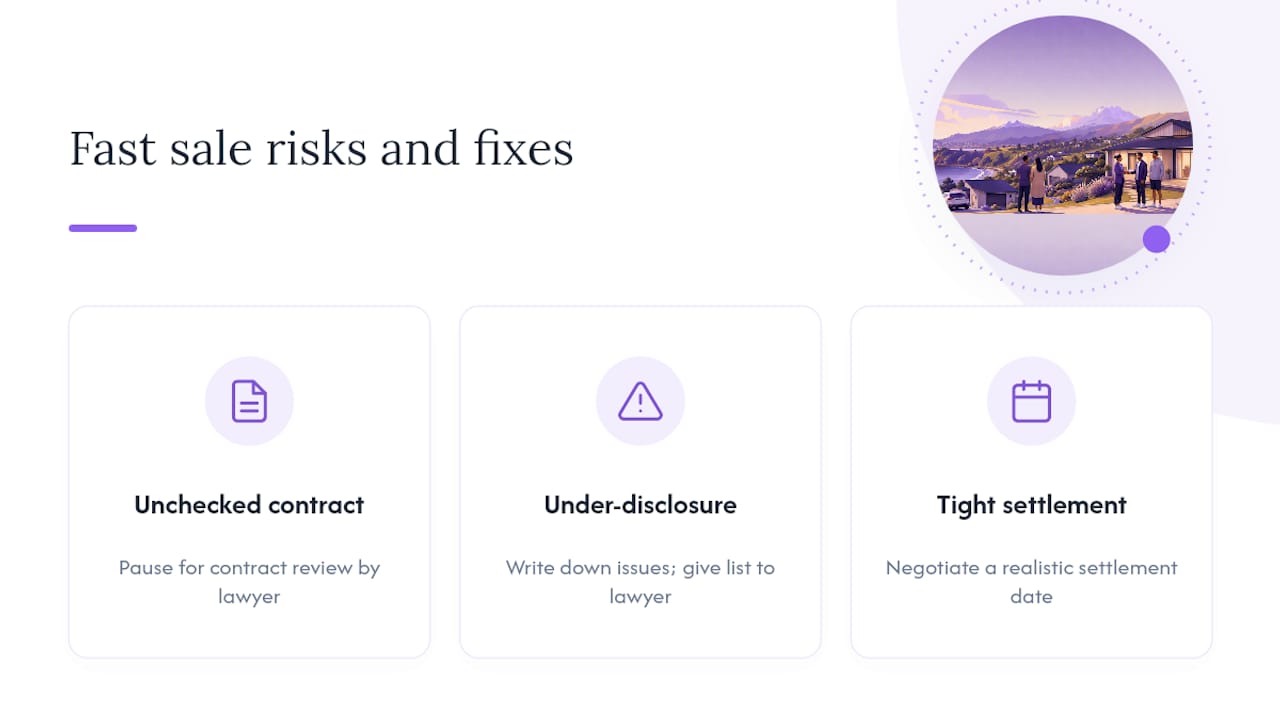
The biggest risk isn’t the buyer disappearing. It’s signing an agreement before you’ve had it properly checked. A rushed signature on unclear chattels terms, an ambiguous settlement clause, or a deposit arrangement that skips a trust account can cost you far more than the discount you accepted on price.
A second risk is under-disclosure. In the rush to move quickly, sellers sometimes gloss over a known issue rather than actively hiding it, and that’s still a breach of the disclosure duty that applies to every private sale in New Zealand. Write down every issue you’re aware of and hand that list to your lawyer before the agreement is drafted.
A third risk is accepting a settlement date that doesn’t actually work for you, then scrambling to vacate. Negotiate the date honestly at offer stage rather than agreeing to something tight just to close the deal faster.
Mitigating all three comes down to the same habit: slow down at exactly the two points that matter, the disclosure conversation and the contract review, even while the rest of the process moves fast. A cash sale can still be quick without being reckless.
Why this route suits sellers who need certainty over top dollar
Most sellers who choose this path aren’t chasing the highest possible number. They’re dealing with separation, debt, an inherited property, or a move that can’t wait for a six-week market campaign, and what they need most is a firm date and a firm price.
The legal safeguards don’t disappear just because the sale is fast. A lawyer holding your deposit in trust and checking your Sale and Purchase Agreement protects you exactly as much in a 10-day settlement as it would in a 10-week one. Speed and legal protection aren’t in tension. They just require you to line up your lawyer earlier than you might in a traditional sale.
— Aaron
How easySale fits into a fast, as-is sale
Everything covered above, the submission, the offer, the legal steps, the settlement, maps directly onto how easySale operates. Its process runs on three steps: you submit your property details, you receive a no-obligation cash offer, and you settle on the timeline that works for you, whether that’s next week or next month.

The service buys properties in various conditions across New Zealand, including damaged, unconsented, tenanted or inherited homes, without involving agents, commissions, or requiring repairs. That matters most for sellers facing exactly the situations covered in this guide: a damaged property that needs an as-is sale, a separation that needs a quick, discreet resolution, or a deadline that means you need to settle within 7 days.
Before you accept any offer, from easySale or anyone else, ask for proof of funds and get your lawyer to review the agreement. That’s not a formality; it’s the same protection covered in the legal steps above. If you’re ready to see what your property could fetch, submit your details for a no-obligation offer and decide from there whether it fits your timeline.
Primary sources and practical further reading
For the legal detail behind this guide, Settled.govt.nz’s page on selling privately covers your disclosure duty in full, and the official government guide to selling your house walks through the legal steps in more depth.
If you want a companion checklist for the private sale process, this step-by-step guide and easySale’s FAQ page both cover common seller questions before you start.
This article is general information, not a substitute for advice from a qualified lawyer. Consult a qualified legal professional about your own circumstances before acting on anything here.
Sources
FAQ
Do I have to disclose defects when selling as-is?
Yes. New Zealand law requires you to disclose known issues such as weathertightness or structural defects even in an as-is sale, because “as is” shifts due diligence to the buyer rather than removing your disclosure duty.
How fast can I actually settle on a cash sale?
Cash offers commonly arrive within 24 to 48 hours of assessment, with settlement following in as little as 7 days when both parties agree, though many sellers negotiate a later date to suit their move.
Will I still pay any fees if I avoid an agent?
You avoid agent commission entirely, but you’re still responsible for legal or conveyancing fees to transfer the title properly.
What does easySale charge to make an offer?
easySale doesn’t charge sellers a fee to submit details or receive an offer; current pricing and process details are outlined on its FAQ page.
How do I know a cash buyer is legitimate?
Ask for proof of funds, confirm the deposit will sit in a solicitor’s trust account, and insist on a proper Sale and Purchase Agreement reviewed by your own lawyer before you sign anything.
Recommended
