
How to settle property quickly in New Zealand

TL;DR:Needing to settle property quickly is common among homeowners facing various pressures, and understanding the process can significantly reduce delays.The conditional phase, where most delays occur, can be shortened by pre-arranging legal advice, documentation, and inspections, especially with cash offers.
Needing to settle property quickly is more common than many homeowners realise. Whether you are facing financial pressure, a relationship breakdown, a job relocation, or simply an inherited property you need to move on from, the clock can feel like it is working against you. The good news is that the settlement process in New Zealand has clear steps, and knowing how to move through them efficiently can make a genuine difference. This guide covers what to know about property settlement in New Zealand, including how to cut delays, what to prepare, and which options give you the fastest path forward.
Table of Contents
- Key takeaways
- How to settle property quickly: understanding the process
- Cash offers and unconditional sales
- Steps to prepare for a fast settlement
- Common pitfalls that delay settlement
- What happens on settlement day
- My perspective on fast settlement in New Zealand
- Sell fast with Easysale
- FAQ
Key takeaways
| Point | Details |
|---|---|
| Conditional period is the key bottleneck | The conditional phase of 5–10 working days is where most delays occur and where your focus should be. |
| Cash offers speed up settlement dramatically | A cash buyer can make an offer within 24–48 hours and settle in as little as 7 days. |
| Preparation before signing saves time later | Getting legal advice, finance pre-approval, and documents ready before you accept an offer keeps things moving. |
| Settlement day has a precise sequence | Funds transfer, title registration, and key handover follow a fixed order, usually completing by midday. |
| Your conveyancer is your greatest asset | A proactive lawyer or conveyancer can resolve issues and negotiate extensions before they become major delays. |
How to settle property quickly: understanding the process
Before you can speed anything up, you need to understand what you are actually working with. In New Zealand, a property sale follows two main phases after a buyer and seller agree on price and terms.
The first is the conditional period. This is the stretch of time where the buyer completes their due diligence. That typically includes arranging finance approval, conducting a building inspection, ordering a Land Information Memorandum (LIM) report, and sometimes arranging a registered valuation. The conditional period is typically 5–10 working days, and settlement cannot proceed until all conditions are satisfied or formally waived.
The second phase begins when the contract goes unconditional. This means every condition has been met, and the agreement becomes legally binding on both parties. Going unconditional triggers the settlement countdown, after which the agreed settlement date becomes fixed. Most delays that frustrate sellers happen in that first phase. Finance approvals take longer than expected. Building inspectors are booked out. LIM reports from council can take several working days to arrive. Most delays occur between acceptance and going unconditional due to these exact factors.
Pro Tip: If you are keen to move quickly, ask prospective buyers upfront whether they have finance pre-approved and what their inspection timeline looks like. A buyer who is organised shortens your conditional period significantly.
The distinction matters because the biggest speed lever is moving quickly from conditional to unconditional. Effort spent on the settlement day mechanics has far less impact on your overall timeline than getting through that conditional phase fast.
Cash offers and unconditional sales
If speed is your priority, this is where the real gains are. A cash offer from a buyer who does not require bank finance removes the biggest single cause of conditional period delays. There is no mortgage approval to wait on, no valuation required by a lender, and no risk of the deal falling over because a bank said no.

Cash buyer transactions can reduce settlement timelines to as little as 7 days, with offers made within 24–48 hours. For a homeowner under genuine time pressure, that is a substantial difference compared with the median time on market of approximately 56 days nationally for a traditional sale.
Here is a comparison of typical settlement timelines by offer type:
| Sale type | Typical offer to settlement time | Key conditions involved |
|---|---|---|
| Traditional financed sale | 4–8 weeks | Finance, building inspection, LIM, valuation |
| Conditional cash sale | 2–3 weeks | Building inspection, LIM |
| Unconditional cash sale | 7–14 days | None (or minimal) |
| Direct cash buyer (e.g. Easysale) | 7 days from offer | No agent, no inspections required |
An unconditional offer means the buyer agrees to purchase without attaching any conditions at all. There is no conditional period. The contract is binding from the moment both parties sign. This is the fastest possible path in a traditional sale context. You can read more about how unconditional offers work if you want a deeper understanding before you negotiate with buyers.
The trade-off with cash and unconditional offers is usually price. Buyers accepting more risk and committing without conditions will typically offer less than a buyer who has done their due diligence first. That is a decision only you can make based on your circumstances. For some sellers, a slightly lower price in seven days is worth far more than a higher price in eight weeks.
Pro Tip: If you are considering an unconditional offer, always get independent legal advice before signing. Your lawyer can review the contract and make sure you are protected, even on a fast timeline.
Steps to prepare for a fast settlement
A fast settlement does not happen by accident. It happens because the seller has already done most of the groundwork before a buyer is even in the picture. Here is how to set yourself up to move quickly.
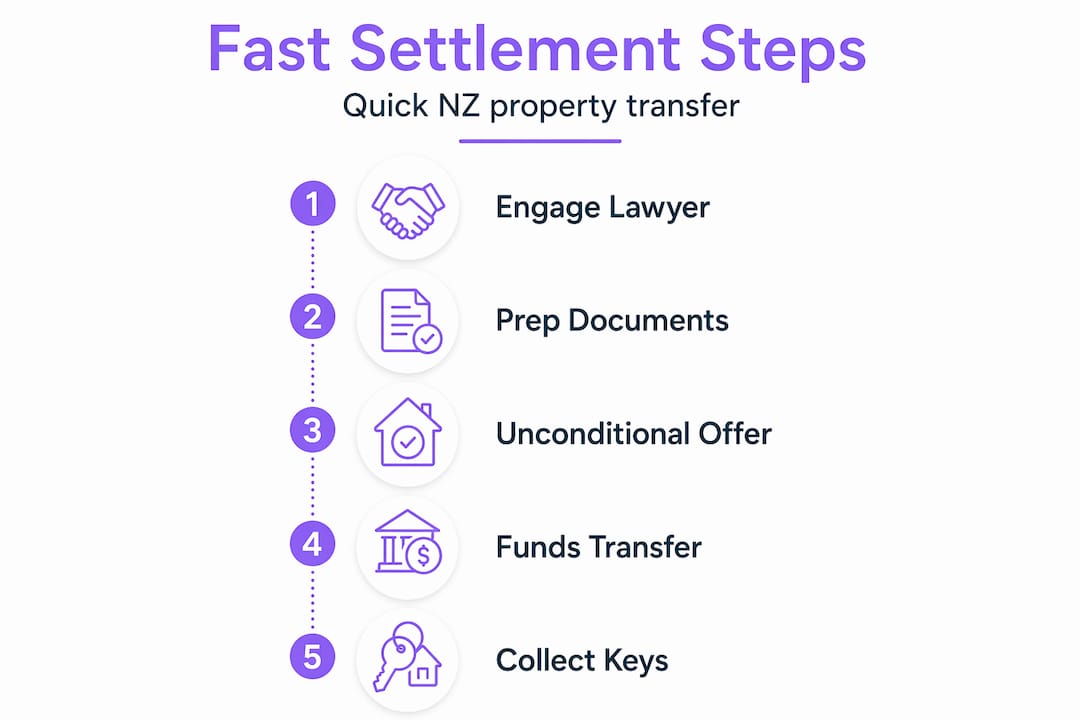
- Get legal advice early. Engage a property lawyer or conveyancer before you list or accept any offer. They can review your title, identify any encumbrances, and flag potential issues that could stall settlement later. Waiting until after you sign costs you time.
- Gather your documents. Compile your property title details, rates notices, insurance documents, and any tenancy agreements well in advance. Your lawyer will need these, and missing documents are a common cause of last-minute delays.
- Order a LIM report yourself. Councils take varying amounts of time to process LIM requests. If you have a LIM ready to provide to buyers, you remove one of the most common conditional period delays entirely.
- Book inspections promptly. As soon as a buyer expresses serious interest, start coordinating building inspection access. Delays in scheduling are often about availability, not findings. Getting ahead of the calendar saves days.
- Communicate clearly with all parties. Your lawyer, the buyer’s lawyer, and any lenders involved need to be kept in the loop. Gaps in communication are where delays quietly accumulate.
- Plan your vacating timeline. Decide when you can realistically move out and work backwards from there. Pre-settlement inspection and property vacancy timing affect key handover and can hold up final settlement even when the legal side is complete.
- Have funds prepared. If you need to pay off a mortgage at settlement, confirm the payout figure with your bank early. Delays in obtaining payout figures are surprisingly common and can push settlement back.
Pro Tip: Think of the period between signing and going unconditional as a sprint, not a waiting game. Every day you actively push things forward is a day you get back.
Common pitfalls that delay settlement
Even with good preparation, things can go sideways. Knowing what typically goes wrong puts you in a better position to respond quickly rather than reactively.
The most frequent issues include:
- Finance delays. A buyer’s bank may require a registered valuation that comes in below the purchase price. This can trigger a renegotiation or, in the worst case, cause the deal to fall over entirely.
- Inspection findings. A building report that identifies significant issues can prompt the buyer to request a price reduction or repairs. Having a pre-sale building inspection yourself gives you advance knowledge of what will come up.
- Title and document errors. Incorrect details on paperwork, unresolved easements, or caveats on the title can pause settlement while corrections are made. Your lawyer should check the title before you list.
- Chain breaks on settlement day. When any link in the chain of settlement steps between lawyers and banks breaks, it impacts the release of keys. Buyers and sellers cannot fix this through goodwill alone. Your conveyancer is the one who can actively resolve it.
- Tenancy complications. If your property has tenants, the Residential Tenancies Act sets specific notice requirements. You cannot simply ask tenants to leave quickly. Factor this into your timeline from the start.
“Legal advisers and conveyancers are crucial communication hubs who can request extensions or resolve issues preventing a timely settlement.” Settling on settlement day
If a delay looks unavoidable, your lawyer can request a settlement extension from the other party. Extensions are not automatic, and the other side does not have to agree, but an experienced conveyancer knows how to negotiate these conversations without creating conflict. Acting early is the key. The moment you see a delay coming, raise it.
What happens on settlement day
Settlement day is the finish line, but it still requires your attention. Understanding the sequence of events helps you avoid last-minute surprises.
| Time | What happens |
|---|---|
| Morning | Your lawyer confirms all paperwork is in order and liaises with the buyer’s lawyer |
| Mid-morning | Buyer’s bank transfers purchase funds to buyer’s lawyer’s trust account |
| Late morning | Funds transferred to your lawyer; mortgage payout sent to your lender |
| By midday | Title transferred to buyer; keys released to buyer |
| Afternoon | You receive net sale proceeds; move-out completed |
Settlement day has a precise timeline involving fund transfers, title registration, and keys collection, usually completed by midday. If funds arrive late, penalty interest applies. This is another reason to have your bank and lawyer communicate well before the day arrives.
For the property itself, complete your final inspection the day before if possible and confirm the property is in the agreed condition. Vacate on time. Leave keys accessible as arranged with your lawyer. Keep your phone on and available all morning in case your lawyer needs to reach you quickly.
Pro Tip: For a fast property transfer, arrange your moving truck for the morning before settlement so keys can be handed over the moment legal processes complete. Waiting until the afternoon of settlement day to start moving creates unnecessary pressure.
My perspective on fast settlement in New Zealand
I have spoken with enough stressed sellers to know that the most common mistake is waiting until you are already under pressure before seeking advice. People assume that because they are in a hurry, they need to cut corners on legal review, skip the pre-sale inspection, or rush into an unconditional offer without understanding what that means. In my experience, that approach creates more delays, not fewer.
The sellers who settle fastest are usually the ones who engaged a lawyer early, had their documents in order before the first offer arrived, and were completely honest with their buyer about their timeline and circumstances. Transparency tends to create co-operation, and co-operation is what keeps a fast settlement on track.
I also think the pricing versus speed trade-off gets misrepresented. Most people focus on what they might lose in sale price with a cash buyer. Fewer people calculate what they spend in holding costs, stress, and lost opportunity by waiting for a higher offer. When you add up mortgage payments, rates, insurance, and the emotional cost of uncertainty over two or three extra months, a lower cash offer often represents genuine value.
The last thing I would say is this: treat the pre-settlement inspection and your vacating logistics as part of your speed plan. They are not afterthoughts. Treating pre-settlement inspection and vacating logistics as critical parts of the speed plan is what separates a clean seven-day close from one that drags out an extra week because the property was not ready.
— Aaron
Sell fast with Easysale
If you need to settle property quickly and a traditional sale timeline does not work for your situation, Easysale offers a practical alternative designed specifically for New Zealand homeowners.

Easysale buys property directly, in any condition, anywhere in New Zealand. You submit your property details, receive a no-obligation cash offer within 24–48 hours, and choose your own settlement timeline. There are no agent fees, no open homes, and no waiting on finance approvals from a third-party buyer. For homeowners dealing with financial pressure, a relationship breakdown, or a property that needs work, this is a fast, stress-free option worth considering. Visit Easysale today to get your free, no-obligation cash offer and find out how quickly you could be settled.
FAQ
How quickly can you settle a property in New Zealand?
With a cash buyer and an unconditional offer, settlement can be completed in as little as 7 days. A standard financed sale typically takes 4 to 8 weeks from accepted offer to settlement day.
What is the conditional period in an NZ property sale?
The conditional period is the time after an offer is accepted during which the buyer completes due diligence, such as finance approval and inspections. It typically lasts 5 to 10 working days and is the most common source of settlement delays.
Can I sell my house without a real estate agent to settle faster?
Yes. Selling directly to a cash buyer such as Easysale removes the agent from the equation entirely, along with open homes, commission fees, and the uncertainty of waiting for a qualified buyer.
What causes delays on settlement day?
The most common cause is a break in the chain of fund transfers between banks and lawyers. Late funds trigger penalty interest, so having your lawyer confirm all details the day before settlement significantly reduces this risk.
Is an unconditional offer risky for a seller?
For sellers, unconditional offers carry minimal risk because the buyer cannot withdraw without legal consequences. The main consideration is making sure you understand your own obligations, such as providing vacant possession on the settlement date, which your lawyer can confirm before you sign.
Recommended
