
Stress-free home selling guide for Kiwi homeowners

TL;DR:A stress-free home sale relies on a clear plan, realistic pricing, and organised communication to reduce seller anxiety.Starting preparation 30 to 90 days before listing and focusing on low-cost improvements can help sellers confidently navigate market conditions.
A stress-free home sale is defined by three things: a clear plan, realistic pricing, and organised communication from start to finish. Most seller anxiety does not come from the market itself. It comes from uncertainty, scattered information, and unrealistic expectations about how quickly things should move. This stress-free home selling guide gives you a practical, step-by-step framework built for New Zealand homeowners who want to sell with confidence and minimal disruption. Whether you are facing a life change, financial pressure, or simply want to move on without the chaos, the steps below will help you stay in control throughout the entire process.
What does a stress-free home selling workflow actually look like?
Stress-free home selling is not about luck or a perfect market. It is about treating your sale as a managed project with defined stages, clear decisions, and realistic timelines. The industry term for this approach is structured property disposition, though most Kiwi sellers simply call it selling smart.

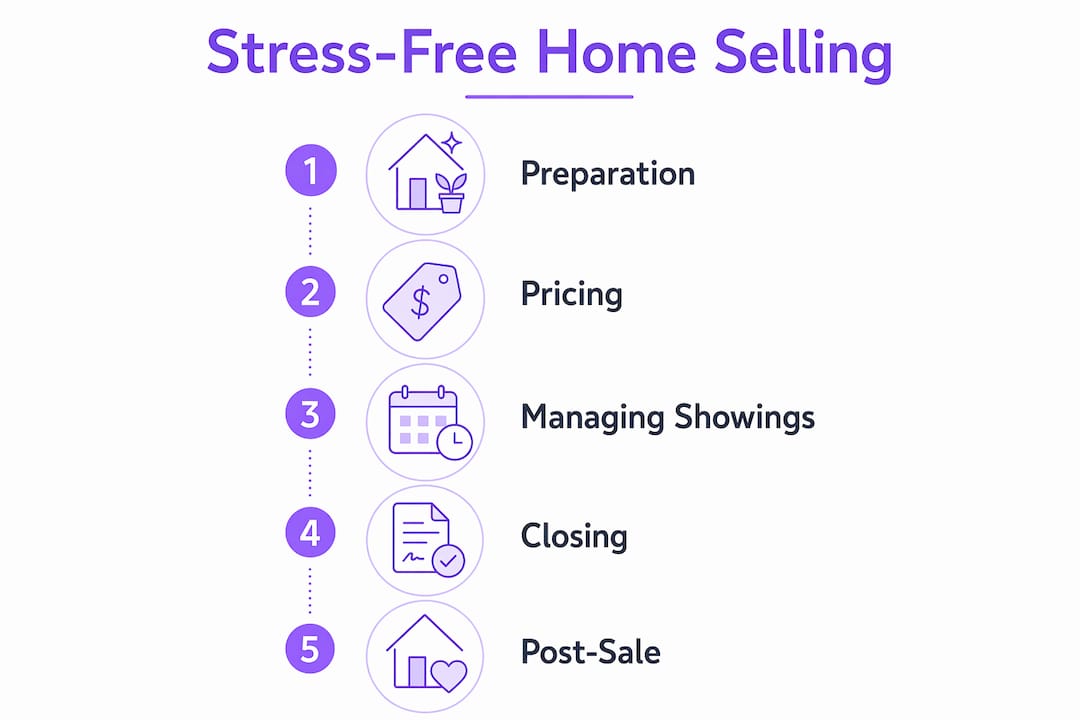
The core workflow has four stages: preparation, pricing, managing buyer activity, and closing. Each stage has specific tasks and decision points. When you know what is coming next, the process feels manageable rather than overwhelming. Sellers who skip the planning stage are the ones who end up reactive, stressed, and making poor decisions under pressure.
Easysale works with homeowners across New Zealand who have been through exactly this. The pattern is consistent: sellers who enter the market with a written plan and a realistic timeline report far less stress than those who list impulsively and hope for the best.
How early should you start preparing your home?
Preparation is the single biggest lever you have for reducing stress before your property even hits the market. Optimal preparation starts 30 to 90 days before listing, giving you enough time for assessments, minor repairs, and cosmetic improvements without rushing. Starting early means you make decisions calmly rather than in a panic the week before photos are taken.
The good news is that expensive renovations are rarely worth it. High-impact, low-cost preparation like decluttering, fresh paint, and curb appeal consistently outperforms costly upgrades in terms of return on investment. A clean, neutral, well-lit home photographs better and attracts more buyers than a home with a brand-new kitchen that has pushed the asking price beyond the suburb’s ceiling.
Here is where to focus your preparation energy:
- Declutter every room. Remove personal items, excess furniture, and anything that makes spaces feel smaller. Buyers need to picture themselves living there.
- Freshen up with paint. A coat of neutral paint in living areas and bedrooms is one of the cheapest and most effective improvements you can make.
- Improve curb appeal. Mow the lawns, trim hedges, clean the driveway, and tidy the front entrance. First impressions form before buyers step inside.
- Fix visible minor issues. Leaking taps, broken light fittings, and sticking doors signal neglect to buyers. Address these before listing.
- Consider a pre-listing inspection. Knowing what a buyer’s inspector might find lets you fix issues on your terms rather than during a stressful negotiation.
Pro Tip: Use a simple checklist or a free project management app like Trello or Notion to track every preparation task with a due date. Seeing tasks ticked off builds momentum and keeps you from forgetting small but important jobs.
For a detailed preparation plan, the house preparation guide from Easysale covers the specific steps Kiwi sellers use to maximise offers before listing.
How do you price your home to avoid delays and stress?
Pricing is where most sellers create their own stress. Overpricing delays sales and elevates anxiety. A property that sits on the market for weeks starts to carry a stigma, and buyers begin to wonder what is wrong with it. The result is lower offers and a longer, more stressful campaign than a correctly priced listing would have produced.
The most effective pricing strategy is to set a competitive price from day one using recent comparable sales in your suburb and current market velocity. Your agent should provide you with data on what similar homes have sold for in the last 60 to 90 days, not what they were listed for. Sale prices are what matter.
| Pricing approach | Likely outcome |
|---|---|
| Priced at market value from day one | Strong early interest, faster sale, less negotiation stress |
| Priced slightly above market to “test” | Slow enquiry, extended days on market, eventual price reduction |
| Priced below market to generate competition | High interest, potential for multiple offers, faster close |
| Priced significantly above market | Minimal enquiry, property becomes stale, buyers assume problems |
The “test the market” trap is one of the most common property selling mistakes Kiwi sellers make. It feels logical to start high and come down, but buyers notice price reductions and use them as leverage. You lose negotiating power and time.
Pro Tip: Set a clear price review trigger before you list. For example: “If we receive fewer than five enquiries in the first two weeks, we will review the price.” Having this decision made in advance removes the emotional difficulty of adjusting mid-campaign.
How do you manage showings and offers without disruption?
Showings are the most disruptive part of selling for most families. The key is to create a showing schedule that works around your life rather than letting buyers dictate your week. Discuss with your agent which days and times suit your household, and stick to those windows. Most serious buyers will accommodate a structured schedule.
Before each showing, run through a quick 15-minute tidy routine: clear benches, open curtains, remove pet items, and air the house. Having this routine prepared in advance means you are not scrambling every time a viewing is booked.
When offers arrive, evaluate them in this order:
- Price. Is it within an acceptable range of your asking price, accounting for current market conditions?
- Conditions. Finance conditions, building inspection clauses, and settlement dates all affect how certain the sale is. A lower unconditional offer is often more valuable than a higher conditional one.
- Settlement timeline. Does the proposed settlement date align with your moving plans? A buyer who wants a 90-day settlement when you need 30 days creates its own stress.
- Buyer reliability. Has your agent spoken with the buyer’s broker or confirmed pre-approval? Financing delays are one of the most common causes of deal collapse.
- Repair credits and inclusions. Offer negotiation involves more than price. Contingencies, timelines, and repair credits all need clear agreement to avoid last-minute surprises.
Your agent’s role here is to manage the communication between you and the buyer so you are not fielding calls and messages at all hours. If your agent is not doing this, that is a problem worth addressing early.
How do you organise timelines and communication for a smooth sale?
Scattered, unclear communication is the primary driver of seller stress during a property campaign. When information lives across text messages, emails, phone calls, and verbal conversations, things get missed and anxiety builds. The fix is simple: centralise everything.
Ask your agent to use a single communication channel, whether that is email, a shared document, or a client portal. Every offer, every document, and every deadline should be recorded in one place you can access at any time. This removes the feeling that things are happening without your knowledge.
Here is how to build a simple sale organisation system:
- Create a sale folder. Keep all documents, contracts, and correspondence in one digital folder. Google Drive or Dropbox both work well.
- Set a weekly check-in with your agent. A 10-minute call every Monday to review activity, feedback, and next steps keeps you informed without constant back-and-forth.
- Map your key dates. List your target listing date, open home dates, offer deadline, and settlement date in a simple calendar. Share it with your agent and solicitor.
- Plan for common “what-if” scenarios. What will you do if the first offer falls through? What if the building inspection raises issues? Having a plan for these situations before they happen removes the panic when they do.
Pro Tip: Ask your agent for a written summary after every open home, including the number of attendees, feedback themes, and any follow-up enquiries. This keeps you grounded in real data rather than speculation.
The property sale timeline guide from Easysale outlines the specific milestones Kiwi sellers should plan for from listing to settlement.
What do you do when things don’t go to plan?
Even well-prepared sellers encounter setbacks. The difference between a stressful experience and a manageable one is how you respond. Current NZ market conditions require patience and flexibility. Sellers who expect a quick sale in every market condition are setting themselves up for disappointment.
Here are the most common stress points and how to handle them:
- Slow enquiry or no offers. Review your pricing first. If the price is correct, look at your marketing photos, listing description, and whether your agent is actively promoting the property.
- Inspection renegotiations. Buyers often request repairs or price reductions after a building inspection. Decide in advance which issues you are willing to address and which you are not. Having a position prepared makes negotiation far less emotional.
- Buyer financing delays. Finance conditions can extend timelines unexpectedly. Keep your solicitor informed and ask your agent to maintain regular contact with the buyer’s broker.
- Offer withdrawals. These are disappointing but not uncommon. Return to your buyer enquiry list and follow up with any parties who showed strong interest.
- Emotional fatigue. Selling a home is genuinely tiring. Build in rest, lean on your support network, and remind yourself that the process is temporary.
If the traditional sale process is causing significant stress, cash offers allow sellers to bypass staging, repairs, and financing uncertainties entirely. This is a practical option worth considering when speed and certainty matter more than achieving the highest possible price.
Key takeaways
Stress-free home selling requires preparation starting 30 to 90 days before listing, competitive pricing from day one, and centralised communication throughout the campaign.
| Point | Details |
|---|---|
| Start preparation early | Begin 30 to 90 days before listing to allow time for repairs and cosmetic improvements without rushing. |
| Price competitively from day one | Overpricing stalls sales and reduces negotiating power. Use recent comparable sales to set a realistic price. |
| Centralise all communication | Keep documents, offers, and deadlines in one place to reduce confusion and maintain control. |
| Evaluate offers beyond price | Assess conditions, settlement timelines, and buyer reliability before accepting or rejecting any offer. |
| Have a contingency plan | Prepare responses to common setbacks like inspection renegotiations and financing delays before they happen. |
What I have learned from watching Kiwi sellers get this wrong
After years of working with homeowners across New Zealand, the pattern I see most often is this: sellers who treat their property sale as an event rather than a process are the ones who end up stressed, frustrated, and sometimes financially worse off.
The most damaging belief I encounter is that a well-located home will sell itself. It will not. Not in 2026, and not in most markets before that either. Buyers have more information than ever, and they are patient. They will wait for a correctly priced, well-presented property rather than overpay for one that has been sitting on the market for six weeks.
The sellers who come through the process calmly are the ones who made decisions before the campaign started. They knew their price floor. They knew their settlement timeline. They had a plan for what to do if the first offer fell through. That preparation is not complicated, but most people skip it because they are focused on the excitement of listing rather than the discipline of planning.
One more thing worth saying: choosing the right agent matters enormously. Not the agent who gives you the highest appraisal, but the one who gives you honest market data, communicates consistently, and has a track record of sales in your suburb. The tips for stress-free property selling that actually work all come back to the same foundation: clear information, realistic expectations, and a process you trust.
— Aaron
How Easysale can help you sell without the stress
If the traditional sale process feels like too much right now, Easysale offers a straightforward alternative for New Zealand homeowners. You submit your property details, receive a fair cash offer within 24 hours, and settle on a timeline that suits you. No open homes, no repair requirements, no agent commissions.

Easysale buys properties in any condition across New Zealand, which makes it a practical option for sellers facing financial pressure, a tight timeline, or a property that needs work. The process is transparent and there is no obligation to accept the offer. If you want to explore what a private cash sale looks like for your property, visit Easysale to get started. It takes less than five minutes to submit your details and find out where you stand.
FAQ
What is a stress-free home sale?
A stress-free home sale is a property transaction managed through clear preparation, realistic pricing, and organised communication. Sellers who follow a structured plan from 30 to 90 days before listing consistently report less anxiety and better outcomes than those who list without a strategy.
How long does it take to sell a house in New Zealand in 2026?
Timelines vary by location and price point, but current NZ market conditions require patience and realistic expectations. Most well-priced properties in active suburbs sell within four to eight weeks of listing, though some markets move more slowly.
Should I renovate before selling?
Major renovations rarely recoup their cost in the short term. Focus on high-impact, low-cost improvements like decluttering, fresh paint, and curb appeal. These consistently deliver better returns than expensive upgrades.
What should I do if my home is not selling?
Review your pricing first using recent comparable sales in your area. If pricing is correct, assess your marketing photos, listing description, and agent activity. If the campaign has stalled after several weeks, a price adjustment or a change in strategy is usually the most effective response.
Is selling to a cash buyer a good option?
Selling to a cash buyer like Easysale removes the need for staging, repairs, open homes, and financing conditions. It is a practical option when speed and certainty are priorities, particularly for sellers facing financial difficulty, a tight timeline, or a property in poor condition.
Recommended
