
The role of quick sale guarantees for NZ homeowners

TL;DR:A quick sale guarantee is a real estate agreement promising to buy your property by a set date if no open-market buyer is found, reducing sale uncertainty. However, it often involves discounts of 15 to 30 percent below market value and requires careful contract review to ensure enforceability. These guarantees are ideal for urgent sellers facing deadlines, poor property conditions, or financial pressures, but they may not suit those with flexible timelines or well-maintained homes.
A quick sale guarantee is a real estate agreement that assures the sale of your property by a fixed date, with the buyer committing to purchase it directly if no open-market buyer is found first. The role of quick sale guarantees is to remove the uncertainty that makes urgent property sales so stressful. Whether you are facing financial pressure, a relationship change, or a job relocation, knowing your home will sell by a specific date changes everything. This article explains how these guarantees work, what you gain and give up, and how to decide whether one suits your situation as a New Zealand homeowner.
How do quick sale guarantees work in practice?
A guaranteed sale programme typically follows a structured process that gives you both a market opportunity and a safety net. Understanding each step helps you know exactly what you are agreeing to before you sign anything.
- Property assessment. The provider evaluates your home’s condition, location, and current market value. This determines the guaranteed fallback price you will receive if the property does not sell on the open market.
- Marketing period. Your property is listed and actively marketed for a set period, often between 30 and 90 days. During this time, the provider attempts to achieve a higher open-market price on your behalf.
- Guaranteed fallback purchase. If no buyer is found within the agreed timeframe, the provider steps in and purchases the property at the pre-agreed price. This guaranteed fallback purchase is the core of the arrangement.
- Settlement on your timeline. Once the guarantee is triggered or a buyer is found, settlement proceeds according to the agreed terms, often within days rather than months.
It is worth understanding the difference between two types of providers. Direct cash buyers purchase your property outright without a marketing phase. Brokerage-style guarantees, by contrast, trigger only after a failed marketing period and may, in some cases, function primarily as a lead generation tool rather than a genuine purchase commitment. Knowing which type you are dealing with is critical.
Contractual terms also vary significantly between providers. Some programmes include a scheduled price reduction if the property remains unsold, meaning the guaranteed price you receive at the end of the marketing period may be lower than the price agreed at the start. Always read the full contract before proceeding.
Pro Tip: Ask any provider to confirm in writing whether they are a direct buyer or a brokerage acting as an intermediary. This single question reveals whether the guarantee is backed by real purchasing power or is conditional on finding a third-party buyer.
What are the benefits and trade-offs compared to traditional sales?
The quick sale guarantee benefits are real and meaningful for homeowners in urgent situations. The trade-offs are equally real and deserve honest attention.
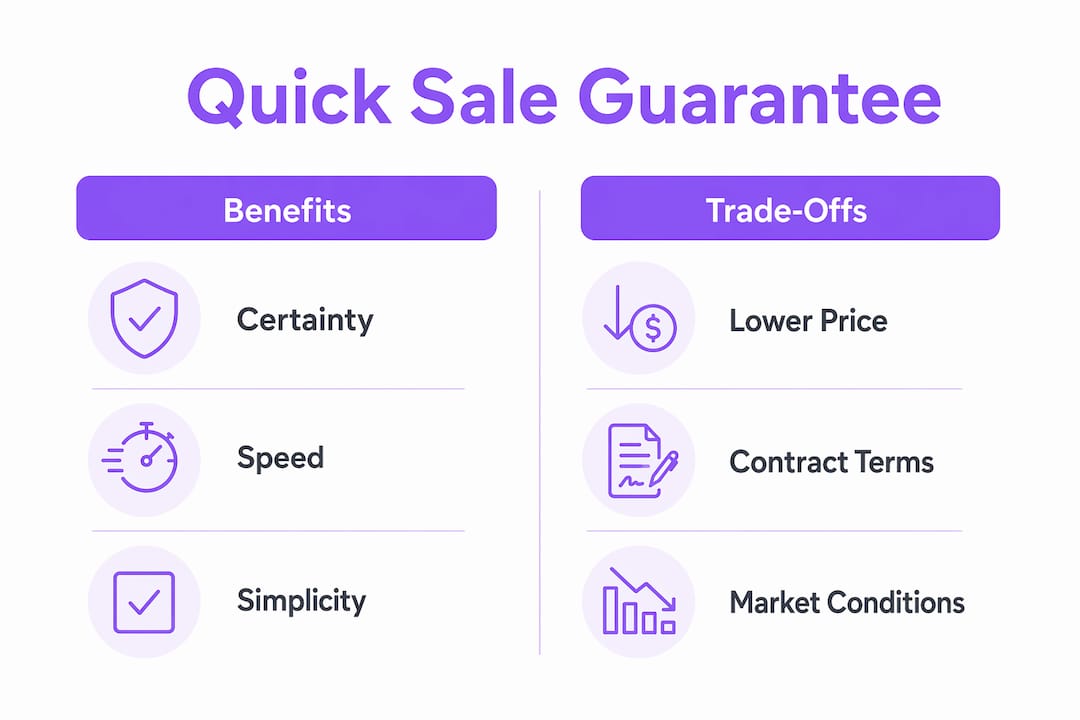
The advantages of fast sale guarantees
The most significant advantage is the removal of contingencies. Traditional property sales in New Zealand can fall through because of buyer financing issues, valuation disputes, or a buyer simply changing their mind. Quick sale guarantees remove financing contingencies and appraisal delays, giving you a fixed closing date you can plan around. This matters enormously when you have a mortgage deadline, a new rental starting, or a family situation requiring a clean break.

The psychological benefit is also substantial. Guaranteed sales eliminate chain risk, which means you are not waiting anxiously for another buyer’s sale to complete before yours can proceed. For many sellers, the certainty of knowing the sale will happen outweighs the financial cost of accepting a lower price. This is not a minor point. The stress of an uncertain sale affects your ability to make clear decisions about your next move.
The price trade-off you need to understand
The primary trade-off is price. Quick sale companies typically offer 15 to 30 percent below market value, and this discount is not arbitrary. It reflects the holding costs the buyer takes on, including rates, insurance, utilities, and repairs, as well as the resale risk they absorb by committing to purchase your property regardless of market conditions. The discounted price covers buyer risk and costs, not just a service margin.
| Factor | Quick sale guarantee | Traditional brokerage sale |
|---|---|---|
| Sale certainty | Guaranteed by fixed date | No guarantee; can fall through |
| Time to settlement | Days to weeks | Typically 60 to 120 days or more |
| Price achieved | 15 to 30% below market value | Closer to full market value |
| Staging and showings | Not required | Usually required |
| Financing contingencies | Removed | Present and can cause delays |
| Stress level | Low | Moderate to high |
Pro Tip: If your property is in good condition and the market is active, consider requesting a short marketing period of 30 days before the guarantee triggers. You may achieve a higher price while still having the safety net in place.
What should sellers watch out for with quick sale guarantees?
The importance of sale guarantees lies in the protection they offer, but that protection is only as strong as the contract behind it. Several pitfalls catch sellers off guard.
- Exclusivity clauses. Many guarantee contracts require you to list exclusively with the provider for the duration of the marketing period. This prevents you from accepting offers from other buyers or agents during that time.
- Vague contract terms. Contract clarity is paramount. If the price, conditions, and timeline are not clearly defined, the guarantee can be voided or renegotiated at the provider’s discretion. Vagueness benefits the provider, not you.
- Property eligibility restrictions. Not every property qualifies. Some providers exclude homes with significant structural damage, title issues, or properties in certain locations. Confirm your property meets the eligibility criteria before investing time in the process.
- Lead generation risk. Some brokerage-style programmes use the guarantee as a marketing hook to attract listings. A genuine guarantee must be backed by direct purchasing power or a firm contractual commitment, not just a promise to try.
- Scheduled price reductions. As noted earlier, some programmes reduce the guaranteed price incrementally during the marketing period. You may agree to a price today that is lower by the time the guarantee is triggered.
The single most effective protection is an independent legal review of the contract before you sign. A property solicitor can identify clauses that limit your rights or create conditions that make the guarantee difficult to enforce. This cost is small relative to the value of your property.
How can you assess if a quick sale guarantee suits your needs?
Not every homeowner needs a quick sale guarantee, and not every urgent sale situation calls for one. The right fit depends on your specific circumstances.
- Assess your urgency. If you have a hard deadline, such as a mortgage default notice, a court order, or a confirmed relocation date, the certainty of a guarantee is worth the price concession. If your timeline is flexible, a traditional sale may recover more value. Understanding why homeowners sell fast helps clarify whether your situation genuinely calls for a guarantee.
- Consider your property’s condition. Properties requiring significant repairs are harder to sell on the open market and often sit unsold for extended periods. A quick sale guarantee removes the need to fund repairs before selling, which is a practical advantage for many sellers.
- Review your financial position. If holding the property for another three to six months costs you in mortgage payments, rates, and insurance, the 15 to 30 percent discount may be partially offset by the costs you avoid.
- Explore direct cash buyer options. A direct cash buyer, such as Easysale, bypasses the marketing period entirely and makes an offer based on the property’s current condition and value. This is a faster path than a brokerage guarantee programme and removes the risk of a scheduled price reduction. You can learn more about the NZ quick sale process to compare your options clearly.
- Ask the right questions before committing. Ask any provider: Is your offer backed by your own funds or a third party? What conditions can void the guarantee? Is the price fixed or subject to reduction? What is the exact settlement timeline?
The sellers who benefit most from quick sale guarantees are those facing genuine urgency, properties in less-than-ideal condition, or situations where the cost of a prolonged sale outweighs the benefit of a higher price. If you fit that profile, a guarantee is a practical and often rewarding solution.
Key takeaways
Quick sale guarantees deliver real value for urgent sellers, but only when the contract is clear, the provider is a genuine buyer, and the price trade-off aligns with your financial situation.
| Point | Details |
|---|---|
| Core role of guarantees | Assure a fixed sale date by committing the provider to purchase if no open-market buyer is found. |
| Price trade-off | Expect offers 15 to 30% below market value, reflecting buyer risk and holding costs. |
| Contract clarity matters | Vague terms can void the guarantee; always seek independent legal review before signing. |
| Direct buyer vs brokerage | Direct cash buyers offer faster certainty; brokerage guarantees only trigger after a failed marketing period. |
| Best-fit seller profile | Urgent sellers, properties needing repairs, and those with hard financial deadlines benefit most. |
What I have learned about quick sale guarantees after years in NZ property
The most common misunderstanding I see is that homeowners treat a quick sale guarantee as a straightforward product with a fixed outcome. It is not. The guarantee is only as reliable as the entity offering it and the contract underpinning it. I have spoken with sellers who accepted a guarantee from a brokerage, only to find the price had been reduced twice during the marketing period and the final payout was far below what they expected.
What I tell every seller is this: the quick sale guarantee benefits are genuine, but they require you to do your homework first. The certainty you are buying is worth the price discount, provided the contract actually delivers that certainty. If the terms are vague, the guarantee is not a guarantee at all.
The sellers who come out of this process satisfied are those who understood the trade-off clearly from the start. They knew they were accepting a lower price in exchange for a confirmed outcome, and they made that choice deliberately. That is a sound decision for many urgent situations. The sellers who feel let down are those who signed without reading the fine print or without asking whether the provider had the funds to actually complete the purchase.
My advice: treat the contract review as non-negotiable, confirm the provider’s purchasing capacity directly, and be honest with yourself about whether your timeline genuinely requires a guarantee or whether a short traditional campaign could still work. If you need certainty above all else, a direct cash buyer is the cleanest path.
— Aaron
Sell your home quickly and confidently with Easysale
If you have read this far and recognise your situation in what we have described, Easysale offers a direct path to a fast, fair property sale without the complexity of a brokerage guarantee programme.
Easysale buys properties across New Zealand in any condition, with no agent fees, no commissions, and no open homes. The process is straightforward: submit your property details, receive a no-obligation cash offer, and settle on a timeline that works for you. Whether you are selling for retirement or downsizing or dealing with a damaged property that the open market has not responded to, Easysale provides a transparent offer backed by real purchasing power. Explore your options at easysale.co.nz today.
FAQ
What is a quick sale guarantee in property?
A quick sale guarantee is a contract where a buyer or programme commits to purchasing your property by a fixed date if no open-market buyer is found first. It removes the uncertainty of traditional sales by assuring a confirmed outcome.
How much below market value do quick sale guarantees pay?
Quick sale providers typically offer 15 to 30 percent below market value. This discount reflects the holding costs and resale risk the buyer absorbs by committing to purchase regardless of market conditions.
Are quick sale guarantees legally binding?
A quick sale guarantee is only as enforceable as the contract behind it. Vague conditions or undefined timelines weaken enforceability, which is why independent legal review before signing is strongly recommended.
What is the difference between a direct cash buyer and a brokerage guarantee?
A direct cash buyer purchases your property outright without a marketing phase. A brokerage guarantee triggers only after a failed marketing period and may not be backed by the provider’s own funds.
Is a quick sale guarantee right for every homeowner?
No. Quick sale guarantees suit sellers with genuine urgency, hard financial deadlines, or properties in poor condition. If your timeline is flexible and your property is market-ready, a traditional sale will likely achieve a higher price. Review the NZ quick sale options available to you before committing to any programme.
Recommended
