
Ways to avoid foreclosure: steps for Kiwi homeowners


If you have missed a mortgage payment, or you know you are about to, the single most important thing you can do is talk to your lender before it contacts you. That sentence sounds too simple to matter, but it is the difference between negotiating from a position of control and reacting to a bank’s timeline. Alongside that first call, contact a free housing adviser or budgeting service, and start gathering your income and expense documents. These three moves, done in the same week, give you the best possible shot at keeping your home or selling it on your own terms.
Here’s what to do today, in order:
- Call your lender’s hardship or financial hardship team and ask about a hardship variation before you miss a second payment.
- Contact a free financial mentoring service or community law centre for independent advice.
- Pull together your last three payslips, a list of expenses, and any evidence of hardship (redundancy letter, medical certificate, insurance payout details).
- Ask your lender, in writing, what options exist: repayment plan, forbearance, or loan restructure.
- Write down every date, name, and reference number from every call.
Present this checklist to your lender or adviser word for word. It shows you are organised, and organised borrowers get better outcomes than borrowers who go quiet.
Key Takeaways
Acting within days of missing a payment, not weeks, is the single factor most likely to determine whether you keep your home or lose control of the sale process.
| Point | Details |
|---|---|
| Contact your lender first | Call before or immediately after a missed payment to open a hardship conversation. |
| Get independent advice fast | A financial mentor or community law centre can review your options within days. |
| Gather documents now | Payslips, expenses, and hardship evidence speed up any application. |
| Know your legal timelines | Hardship decisions take up to 20 working days; default notices allow at least 20 working days to remedy. |
| Plan a sale early if needed | A private or direct cash sale through Easysale can beat a mortgagee sale on price and control if keeping the home isn’t realistic. |
Table of Contents
- How foreclosure normally progresses in New Zealand
- Options to stay in your home
- Options if you can’t keep the house
- How to negotiate with your lender: documents and scripts
- Where to get free help and how to complain
- New Zealand legal timelines you need to know
- Contact your lender immediately and keep records of everything
- Open every letter, text, and email from your mortgage servicer
- Emergency financial assistance if you’re at risk of losing your home
- What to do the day a foreclosure notice arrives
- Getting family and community support involved
- Author’s practical perspective: what usually works
- A fast, private sale option if a mortgagee sale is closing in
- Sources
How foreclosure normally progresses in New Zealand
You usually have weeks, not days, once you fall behind. But that window shrinks fast if you don’t respond, so acting the moment you sense trouble is what actually protects your options.
The process almost always follows the same pattern:
- Missed payment: your lender’s system flags the account and a hardship or collections team is notified.
- Letters and calls: the bank attempts contact, usually by phone, text, and letter, over several weeks.
- Formal default notice: if there is no resolution, the lender issues a notice under the Property Law Act 2007, which must give you at least 20 working days to remedy the default.
- Mortgagee sale process begins: if the default isn’t fixed within that window, the bank can move to advertise and sell the property.
How long do I actually have? Under New Zealand rules, a default notice must allow at least 20 working days, roughly four weeks, for you to catch up or negotiate before the bank can proceed to sale. That is not a lot of time once the notice lands, which is why the real opportunity is in the weeks before it arrives.
Lenders don’t want to reach this stage either. Mortgagee sales are expensive to run and rarely recover as much as a negotiated resolution, which is exactly why industry guidance points to delayed or absent communication as the main reason homeowners end up there. Silence is the trigger banks act on. A phone call is the trigger they respond to.
Options to stay in your home
If your hardship is temporary, a short-term arrangement is usually the fastest fix. If it’s permanent, you need a structural change to the loan itself. Getting this distinction right before you approach your lender saves you weeks of back-and-forth.
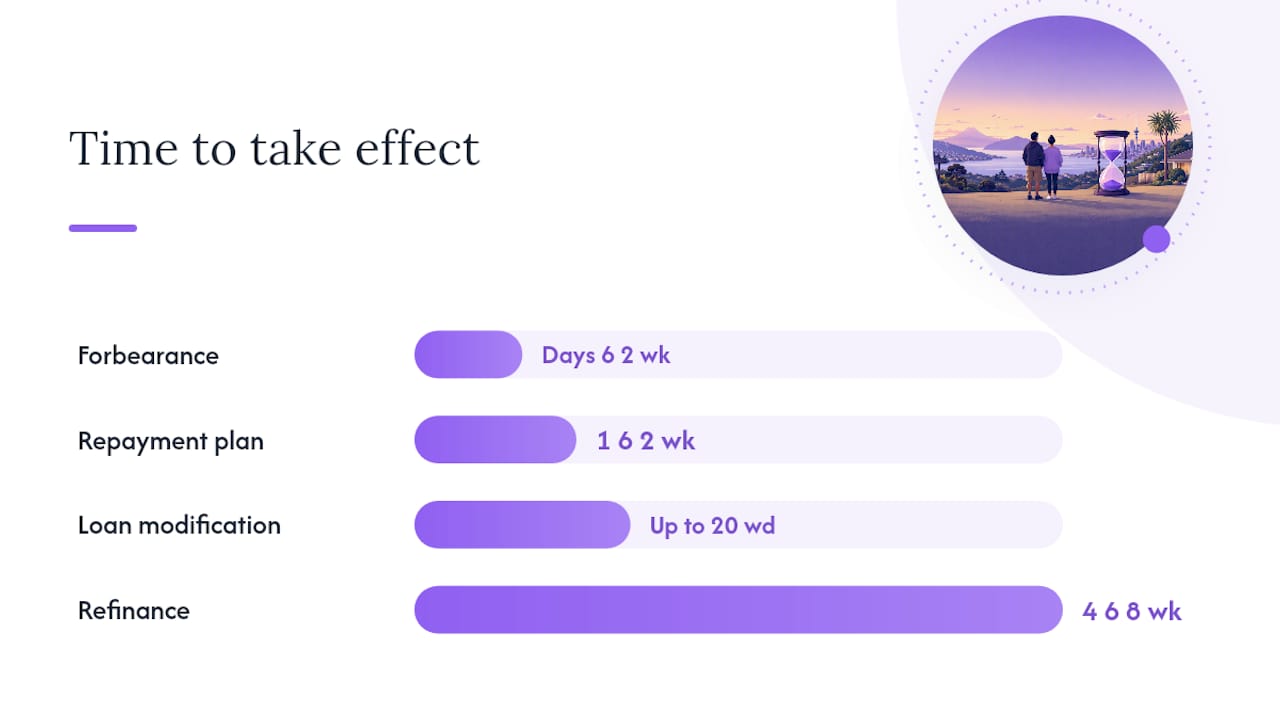
Forbearance or a short-term payment pause suits a temporary setback, such as a job loss you expect to resolve within a few months. It typically takes effect within days to a couple of weeks once approved, carries a mild credit impact if reported as a hardship arrangement rather than a default, usually has no direct fee, and suits short bursts of hardship rather than ongoing shortfalls.

A repayment plan adds missed amounts onto future instalments over an agreed period. It takes a similar amount of time to arrange, has a comparable credit profile, sometimes attracts a small administration cost, and works best when your income has recovered but you’re behind on arrears.
Loan modification (hardship variation) changes the terms of the loan itself, such as extending the term or moving to interest-only for a period. Under Consumer Protection guidance, lenders must acknowledge your hardship application within 5 working days, request further information within 10 working days, and issue a decision within 20 working days if no extra information is needed. It can affect your credit file more visibly than a short pause, may involve legal or admin fees, and suits homeowners whose income has genuinely dropped long-term.
Refinancing replaces your current loan with a new one, sometimes with another lender, at different terms. It takes the longest, often four to eight weeks, generally requires good enough credit to qualify, comes with application and possible break fees, and suits homeowners with equity and a stable but reduced income.
| Option | Timeline to take effect | Credit impact | Typical fees | Best suited for |
|---|---|---|---|---|
| Forbearance | Days to 2 weeks | Low, if managed as hardship | Usually none | Short-term, temporary hardship |
| Repayment plan | 1 to 2 weeks | Low to moderate | Sometimes a small admin fee | Recovered income, catching up on arrears |
| Loan modification | Up to 20 working days | Moderate | Possible legal/admin costs | Long-term reduced income |
| Refinance | 4 weeks | Depends on credit approval | Application and break fees | Homeowners with equity, stable income |
When you call, use language like this: “I’ve had a change in circumstances and I’d like to apply for a hardship variation. Can you send me the application form and tell me what supporting documents you need?” That single sentence puts you inside the formal hardship process rather than a general collections conversation.
Options if you can’t keep the house
If keeping the house genuinely isn’t realistic, the priority is to sell on your own terms before the bank sells on theirs. A planned sale almost always beats a mortgagee sale financially, and it protects your dignity and your credit file far better too.
A private sale, whether through an agent or direct to a buyer, takes anywhere from two to eight weeks depending on the market and how motivated you are to move quickly. It has minimal credit impact if the mortgage is repaid in full at settlement, involves standard selling costs (and commission, if you use an agent), and suits homeowners who still have time before a default notice bites.
A short sale, where the lender agrees to accept less than the full mortgage balance, can take longer to arrange because it needs lender sign off, may show on your credit file as a settled debt for less than owed, usually carries no extra fee beyond normal sale costs, and suits homeowners with negative equity who need the bank’s cooperation to close the gap.
A deed-in-lieu or mortgage release, where you hand the property back to the lender instead of a forced sale, is faster to arrange, typically a few weeks, but still affects your credit similarly to a default. It has minimal extra cost, and suits homeowners with no viable buyer and no time left before a mortgagee sale.
Bankruptcy is a last resort. It takes months to resolve fully, carries a severe and long-lasting credit impact, involves administrator and legal costs, and only suits genuinely insolvent situations where no other option exists.
| Exit route | Timeline | Credit outcome | Costs | When it’s suitable |
|---|---|---|---|---|
| Private sale | 2 weeks | Minimal, if debt cleared | Standard sale costs | You have time before a default notice |
| Short sale | Several weeks, needs lender approval | Moderate, settled for less than owed | Standard sale costs | Negative equity, cooperative lender |
| Deed-in-lieu | A few weeks | Similar to default | Minimal | No buyer, little time left |
| Bankruptcy | Months | Severe, long-term | Legal and admin fees | Genuine insolvency, no other option |
If you’re selling, do this first: get an honest valuation, decide whether speed or maximum price matters more to you, and start the process the day you know a sale is likely, not the day the notice arrives. Selling privately or to a direct buyer gives you control over timing, marketing, and price. A mortgagee sale, by contrast, is usually conducted ‘as is, where is’, often without vacant possession or the warranties a normal buyer expects, and the mortgagee is only required to obtain the best price reasonably obtainable at the time, not the best price you might get with more time. Worse, if the sale doesn’t cover your remaining debt, you stay liable for the shortfall.
How to negotiate with your lender: documents and scripts
Be proactive and honest, and turn up with a realistic proposal rather than a vague request for help. Lenders respond to borrowers who look organised, because it signals the arrangement will actually stick.
Before you call or email, prepare:
- Your last three payslips or proof of income (including any benefit payments).
- A simple statement of position: income, essential expenses, and current debts.
- Evidence of your hardship: redundancy letter, medical certificate, separation agreement, or similar.
- Your latest mortgage statement and any letters already received from the lender.
Use these scripts as a starting point, adjusted to your situation:
“I’ve experienced [job loss / illness / relationship separation] and I’m currently unable to meet my full repayments. I’d like to discuss a hardship variation or a temporary repayment plan while my situation stabilises.”
“I can afford $[amount] per fortnight right now. Can we set up a short-term arrangement at this level while I get back on track?”
“Can you confirm in writing what documents you need for a hardship application, and what your decision timeframe will be?”
Watch for red flags: anyone charging an upfront fee to “stop” a mortgagee sale, unsolicited offers to “buy your debt,” or pressure to sign documents without reading them properly are all warning signs worth pausing on. Genuine lenders and free advisers never ask for payment to simply discuss your options.
Pro Tip: Keep a simple log, a notebook or a spreadsheet, with the date, time, name of the person you spoke to, and what was agreed after every single contact with your lender. If a dispute ever arises about what was promised, this record is your strongest evidence.
Where to get free help and how to complain
Your best first calls are a HUD-style housing counsellor equivalent, a community law centre, a budgeting or financial mentoring service, or, if things go wrong, the Banking Ombudsman. In New Zealand, the closest equivalents to the U.S. HUD-approved housing counsellor network are free financial mentors, budgeting advisers, and community law centres, and they are worth contacting the same week you contact your lender.
Here is what each type of help can, and cannot, do for you:
- Financial mentors and budgeting services: help you build a statement of position, negotiate directly with lenders, and access hardship grants; they can’t force a bank’s decision.
- Community law centres: give free legal advice on your rights under the Property Law Act and consumer credit law; they can represent you in some disputes but have limited capacity for full litigation.
- The Banking Ombudsman Scheme: investigates complaints about lender conduct and process failures; it can order remedies but rarely stops a properly conducted mortgagage sale once it’s underway.
- Private lawyers: useful for reviewing loan documents or a notice you believe was issued incorrectly.
If you believe your lender hasn’t followed proper process, or has treated you unfairly:
- Put your complaint in writing directly to the lender’s internal complaints team first.
- Ask for their decision and reasoning in writing, including any rights to escalate.
- If unresolved, lodge a complaint with the Banking Ombudsman Scheme, including your dates, reference numbers, and copies of correspondence.
- If the issue involves a legal error, such as a notice period that was too short, seek advice from a community law centre or private lawyer about your options.
- Escalate to legal action only as a last resort, once free dispute-resolution avenues are exhausted.
Under Commerce Commission guidance, if a lender refuses your hardship application, it must give written reasons and explain your right to apply to the courts or a dispute-resolution scheme. Don’t wait for the sale notice to find this out; ask the question early.
New Zealand legal timelines you need to know
Under New Zealand law, you have a genuine right to apply for a hardship variation, and lenders must follow set timeframes once you do. Use that right now, not after a formal notice arrives.
| Legal step | Timeframe | What it means for you |
|---|---|---|
| Hardship application acknowledgement | 5 working days | Lender must confirm receipt of your application |
| Request for further information | 10 working days | Lender must ask for anything missing within this window |
| Decision on hardship application | 20 working days | Lender must decide and notify you in writing |
| Property Law Act default notice | At least 20 working days to remedy | Minimum time you have to fix the default before sale proceedings can start |
These timeframes come from Consumer Protection’s guidance on payment problems and reflect obligations under the Credit Contracts and Consumer Finance Act. They are legal minimums, not suggestions, so if your lender is dragging past them, that is grounds to escalate to the Banking Ombudsman.
Once a Property Law Act notice is issued, the lender’s mortgagee also owes you a duty under the Property Law Act 2007 to take reasonable care to get the best price reasonably obtainable if a sale proceeds. That duty exists, but it doesn’t guarantee a good outcome for you, which is exactly why acting inside the notice period matters more than relying on that protection.
Get independent advice early. A five minute conversation with a community law centre or financial mentor in week one of a hardship situation is worth more than a rushed conversation in week three, when your options have already narrowed.
Contact your lender immediately and keep records of everything
The moment you know you’ll struggle with a payment, before it’s even due, pick up the phone. Lenders have dedicated hardship teams whose job is to keep loans performing, not to rush borrowers into default, and they are generally far more flexible with borrowers who call ahead than with borrowers who go silent.
Every time you speak with your lender, whether by phone, email, or in person, write down the date, the person’s name, what was discussed, and any reference number given. This record becomes essential if there’s ever a dispute about what was agreed, or if you need to demonstrate to the Banking Ombudsman that you engaged in good faith. A simple email following up any phone call (“Just confirming what we discussed today…”) creates a paper trail with almost no extra effort.
Open every letter, text, and email from your mortgage servicer
It’s tempting to leave unopened mail alone when you suspect it’s bad news, but this is the single most damaging thing you can do to your own case. Every notice your servicer sends, whether it’s a missed payment reminder, a hardship application update, or a formal default notice, carries dates and deadlines that shape your options.
Missing the acknowledgement of a formal notice doesn’t stop the clock; it just means you find out about your deadline later, with less time to respond. Set a habit: check mail and email from your lender the same day it arrives, and if a letter mentions a deadline, put it in your calendar immediately. If you’re unsure what a letter means, call your lender or a housing adviser and ask them to explain it in plain language before you decide what to do next.
Emergency financial assistance if you’re at risk of losing your home
Beyond negotiating directly with your lender, several government and community-based supports exist to relieve immediate financial pressure. Work and Income can assist with hardship grants or benefit adjustments if your income has dropped. Budgeting services affiliated with financial mentoring networks can help you access one-off grants for essential costs, freeing up cash to keep mortgage payments current.
Some KiwiSaver providers allow early withdrawal in cases of significant financial hardship, which can bridge a short gap while you sort out a longer-term arrangement with your lender. This isn’t a decision to make lightly, since it reduces your retirement savings, but for some homeowners it buys the weeks needed to arrange forbearance or a repayment plan without missing further payments. Ask a financial mentor to walk you through whether this makes sense for your specific numbers before you apply.
What to do the day a foreclosure notice arrives
The clock is now running, so treat the day you receive a formal notice as day one of an active plan, not a day to panic. Read the notice fully and note the exact remedy deadline stated. Call your lender that same day to confirm you’ve received it and to ask directly what options remain open to you at this stage.
Contact a financial mentor or community law centre within 48 hours to have someone independent review the notice with you; they can quickly tell you whether the notice period given meets the legal minimum and whether anything about the process looks irregular. If you’ve decided selling is the right move, start that process immediately rather than waiting to see if negotiation works first. Running both tracks, negotiation and a sale process, at the same time protects you either way; you can always stop a sale process if the lender agrees to a workable arrangement.
Getting family and community support involved
Financial hardship is isolating, and many homeowners try to manage it entirely alone out of pride or embarrassment. That instinct works against you here. Family members can sometimes offer a short-term loan to cover a single missed payment, buying enough time for a hardship application to be processed. Even where money isn’t available, having a trusted family member sit in on a call with your lender or adviser can help you stay calm and ask the right follow-up questions.
Community organisations, iwi-based support services, and local church or cultural groups often have small emergency funds or connections to budgeting advisers that aren’t widely advertised. A financial mentor will usually know what’s available in your specific region and can point you toward support you wouldn’t find through a general search. Involving people early, rather than after a mortgagee sale notice arrives, gives everyone more room to actually help.
Author’s practical perspective: what usually works
The advice that works best is almost boringly simple: contact your lender before they contact you, get independent advice in the same week, and start planning a private sale the moment keeping the house looks unlikely. What separates homeowners who come through this in reasonable shape from those who don’t isn’t the severity of their hardship. It’s how early they acted on it.
The most common mistake I see reflected in the guidance from bodies like the Banking Ombudsman isn’t financial mismanagement. It’s silence. Homeowners avoid calls, let letters pile up unopened, and treat a missed payment as something to hide rather than something to manage. By the time they engage, the default notice has already started its 20 working day clock, and every option left is more constrained than it would have been three weeks earlier.
The second mistake is treating the lender as an adversary from the outset. Lenders would generally rather negotiate than run a mortgagee sale, because sales are costly, slow, and rarely recover full value. Cooperative, documented engagement tends to get better outcomes than defensive or hostile engagement, even when the underlying hardship is identical.
The third, and most avoidable, mistake is delaying a decision to sell. Homeowners who accept early that keeping the house isn’t realistic, and start a private sale process while they still have weeks of runway, consistently end up with better financial outcomes and far less stress than those who wait for a mortgagee sale to take the decision out of their hands entirely.
A fast, private sale option if a mortgagee sale is closing in
If you’re weighing up whether you can realistically keep the house, or whether it’s time to sell before the bank forces the issue, Easysale offers a route that doesn’t depend on finding a buyer through the open market or waiting on an agent’s marketing campaign. It’s a direct, as-is cash sale, meaning no repairs, no real estate commission, and no waiting on finance conditions from a buyer.

The process is straightforward: you submit your property details, Easysale provides a no-obligation cash offer, and if you accept, settlement happens on a timeline you choose, sometimes within days rather than weeks. That speed and certainty matter most when a Property Law Act notice is already ticking down, because it lets you settle before a mortgagee sale ever becomes necessary. Easysale buys properties in any condition, including tenanted or damaged homes, which suits many homeowners in financial distress who don’t have time or money for repairs.
If a quick, certain sale looks like the right move, you can request a no-obligation cash offer today and see what’s possible before deciding your next step. This is general information only, not legal or financial advice, so confirm your specific position with your lender or an independent adviser before making a final decision.
Sources
- Payment problems | Consumer Protection
- Mortgagee sales | Banking Ombudsman Scheme
- Purchasing a mortgagee sale | Cooney Lees Morgan
This article is general information, not a substitute for advice from a qualified financial advisor. Consult a qualified financial professional about your own circumstances before acting on anything here.


