
4 Clear Signs You're in a Buyers' Market in New Zealand

A buyers’ market is when supply exceeds demand — there are more homes for sale than active buyers, giving purchasers greater negotiating power. You can spot one through rising inventory, longer days on market, and softer or flat median prices. For buyers, it means more choice, more time, and room to negotiate. For sellers, it means pricing realistically and being ready to work harder to secure a deal.
TL;DR:Inventory levels are significantly higher than six months ago, indicating a strong buyer’s market in many areas of New Zealand.Median days on market have increased, with properties taking longer to sell, reflecting decreased demand and a cooling market.Sellers are more frequently offering concessions such as price drops, extended settlements, or covering costs to attract buyers.Local auction clearance rates and the frequency of multiple offers have declined, confirming reduced competition.First-home buyers are the most active segment, leveraging patience and conditional offers to negotiate better deals in the current environment.
Table of Contents
- What are the key indicators of a buyers’ market?
- What causes a buyers’ market to form?
- How does a buyers’ market change what buyers and sellers should actually do?
- How do you check if your local area is in a buyers’ market?
- What does the current New Zealand evidence say?
- What exactly defines a buyers’ market versus a sellers’ market?
- When does a quick cash sale make sense in a buyers’ market?
- Sources
What are the key indicators of a buyers’ market?
Four numbers tell you almost everything about which way a market is tilting. The first is inventory: when listings pile up faster than buyers can absorb them, sellers start competing with each other rather than the other way around.
The second is days on market. A property that once sold in two weeks now sitting for six or eight weeks is a clear signal that demand has thinned out. The third is price movement. Watch the median sale price over several months rather than one or two headline sales; short-term noise from a handful of high or low transactions can be misleading.
Concessions are the fourth signal, and often the most telling. When vendors start offering to cover chattels, extend settlement, or drop asking prices before an open home even happens, they’re telling you something about their motivation. Auction clearance rates and the frequency of multiple-offer situations round out the picture. Fewer competing bids and lower clearance rates both point to buyers holding the advantage.
- Rising listing numbers relative to buyer enquiries
- Longer average days to sell
- Stabilising or falling median prices over a rolling quarter
- More vendors offering price flexibility or settlement concessions
- Fewer auctions clearing and fewer multi-offer scenarios
Recent commentary on New Zealand conditions shows that when inventory sits high and properties take longer to sell, those two factors together are the most reliable practical test of a buyer-friendly market.
What causes a buyers’ market to form?
Markets tip toward buyers for a mix of supply and demand reasons, and usually both are moving at once. On the supply side, more properties hit the market when investors sell off portfolios, when new builds settle in large numbers, or when financial pressure forces distressed owners to list.
On the demand side, higher interest rates shrink what buyers can borrow, tighter lending rules push some out of the market entirely, and investor activity often drops off first when returns look less attractive. Seasonal patterns play a role too; winter listings in most regions move more slowly than spring ones regardless of the broader cycle.
- Investor sell-offs and distressed stock increasing supply
- Higher mortgage rates reducing borrowing capacity
- Tighter lending criteria narrowing the buyer pool
- OCR changes and policy shifts altering sentiment quickly
- Seasonal slowdowns amplifying an existing trend
None of this happens evenly. A city might show classic buyer-market signals while a tightly held coastal suburb ten minutes away still sees several offers on every listing, because local supply constraints don’t move at the same pace as the national picture.
How does a buyers’ market change what buyers and sellers should actually do?
The practical upside for buyers is time. You can arrange a building inspection, negotiate a longer due diligence period, and walk through a property twice before committing, rather than making a rushed unconditional decision on auction day. Getting finance pre-approval sorted before you start looking still matters. It lets you move decisively the moment you find a motivated vendor, without losing the negotiating leverage the market has handed you.
- Get pre-approved finance in place before you start viewing properties.
- Use conditional offers with sensible timeframes for building and LIM reports.
- Identify motivated vendors — long listing times, price drops, or a fast-approaching settlement deadline on their side are good tells.
- Negotiate calmly rather than opening with an aggressive lowball figure.
Sellers have their own playbook. Price realistically from day one rather than testing the market high and chasing it down later. Presentation matters more when buyers have options; a tidy, well-staged home stands out against a crowded field of similar listings. Some vendors offer to include chattels, cover minor repairs, or extend settlement to sweeten a deal without touching the headline price.
Extreme lowball offers rarely succeed, even in a strongly buyer-favoured market. Experienced negotiators tend to find better results by reading vendor motivation accurately and offering a fair, defensible discount rather than an insulting one. For more detail on structuring an offer that respects both sides, this guide to negotiating the best offer on a home sale covers LIM and building report considerations worth knowing before you put pen to paper.
Pro Tip: Ask the listing agent how many offers a property has received and how long it’s been listed. A honest answer to both questions tells you more about your negotiating room than any online estimate.
How do you check if your local area is in a buyers’ market?
National headlines rarely match what’s happening on your street. Start with the numbers that matter locally: active listings in your target suburb, median days to sale over the last quarter, and how sale prices compare with asking prices.
| Metric | What to check | Signals a buyers’ market |
|---|---|---|
| Active listings | Count in your target suburb this month vs. six months ago | Noticeably higher |
| Median days to sale | Local agent or portal data | Trending longer |
| Clearance/offer rate | Auction results or multi-offer frequency | Falling |
| Median price movement | Three to twelve month trend | Flat or softening |
- Ask a local agent directly how many offers recent comparable sales attracted.
- Attend two or three open homes and count how many other groups turn up.
- Watch a handful of local auction results over a few weeks rather than one isolated result.
Real estate professionals sitting the New Zealand licensing exam are taught to look for what’s sometimes called BILO, big inventory and long time on market, as the combined signal that a market has swung toward buyers. It’s a simple mental checklist worth borrowing even if you’re not sitting any exam.
One caveat: pockets differ. A suburb near a new motorway extension or a popular school zone can buck the wider regional trend, so always check figures at the suburb level, not just the city or regional level.
What does the current New Zealand evidence say?
New Zealand agent surveys and portal data over recent reporting periods have consistently pointed the same direction: more stock, slower sales, and a buyer-friendly tilt across much of the country. First-home buyers have been carrying a disproportionate share of activity, stepping in as investor demand has cooled.
When agent sentiment consistently points to buyers holding the upper hand and first-home buyers are doing most of the running, that’s a genuinely measurable shift in bargaining power, not just a headline talking point.
The practical read for a typical Kiwi household: if you’re buying, this is the environment where patience and a properly conditional offer earn their keep. If you’re selling, expect longer marketing periods than you might remember from a hotter cycle and price with that reality in mind, not against it. Easysale’s own analysis of buyer’s market conditions across New Zealand has tracked this shift closely, alongside broader notes on understanding a buyer’s market in NZ property.
What exactly defines a buyers’ market versus a sellers’ market?
A buyers’ market exists whenever the supply of homes for sale outpaces the number of active, qualified buyers. That imbalance shows up as more listings sitting unsold, longer average marketing periods, and sellers competing on price and terms rather than buyers competing on speed and certainty.

A sellers’ market is the mirror image: too few homes for too many buyers, pushing prices up quickly and often triggering multiple offers or auction premiums. The distinction isn’t about whether prices are rising or falling in isolation. It’s about who has to work harder to close a deal.
Importantly, a buyers’ market doesn’t mean every property crashes in value. It means the average property takes longer to sell and the average vendor has less room to hold a firm line on price. Well-presented, realistically priced homes in good locations can still sell close to expectations, even in conditions that clearly favour buyers overall. The shift shows up more in negotiating dynamics and timeframes than in a uniform price collapse.
This dynamic also plays out differently across sectors. Residential buyers’ markets tend to track interest rates and first-home buyer sentiment closely. Commercial property responds more to business investment confidence and lease demand. Rental markets rarely mirror the sales market at all. Even when it’s a strong buyers’ market for purchasers, rental vacancy can stay tight if migration or population growth keeps tenant demand high.
When does a quick cash sale make sense in a buyers’ market?
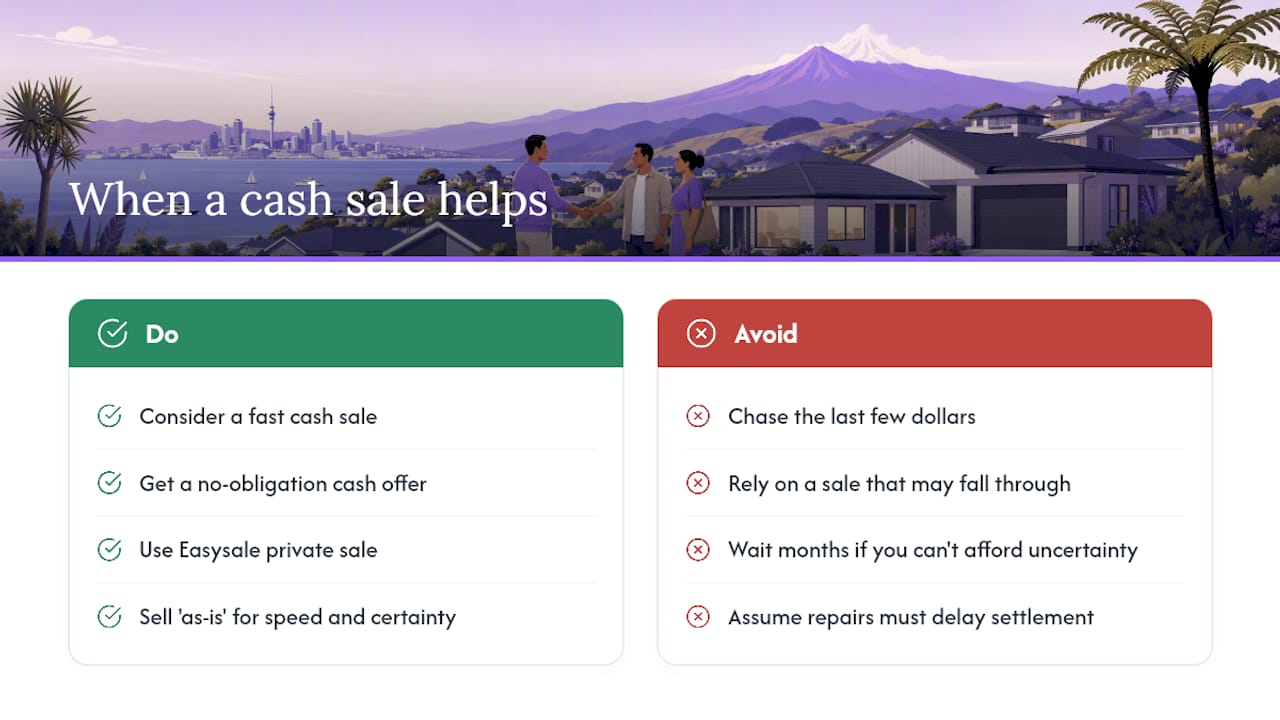
If you’re selling into a slower market and certainty matters more to you than chasing the last few dollars, a fast cash sale is worth genuine consideration. A buyers’ market often means a longer wait, more price negotiation, and the risk of a deal falling through on finance or a building report. If your circumstances mean you can’t afford months of uncertainty, financial pressure, a property that needs work you can’t fund, or a settlement that simply has to happen on your timeline, trading a small amount of top-line price for speed and certainty is a rational trade, not a defeat.
Easysale buys homes as they are, without agent commissions or repair demands, and settles on your schedule. If that sounds like your situation, our guide on how to sell a house as is explains what that process looks like in practice.
— Aaron
If speed and certainty matter more than squeezing out the last few thousand dollars, get a no-obligation cash offer through Easysale’s private sale service and see what a straightforward, agent-free sale looks like for your situation. Homes needing repairs or with consent issues are still welcome; check the as-is, where-is buying process for details on how that works.
This article is general information, not a substitute for advice from a qualified financial advisor. Consult a qualified financial professional about your own circumstances before acting on anything here.
Sources
- Is it a buyers market in NZ? If you are looking to purchase property this year — MHQ
- What is a buyers market? — Rachael Bridger
Recommended
