
Why homes aren't selling in New Zealand: 2026 guide
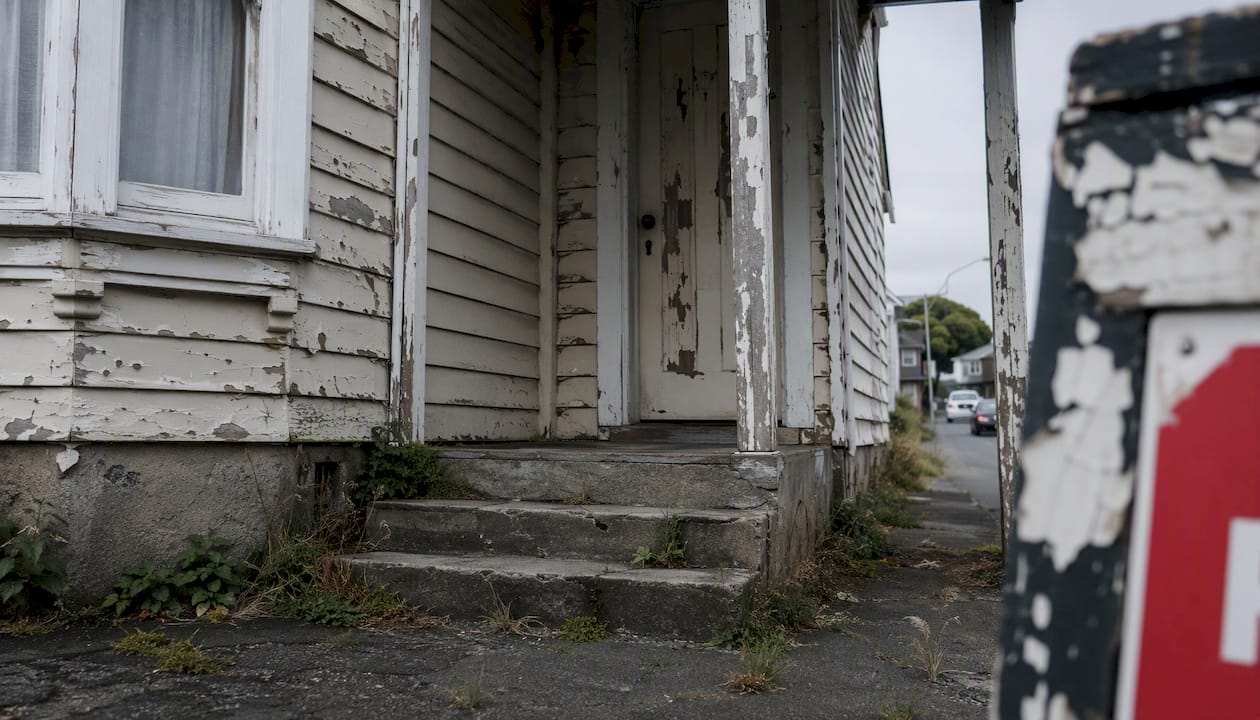
Most homes that sit unsold have one or more of three problems: the price is above what buyers will pay in today’s market, the presentation is putting people off before they even book a viewing, or there’s a legal or access issue quietly blocking the sale. The single most useful thing you can do right now is request an objective price check, either a registered valuer’s report or a second agent’s comparative market analysis, before spending money on anything else.
Here’s what to expect before you change strategy:
- Week 1–2: Get a price check and a fresh agent opinion. Identify any legal or access issues.
- Week 2–4: Fix presentation, improve photos, and confirm your marketing is reaching buyers on Trade Me Property and Realestate.co.nz.
- Week 4–6: If viewings are low and offers haven’t arrived, it’s time to reprice, change method, or consider an alternative sale route.
Key takeaways
The most effective approach to an unsold home in New Zealand is to fix the price first, the presentation second, and treat a fast-sale alternative as a genuine backstop rather than a last resort.
| Point | Details |
|---|---|
| Price is the primary lever | Get a registered valuer or second agent CMA before spending on presentation fixes. |
| Legal defects block finance | Unconsented work, meth contamination, and defective titles eliminate buyers who need a mortgage. |
| Median days to sell is your benchmark | REINZ data shows the national median in the high 40s; anything beyond that warrants a strategy change. |
| Presentation fixes are cheap and fast | Decluttering, odour treatment, and professional photos often convert stale listings within weeks. |
| Easysale offers a guaranteed exit | For urgent or complex sales, Easysale buys properties as-is with no agent fees across New Zealand. |
Table of Contents
- Why are homes not selling in New Zealand right now?
- Property defects that can kill a sale before it starts
- Pricing and valuation mistakes: why price matters now
- Presentation, photography and marketing mistakes that slow or kill interest
- How tenant issues and access problems affect your sale
- When to worry: timelines, days to sell, and the cost vs price-cut trade-off
- A practical 2–6 week plan to get your home sold
- When the open market isn’t working: cash buyers and fast-sale options
- What Kiwi buyers are actually looking for right now
- How recent sales data in your area shapes buyer expectations
- Does the time of year affect how quickly your home sells?
- Which selling method suits your situation: auction, tender, or private sale?
- How to have a productive conversation with your agent about what’s not working
- What sellers usually get wrong, and what actually fixes it
- Need a guaranteed sale? Here’s how Easysale works
- Sources
Why are homes not selling in New Zealand right now?
The short answer: the market has shifted firmly in buyers’ favour, and most sellers haven’t caught up. Sales activity has been weakening across much of New Zealand, with elevated listing numbers giving buyers more choice and more negotiating power than they’ve had in years. Higher mortgage rates have reduced what buyers can borrow, which directly compresses the price they’re willing to pay.
CoreLogic property economist Kelvin Davidson has described the current situation as the longest and deepest downturn in 30–40 years, a period where buyers are exercising far more care and sellers need credibility over optimism.
Regional differences are significant. Auckland carries elevated unsold stock and longer selling times. Wellington has seen similar pressure. Some provincial centres remain steadier, which is exactly why national headlines can mislead you. What matters is what comparable properties in your specific suburb have sold for in the last 60–90 days, not what the national median did last month.
Statistic to know: The national median days to sell reached the high 40s in recent REINZ data, meaning the average home is taking well over six weeks to find a buyer under current conditions.
The REINZ House Price Index is worth bookmarking. REINZ recommends using both the HPI and median prices together, because medians alone can be skewed by the mix of properties sold in any given month.
Property defects that can kill a sale before it starts
Some issues don’t just slow a sale, they eliminate entire categories of buyers. Banks won’t lend on certain properties, and buyers who can’t get finance simply can’t buy. Agent reports consistently identify a cluster of red-flag issues that shrink the buyer pool dramatically:
- Flood zone classification: Properties in flood-prone areas face lender restrictions and insurance difficulties. Buyers who are aware of this will either walk away or demand a significant discount. Disclosure is mandatory; the remedy is usually price adjustment or targeted marketing to cash buyers.
- Unconsented building work: A deck, sleepout, or garage conversion built without council consent creates a legal liability for the buyer. Many lenders won’t finance the purchase until the work is consented or removed. Get a LIM report early and understand what’s on it.
- Defective or cross-lease title: Cross-lease titles with inaccurate flats plans, or titles with encumbrances that restrict use, reduce the buyer pool and can cause finance to fall over at the last minute. A property lawyer can advise on whether a title issue is fixable before listing.
- Meth contamination: Even a low-level positive test result can cause banks to decline lending. Testing before listing and providing a clean report is far more effective than leaving buyers to discover the issue themselves.
- Leaky building syndrome: Properties with weathertightness issues, or even the appearance of them, trigger immediate caution. A building inspection report from a qualified inspector, shared proactively, builds more confidence than silence.
- Fire damage or significant structural defects: These typically require cash buyers or specialist purchasers. Standard marketing to owner-occupiers rarely works.
Pro Tip: Disclosure done well is not the same as disclosure done reluctantly. Presenting a known issue alongside a remediation quote, a builder’s report, or a legal opinion shows buyers the path forward. That transparency often keeps a deal alive where silence would have killed it.
For a full overview of your legal disclosure obligations, the legal considerations for NZ sellers guide covers what you must disclose and how to do it properly.
Pricing and valuation mistakes: why price matters now
Overpricing is the single most common reason homes don’t sell, and it’s also the most fixable. In a buyer-favouring market, every listing is compared against a dozen alternatives.
Emotional pricing — setting a price based on what you paid, what you spent on renovations, or what you need to clear your mortgage — is a persistent trap. The market doesn’t care about your costs. It cares about what a willing buyer will pay today, given everything else available to them.
Getting an objective price means three things:
- Comparative market analysis (CMA): Ask your agent for a written CMA showing the last 90 days of comparable sales in your area, not just listings, but actual settled sales.
- Registered valuer: QV (Quotable Value) and independent registered valuers provide formal appraisals that carry weight with both sellers and buyers. This costs a few hundred dollars and is often worth it when there’s genuine uncertainty.
- Second agent opinion: If your current agent set the price, get a second opinion from a different agency. Ask them to show their evidence, not just give you a number.
Pro Tip: An early price adjustment, made within the first two weeks of listing, often generates a fresh wave of buyer interest and can produce a better net result than spending $5,000–$10,000 on staging and cosmetic work at an inflated price. The maths usually favour the price cut.
Presentation, photography and marketing mistakes that slow or kill interest
Buyers form an opinion about your property within seconds of seeing the listing photos. If those photos show clutter, poor lighting, or a home that looks lived-in rather than ready to sell, most buyers won’t book a viewing. The good news is that presentation issues are among the cheapest problems to fix.
Presentation checklist:
- Remove personal items: family photos, collections, religious shrines, and highly personalised décor make it harder for buyers to picture themselves living there. Agent anecdotes from OneRoof confirm that visible shrines and strong personal memorabilia have caused buyers to walk out of otherwise good properties.
- Address odours: pet smells, cigarette smoke, and damp are immediate deal-breakers. Professional cleaning and odour treatment cost a fraction of a price reduction.
- Improve curb appeal: mow the lawn, clear the gutters, paint the front door. First impressions from the street set the tone for the entire inspection.
- Fix minor defects: a dripping tap, a cracked tile, or a sticking door signals neglect. Buyers extrapolate from small visible problems to hidden large ones.
- Maximise light: open curtains, replace dim bulbs, and schedule viewings for daylight hours.
Marketing checklist:
- Confirm your listing is live on both Trade Me Property and Realestate.co.nz. These are the two primary platforms Kiwi buyers use.
- Professional photography is non-negotiable. Phone photos cost you viewings.
- Include a floorplan and accurate room measurements. Buyers who can’t assess a layout online often skip the viewing.
- Ask your agent for a written marketing plan showing how many viewings have been booked, how many enquiries received, and what the click-through rate on the listing looks like.
For a deeper look at common listing pitfalls, the Easysale blog covers the most avoidable mistakes NZ sellers make.
How tenant issues and access problems affect your sale
Tenanted properties are harder to sell, and the reasons are practical rather than legal. When tenants restrict viewing access, refuse to tidy for open homes, or decline to vacate for photography, the listing suffers in ways that are difficult to explain to buyers without raising more questions.

Common problems agents report include tenants limiting inspection times to narrow windows, refusing to remove pets or personal items for photos, and in some cases demanding approval over which photos go live. Each of these reduces the quality of the listing and the number of buyers who progress to a viewing.
Practical fixes that work:
- Negotiate a written access agreement with your tenant before listing, covering open home times, photography sessions, and private viewings.
- Offer a rent reduction or a one-off payment in exchange for cooperation. This is legal and often effective.
- Schedule open homes at times that minimise disruption for the tenant, which tends to produce better cooperation.
- If the tenancy is periodic, understand your notice obligations under the Residential Tenancies Act before making any decisions about vacant possession.
A property sold with vacant possession almost always attracts a wider buyer pool than one sold subject to a tenancy, particularly for owner-occupier buyers.
When to worry: timelines, days to sell, and the cost vs price-cut trade-off
The national median days to sell sitting in the high 40s tells you that even well-priced, well-presented homes are taking six weeks or more to find a buyer. If your property has been listed longer than that with few viewings and no offers, something specific is wrong.
Use these signals to judge when to act:
Statistic to know: REINZ data from June showed sales volumes and median prices slipping, with mortgage rates cited as the primary constraint on buyer activity.
| Signal | What it means | Suggested action |
|---|---|---|
| Fewer than 5 viewings in 2 weeks | Price or marketing problem | Review price and listing quality |
| Viewings but no offers after 3–4 weeks | Presentation or price gap | Improve presentation or adjust price |
| Offers well below asking | Price is above market | Reduce price to comparable sales level |
| No viewings at all | Listing not reaching buyers | Check platform coverage and marketing |
Cost vs price-cut trade-off: Spending $3,000 on staging and $1,500 on professional photos makes sense if the property is correctly priced and the issue is purely presentation. It makes no sense if the property is $40,000 overpriced. Fix the price first, then invest in presentation.
A practical 2–6 week plan to get your home sold
This is a prioritised sequence, not a to-do list to tackle all at once.
- Week 1: Price check and agent review. Get a written CMA from your current agent and request a second opinion from a different agency. If the evidence points to overpricing, adjust now rather than in week six.
- Week 1–2: Legal and access audit. Pull your LIM report. Identify any unconsented work, title issues, or tenancy access problems. Address what you can quickly.
- Week 2: Presentation fixes. Declutter, clean, address odours, and improve curb appeal. These are weekend tasks, not projects.
- Week 2–3: Professional photography and listing refresh. If your current photos are more than a few weeks old or were taken on a phone, replace them. Update the listing description.
- Week 3–4: Confirm marketing coverage. Verify your listing is on both major platforms with a floorplan. Ask your agent for a viewings and enquiry report.
- Week 4–6: Escalation decision. If viewings are still low and no offers have arrived, you have three options: reduce the price to the level comparable sales support, change the sale method (consider auction or tender), or explore an alternative sale route such as a cash buyer.
For more on factors affecting property sale speed in the current NZ market, the Easysale blog has a detailed breakdown.
When the open market isn’t working: cash buyers and fast-sale options
Some situations call for a different approach entirely. If your property has significant defects, a complicated title, an uncooperative tenant, or you simply need to sell within weeks rather than months, the traditional open market may not be your best option.
Who typically uses fast-sale or cash buyer routes:
- Owners of damaged or contaminated properties that lenders won’t finance
- Sellers facing urgent timelines (probate, relationship separation, financial pressure)
- Landlords wanting to exit without the complexity of managing tenant access during a sale
- Homeowners who’ve already tried the open market and need a guaranteed outcome
Open market vs cash buyer vs auction/tender:
| Method | Speed | Certainty | Net proceeds |
|---|---|---|---|
| Open market (private treaty) | 6–16+ weeks | Low to moderate | Highest potential |
| Auction/tender | 4–6 weeks | Moderate | Competitive if strong interest |
| Cash buyer (as-is) | 1–4 weeks | High | Below market, but certain |
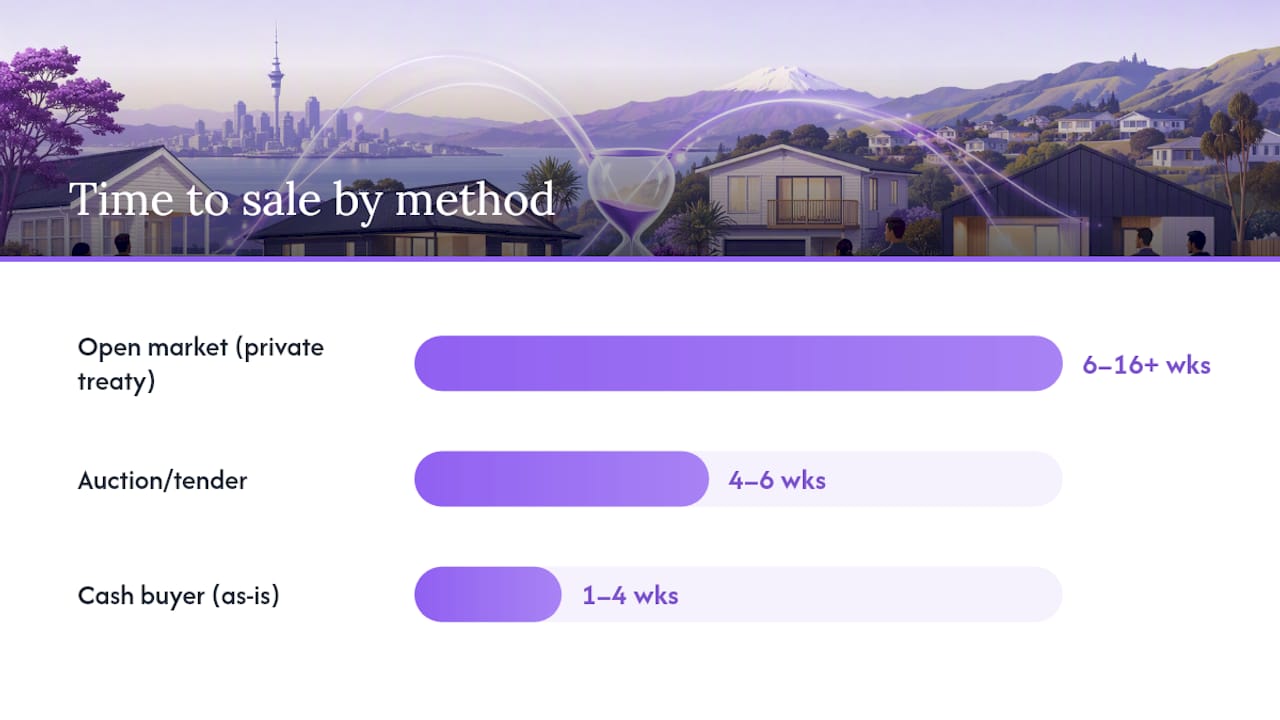
Easysale operates as a direct cash buyer for residential properties across New Zealand. The process is straightforward: submit your property details, receive a no-obligation offer and settle on a timeline that suits you. Properties are purchased in any condition, with no agent fees or commissions deducted.
The gap between a cash offer and an open-market sale is often smaller than it first appears.*
For homeowners with damaged or hard-to-sell properties, Easysale’s as-is purchasing model removes the need to remediate before selling.
What Kiwi buyers are actually looking for right now
Buyer preferences in New Zealand have shifted noticeably over the past two years. Owner-occupiers, who now make up a larger share of active buyers than investors, prioritise liveability over investment yield. That means they’re looking at school zones, commute times, and the condition of the home rather than rental return calculations.
Energy efficiency has moved from a nice-to-have to a genuine purchasing factor. Homes with good insulation, double glazing, and modern heating systems attract more interest than those without, particularly in colder regions like Canterbury and Otago. First-home buyers, supported by KiwiSaver withdrawals and First Home Loan criteria, are active in the sub-$700,000 price range in many regions, but they’re also the most sensitive to any defects that might complicate their finance approval.
Investors are present but selective. The removal of interest deductibility changes and ongoing uncertainty about tax policy have made many investors cautious about adding to their portfolios, which reduces competition at the top of the market.
How recent sales data in your area shapes buyer expectations
Buyers in 2026 are well-informed. Most have spent weeks on Trade Me Property and Realestate.co.nz before they contact an agent, and they arrive at viewings knowing what comparable properties have sold for. If your asking price is above recent settled sales in your street or suburb, buyers notice immediately.
The practical implication: your price needs to be anchored to actual settled sales, not current listings. Listings are asking prices; settled sales are what buyers actually paid.
REINZ HPI data gives you a cleaner read on value movements than median prices alone, because it controls for the mix of properties sold. Use it alongside your agent’s CMA to understand whether values in your area have moved up, down, or sideways over the past six months.
Does the time of year affect how quickly your home sells?
Seasonality matters in New Zealand, though it’s less decisive than many sellers assume. Spring (September through November) is traditionally the strongest selling season: more buyers are active, gardens look their best, and daylight hours make evening viewings practical. Listings that go live in late August or early September often benefit from the first wave of spring buyer activity.
Summer (December through February) is mixed. Buyer numbers stay reasonable through December, but the Christmas and New Year period is genuinely slow, and listings that sit over that period can develop a stale appearance by February. Autumn (March through May) is a solid secondary selling window, often underused by sellers who missed spring.
Winter is the weakest period, but it’s not a reason to delay indefinitely. A well-priced, well-presented property will attract serious buyers in any season. The risk of waiting for spring is that you carry holding costs for another four to six months, and the market may not improve enough to justify the wait.
Which selling method suits your situation: auction, tender, or private sale?
The right method depends on your property type, your timeline, and the level of buyer competition you can realistically expect.
Auction works best when there are multiple motivated buyers and the property has broad appeal. The competitive environment can push the price above what a private negotiation would achieve, and the unconditional nature of auction contracts removes the risk of finance or builder’s report conditions falling over. Auctions typically run over a 3–4 week campaign. If the property passes in, you’re back to private negotiation, sometimes with a weakened position.
Tender (deadline sale) suits properties where the value is harder to assess, such as lifestyle blocks, unusual homes, or properties with development potential. Buyers submit confidential offers by a set date, which can create urgency without the public theatre of an auction. It works less well when buyer interest is thin.
Private treaty (asking price or negotiation) is the most common method and suits the widest range of properties. It gives buyers time to arrange finance and conduct due diligence, which suits owner-occupiers. The risk is that without a deadline, some buyers take their time and the listing can drift.
For a plain-language explanation of these and other industry terms in NZ property sales, the Easysale blog has a useful reference.
How to have a productive conversation with your agent about what’s not working
Most agents are reluctant to deliver bad news, particularly about price. Industry commentary notes that some agents win listings by agreeing with an optimistic price, then manage the seller toward a reduction over weeks of low activity. The cost of that approach is time, carrying costs, and a listing that looks stale.
The conversation you need to have with your agent is evidence-based, not emotional. Ask for:
- The number of viewings in the past two weeks and the trend (up, down, or flat)
- Written feedback from buyers who attended viewings
- A list of comparable settled sales in the past 90 days, with prices
- Their honest assessment of where the market will clear your property
If your agent can’t or won’t provide this, that’s useful information. A second agent opinion costs nothing and often produces a more candid assessment, because the second agent has nothing to lose by being honest.
What sellers usually get wrong, and what actually fixes it
The pattern I see repeatedly is this: a seller lists at a price they feel is fair, waits four to six weeks hoping the market will come to them, then makes a small price reduction that still leaves them above comparable sales. By that point, the listing has been on the market long enough that buyers assume something is wrong with the property.
The sellers who get the best outcomes in a slow market tend to do two things differently. First, they price at or slightly below comparable sales from the start, which generates early competition and often produces a better final price than the optimistic-then-reduce approach. Second, they treat agent feedback as data, not opinion. When three separate buyers say the kitchen feels dated, that’s a signal worth acting on, whether through a small renovation or a price adjustment that accounts for it.
One example worth sharing: a Wellington seller had been on the market for eleven weeks with minimal interest. The property had a minor unconsented deck and photos taken on a cloudy day. None of those changes were expensive. The delay was.
When you talk to your agent, ask this directly: “If this property were your own and you needed to sell it within six weeks, what would you do differently?” The answer tells you a great deal about whether you’re getting honest advice.
Need a guaranteed sale? Here’s how Easysale works
If you’ve worked through the fixes above and the property still isn’t moving, or if your timeline simply doesn’t allow for a 10–16 week open-market campaign, Easysale offers a direct alternative.

Easysale buys residential properties across New Zealand in any condition, with no agent fees, no commission, and no requirement to repair or present the home before sale. The process runs in three steps: submit your property details online, receive a no-obligation cash offer, and settle on a timeline that suits you. There’s no obligation to accept, and the offer is based on current market conditions with full transparency about how it’s calculated.
The trade-off is straightforward: you receive certainty and speed rather than the highest possible open-market price. For homeowners dealing with damaged properties, urgent financial circumstances, or the complications of a tenanted sale, that certainty has real value. To find out what Easysale would offer for your property, visit the damaged or hard-to-sell property page and submit your details for a no-obligation assessment.
Sources
- Property market’s ‘longest and deepest downturn’ in 30-40 years
- 10 things that can make a house harder to sell - floods, firebombings and religious shrines, All things property, under OneRoof
- REINZ House Price Index (HPI) dashboard
- Housing market remains subdued as sales activity continues to weaken | RNZ
Recommended
