
Why sellers choose direct buyers: a practical NZ guide


TL;DR:Selling directly to a buyer offers a fast, certain, and cost-effective way for New Zealand homeowners to close property transactions. It eliminates many steps of traditional sales, reduces costs, and allows settlement in as little as 7 to 14 days, but typically at a lower price. This method is ideal for urgent, damaged, inherited, or privacy-sensitive properties where speed and certainty outweigh maximum market value.
Selling directly to a buyer, known in the industry as a direct sale or off-market sale, is the fastest way for New Zealand homeowners to close a property transaction without agent involvement. Why sellers choose direct buyers comes down to three things: speed, certainty, and cost savings. Direct sales close in 7–14 days, compared to the 47–62 days typical of traditional listings. That difference matters enormously when you are facing a tight deadline, a property in poor condition, or a life change that cannot wait for the market to cooperate. Easysale works with Kiwi homeowners across exactly these situations, offering a no-obligation cash offer and a settlement timeline that suits you.
Why sellers choose direct buyers over traditional listings
The core reason sellers prefer direct sales is the removal of financing risk. Cash offers close successfully at roughly four times the rate of offers dependent on mortgage financing. That means a direct buyer is far less likely to pull out at the last minute because a bank declined their loan application.
Traditional sales involve open homes, multiple inspections, conditional offers, and weeks of back-and-forth negotiation. Each step adds time and uncertainty. A direct sale removes most of those steps entirely. You deal with one buyer, one offer, and one settlement date.
The financial case is equally clear. Avoiding agent commissions of 4%–6% saves a significant sum. On a $700,000 property, that is $28,000–$42,000 staying in your pocket rather than going to an agent. Add in the cost of preparing a home for market, and the savings grow further.
Direct buyers also purchase properties as-is, meaning you do not need to repaint, renovate, or repair anything before settlement. The buyer factors the property’s condition into their offer from the start.
How does selling directly to buyers speed up the home sale process?
Speed in a direct sale comes from removing the steps that slow traditional transactions down. There are no financing contingencies, no waiting for a bank valuation, and no chain of buyers and sellers all dependent on each other.
The practical differences are significant:
- No open homes or repeated showings. You do not need to vacate your property every weekend for months.
- No conditional offers. A direct buyer’s offer is not subject to finance approval or a building inspection that triggers renegotiation.
- Fewer parties involved. No agent, no buyer’s agent, and often no lengthy solicitor back-and-forth on standard conditions.
- Faster paperwork. With fewer conditions to satisfy, the contract is simpler and settlement moves quickly.
- Seller-controlled timeline. You choose the settlement date, which matters when you need to coordinate a move or manage another financial commitment.
Direct buyers incorporate repair and legal risks into their initial offer. This means inspections do not trigger price renegotiations the way they do in a traditional sale. The price you agree on is the price you receive.
Pro Tip: Before accepting any direct offer, ask the buyer for written proof of funds. A legitimate direct buyer will provide this without hesitation. It confirms they can settle on the agreed date and protects you from last-minute surprises.
What cost savings do sellers gain by choosing direct buyers?
The financial benefits of selling directly go beyond avoiding commission. They include savings on repairs, staging, marketing, and the ongoing holding costs of a property sitting on the market for months.
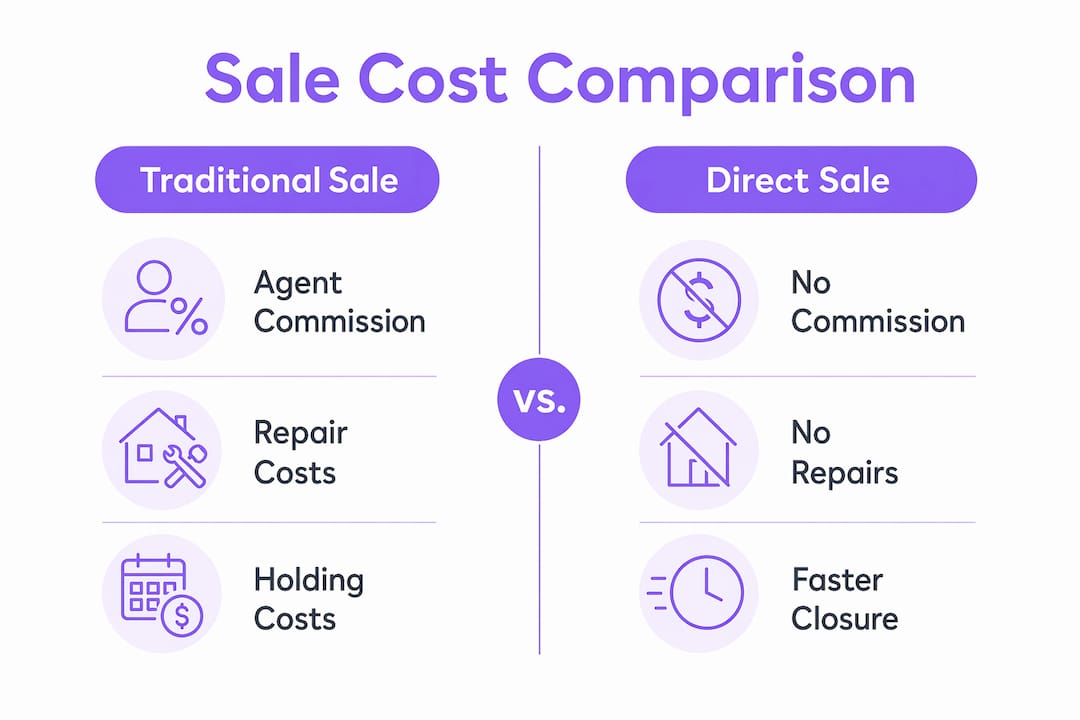
| Cost category | Traditional sale | Direct sale |
|---|---|---|
| Agent commission | 4%–6% of sale price | None |
| Repairs and presentation | Often $5,000–$30,000+ | None required |
| Marketing and photography | $1,000–$3,000+ | None |
| Holding costs (rates, insurance, mortgage) | Accumulate over 47–62 days | Minimal, closes in 7–14 days |
| Negotiation risk | Price can drop after inspection | Price agreed upfront |
The commission saving alone is substantial. Avoiding a 4%–6% commission on a $1,000,000 property saves between $40,000 and $60,000. For many sellers, that figure more than offsets the lower offer price a direct buyer typically presents.
Holding costs are an underappreciated factor. Every extra week a property sits on the market costs you in mortgage interest, council rates, insurance, and property maintenance. A direct sale that closes in two weeks instead of two months can save thousands in holding costs alone.
Sellers avoid repair costs entirely with a direct buyer. There is no pre-sale building report demanding you fix the roof, replace the hot water cylinder, or re-carpet the bedrooms. The buyer takes the property in its current state.
Pro Tip: When you receive a direct offer, ask the buyer to walk you through how they calculated it. A reputable buyer will explain what repair costs and resale margin they have factored in. Understanding the arithmetic helps you evaluate whether the offer is fair, not just fast.
What are the trade-offs of selling to direct buyers?
Direct sales are not the right choice for every seller. The primary trade-off is price. A direct buyer’s offer will almost always be lower than what you might achieve through a competitive open-market campaign.
Direct buyer offers reflect genuine costs borne by the buyer, including repair expenses, holding costs during renovation, and a resale margin. This is honest arithmetic, not exploitation. The buyer is taking on risk and effort that you are choosing not to take on yourself.
Key trade-offs to weigh up:
- Lower sale price. You are paying a premium for speed and certainty. The offer will typically be below market value.
- Less competitive tension. A traditional auction or tender can push the price above expectations. A direct sale removes that possibility.
- Buyer vetting is your responsibility. Without an agent managing the process, you need to confirm the buyer is legitimate and financially capable.
- Not ideal for high-demand properties. If your home is in a sought-after suburb and in excellent condition, a traditional campaign may deliver a significantly better result.
Inspections in a direct sale are for the buyer’s information only. They do not give the buyer grounds to renegotiate the price, which is a meaningful difference from traditional sales where a building report can reopen price discussions.
The right question is not “will I get less?” but “is the difference worth what I gain?” For sellers who need speed, certainty, or a sale without preparation costs, the answer is often yes.
In what situations is a direct buyer the best option?
Direct buyers suit a specific set of circumstances. Recognising whether your situation fits those circumstances is the most practical way to decide.
Urgent timelines are the most common driver. Relocation for work, separation, financial pressure, or a health event can all create a deadline that the traditional market simply cannot meet. Urgent property sales in New Zealand are increasingly handled through direct buyer channels for exactly this reason.
Properties needing significant work are another clear fit. A home with deferred maintenance, storm damage, or code violations will struggle on the open market. Traditional buyers using bank finance often cannot purchase properties in poor condition because lenders decline to fund them. Direct buyers handle complex property issues including code violations, liens, and tenants, which are situations that deter most retail buyers entirely.
Inherited properties present their own challenges. Deceased estate sales often involve multiple beneficiaries, emotional complexity, and properties that have not been maintained. Selling an inherited property through a direct buyer removes the need to prepare the home for market or manage open homes during a difficult time.
Privacy and discretion matter to some sellers more than price. Direct sales avoid open houses and repeated showings, which reduces the emotional strain of having strangers walk through your home. For sellers going through separation, financial hardship, or health challenges, that privacy has real value. A discreet home sale is often the deciding factor for sellers who would otherwise delay the process indefinitely.
In urgent or complex sales, direct buyers provide certainty that the traditional market simply cannot match. That certainty has a real dollar value, even if it does not show up directly in the sale price.
Key takeaways
Sellers choose direct buyers because speed, certainty, and reduced costs outweigh the lower offer price in situations where time, property condition, or personal circumstances make a traditional sale impractical.
| Point | Details |
|---|---|
| Speed of sale | Direct sales close in 7–14 days versus 47–62 days for traditional listings. |
| Commission savings | Avoiding a 4%–6% agent commission saves tens of thousands on most NZ properties. |
| No repairs required | Direct buyers purchase as-is, so sellers skip pre-sale renovation costs entirely. |
| Lower offer price | Direct offers are below market value, reflecting buyer risk and repair costs. |
| Best-fit situations | Urgent timelines, damaged properties, inherited homes, and privacy needs suit direct sales best. |
My honest read on the direct buyer market in New Zealand
I have watched the direct buyer conversation in New Zealand shift noticeably over the past few years. Sellers used to treat it as a last resort. Now I see it being considered much earlier in the decision process, and I think that is the right instinct.
The misconception I encounter most often is that a direct buyer offer is inherently unfair. It is not. The discount reflects real costs: the buyer is taking on a property in unknown condition, funding the purchase in cash, managing any repairs, and carrying the risk until resale. That is a service with a price attached. Sellers who understand this evaluate offers more clearly and negotiate more confidently.
What I do think sellers underestimate is the total cost of a traditional sale. The commission is visible, but the repair bill, the marketing spend, the holding costs, and the emotional toll of months on the market are less obvious. When you add those up honestly, the gap between a direct offer and a traditional sale price often narrows considerably.
My practical advice: get a direct offer before you commit to the traditional route. It costs you nothing and gives you a genuine baseline. You might find the difference is smaller than you expected, and the certainty is worth more than you thought.
— Aaron
Sell your home fast with Easysale
Easysale works with New Zealand homeowners who need a fast, straightforward property sale. The process is simple: submit your property details, receive a no-obligation cash offer, and settle on a timeline that works for you. There are no agent commissions, no repair requirements, and no open homes.
Whether you are dealing with a damaged property, an inherited home, or simply need to move quickly, Easysale buys properties across New Zealand in any condition. If you are ready to find out what your home is worth without the usual hassle, get a cash offer from Easysale today.
FAQ
How quickly can a direct buyer settle a property sale?
Direct sales typically close in 7–14 days, compared to 47–62 days for a traditional listing. The exact timeline depends on the buyer and your preferred settlement date.
Will a direct buyer offer less than market value?
Yes. Direct buyers price their offers to account for repair costs, holding expenses, and resale margin. The trade-off is speed and certainty rather than the highest possible price.
Do I need to repair my home before selling to a direct buyer?
No. Direct buyers purchase properties as-is, factoring the property’s condition into their offer from the start. You do not need to spend anything on repairs or presentation.
How do I know a direct buyer is legitimate?
Ask for written proof of funds before proceeding. A reputable direct buyer will provide this without hesitation, confirming they have the cash available to settle on the agreed date.
Is a direct sale right for a property with tenants or code violations?
Yes. Direct buyers are experienced with complex situations including tenanted properties, code violations, and legal encumbrances that typically deter traditional buyers or bank-funded purchasers.


