
Urgent property sales in NZ: Fast, fair options explained


TL;DR:Many homeowners mistakenly believe urgent property sales only occur when banks initiate forced sales, which can lead to missed opportunities. Urgent sales in New Zealand encompass various situations, including financial hardship, relationship breakdowns, and unwanted inherited properties, offering controlled and fair options. Understanding whether a sale is seller-driven or lender-driven is crucial to choosing the fastest, fairest pathway and avoiding costly delays or losses.
Many homeowners assume that an “urgent property sale” only happens when a bank forces you out. That assumption can lead to missed opportunities and poor decisions at the worst possible time. The truth is that urgent sales in New Zealand cover a broad range of situations, from financial pressure and relationship breakdowns to unwanted inherited properties and costly repairs. Understanding your options gives you real control over the outcome, even when the clock is ticking. This article breaks down every type of urgent sale, the legal steps involved, and how to choose the right path for your circumstances.
Table of Contents
- What is an ‘urgent property sale’ in New Zealand?
- Key urgent sale options: Seller-driven vs. lender-driven pathways
- Understanding the mortgagee sale process: Last-resort pathway
- How fast, fair urgent sales work: Seller-focused strategies
- An expert perspective: What most NZ homeowners overlook when selling urgently
- Get help with your urgent sale today
- Frequently asked questions
Key Takeaways
| Point | Details |
|---|---|
| Multiple urgent sale options | Urgent property sales in NZ can be voluntary or forced, with sellers often able to choose a fast, fair solution. |
| Timing and control matter | Selling before a mortgagee sale allows you to keep control, set terms, and avoid extra costs. |
| Acting early increases options | Exploring urgent sale pathways and negotiating early gives homeowners more power and better results. |
| Legal steps protect homeowners | Banks must give formal notices and allow time to fix defaults before enforcing a mortgagee sale. |
What is an ‘urgent property sale’ in New Zealand?
An urgent property sale is simply any sale that is deliberately accelerated due to financial urgency, personal circumstances, or property-related pressures. The term is broad by design. It covers everything from a homeowner who needs to relocate within four weeks for work, to someone dealing with a deceased estate that must be settled quickly, to a landlord facing mounting repair costs on a rental they can no longer afford to maintain.
Urgency does not mean desperation, and it certainly does not mean you have to accept an unfair outcome. Many sellers actively choose a faster pathway because it suits their situation. Speed and fairness are not opposites. Understanding the property sale process explained in New Zealand helps you see where urgent sales fit within the broader framework of residential property transactions.
Common reasons homeowners need an urgent sale:
- Impending mortgage default or serious financial hardship
- Relationship separation requiring a fast property division
- Urgent relocation for work, family, or health reasons
- Inherited or unwanted property that is costly to hold
- Significant property damage that makes the home difficult or expensive to maintain
- Deceased estate requiring timely settlement among beneficiaries
- Investor exit from a portfolio that no longer performs
As outlined in our guide to fast property sale, for urgent seller situations involving financial strain, unwanted property, damage, or relationship separation, NZ sellers may look for faster pathways such as cash offers and direct buyer purchases, which are marketed as simpler and potentially quicker than conventional sales.
The key insight here is that being a motivated seller does not automatically put you at a disadvantage. Knowing your options early is what protects you.
Key urgent sale options: Seller-driven vs. lender-driven pathways
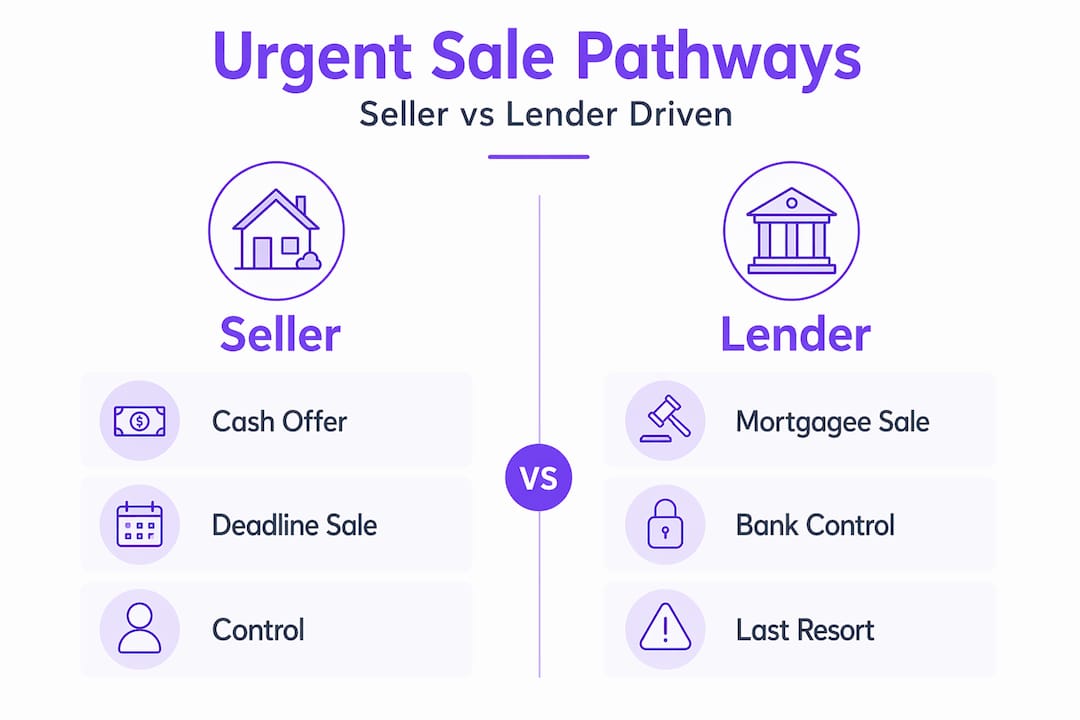
Not all urgent sales are created equal. The single most important distinction you need to understand is whether the sale is driven by you or driven by your lender. These two pathways feel very different in practice, and they carry very different consequences for your financial outcome.
| Feature | Seller-driven (cash offer or deadline sale) | Lender-driven (mortgagee sale) |
|---|---|---|
| Who controls the process | You, the seller | The lender or bank |
| Speed | Can settle in as little as 7 days | Weeks to months after formal notices |
| Typical scenario | Financial pressure, relocation, unwanted property | Loan default after remedy period expires |
| Flexibility | High: you choose the buyer and timeline | Low: lender acts in its own interest |
| Sale price outcome | Negotiable, often fair market value | May fall below market value |
| Emotional control | You initiate and manage | Reactive, often stressful |
The types of quick property sales available in New Zealand range from direct cash buyer purchases through to deadline sales, each offering varying degrees of speed and market exposure. A deadline sale, for example, sets a fixed date by which buyers must submit offers. Importantly, you as the seller are not required to accept any offer, even if it exceeds your expectations. This gives you genuine flexibility while still creating competitive buyer interest.
A mortgagee sale, by contrast, occurs only after a formal default process. The lender takes control and sells the property to recover what it is owed. Understanding what a cash offer means before you reach that stage is critical because it gives you an alternative pathway with far more dignity and financial upside.
The Banking Ombudsman Scheme notes that for homeowners needing an urgent sale, the key distinction is timing and control: a seller-driven urgency option versus a lender-driven forced sale after formal default steps and notices.
Pro Tip: If you suspect you might default on your mortgage in the coming months, explore quick-sale options now. Acting early preserves your bargaining power and keeps the decision in your hands, not the bank’s.
Understanding the mortgagee sale process: Last-resort pathway
A mortgagee sale is the outcome most homeowners fear, and understandably so. But knowing how the process actually works can help you act before it reaches that point. The good news is that there are legally required steps a lender must follow before they can sell your home, and those steps give you a meaningful window of opportunity.
Step-by-step legal process for a mortgagee sale:
- Loan default occurs — You miss mortgage repayments or breach another loan condition.
- Default notice is served — The lender issues a formal written notice outlining the default and what you must do to remedy it.
- Remedial period begins — You are given a legally defined period to fix the default, usually by catching up on missed payments.
- No remedy takes place — If you do not resolve the default within the remedy period, the lender may then exercise enforcement powers.
- Lender initiates sale — The bank appoints a selling agent and proceeds to market and sell the property to recover the outstanding debt.
- Settlement and proceeds — Any funds above the outstanding debt and sale costs are returned to you, but the process offers little control over price or timing.
As confirmed by legal guidance on default notices under the Property Law Act 2007, before the mortgagee exercises enforcement powers like selling, it must provide a valid default notice and the mortgagor must be given a remedial period to fix the default.
| Stage | What happens | Who has control |
|---|---|---|
| Default notice served | Written notice of breach, amount owing, remedy required | Lender initiates, but you can still act |
| Remedial period | You have a set timeframe to repay arrears or resolve breach | You |
| Remedy period expires | Lender may proceed with enforcement | Lender |
| Property marketed | Agent appointed, property listed | Lender |
| Settlement | Sale proceeds used to repay debt | Lender |
The critical opportunity window: The Banking Ombudsman confirms that if the borrower repays the debt secured by the mortgage, the mortgage is discharged. That means repaying your overdue amount stops the entire enforcement process. This is your most powerful tool if you are in the early stages of default.
Reaching the mortgagee sale stage carries real emotional and financial costs. Beyond the stress of losing your home, you may also lose equity built over years if the bank sells quickly at a lower price. The earlier you seek a solution, whether through refinancing, selling privately, or accessing a fast cash offer, the better your outcome is likely to be.
Explore your quick sale steps explained to understand what a seller-led resolution looks like in practice.
How fast, fair urgent sales work: Seller-focused strategies
If you have decided to take control and sell quickly on your own terms, you have two primary pathways: a direct cash offer or a deadline sale. Both can move significantly faster than a traditional real estate listing and can be completed without the usual weeks of open homes, negotiations, and waiting.
Steps in a typical cash offer or direct sale:
- Submit property details — Share basic information about your property, including its condition, location, and your preferred timeline.
- Receive an offer — A direct buyer or cash purchasing company reviews your details and provides a no-obligation offer, often within 24 to 48 hours.
- Review and accept — You review the terms at your own pace. There is no pressure to accept anything that does not suit you.
- Sign the agreement — A straightforward sale and purchase agreement is prepared with minimal conditions attached.
- Settle on your timeline — Settlement can occur in as little as seven days if needed, or you can negotiate a date that suits your situation.
Fast property-sale pathways are marketed as simpler and potentially quicker than conventional sales, often aiming for settlement as fast as seven days. That speed is not just convenient; it can also prevent further financial deterioration, such as growing arrears, rising repair costs, or mounting holding costs on a property you no longer want.
The deadline sale is a useful middle ground if you want some market competition without committing to a lengthy campaign. Buyers submit their best offers by a fixed date and time, and as noted in this buyer’s guide to sale methods, the seller is not obliged to accept any offer, even if above expectations. This keeps the power firmly with you.

Pro Tip: Before signing any fast sale agreement, confirm the buyer’s credentials, check that the contract has no unusual conditions, and make sure you understand the settlement date and what costs you are responsible for. Speed should never mean skipping due diligence.
There are honest trade-offs to acknowledge. A direct cash buyer may offer slightly below the top of the market in exchange for certainty, speed, and no commission fees. For many sellers, particularly those understanding fast, fair offers, that trade-off is absolutely worth it. Reduced stress, no open homes, no drawn-out negotiations, and a guaranteed result often outweigh a marginal price difference. You can also explore private property sale tips to understand what else you can do to maximise your outcome. Reading about why accept a fast offer can also help you weigh up the decision clearly.
An expert perspective: What most NZ homeowners overlook when selling urgently
Here is something most articles on urgent sales do not say plainly: the biggest mistakes are rarely about choosing the wrong sale method. They are about panicking too early, or waiting too long.
When homeowners panic, they accept the first offer that arrives without checking whether it is reasonable, whether the buyer is credible, or whether the terms actually suit their situation. Speed feels like safety when you are under pressure, but signing a bad contract quickly can leave you worse off than if you had taken two extra days to compare options.
On the other side, many homeowners wait too long before acting, assuming the lender will be flexible or that things will resolve themselves. The legal process tied to mortgagee sales is not flexible. As confirmed by guidance on property default notices, once enforcement begins, your window to influence the outcome narrows quickly. Early engagement and negotiation to remedy the default, or to secure a voluntary sale that discharges the mortgage, can be decisive.
“The clock is ticking, but you have more control than you think. The homeowners who get the best outcomes in urgent sales are the ones who act early, ask questions, and refuse to be rushed into a decision they do not understand.”
Another overlooked factor is cost calculation. Sellers often focus on the sale price but forget to calculate the full picture: agent commissions if using a real estate agent, legal fees, the cost of bridging accommodation, and the financial impact of holding the property for an extra two or three months while waiting for a traditional sale to complete. When you add all of that up, a fast cash offer that saves you those costs and months of stress often delivers comparable net proceeds.
Our guide to selling fast walks you through how to calculate your real bottom line, so you can compare options accurately and make a decision you feel confident about.
Get help with your urgent sale today
If you are facing financial pressure, a major life change, or simply need to sell quickly and move on, you do not have to navigate this process alone. Fast, fair, and stress-free sale options genuinely exist in New Zealand, and they are more accessible than most homeowners realise.
At easySale.co.nz, we work with homeowners across New Zealand who need a straightforward solution. There are no real estate agents involved, no open homes, and no commission fees. You submit your property details, receive a no-obligation cash offer, and settle on a timeline that works for you. Whether you need seven days or seven weeks, we work around your situation. If you are ready to take the next step, sell your house privately with us and get a fair offer without the usual hassle.
Frequently asked questions
How quickly can I sell my house in an urgent sale in New Zealand?
A private sale with a cash offer can settle in as little as seven days, depending on buyer readiness and your preferred settlement date.
What is the difference between a mortgagee sale and a deadline sale?
A mortgagee sale is forced by the lender after loan default, while a deadline sale lets you set a date and choose from buyer offers with no obligation to accept any of them.
Can I stop a mortgagee sale if I pay my overdue amount?
Yes. Repaying the debt secured by the mortgage discharges it entirely, which stops the bank from proceeding with any enforcement or sale.
Who buys houses quickly in New Zealand?
Most fast sales are made directly to cash buyers or companies specialising in urgent purchases, offering no-obligation offers with fast settlement timelines.
What legal notice must be given before a mortgagee sale?
A formal default notice must be served giving you a remedial period to fix the default before any enforcement action such as a sale can lawfully begin.


