
Divorce property sale process: stress-free NZ guide

Divorce creates immediate financial and emotional pressure, especially when the family home sits at the centre of property division. New Zealand homeowners navigating separation face complex legal requirements, tight deadlines, and the stress of managing a property sale while dealing with relationship breakdown. This guide walks you through the divorce property sale process step by step, covering legal frameworks, practical options, timelines, costs, and strategies to achieve a quick, fair outcome with minimal stress.
Table of Contents
- Key takeaways
- Understanding relationship property division under New Zealand law
- Options for handling the family home during divorce
- Step-by-step process to sell your property during divorce
- Timelines, costs, and common challenges in divorce property sales
- Fast, fair property sales support for divorcing homeowners
- Frequently asked questions
Key Takeaways
| Point | Details |
|---|---|
| Fifty fifty split | Under New Zealand law the family home is typically divided fifty fifty in relationships lasting three years or more. |
| Sale or buyout | Options include selling the property, a buyout by one partner, offsetting assets or maintaining temporary joint ownership. |
| Lawyer certified agreements | Separation agreements must be certified by independent lawyers to be legally binding and settlements operate under tight timelines. |
| Fast cash sales | Fast cash sales can speed settlement and reduce stress when urgency exists. |
| Costs vary widely | Costs and fees vary widely but quick sales can significantly reduce fees and stress. |
Understanding relationship property division under New Zealand law
Under New Zealand’s Property (Relationships) Act 1976, the family home is typically relationship property divided 50/50 in relationships of 3+ years. This equal division principle applies to most married and de facto couples, covering the house itself plus other assets acquired during the relationship. The law aims to recognise both partners’ contributions, whether financial or non-financial, creating a fair starting point for property settlements.
Shorter relationships under three years follow different rules. Courts consider individual contributions rather than automatic equal division, examining who paid deposits, mortgage payments, or renovation costs. This contribution-based approach can lead to unequal splits favouring the partner who invested more financially or practically in the property.
Separation agreements must be certified by independent lawyers to be legally binding. Each partner needs their own solicitor to review terms, ensuring both parties understand their rights and obligations before signing. Courts scrutinise trusts and other ownership structures to determine true asset ownership, sometimes piercing trust arrangements if they were created to avoid fair division. Understanding these legal foundations helps you avoid surprises during negotiations and prepares you for realistic outcomes.
Key legal considerations include:
- Relationship property covers the family home, vehicles, furniture, and shared investments acquired during the relationship
- Separate property like inheritances or pre-relationship assets typically stays with the original owner
- Contributions to mortgage payments, renovations, or maintenance affect division in shorter relationships
- Courts can adjust equal division in cases of economic disparity or if one partner dissipates assets
Pro Tip: Engage a family lawyer early in the separation process, even before formal divorce proceedings begin. Early legal advice clarifies your position, identifies potential complications with trusts or separate property claims, and helps you negotiate from an informed position. This investment typically saves money and stress by avoiding costly disputes later.
With the legal framework understood, you can now evaluate practical options for handling the family home during your divorce, choosing the approach that best fits your financial situation and timeline.
Options for handling the family home during divorce
You face several paths when deciding what to do with your shared property. Common options include selling the property and splitting proceeds, one partner buying out the other, offsetting the home’s value against other assets, or maintaining temporary joint ownership. Each approach suits different circumstances, financial capabilities, and relationship dynamics.
Selling the property and dividing proceeds offers clean separation and equal financial outcomes. Both partners walk away with their share in cash, eliminating ongoing financial ties. However, traditional market sales can be slow and stressful, taking months to achieve settlement whilst you manage inspections, negotiations, and buyer financing delays. Quick cash sales provide an alternative, offering speed and reduced stress when urgency exists, though potentially at slightly lower sale prices.
The buyout option suits situations where one partner can afford sole ownership and wants to keep the family home. This works well when children are involved and maintaining stability matters, or when one partner has strong emotional attachment to the property. The buying partner must secure financing to pay out the other’s share, which requires sufficient income and equity. This approach avoids market uncertainty but concentrates financial risk in one person.
Offsetting property value against other assets creates flexibility when substantial investments, KiwiSaver funds, or business interests exist. One partner keeps the house whilst the other receives equivalent value through shares, vehicles, or other property. This requires accurate valuations and careful legal documentation to ensure fairness. Temporary joint ownership delays the sale decision, useful when market conditions are poor or when children need stability during a transition period. Both partners remain on the title and share ongoing costs until an agreed future sale date.
| Option | Best for | Advantages | Disadvantages |
|---|---|---|---|
| Traditional market sale | Maximising sale price, no time pressure | Highest potential return, competitive bidding | Slow process (3-6 months), high agent fees, ongoing stress |
| Quick cash sale | Financial urgency, stress reduction | Fast settlement (10-18 days), no agent fees, certainty | Potentially lower offer than market peak |
| Buyout | One partner keeping home, children’s stability | Clean break, no market exposure | Requires financing, concentrates risk |
| Asset offset | Complex asset portfolios | Flexible, avoids forced sale | Needs accurate valuations, complex negotiations |
| Temporary joint ownership | Poor market, children’s needs | Delays decision, maintains stability | Ongoing shared costs, continued financial ties |
Pro Tip: If facing financial pressure from mortgage arrears, pending repossession, or urgent relocation needs, prioritise speed over maximising sale price. Quick cash sales often deliver better net outcomes by eliminating agent commissions, reducing legal complexity, and preventing costly mortgage default penalties. Calculate your actual take-home amount after all fees and carrying costs when comparing options.
Having considered your property handling options, the next section guides you through practical steps to execute the sale efficiently and legally, ensuring you meet all requirements whilst protecting your interests.
Step-by-step process to sell your property during divorce
Executing a divorce property sale requires careful coordination of legal agreements, property preparation, and sale negotiations. Following a structured process helps you avoid delays, disputes, and unexpected costs whilst achieving a fair outcome.

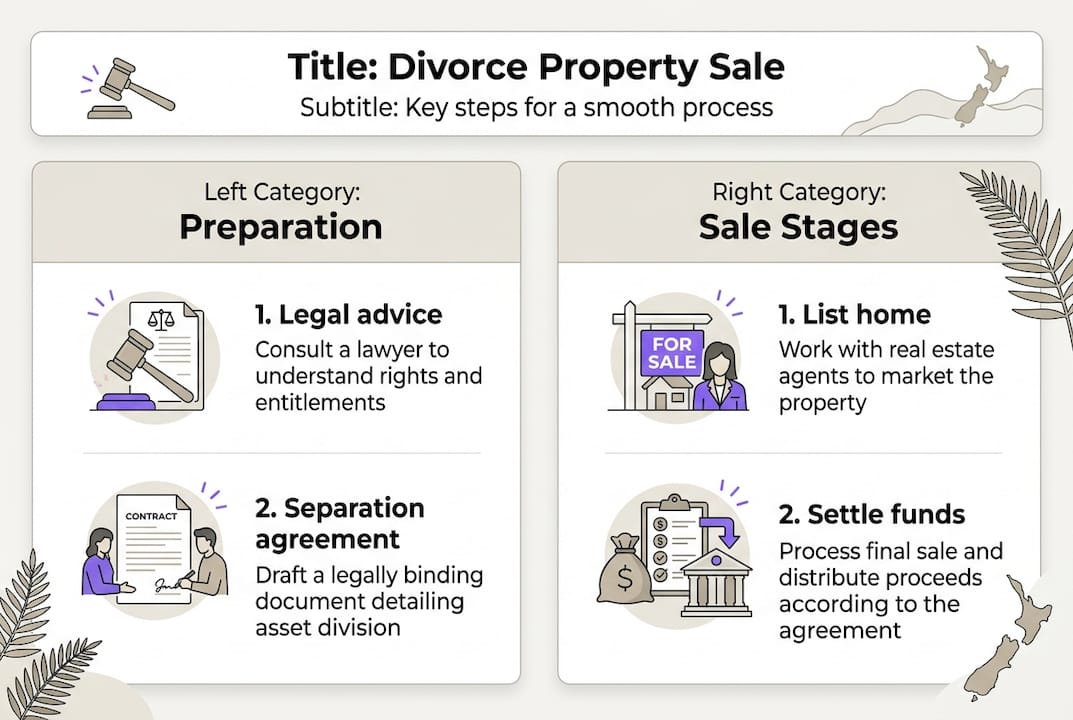
First, draft and certify a separation agreement with independent lawyers. This legally binding document records how you’ll divide the property, who pays ongoing costs until settlement, and how you’ll split sale proceeds. Each partner needs their own solicitor to review and certify the agreement, ensuring both parties understand terms and consent freely. This step typically costs $1,500 to $3,500 but provides essential legal protection and clarity.
Second, decide your sale method based on urgency and stress tolerance. Traditional real estate listing maximises exposure through open homes, online marketing, and agent networks, potentially achieving higher prices through competitive bidding. This route takes three to six months on average and involves ongoing property maintenance, multiple inspections, and negotiation uncertainty. Quick cash sales through property buying services offer guaranteed purchases within days, eliminating agent fees, open homes, and buyer financing risks. This method suits urgent situations where speed and certainty outweigh maximising price.
Third, prepare your property for sale regardless of method chosen. Arrange building inspections if selling traditionally, providing buyers with confidence about the property’s condition. Gather documentation including rates notices, insurance details, and any renovation or maintenance records. Disclose known issues honestly to avoid legal complications post-sale. Quick cash buyers typically purchase properties as-is, reducing preparation requirements significantly.
Fourth, negotiate offers and accept one meeting your timeline and financial needs. Traditional sales involve back-and-forth negotiations on price, settlement dates, and conditions. Cash offers usually come with fewer conditions and faster settlement terms, providing certainty when you need quick resolution. Ensure both partners agree on the accepted offer as required by your separation agreement.
Fifth, complete sale settlement, transfer ownership, and distribute funds per your agreement. Your lawyers coordinate with the buyer’s solicitor to finalise documentation, arrange title transfer, and ensure mortgage discharge. Settlement typically occurs 30 to 90 days after offer acceptance for traditional sales, or 10 to 18 days for quick cash purchases. Funds are distributed according to your separation agreement terms once all parties sign final documents.
| Sale stage | Traditional market sale | Quick cash sale |
|---|---|---|
| Agreement preparation | 2-4 weeks | 2-4 weeks |
| Property listing/offer | 4-12 weeks | 24-48 hours |
| Offer negotiation | 1-3 weeks | Immediate |
| Settlement period | 4-12 weeks | 10-18 days |
| Total timeline | 3-6 months | 3-5 weeks |
| Agent fees | ~$25,000 (on $500k sale) | $0 |
| Legal costs | $2,000-$4,000 | $1,500-$2,500 |
Pro Tip: Request quick cash offers even if you’re considering traditional sale. Having a guaranteed backup offer provides negotiating leverage with traditional buyers and creates a safety net if market conditions deteriorate. Many property buying services provide no-obligation quotes within 24 hours, giving you options without commitment.
After understanding the steps to sell your property, it’s important to be aware of timelines and common challenges to avoid delays or disputes that could derail your sale.
Timelines, costs, and common challenges in divorce property sales
New Zealand law sets strict deadlines for resolving property claims after separation. De facto couples have three years from separation to initiate court proceedings for property division. Married couples must apply within 12 months after their divorce becomes final. Missing these deadlines can permanently bar your claim to relationship property, making early action critical when separation occurs.
Cost ranges vary dramatically based on your approach and level of agreement. Uncontested separation agreements cost $1,500 to $3,500 for legal drafting and certification. Contested proceedings requiring court involvement escalate quickly, ranging from $5,000 for simple disputes to over $30,000 for complex cases involving trusts, business assets, or lengthy litigation. Quick private sales can save approximately $25,000 in real estate agent commissions on a typical $500,000 property, significantly reducing your total divorce costs.
Common challenges complicate many divorce property sales. Contested ownership claims arise when one partner disputes the 50/50 division, arguing separate property contributions or seeking adjustments for economic disparity. These disputes require court intervention, adding months or years to resolution timelines. Delayed agreements occur when partners can’t reach consensus on sale method, timing, or price expectations, leaving the property in limbo whilst carrying costs accumulate.
Emotional stress causes practical delays as separating partners struggle to communicate effectively about property decisions. One partner may resist selling due to attachment to the family home, or disagreements about property value create negotiation deadlocks. Financial strain from maintaining mortgage payments, rates, and insurance on a property neither partner occupies adds pressure, sometimes forcing rushed decisions or default risks.
| Factor | Traditional market sale | Quick cash sale |
|---|---|---|
| Average timeline | 3-6 months | 3-5 weeks |
| Price achieved | Potentially higher (market dependent) | Fair market value, slightly below peak |
| Agent fees | $20,000-$30,000 | $0 |
| Stress level | High (open homes, negotiations, uncertainty) | Low (quick certainty, minimal involvement) |
| Buyer financing risk | High (sales fall through on finance) | None (unconditional cash purchase) |
| Property preparation | Extensive (repairs, staging, cleaning) | Minimal (sold as-is) |
Key challenges to anticipate:
- Disagreement on property valuation requiring independent appraisal
- One partner blocking sale to maintain control or create financial pressure
- Difficulty securing finance for buyouts when equity is limited
- Market downturns reducing expected sale proceeds
- Urgent relocation or financial needs creating time pressure
Pro Tip: Set realistic timelines early and build in buffer periods for unexpected delays. If you’re facing mortgage arrears or repossession threats, communicate urgency clearly to your lawyer and consider quick sale options immediately rather than hoping for traditional sale success. Early legal advice and pragmatic decision-making reduce risks of costly disputes that can consume tens of thousands in legal fees.
Having covered the practical and financial challenges of divorce property sales, you now understand where obstacles typically arise and how to navigate them effectively.
Fast, fair property sales support for divorcing homeowners
Navigating property sales during divorce doesn’t have to compound your stress. EasySale specialises in fast cash offers for houses in any condition, helping divorcing homeowners avoid lengthy traditional sales that drain time, money, and emotional energy. Our service reduces stress and legal fees by offering a quick and private solution that respects your need for certainty during a difficult transition.

We buy homes as-is with fair pricing, settling sales in 10 to 18 days to meet urgent needs. No agent fees, no open homes, no buyer financing delays. Just a straightforward cash offer and a settlement timeline that works for your situation. Our divorce and separation home sales service guides you through your options with experienced professionals who understand the unique pressures you face.
Whether you’re dealing with financial pressure, need to relocate quickly, or simply want to move forward without the stress of traditional property marketing, EasySale provides a practical alternative. Contact us today to discuss your situation and receive a no-obligation cash offer within 24 hours.
Frequently asked questions
What is the usual timeline to complete a divorce property sale in New Zealand?
Agreed sales typically complete within one to three months from initial separation agreement to final settlement. Contested cases involving court proceedings can extend from six months to over 18 months depending on complexity and dispute severity. Quick cash sales significantly accelerate this timeline, often settling within three to five weeks total including agreement preparation.
Can I sell the family home without my spouse’s consent during divorce?
No, sales require agreement documented in a lawyer-certified separation agreement or court order. Both partners typically hold legal interest in relationship property, preventing unilateral sale decisions. Without consent, you must apply to the Family Court for orders authorising the sale, which adds time and legal costs. This requirement protects both parties’ interests and prevents unauthorised asset disposal during separation.
How can I speed up the sale if facing financial pressure during divorce?
Consider selling to quick cash buyers who provide offers within 24 to 48 hours and settlements in as little as 10 days. This method saves agent fees, reduces stress, and eliminates buyer financing delays that often derail traditional sales. Early agreement between partners and choosing fast sale options help avoid repossession and financial hardship. Selling your house fast becomes critical when mortgage arrears threaten your credit rating or when urgent relocation needs arise.
What costs should I expect during the divorce property sale process?
Prepare for legal costs between $1,500 and $3,500 for uncontested separation agreements with lawyer certification. Contested proceedings requiring court involvement can cost $5,000 to over $30,000 depending on complexity and duration. Traditional real estate sales add agent commissions of approximately $25,000 on a $500,000 property. Quick cash sales eliminate agent fees entirely, significantly reducing your total divorce costs whilst providing faster access to your equity share.
Recommended
