
Divorce property sale tips for Kiwis: fast, fair, low stress


TL;DR:Before listing or marketing shared property after separation, get independent legal advice and agree on a clear selling strategy.Options for selling include joint sale, one-party buyout, delayed sale, quick cash sale, or court-ordered sale, each with different pros and cons.
If you need to sell shared property after separation, do this first: pause, get independent legal advice, and agree on one clear selling route before you contact a single agent or lender. That one step protects your financial interests and prevents the kind of costly disputes that drag on for months.
Here is what to do in the next 48–72 hours:
- Get independent legal advice. Each party needs their own lawyer. Shared legal advice is not independent and will not make any agreement enforceable.
- Document ownership. Pull the title from Land Information New Zealand (LINZ) and confirm who is on it.
- Gather your financial paperwork. Mortgage statements, rates notices, insurance policies, any recent valuation, and KiwiSaver statements for both parties.
- Freeze major financial moves. Do not refinance, redraw, or make large withdrawals from joint accounts until you have legal advice.
- Start a disclosure list. Write down every asset and liability you share, including the property, vehicles, savings, and debts.
- Consider a notice of interest (caveat). If you are worried your partner might attempt to sell or mortgage the property without your agreement, a solicitor can lodge a caveat against the title quickly. This prevents any dealing on the title without your involvement.
Pro Tip: Keep a dedicated folder, physical or digital, for every document you gather. Date each item as you add it. This simple habit saves hours of back-and-forth with lawyers later.
Table of Contents
- How do you prepare to sell while separated?
- What are your selling options when divorcing?
- What happens if your partner refuses to sell?
- How do you run the sale with minimal conflict?
- How do you make a property agreement legally binding in New Zealand?
- What does the financial settlement actually look like?
- Key takeaways
- The part most people get wrong about selling property after separation
- When a direct cash sale is the right call
- Useful NZ sources and where to get help
How do you prepare to sell while separated?
The first week is about information, not action. Before you list the property or agree to anything, you need a clear picture of what you own, what you owe, and who is responsible for ongoing costs.
Week 1: Disclosure and contacts
Start by listing every shared asset and liability in writing. Include the property address, current mortgage balance, rates arrears, insurance status, and any outstanding repairs. Contact your lender to confirm the mortgage balance and ask about discharge fees. These figures matter when calculating net proceeds.
Reach out to a family lawyer early. You do not need to be divorced to start dividing property. Under New Zealand law, separating parties can formalise division at any point during separation, well before any divorce is finalised. If you are not ready to engage a lawyer immediately, community law centres and Citizens Advice can provide initial guidance and point you in the right direction at no cost.
Week 2: Valuation and agent conversations
Get a market view before you commit to any price. A comparative market analysis (CMA) from a local agent is free and gives you a working range. For a formal figure that holds up in legal negotiations, commission a registered valuation from a Registered Valuer. This is worth the cost if the parties disagree on price.

When you speak to agents, do it together where possible. Both parties need to agree on the agent, the listing price, and the marketing strategy. Deciding these things separately creates conflict later.
Month 1: Agree on logistics

Before the property goes live, agree in writing on who pays for repairs, staging, and open-home preparation. Decide how viewings will be managed if one party is still living in the home. Arrange secure storage for valuables. These conversations are easier to have before an offer is on the table than after.
Pro Tip: Keep a contemporaneous ledger of every property outgoing you pay during separation: mortgage payments, rates, insurance premiums, and repair costs. These figures are frequently used to adjust the final proceeds split, and documented outgoings can materially affect your settlement calculation.
What are your selling options when divorcing?
There are five main routes for selling shared property after separation. Each has real trade-offs, and the right choice depends on your timeline, financial position, and the level of cooperation between you and your ex-partner.
| Selling option | Speed to settlement | Likely price vs market | Fees and costs | Certainty of completion | Privacy and stress |
|---|---|---|---|---|---|
| Joint sale via agent | — | Close to market value | Agent commission plus legal and conveyancing fees | Conditional on buyer finance and building reports | Moderate: open homes, marketing, public listing |
| One party buys out the other | — | Market value (registered valuation recommended) | Legal fees, valuation, possible stamp duty | High once both parties sign | High privacy; no public marketing |
| Delay or retain | Indefinite | Market value at future date | Ongoing mortgage, rates, insurance | Low: depends on future agreement | Can be high if relationship remains strained |
| Fast cash buyer (direct sale) | 7–21 days possible | Below market value (discount for speed and certainty) | No agent commission; legal fees only | Very high: cash, no conditions | High privacy; no open homes or listings |
| Court-ordered sale | 12–24+ months | Market value (court-appointed agent) | Legal fees, court filing fees, hearing fees | High once ordered | High stress; public court process |
When does a fast cash buyer make sense?
A direct cash sale is worth considering when time pressure is real, the property needs work, or privacy matters more than squeezing every dollar from the market. It removes the stress of open homes, conditional offers falling through, and extended marketing periods. The trade-off is a lower sale price, so it suits sellers who value speed and certainty over maximising proceeds. For a practical look at quick sale options in NZ, the steps are straightforward.
A court-ordered sale is the last resort. It is slow, expensive, and the outcome is uncertain. Every other option is worth exhausting first.
What happens if your partner refuses to sell?
This is one of the most stressful situations in a separation, but there is a clear pathway through it. The sequence runs from negotiation to mediation to consent orders to court, and most cases resolve before reaching a hearing.
Step 1: Direct negotiation (days to weeks)
Write to your ex-partner, through your lawyer if needed, with a clear proposal: the selling route, a suggested price range, and a proposed timeline. A written proposal is harder to ignore than a verbal one and creates a record if the matter escalates.
Step 2: Mediation (weeks to 2–3 months)
If direct negotiation stalls, mediation or Family Dispute Resolution is the next step. A trained mediator helps both parties reach an agreement without going to court. This is faster and far cheaper than litigation. If you are already in Family Dispute Resolution for parenting arrangements, you can address property division in the same process.
Step 3: Consent orders (1–3 months)
If you reach an agreement through negotiation or mediation, you can file it with the Family Court as consent orders. Once sealed by the court, these orders are enforceable. Both parties still need independent legal advice before signing.
Step 4: Family Court application (12–24 months)
If no agreement is possible, either party can apply to the Family Court to divide relationship property. The filing fee is required, with additional fees for hearings charged per half-day. Under the Property (Relationships) Act 1976, the court has the power to order a sale, appoint a person to carry it out, and divide the proceeds. Contested proceedings commonly take 12–24 months.
Protecting your interest in the title
If you are concerned your partner might attempt to deal with the property without your agreement, a solicitor can lodge a caveat against the title quickly. This prevents any sale, mortgage, or transfer from proceeding without your involvement. It is a protective step, not an aggressive one, and it costs relatively little to put in place.
How do you run the sale with minimal conflict?
The agent you choose matters as much as the price you set. A neutral agent, one who has no prior relationship with either party, is far better placed to manage the process without being drawn into the dispute.
Appointing the right agent
Interview at least two or three agents together where possible. If that is not practical, each party can interview candidates separately and compare notes. Look for someone who is direct about process, clear on how they will communicate with both parties, and experienced with separation sales.
Questions worth asking in the interview:
- How will you communicate with both of us if we are not in contact with each other?
- What happens if we disagree on an offer?
- Have you managed a sale where the owners were separated before?
- How do you handle open homes when one party is still living in the property?
Red flags include an agent who dismisses the complexity, promises a price that seems unrealistically high, or seems uncomfortable with the situation. Both parties must sign the agency agreement, so both joint owners need to be comfortable with the appointment.
Marketing and showing protocols
Agree on the marketing strategy before signing anything: listing price, marketing budget, photography date, and whether to hold open homes or private viewings only. Put it in writing. If one party is living in the property, agree on notice periods for viewings, who is responsible for presentation, and where valuables will be stored during open homes.
When offers come in, the agent presents them to both parties. Neither party can accept or reject an offer unilaterally. If you disagree on an offer, the agent can facilitate discussion, but cannot make the decision for you. This is where having agreed price parameters in advance saves a lot of friction.
Pro Tip: NZ agents use platforms like AdPropix to manage property marketing across multiple channels. Understanding how your property will be marketed helps both parties feel informed and reduces suspicion about the process.
How do you make a property agreement legally binding in New Zealand?
The fastest enforceable path is a properly executed section 21A contracting-out agreement or sealed consent orders. Anything less than that is an informal promise, and informal promises are genuinely hard to enforce.
Under the Property (Relationships) Act 1976, the starting point for dividing the family home is equal sharing. You can contract out of that default, but only if the agreement meets strict formal requirements.
Formal requirements for a contracting-out agreement:
- The agreement must be in writing.
- Each party must have independent legal advice from their own lawyer before signing. Shared advice does not satisfy this requirement.
- Each lawyer must certify that they explained the agreement and its effects to their client. This certification appears on the document itself.
- Both parties sign the agreement in the presence of their respective lawyers.
If any of these steps are missed, the agreement may not be enforceable through the court. That means either party could later challenge it, which typically leads to the costlier court process you were trying to avoid.
Consent orders as an alternative
If you reach agreement through mediation or negotiation, you can file that agreement with the Family Court as consent orders. The court seals the orders, making them enforceable without a contested hearing. Both parties still need independent legal advice before the orders are filed.
Where to get help
- Family lawyer: the most direct route for a formal contracting-out agreement or consent orders
- Community Law: free legal advice at community law centres across New Zealand
- Citizens Advice Bureau: initial guidance and referrals
- Family Court: contact details and forms at justice.govt.nz
Pro Tip: Getting independent legal advice early costs far less than fixing an unenforceable agreement later. The biggest mistake separated couples make is negotiating property division without formalising it through independent legal counsel. Informal promises regularly lead to costlier court disputes.
What does the financial settlement actually look like?
Settlement is the point where the mortgage is paid off, costs are deducted, and the remaining proceeds are split. Getting there requires clear records and a realistic budget.
What to record during the marketing period
Keep receipts and bank statements for every property-related payment made during separation: mortgage repayments, rates, insurance premiums, body corporate levies, and any repairs or maintenance. These figures are used to adjust the final proceeds split. The party who has paid more than their share of outgoings may be entitled to a credit at settlement.
Typical settlement timeline
- Unconditional offer received: day 0
- Settlement date agreed (typically 20–40 working days): days 1–5
- Solicitor instructed to act on settlement: days 1–7
- Mortgage discharge arranged with lender: days 1–14
- Final settlement statement prepared: 5–7 days before settlement
- Settlement day: funds transferred, title transferred, keys released
Costs to budget for
- Agent commission: typically 2–4% of the sale price, negotiable
- Legal and conveyancing fees: varies by complexity; a standard PRA settlement involving the family home and KiwiSaver commonly costs both parties a combined NZ$5,000–NZ$15,000 in legal fees
- Registered valuation: NZ$700–NZ$1,200 typically
- Lender discharge fee: varies by lender; confirm with your bank
- Repairs and staging: agreed between parties before listing
KiwiSaver and other relationship assets
KiwiSaver balances accumulated during the relationship are generally relationship property under the Property (Relationships) Act 1976. They are typically addressed as part of the overall settlement calculation, not separately from the property sale. Your family lawyer can advise on how KiwiSaver is treated in your specific situation, and the Ministry of Justice has tools and guidance to help you understand your position.
For a detailed walkthrough of the divorce property sale process in New Zealand, including settlement logistics, that resource covers the steps clearly.
Key takeaways
Selling shared property after separation goes smoothest when you get independent legal advice early, document everything, and agree on a selling route before marketing begins.
| Point | Details |
|---|---|
| Get legal advice first | Each party needs their own lawyer; shared advice will not make any agreement enforceable. |
| Document all outgoings | Keep receipts for mortgage, rates, insurance, and repairs — these figures adjust the final proceeds split. |
| Agree on a neutral agent | Both joint owners must sign agency documents; appoint an agent neither party has a prior relationship with. |
| Know your legal options | A section 21A contracting-out agreement or sealed consent orders are the fastest enforceable paths in NZ. |
| Easysale for speed and privacy | If time or privacy are priorities, Easysale offers a direct cash purchase with no agent fees and flexible settlement. |
The part most people get wrong about selling property after separation
Most of the practical advice on this topic focuses on the legal steps, and rightly so. But the part that actually derails sales is not the paperwork. It is the decision-making gap between when people separate and when they get formal advice.
People wait. They try to sort things out between themselves first, which is understandable. But informal agreements about who gets what, made over text messages or kitchen table conversations, carry almost no legal weight. When the relationship deteriorates further, those agreements unravel, and the parties end up in exactly the court process they were trying to avoid, only now they have lost months and spent more money.
The other thing worth saying plainly: the equal-sharing presumption under the Property (Relationships) Act 1976 is the starting point, not the end point. There are legitimate carve-outs and adjustments available, but you will not know what applies to your situation without proper advice. Assuming a 50/50 split is automatic, or assuming it is not, are both mistakes that cost people real money.
Speed matters too. If both parties want a clean break and neither wants to buy the other out, a fast sale, even at a modest discount to market value, often leaves both people better off than a drawn-out traditional sale with months of conflict, ongoing shared costs, and the emotional weight of a property neither party wants to maintain.
When a direct cash sale is the right call
If time pressure or privacy are real factors in your situation, a direct cash buyer removes most of the friction from the process.
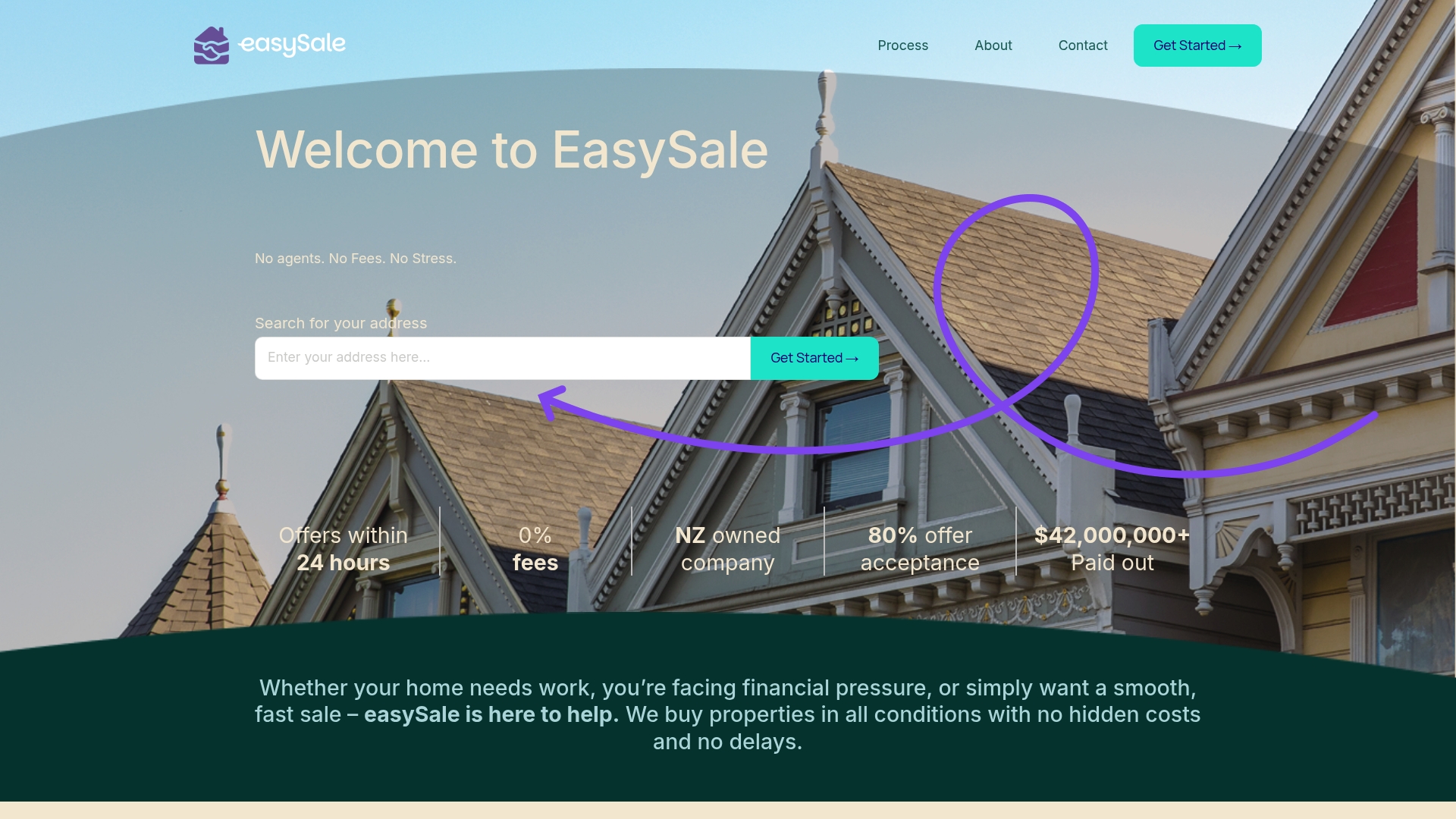
Easysale is a New Zealand-owned direct property buyer that purchases homes in any condition, with no agent involved and no commission fees. For separated couples who need a clean, fast exit, the process is straightforward: submit your property details, receive a no-obligation cash offer within 24 hours, and settle on a timeline that works for both parties. There are no open homes, no public listings, and no conditional offers that fall through at the last minute.
The trade-off is a sale price below what you might achieve through a traditional agent campaign. That is an honest reality. But for many Kiwis going through separation, the certainty of a confirmed cash offer, combined with the privacy of no public marketing and the speed of a settlement measured in days rather than months, makes that trade-off worthwhile.
If you are weighing up your options, you can get a no-obligation cash offer from Easysale directly. No commitment, no pressure, just a clear number so you can make an informed decision.
Useful NZ sources and where to get help
Getting the right support early makes a real difference. These are the most reliable New Zealand sources for legal guidance, financial information, and practical help.
- Ministry of Justice — divide relationship property: official guidance on the three pathways to dividing property, Family Court application forms, and filing fees
- Ministry of Justice — apply to divide relationship property: step-by-step application process, forms, and fee information (filing fee: $816 including GST)
- Community Law NZ: free legal advice at community law centres across New Zealand; no appointment needed at many centres
- Citizens Advice Bureau NZ: initial guidance, referrals, and practical information on separation and property
- Inland Revenue NZ: information on tax implications of property transfers and any bright-line test considerations relevant to your sale
- Settled.govt.nz: practical real estate guidance for sellers going through separation, including agent selection and process steps
- Easysale — divorce and separation sales: dedicated guidance for Kiwis selling shared property after separation, including the direct cash-buyer option
- Easysale — sell house privately: direct cash offers with no agent fees and flexible settlement timelines
This article provides general information only and is not legal or financial advice. Your situation will have specific details that affect your rights and obligations. Confirm the current rules with a qualified family lawyer or the relevant primary source before making decisions.


