
Why sell property during a breakup: a Kiwi guide

TL;DR:Many New Zealand couples face legal deadlines to resolve property division within three years of separation, making early sale essential to avoid court intervention. Selling the family home simplifies emotional negotiations, provides certainty, and allows quicker financial independence, especially compared to buyouts or holding joint ownership. Using a private, fast, and discreet sale with professional legal advice ensures a smooth transition during the challenging breakup period.
Breaking up is hard enough without realising you may be unknowingly approaching a legal deadline on your family home. Many New Zealand homeowners don’t know that understanding why sell property during a breakup matters as much as knowing when to act. Under New Zealand law, you generally have three years from separation to resolve relationship property, and letting that window slip can mean court intervention, frozen finances, and prolonged conflict. This guide explains the financial, legal, and emotional reasons why selling your home during a separation is often the most practical decision you can make.
Table of Contents
- The legal timeline and urgency for selling property in a breakup
- How selling converts complexity into clarity during a breakup
- Comparing property division options: sell, buyout, or hold
- Practical steps to sell property fast and discreetly during a breakup
- Why selling property during a breakup is often the smartest choice most overlook
- How easySale supports Kiwis selling property during a breakup
- Frequently asked questions
Key Takeaways
| Point | Details |
|---|---|
| Three-year deadline | You have three years from separation to settle property division before legal defaults apply. |
| Selling simplifies disputes | Selling turns complex ownership issues into clear cash splits, reducing stress and delays. |
| Buyouts can be hard | Refinancing solo to buy out a partner is often unaffordable, making selling more practical. |
| Fast sales need legal clarity | Confirming legal authority and having an agreement speeds up property sales during breakups. |
| Cash sales offer speed | Cash buyers provide quick, certain sales ideal for urgent, discreet property disposal. |
The legal timeline and urgency for selling property in a breakup
Time is a factor most separating couples underestimate. New Zealand’s Property (Relationships) Act 1976 governs how assets, including the family home, are divided after a relationship ends. The Act sets out a default position of equal sharing for qualifying relationships, but it also imposes a strict timeframe that catches many people off guard.
Relationship property claims in NZ must generally be settled within three years of the date of separation. Agreements made outside that window may face legal restrictions or require court approval to proceed. That means if you and your ex-partner delay decisions about the family home, your options narrow considerably over time.
“For New Zealand relationship property matters, you generally have 3 years from the date of separation to sort out how relationship property is divided; agreements made outside that window may be restricted.” — Trade Me Property
Here is why acting early on a property sale makes practical sense:
- Avoid court-imposed decisions. If you and your ex-partner cannot agree within the legal timeframe, a court may step in and impose a split. That process is slow, costly, and removes your ability to negotiate on your own terms.
- Protect your financial position. Ongoing mortgage payments, rates, insurance, and maintenance costs continue to accumulate on jointly owned property. Every month of delay has a real dollar cost.
- Reduce legal complexity. An agreed sale with a documented proceeds split is far simpler to execute than a contested property hearing. Understanding property sale timelines in NZ helps you plan accordingly.
- Enable financial independence sooner. Once the property is sold and proceeds are divided, both parties can move forward with their own finances, housing plans, and lives.
Acting promptly is not just about legal compliance. It is about preserving your options and reducing stress at an already difficult time.
How selling converts complexity into clarity during a breakup
One of the most overlooked benefits of selling property during a breakup is how it simplifies what is otherwise an emotionally loaded negotiation. When two people co-own a home, every decision about that property, from who pays the mortgage to who mows the lawn, becomes a potential point of conflict.
Selling sets a fixed, market-determined price that both parties agree on before the sale completes. That single number removes the ongoing argument about the home’s value and who deserves what share. Selling can convert disputes over who keeps the house into clearer cash splits, offering a faster and less adversarial resolution than waiting for complex settlements or buyouts.
Consider the alternative: a buyout. For one partner to buy out the other, they need to qualify for a mortgage on a single income. They must pass the bank’s lending criteria, often tougher now than when the original joint mortgage was approved. Many partners discover they simply cannot afford to take over the loan alone, which stalls the entire process.
Key advantages of selling over other options when selling property during divorce are on the table:
- Agreed cash split: Both parties receive a defined amount with no ongoing shared liability.
- No refinancing required: Neither partner needs to prove solo mortgage affordability.
- Removes shared upkeep obligations: No more shared responsibility for rates, repairs, or insurance premiums.
- Faster resolution: A sale can settle in weeks rather than the months a buyout negotiation may take.
- Reduced emotional triggers: Once sold, there is no property tying you both together financially.
Understanding the legal factors in selling property in New Zealand also helps you structure the sale correctly from the start, avoiding costly errors down the track.
Pro Tip: Before agreeing to any division arrangement, both parties should obtain independent legal advice. A solicitor can review your specific situation and ensure any agreement you reach is enforceable under the Property (Relationships) Act 1976.
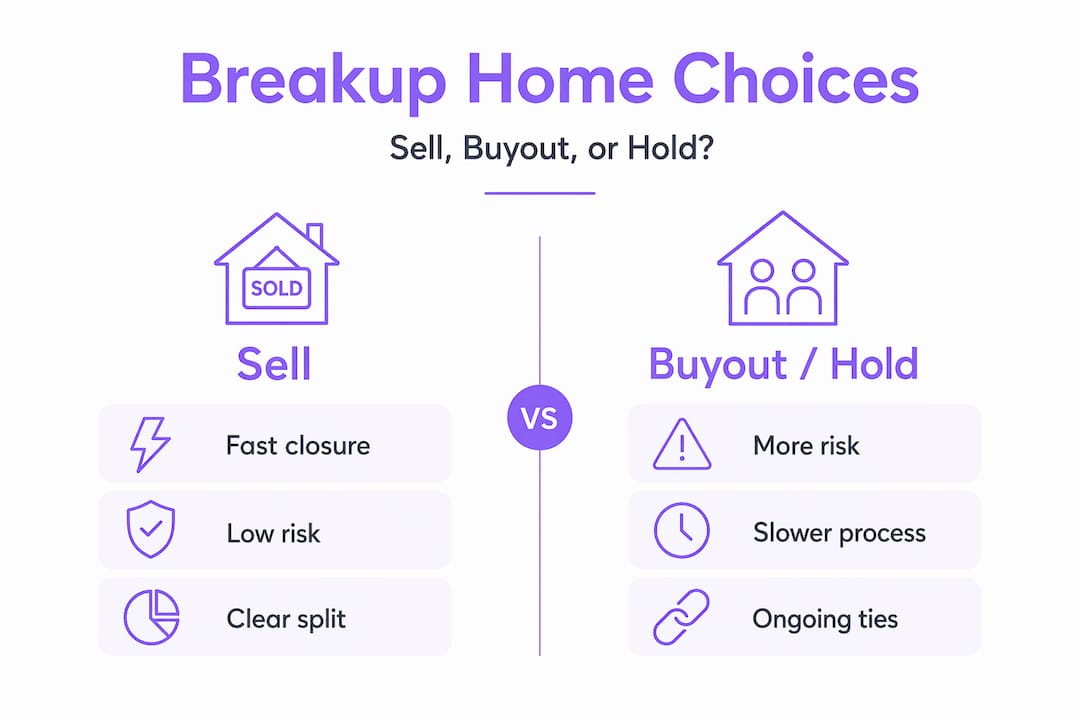
Comparing property division options: sell, buyout, or hold
When a relationship ends, most couples face three realistic choices for the family home. Understanding the practical implications of each helps you make a clear-headed decision rather than one driven purely by emotion.
| Option | Speed | Financial risk | Complexity | Best for |
|---|---|---|---|---|
| Sell and split proceeds | Fast | Low | Low | Most couples seeking a clean break |
| One partner buys the other out | Slow | Medium to high | High | When one partner can afford solo refinancing |
| Hold jointly and defer sale | Varies | High | Very high | Rarely recommended; prolongs shared liability |
The family home decision is typically the biggest emotional and financial issue in a separation, with selling and splitting proceeds, buyouts requiring refinancing, or offsetting values against other assets as the most common approaches. Each has merit in the right circumstances, but selling stands out for most Kiwi homeowners because it is the option that creates certainty fastest.
Here is what holding joint title really costs you:
- Ongoing mortgage repayments that both parties remain legally responsible for, even if only one lives in the home.
- Insurance and maintenance costs that continue to accumulate.
- Neither party can independently sell, refinance, or leverage the property without the other’s consent.
- Relationship tension tends to increase, not decrease, the longer shared ownership continues.
The buyout route carries its own risks. If the buying partner later defaults on the solo mortgage, the selling partner may still face credit implications depending on how the loan was structured. Banks scrutinise solo applications more carefully in a rising interest rate environment, and many prospective buyers are declined after what seemed like a sure thing.
Pro Tip: If you are leaning toward a buyout, have your partner obtain a pre-approval from their lender before you both commit to that path. Discovering the buyout is not financially viable six months into negotiations is a costly setback. A guide to selling property fast can help you move quickly if you decide selling is the smarter route.
Practical steps to sell property fast and discreetly during a breakup
Speed and privacy matter when you are navigating a separation. Open homes, public listings, and lengthy negotiations can feel invasive at a time when you simply want to move forward. Here is how to approach a property sale that is both efficient and discreet.

Confirming legal authority to sell is the first practical hurdle. In practice, the fastest sale hinges on confirming who has legal authority to sign and having a clear agreement on proceeds before marketing begins. Without this, a buyer’s solicitor may raise concerns that delay or derail the settlement.
Follow these steps to sell your property with minimal friction:
- Get independent legal advice first. Both parties should engage their own solicitor to review ownership, mortgage obligations, and any existing agreements. This protects everyone and prevents disputes mid-sale.
- Draw up a separation agreement. This document specifies the agreed sale price range, how proceeds will be divided, and who is authorised to sign sale documents. It does not need to be a full relationship property agreement to be useful at this stage.
- Confirm title ownership. Check the property’s certificate of title to identify all registered owners. Only those named on the title can legally sign a sale and purchase agreement.
- Choose your sale method carefully. Traditional agent-led sales with open homes take time and attract public attention. A private or direct cash sale is often faster and more discreet.
- Settle on a timeline that suits both parties. Cash buyers and direct purchasers often allow flexible settlement dates, which gives both parties time to arrange alternative accommodation without pressure.
Tips for selling your home during separation with minimal stress:
- Communicate through your solicitors if direct communication with your ex-partner is difficult.
- Avoid making improvements or spending money on the property without mutual agreement.
- Keep records of all shared costs during the sale process for accurate proceeds calculation.
If privacy is a priority, consider selling your home privately in NZ or working with a direct cash buyer to bypass public listings entirely. A fast, low-stress sale is achievable when you have the right process in place from the beginning.
Pro Tip: Ask any prospective buyer or buying service whether they can accommodate a confidential, off-market sale. Many direct buyers handle this routinely and understand that discretion is part of the service.
Why selling property during a breakup is often the smartest choice most overlook
Here is something most articles on this topic will not tell you: the biggest obstacle to a sensible property decision during a breakup is rarely legal. It is emotional.
Many people fight to keep the family home not because they can genuinely afford it, but because letting go feels like losing. The home carries memories, familiarity, and a sense of identity. That is completely understandable. But holding onto a property that strains your budget, ties you to your ex-partner financially, and prevents you from rebuilding independently is rarely the act of strength it feels like in the moment.
We have seen this pattern clearly: decisions made under emotional pressure without professional input or proper timing often cascade into costly long-term problems. Slowing down and getting expert help early usually leads to better outcomes for both parties.
The partner who insists on a buyout often discovers, months later, that the solo mortgage is crushing. The couple who defers the sale “until things settle down” sometimes finds themselves approaching the three-year legal limit with nothing resolved and legal fees mounting.
A swift, well-documented sale does something neither the buyout nor the holding pattern can offer: it creates a defined financial starting point for each person’s next chapter. The proceeds are split, the liability is cleared, and neither party owes the other an ongoing obligation tied to bricks and mortar.
Seeking a stress-free divorce property sale is not giving up. It is choosing a clean, clear path forward when your circumstances demand it. That distinction matters more than most people realise when they are in the thick of separation.
How easySale supports Kiwis selling property during a breakup
If you are navigating a separation and need to sell your home quickly, quietly, and without the pressure of traditional real estate, easySale is built for exactly that situation.

easySale purchases residential properties directly from New Zealand homeowners, offering fair cash offers with no agent fees, no open homes, and no conditional sale delays. Whether your property needs work or is in excellent condition, easySale can provide a no-obligation offer and settle on a timeline that suits both parties. For Kiwis managing the emotional and logistical weight of a separation home sale, that kind of certainty is genuinely valuable. easySale also supports homeowners dealing with other urgent life changes, including damaged properties and retirement downsizing. Submit your property details today for a fast, private, and fair cash offer.
Frequently asked questions
How long do I have to sell property after separating in New Zealand?
You generally have three years from separation to settle relationship property matters under the Property (Relationships) Act 1976, including agreeing on a sale.
Can I sell my shared home without my ex-partner’s consent?
Usually not. Both owners must agree to sell jointly owned property, and legal authority to proceed must be established through mutual agreement or a court order before marketing can begin.
Is selling property faster than one partner buying the other out?
Yes. Selling and splitting proceeds is typically faster because a buyout requires refinancing, which can be slow, expensive, and may be declined by the lender entirely.
What are the benefits of using a cash buyer to sell property during a breakup?
Cash buyers offer speed, certainty, and no agent commissions. Cash offers provide a fast, certain exit without the months of open homes or conditional sale risks typical of traditional listings.
How can I sell property discreetly during a breakup?
Private sales and direct cash buyers allow you to avoid public listings and open homes entirely. Private and direct buyer sales allow faster, more private transactions during separation or divorce, reducing exposure and emotional stress considerably.
Recommended
