
Buy-to-let property risks in New Zealand explained

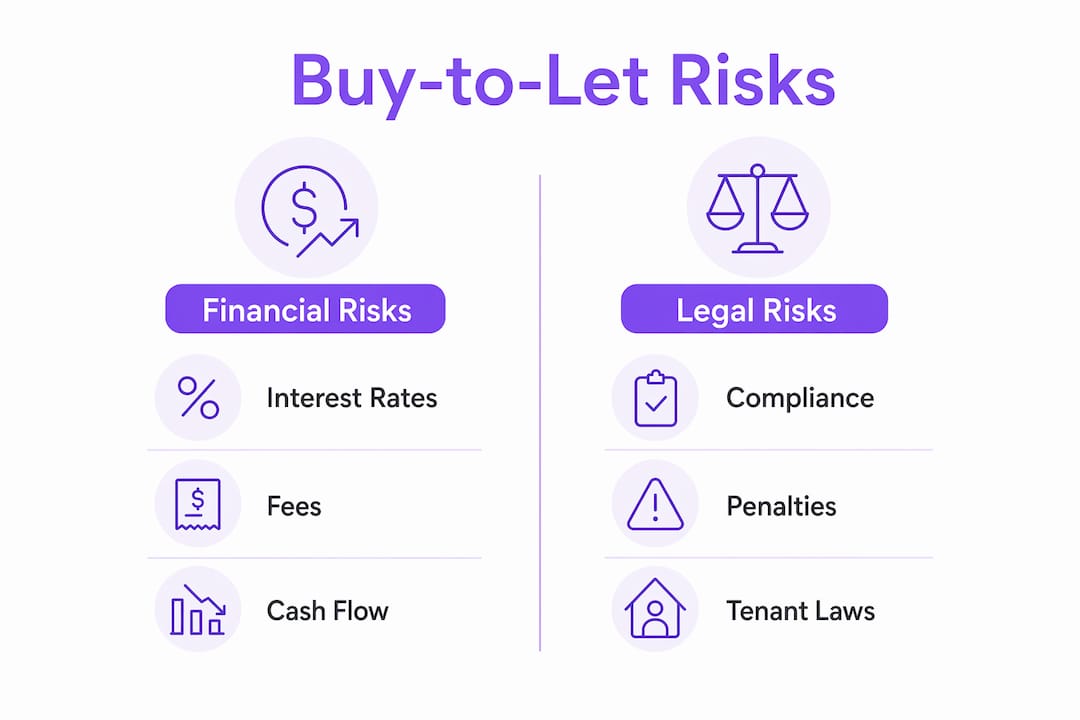
Buy-to-let property investment in New Zealand carries real financial, legal, and market risks that can catch unprepared investors off guard. Before you commit to a rental property, you need a clear picture of what you’re taking on. The main risk categories are:
- Financial risks: mortgage pressure, cash flow shortfalls, and unexpected maintenance costs
- Legal and compliance risks: obligations under the Residential Tenancies Act 1986 and Healthy Homes Standards, with penalties reaching NZ$7,200 per breach
- Tenant-related risks: rent arrears, vacancies, and property damage
- Market and economic risks: property value fluctuations, negative equity, and illiquidity
- Policy and regulatory risks: tax law changes, Reserve Bank of New Zealand (RBNZ) lending restrictions, and shifting government policy
Understanding these risks upfront is not about discouraging you from investing. It’s about going in with your eyes open so you can plan, budget, and make decisions that hold up over the long term.
What are the financial risks of buy-to-let investment in New Zealand?
Cash flow is the number one pressure point for most New Zealand landlords, and it catches first-timers by surprise more often than any other risk. Typical leveraged residential rentals in major New Zealand centres run at a cash flow shortfall averaging around NZ$270 per week. That means you’re topping up your mortgage from your salary every single week, not collecting passive income.
The Reserve Bank of New Zealand makes entry harder for investors than for owner-occupiers. RBNZ restricts high-LVR investor lending to no more than 10% of a bank’s total new investor mortgage lending, with high-LVR defined as loans above 70% of the property’s value. In practical terms, most investors need at least a 30% deposit to access standard lending.
Key figure: First-time landlords commonly underestimate total operating costs by 20–30%, and a healthy reserve fund often needs to exceed NZ$10,000 to cover at least three months of mortgage payments and urgent repairs.
Other financial risks worth planning for:
- Negative equity: If property values fall after you buy, you can end up owing more than the property is worth. Wellington and Auckland investors who purchased between 2019 and 2022 experienced this directly.
- Interest rate exposure: A rate increase of one to two percentage points on a typical mortgage can add several thousand dollars per year to your interest costs.
- Rental income lag: Rent increases take time to flow through. A rates bill increase needs paying now; the rental adjustment that offsets it can take months.
- Maintenance surprises: Leaking roofs, broken appliances, and deferred maintenance add up fast, especially on older properties. Budget for it, not around it.
Understanding property transaction fees is also part of the full financial picture, particularly when you’re calculating entry and exit costs.
Pro Tip: Before you buy, test your cash flow model at interest rates one to two percentage points above today’s level. If the numbers don’t work at that stress rate, the deal is too tight.
Legal and compliance risks under New Zealand tenancy laws
New Zealand landlords carry a significant compliance burden, and the financial penalties for getting it wrong are not trivial. The Residential Tenancies Act 1986 governs the landlord-tenant relationship, and the Healthy Homes Standards add a further layer of specific requirements around heating, insulation, ventilation, moisture control, and draught stopping.

Penalties for Healthy Homes non-compliance can reach NZ$7,200 per breach. Separate breaches, such as failing to lodge a bond within 23 working days or not installing compliant smoke alarms, can attract penalties up to NZ$4,000 each. Multiple breaches in a single tenancy can accumulate quickly.
Key compliance obligations every landlord must meet:
- Written tenancy agreement: Mandatory before the tenant moves in, with specific compulsory clauses including rent amount, bond details, and a copy of the Healthy Homes Compliance Statement.
- Healthy Homes Compliance Statement: Must be signed, dated, and attached to every new or renewed tenancy agreement. Failing to provide it is a separate breach from failing to meet the standards themselves.
- Bond lodgement: Lodge with Tenancy Services via Bond Hub within 23 working days of receipt. Holding the bond yourself is a breach with penalties up to NZ$1,000.
- Smoke alarms: Long-life photoelectric alarms required in every bedroom, hallway, and living area on each level. Replaceable-battery alarms do not meet the standard for rentals.
- Rent increases: Once every 12 months maximum, with 60 days’ written notice. Increasing rent more frequently makes the increase unenforceable.
- Insurance disclosure: You must tell tenants in writing whether the property is insured and disclose the policy excess.
The full compliance checklist for 2026 covers all eight areas in detail. Staying across landlord best practices reduces your exposure to Tenancy Tribunal claims considerably.
Tenant-related risks that landlords in New Zealand face
A non-paying tenant is one of the most stressful situations a landlord can face, and it creates an immediate cash flow problem you have to fund from your own pocket. Despite a 2025 law change that helps landlords speed up evictions, the process still takes time. Missed payments, Tenancy Tribunal hearings, legal fees, and potential repair costs if a tenant leaves the property in poor condition all compound the financial hit.

Vacancies carry their own cost. Tenant turnover and void periods disrupt rental income and require you to budget realistically for periods when the property sits empty. A few weeks without rent can severely disrupt cash flow, particularly if you’re already covering a weekly shortfall from your salary.
Other tenant-related risks to plan for:
- Property damage: Tenant-caused damage beyond fair wear and tear can result in repair costs that exceed the bond. Without a documented entry condition report, the Tenancy Tribunal cannot easily determine what damage is the tenant’s responsibility.
- Maintenance disputes: The Residential Tenancies Act does not specify every maintenance responsibility in detail. Clarifying items like light bulb replacement in the tenancy agreement at the start avoids disputes later.
- Compliance impact: Tenants who don’t ventilate the property properly or report maintenance issues late can create mould, moisture damage, and Healthy Homes compliance problems that fall back on you as the landlord.
Avoiding common rental listing mistakes from the start helps attract reliable tenants and reduces turnover. Thorough screening before signing a tenancy agreement is the most effective way to reduce tenant-related risk.
How property market and economic risks affect buy-to-let investors
Property values do not always go up, and buy-to-let investors carry the full downside when they fall. Negative equity, where you owe more on the mortgage than the property is worth, is a real risk in a market correction. It doesn’t just affect your balance sheet; it limits your options. You can’t sell without crystallising a loss, and you can’t easily refinance.
Property illiquidity is a risk that many investors underestimate until they need cash quickly. Selling a rental property takes weeks or months, costs tens of thousands in agent fees and legal costs, and cannot be done in partial increments. A single rental property is also a concentrated bet on one building in one suburb, with no diversification.
Economic downturns reduce tenants’ ability to pay rent, increase vacancy rates, and can push rental prices down in oversupplied markets. Government policy changes add another layer of uncertainty. Tax rules around rental properties have shifted multiple times in recent years, and what works financially under one policy setting can look very different after a rule change.
Location risk is often overlooked. Neighbourhood decline, nearby construction, or a change in local employment can reduce both rental demand and property values. These factors are hard to predict and harder to reverse once you’re committed to a specific property.
The role of property investors in NZ is worth understanding in context, particularly the concentration risk that comes with holding property as your primary or only investment asset. Wealth sector experts consistently encourage diversification beyond property, given the illiquidity and regulatory cost burdens that have grown alongside rising interest rates.
New Zealand-specific regulatory and market insights on buy-to-let risks
Financial planners who work with New Zealand property investors are consistent on one point: treat a rental property as a leveraged business with cash flow fluctuations, not as a source of passive income. The numbers support that framing. At current mortgage rates and typical yields, most residential rentals in major New Zealand centres run at a loss. The NZ$270 per week shortfall figure cited earlier is not an outlier; it’s the typical position for a leveraged investor in a main centre.
“Property investment is a bet on capital growth, funded by negative cash flow, amplified by leverage. The maths must work for the specific property you are considering, not for property in general.” — Become Wealth, NZ property investment analysis
The RBNZ’s LVR framework shapes the risk profile of every investor entering the market. High-LVR investor loans are capped at no more than 10% of new investor lending, and LVR restrictions are designed to reduce housing market volatility and protect banking stability. These rules don’t apply retrospectively, but they directly affect how much deposit you need and how much leverage you can carry.
Key insights from NZ financial planners and property experts:
- Plan for negative cash flow periods. Expenses beyond mortgage costs, including rates, insurance, maintenance, and Healthy Homes compliance, all erode gross yields before you see a return.
- Build a cash reserve before you buy. A reserve fund exceeding NZ$10,000 covering at least three months of mortgage payments is the recommended baseline for managing unforeseen vacancies and repairs.
- Understand the compliance cost upfront. Bringing an older property up to Healthy Homes Standards can cost NZ$3,000 to NZ$8,000 or more, depending on what heating and ventilation work is required.
- Diversify beyond property. Concentration risk in a single asset class, particularly one as illiquid as residential property, increases your vulnerability to market corrections and policy changes.
- Stress-test your interest rate assumptions. If your model only works at current rates and rates rise by one to two percentage points, the weekly shortfall on a NZ$560,000 mortgage can jump from NZ$270 to roughly NZ$410.
Expert property consultants stress that success comes from understanding and planning for risks upfront, including market corrections, maintenance, and insurance limitations. The investors who get into trouble are usually those who bought on optimistic projections and didn’t model the downside.
If you’re weighing whether to hold or exit an investment property, understanding your options for selling investment property in NZ is a practical next step, particularly if the cash flow position has become unsustainable.
Thinking about exiting your buy-to-let investment?

If the risks covered in this article reflect your current situation, you’re not alone. Many New Zealand landlords reach a point where the compliance burden, cash flow pressure, or maintenance costs make holding the property no longer viable. Easysale buys residential properties directly, in any condition, with no agent fees and no drawn-out sales process. You get a fair cash offer within 24 hours and settle on your timeline.
Whether you’re dealing with a difficult tenancy, rising costs, or simply want to exit cleanly, get a no-obligation cash offer from Easysale today. For landlords considering downsizing or restructuring their portfolio, the retirement and downsizing sale service offers a straightforward path forward.
Key takeaways
Buy-to-let property investment in New Zealand requires careful financial planning, legal compliance, and a realistic assessment of market and tenant risks before you commit.
| Point | Details |
|---|---|
| Cash flow shortfalls are typical | Most leveraged rentals in major NZ centres run at around NZ$270 per week deficit, requiring personal income to cover the gap. |
| Compliance penalties are serious | Healthy Homes breaches attract penalties up to NZ$7,200 per breach; other RTA breaches such as unlodged bond or missing smoke alarms can reach NZ$4,000 each. |
| Reserve fund is non-negotiable | A cash reserve exceeding NZ$10,000 covering at least three months of mortgage payments protects against vacancies and urgent repairs. |
| RBNZ limits investor leverage | High-LVR investor loans are capped at no more than 10% of new investor lending, requiring most investors to hold a 30% deposit. |
| Property is illiquid and concentrated | Selling takes weeks or months and costs tens of thousands; a single rental is a concentrated bet with no built-in diversification. |
Recommended
