
Property chains in NZ explained: Avoid common pitfalls

TL;DR:New Zealand uses a structured, low-risk system of linked same-day settlements instead of UK-style chains.Timing and coordination are critical, especially when buying and selling on the same day, to avoid delays.Alternatives like cash sales or auctions offer faster, more certain options avoiding property chain complications.
Property chains in New Zealand explained: Avoid common pitfalls
If you’ve moved to New Zealand from the UK, or simply spent time reading overseas property news, you might assume that selling your home here comes with the same nerve-wracking “property chain” delays that plague British sellers. The reality is quite different. New Zealand uses its own conveyancing process, which means linked sales happen in a more controlled, structured way. This article breaks down exactly how property transactions connect in New Zealand, where the genuine risks lie, and how you can take practical steps to protect yourself and move forward with confidence.
Table of Contents
- What is a property chain and how does it work in New Zealand?
- How same-day settlements work: The NZ mechanics
- What can go wrong: Delays, risks, and bridging solutions
- How to avoid property chain complications: Quick sale alternatives
- Our take: Why avoiding property chains offers real peace of mind
- Sell easily without the stress: Your next steps
- Frequently asked questions
Key Takeaways
| Point | Details |
|---|---|
| NZ rarely uses chains | Property chains are uncommon in New Zealand, thanks to unique legal processes and shorter transaction timelines. |
| Understand settlement risks | Delays and documentation issues can cascade in linked settlements, sometimes incurring penalty interest. |
| Opt for quick sales | Cash buyers and private sales let you avoid chain hassles and get more certainty when timing matters. |
| Lawyer coordination is key | In New Zealand, lawyers handle all fund transfers and title changes to ensure a smooth same-day settlement. |
What is a property chain and how does it work in New Zealand?
In the United Kingdom, a property chain forms when multiple buyers and sellers are all connected by dependent sales. If one person pulls out or their finances fall through, every transaction above and below them in the chain can collapse. This can leave families waiting months for a sale to complete, only to find themselves back at square one. Chains in the UK can involve five, six, or even more households, each relying on the next to proceed.
New Zealand’s system works differently. In New Zealand, there is no direct equivalent to UK-style property chains. Instead, what you encounter is a system of linked same-day settlements, where funds flow sequentially through connected transactions, all managed by lawyers on both sides. Think of it less as a chain and more as a carefully timed relay of funds.
For Kiwi homeowners, this distinction matters. Rather than an open-ended chain where anyone can walk away at any time, New Zealand settlements are typically locked in by unconditional agreements before any money moves. The moment your sale goes unconditional, both parties are committed. This structure significantly reduces the volatility that British sellers experience.
Here’s a quick comparison to help clarify the difference:
| Feature | UK property chain | NZ linked settlements |
|---|---|---|
| Number of parties | Can be 5 or more | Usually 2 to 3 maximum |
| Collapse risk | High, any party can withdraw | Low, unconditional commitments |
| Coordination method | Estate agents and solicitors | Lawyers’ trust accounts |
| Timeline | Months of uncertainty | Fixed settlement date |
| Legal commitment | Pre-exchange, loose | Post-unconditional, firm |
In practice, this means that a private property sale NZ operates under a much tighter framework than its UK equivalent. Sellers in New Zealand benefit from knowing their settlement date in advance and having legally bound buyers on the other side.
The main situations where NZ sellers face linked risk are when they are simultaneously buying a new home on the same day they sell their existing one. In these cases, their purchase settlement depends on receiving funds from their sale. This is where timing and coordination become critical, and where understanding the process can save you considerable stress.

How same-day settlements work: The NZ mechanics
Now that we understand what a property chain looks like in New Zealand, let’s see how the actual settlement process unfolds.
When you are selling and buying on the same day, the process is structured as a sequence of events that all need to happen within a narrow window of time. According to the NZ settlement process, settlement involves sequential fund transfers via lawyers’ trust accounts, Land Information New Zealand (LINZ) title updates, and bank payments, all with strict cut-off times typically falling between 11am and 3pm. Every step must happen in the right order.
Here is how a typical same-day settlement unfolds:
- Your buyer’s bank releases mortgage funds to your buyer’s lawyer early in the morning.
- Your buyer’s lawyer transfers funds into their trust account and then sends the agreed purchase price to your lawyer’s trust account.
- Your lawyer deducts any outstanding mortgage on your property and pays your bank directly, discharging your loan.
- LINZ records the title transfer so the property officially changes hands in the public register.
- Your lawyer then transfers the net sale proceeds to the lawyer acting for the property you are purchasing.
- The final title update on your new home completes, and you receive the keys.
This sequence sounds straightforward, but the timing is exacting. Banks have internal cut-off times for same-day transfers, and LINZ has its own processing windows. If step two happens at 2:50pm and LINZ closes its title update system at 3:00pm, things can run very close to the edge.
| Stage | Responsibility | Typical timing |
|---|---|---|
| Mortgage funds released | Buyer’s bank | Before 11am |
| Trust account transfer | Buyer’s lawyer | 11am to 1pm |
| Discharge of seller’s mortgage | Seller’s lawyer and bank | 1pm to 2pm |
| LINZ title registration | Both lawyers | 2pm to 3pm |
| Keys released to buyer | Seller’s agent or lawyer | After LINZ confirmation |
Your lawyer plays an absolutely central role in making this work. They are coordinating with multiple banks, the other party’s lawyer, and LINZ simultaneously. A good lawyer will begin preparing documentation days in advance, chasing confirmation of figures and ensuring nothing is missing.
Pro Tip: Ask your lawyer to confirm settlement figures at least two days before the settlement date. This gives everyone time to resolve any discrepancies before the clock is ticking on the day itself.
Choosing a simple property sale NZ approach, such as selling before you buy rather than on the same day, can eliminate this timing pressure entirely. Many sellers also explore the benefits of no-agent sales to keep the transaction straightforward and avoid additional coordination complexity.
What can go wrong: Delays, risks, and bridging solutions
Understanding the process is only half the story. Next, let’s cover what can throw things off track and how to manage those risks.
Even in New Zealand’s more controlled settlement environment, things do go wrong. The most common issues are:
- Bank batch processing delays: Some banks process same-day transfers in batches rather than instantly. If your buyer’s bank is slow to release funds, the entire sequence can shift dangerously close to the cut-off times.
- LINZ system disruptions: LINZ occasionally experiences technical outages or processing backlogs. On busy settlement days, volumes can cause delays that push title updates past the daily deadline.
- Incomplete or incorrect documentation: A missing signature, an incorrect account number, or a discrepancy between the settlement statement and actual figures can freeze the entire process while corrections are made.
- Multi-property links: If your buyer is also selling their own home on the same day, and their buyer is doing the same, you can end up with two or three transactions dependent on each other. Each additional link introduces new failure points.
- Last-minute loan conditions: Buyers who have not fully satisfied their bank’s lending conditions can find their mortgage funding delayed or withdrawn at the eleventh hour.
As noted regarding settlement risk, delays from bank batch processing, LINZ disruptions, or incomplete documents can cascade across dependent transactions, pushing settlements to the next business day with penalty interest charged at the Reserve Bank of New Zealand (RBNZ) rate plus 2%.
“A one-day settlement delay might seem minor, but when penalty interest is running and you have movers booked and a rental about to end, the financial and emotional cost adds up quickly.”
This is where bridging loans come into the picture. A bridging loan is a short-term financing facility that covers the gap when your purchase needs to settle before your sale funds arrive. Banks in New Zealand offer these, though they carry interest costs and approval conditions. Not every homeowner will qualify, particularly those already under financial pressure.
Pro Tip: Always include a settlement adjournment clause in your agreement if you are linking a sale and purchase. This clause allows both parties to agree to a short delay without triggering penalty interest, giving everyone a small buffer if the timing gets tight.
To minimise these risks, the most practical steps you can take include:
- Use an experienced conveyancing lawyer who handles high volumes of same-day settlements.
- Confirm all figures and documentation at least 48 hours before settlement.
- Avoid scheduling your purchase settlement on the same day as a public holiday eve, when bank and LINZ processing times are stretched.
- Keep your legal considerations for sellers top of mind from the moment you sign the sale and purchase agreement.
How to avoid property chain complications: Quick sale alternatives
If you want to reduce risk even further, today’s market offers flexible, fast-moving alternatives to the traditional settlement chain system.
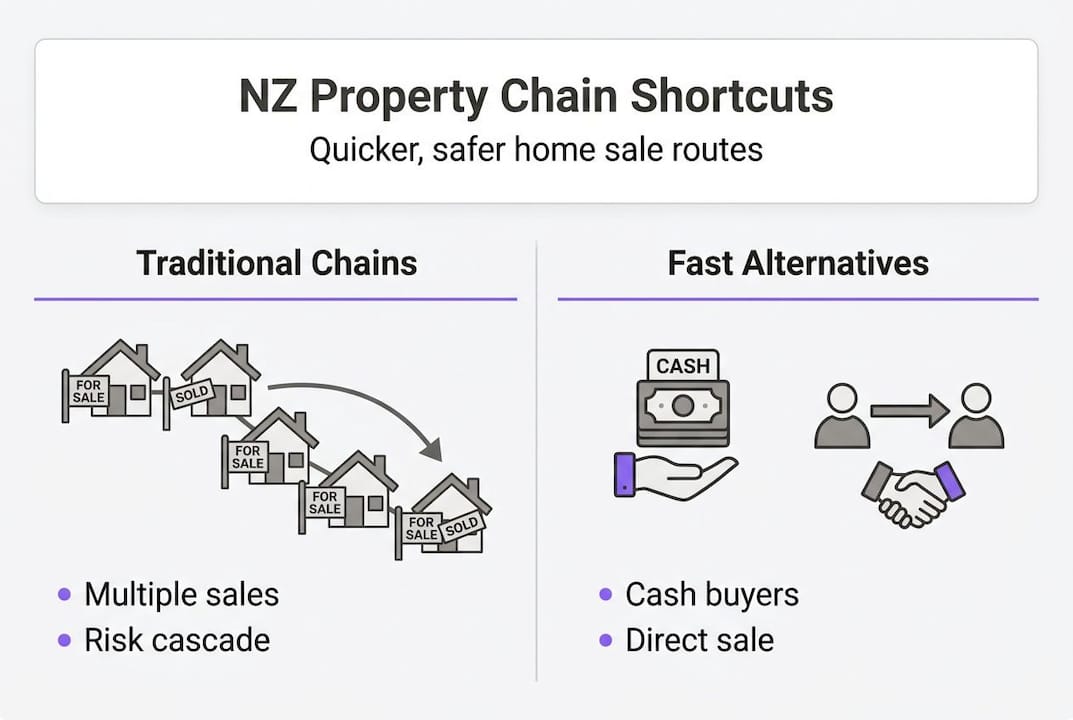
The good news for New Zealand homeowners is that the NZ selling process is already less chain-dependent than the UK system due to shorter conditional periods, the widespread use of auctions where properties become unconditional at the hammer, and strong lawyer coordination. But you can go even further to protect yourself.
Here are the main alternatives worth considering:
- Cash sales to property investors: Selling directly to a cash buyer removes the need for mortgage funding entirely. There is no bank to delay, no lender conditions to satisfy, and no financing chain to worry about. Settlement can happen on your preferred timeline, often within days or weeks rather than months.
- Selling at auction: Auction sales in New Zealand go unconditional at the fall of the hammer. This eliminates the conditional period where buyers can walk away, making the outcome far more certain for sellers.
- Private treaty sales with short conditions: If you sell through a private agreement but insist on a short conditional period (five to ten working days rather than fifteen or more), you reduce the window during which things can unravel.
- Sell before you buy: Completing your sale and banking the funds before you commit to a purchase removes the same-day settlement pressure completely. You may need short-term rental accommodation, but the certainty is often worth it.
The role of cash buyers in today’s New Zealand property market is significant and growing. More homeowners facing financial pressure, relationship changes, health challenges, or the need to relocate quickly are discovering that selling directly to a cash investor offers something traditional sales cannot: certainty. You know the price, you know the date, and nothing falls through at the last moment.
For those exploring all available options, reviewing the full range of quick property sale options available in New Zealand can help clarify which path suits your situation. And if you are weighing up whether a direct sale makes sense for your circumstances, learning more about why sell to investors is a worthwhile step.
The key insight is this: the fewer parties involved in your settlement, the lower the risk. Every additional buyer, seller, bank, and lawyer in the sequence introduces another potential point of delay. Simplicity is your greatest protection.
Our take: Why avoiding property chains offers real peace of mind
Conventional wisdom still treats property chains as an unavoidable part of selling a home. We think that mindset is outdated, at least for New Zealand sellers.
After supporting hundreds of Kiwi homeowners through fast, direct property transactions, we have seen firsthand what happens when families choose certainty over complexity. The people who benefit most are those facing real urgency: a relationship breakdown, a job loss, mounting mortgage pressure, or a health crisis that changes everything overnight. For them, a simple, direct sale is not just convenient. It is genuinely life-changing.
What we have learnt is that flexibility and certainty are far more valuable than squeezing out the last dollar of sale price. A higher offer that takes four months and carries settlement risk is often worth less in practice than a fair, firm offer that settles in three weeks. Many homeowners only realise this after experiencing a delayed or collapsed settlement themselves.
Exploring ways to sell without hassle is not about settling for less. It is about making an informed choice that fits your life right now.
Sell easily without the stress: Your next steps
Ready to put these insights into practice? Here is how to make your move, minus the drama.
At EasySale NZ, we buy residential properties across New Zealand directly, with no commissions, no agents, and no complicated settlement chains. Whether you are dealing with financial pressure, a life change, or simply want the certainty of a fast, clean sale, we make the process straightforward.
You submit your property details, receive a no-obligation cash offer, and settle on a timeline that works for you. No open homes, no waiting on bank approvals, no risk of a last-minute collapse. If you are ready to explore what a hassle-free sale looks like for your property, sell privately for cash and find out how quickly things can move when you remove the complexity.
Frequently asked questions
Is a property chain common in New Zealand property sales?
No, NZ does not have direct UK-style property chains. Instead, linked same-day settlements are used, which are less volatile and far more structured than the extended chains common in Britain.
What are the main risks if settlements are linked?
The biggest risks include bank processing delays, LINZ disruptions, and documentation errors. These issues can cascade across transactions, pushing settlements to the next day and triggering penalty interest on top of the inconvenience.
How can I avoid delays or complications when selling my property?
Choosing a direct cash sale or an auction-based approach with a short or no conditional period dramatically reduces your exposure to chain-related risks and gives you a clear, certain settlement date from the outset.
Recommended
