
Fast-track your property sale timeline in New Zealand

When urgent circumstances force you to sell your home quickly, waiting months for a traditional sale creates mounting stress and financial pressure. Whether you’re facing financial hardship, property damage, or unexpected life changes, understanding how to accelerate your property sale timeline becomes essential. This guide reveals proven methods to sell your property fast in New Zealand, with clear timelines and actionable steps that help you navigate the process efficiently and avoid common delays that trap many sellers.
Table of Contents
- Understanding Your Property Sale Options And Timelines
- Preparing Your Property And Paperwork For A Rapid Sale
- Executing The Sale And Navigating The Settlement Timeline
- Common Pitfalls And How To Ensure A Successful Fast Sale
- How Our Services Help You Sell Your Property Fast In New Zealand
Key takeaways
| Point | Details |
|---|---|
| Sale method impacts speed | Auctions and negotiated quick sales close fastest, often within 2-4 weeks, whilst private sales typically take 4-6 weeks |
| Preparation prevents delays | Having your title ready, appointing an experienced solicitor early, and preparing all documents streamlines the entire process |
| Conditions extend timelines | Sale agreements with finance or inspection conditions add weeks to settlement, whilst unconditional offers accelerate completion |
| Common pitfalls cause failures | Title issues, finance backouts, and property chains frequently derail fast sales if not identified early |
| Professional support accelerates outcomes | Experienced lawyers and cash buyers eliminate typical delays and simplify the process for urgent sellers |
Understanding your property sale options and timelines
Choosing the right sale method dramatically affects how quickly you can complete your property transaction in New Zealand. Each approach carries distinct timelines and requirements that either accelerate or slow your journey to settlement.
Auction sales typically have a faster settlement timeline compared to private sales due to their unconditional nature. When you sell at auction, buyers must be ready with finance approval before bidding, eliminating the common delays that plague conditional offers. If your reserve price is met, you receive an unconditional offer immediately, allowing settlement within 3-4 weeks. This speed makes auctions ideal when you need certainty and rapid completion.
Negotiated quick sales offer the fastest possible timeline, often completing within 2-3 weeks. These direct negotiations with motivated buyers, particularly cash buyers or property investors, bypass the marketing period entirely. You negotiate terms directly, agree on a settlement date that suits your urgency, and move straight to legal completion. This method works brilliantly when speed trumps achieving absolute top dollar.
Private sales through real estate agents typically require 4-6 weeks from listing to settlement. This longer timeline accounts for marketing periods, open homes, buyer due diligence, and condition fulfilment. Whilst this method often achieves higher sale prices, the extended timeframe creates challenges for sellers facing urgent circumstances.
Tender and deadline sales generally take even longer, as buyers submit sealed offers by a set date, followed by evaluation periods and negotiations. This process rarely suits urgent sellers needing quick resolution.
Pros and cons of each sale method:
- Auctions: Fast settlement (3-4 weeks), unconditional offers, competitive bidding, but require upfront marketing costs and no price guarantee
- Negotiated quick sales: Fastest option (2-3 weeks), flexible terms, minimal marketing, but may achieve lower prices than competitive methods
- Private sales: Higher potential prices, broader buyer pool, flexible marketing, but slower timelines (4-6 weeks) and conditional offers common
- Tender sales: Structured process, multiple offers, but longest timelines and complex evaluation periods
Pro Tip: When speed is your priority, focus exclusively on auction or negotiated sale methods. Private sales might fetch slightly higher prices, but the extended timeline creates risk if your circumstances demand rapid completion. Consider exploring quick sale steps simplified to understand the streamlined process, or review our fast property sale guide for comprehensive strategies.
Preparing your property and paperwork for a rapid sale
Proper preparation eliminates the delays that derail most fast property sales. Getting your legal and administrative house in order before listing creates a smooth path to rapid settlement.

Appointing a solicitor promptly is crucial when selling a property. Your lawyer handles the legal complexities of transferring ownership, prepares essential documents, and ensures compliance with New Zealand property law. Choosing an experienced property solicitor familiar with quick sales prevents legal bottlenecks that commonly extend timelines by weeks.
Experienced lawyers and simple titles contribute to faster settlement times. Before marketing your property, verify your title is straightforward and ready for immediate transfer. Complex titles with easements, covenants, or multiple owners require additional legal work that slows conveyancing. Request a current title search early to identify and resolve any issues proactively.
Preparing documents for buyer due diligence accelerates the sale process significantly. Gather building inspection reports, LIM reports, rates certificates, and any consent documentation before receiving offers. When buyers can review these materials immediately, they complete their due diligence faster, reducing the conditional period.
The ADLS Agreement specifies price, settlement date, and special conditions. Understanding this official rulebook for property transactions helps you negotiate terms that support your fast-sale timeline. The agreement’s standard clauses cover essential elements, but special conditions often create delays.
Steps to prepare documents and legal aspects quickly:
- Appoint an experienced property solicitor within 24 hours of deciding to sell
- Order a current title search and LIM report immediately to identify potential issues
- Gather all building consents, code compliance certificates, and inspection reports
- Prepare rates certificates and body corporate documents if applicable
- Review your title for complications and address any issues before marketing
- Discuss settlement timeline preferences with your solicitor to ensure realistic expectations
- Consider pre-approving standard ADLS Agreement terms to expedite offer acceptance
Minimising or waiving conditions like finance approval or LIM review periods speeds up the path to becoming unconditional. Whilst conditions protect buyers, each one extends your timeline. Attracting unconditional offers or negotiating shorter condition periods dramatically accelerates your sale.
Pro Tip: Modern online conveyancing services reduce delays caused by in-person appointments and postal mail. Many New Zealand law firms now offer digital signing and electronic document management, shaving days off the traditional process. Ask your solicitor about digital conveyancing options to maximise speed. Learn more about the property sale process 2026 guide or explore practical tips fast sale strategies.
Executing the sale and navigating the settlement timeline
Once preparations are complete, executing the sale efficiently requires understanding each step from signing to final settlement. Managing this timeline strategically prevents unexpected delays.
The conveyancing process follows a timeline that includes signing a Sale and Purchase Agreement, fulfilling conditions, going unconditional, and completing the transaction on settlement day. Each stage has specific requirements and deadlines that affect your overall timeline.
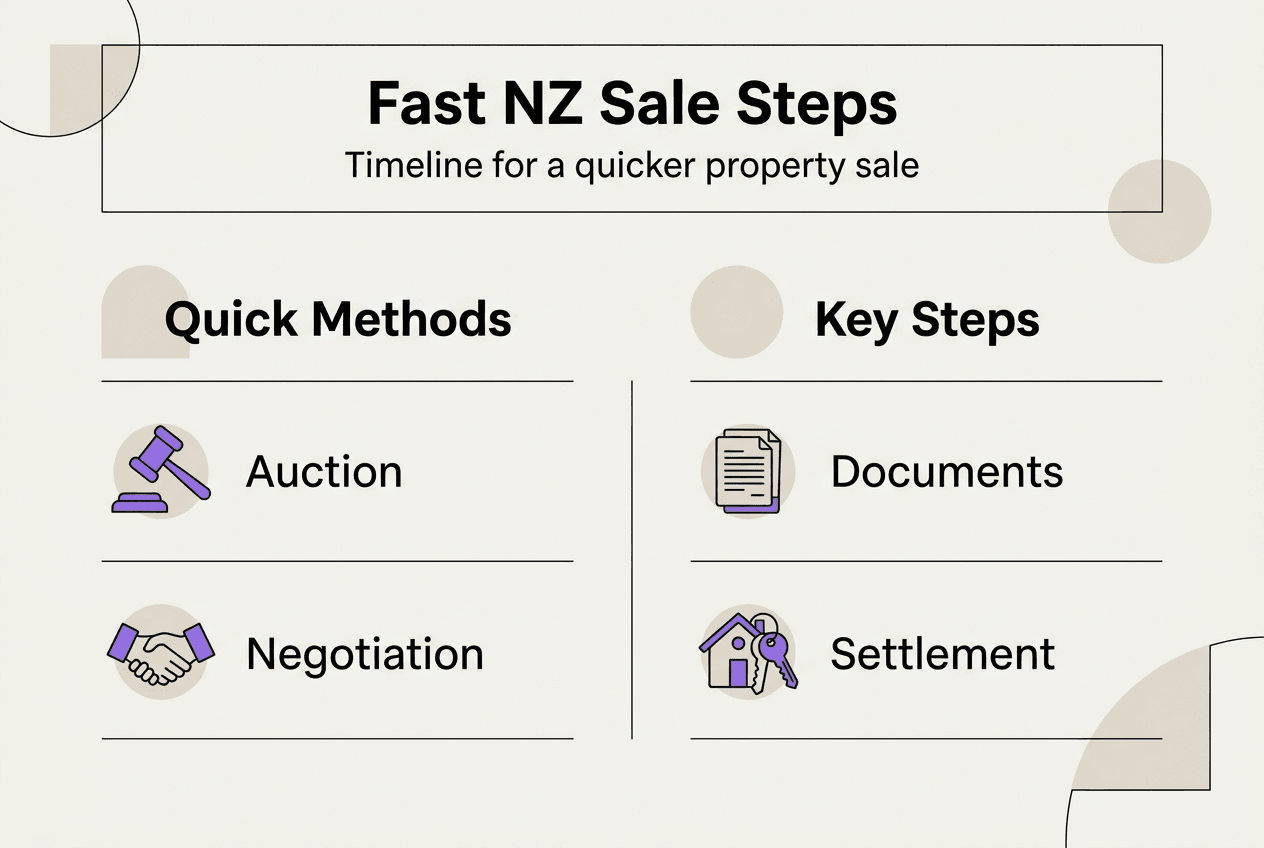
Step 1: Signing the Sale and Purchase Agreement
When you accept an offer, both parties sign the ADLS Agreement specifying the purchase price, settlement date, and any conditions. This legally binding contract establishes the framework for your sale. Conditional agreements give buyers time to arrange finance, complete inspections, or review documents. Unconditional agreements proceed directly to settlement without these protective clauses.
Step 2: Buyers fulfil conditions
Conditions allow buyers set periods to do due diligence before the contract becomes unconditional, affecting the sale speed. Common conditions include finance approval (typically 10-15 working days), building inspections (5-10 working days), and LIM review (5-10 working days). During this period, buyers can withdraw without penalty if conditions aren’t satisfied.
Step 3: Contract becomes unconditional
Once all conditions are met or waived, the contract becomes unconditional and legally binding. Neither party can withdraw without significant financial penalties. This milestone provides certainty and triggers the countdown to settlement.
Step 4: Settlement day
On the agreed settlement date, ownership transfers and payment completes. Your solicitor coordinates with the buyer’s lawyer to ensure all legal requirements are met, funds transfer, and keys exchange. This final step typically occurs 20-30 working days after going unconditional, though negotiated quick sales often settle much faster.
Timeline comparison for different sale methods:
| Sale Method | Marketing Period | Conditional Period | Settlement Period | Total Timeline |
|---|---|---|---|---|
| Auction | 3-4 weeks | None (unconditional) | 3-4 weeks | 6-8 weeks |
| Negotiated Quick Sale | None | Minimal or none | 2-3 weeks | 2-3 weeks |
| Private Sale | 2-4 weeks | 2-3 weeks | 3-4 weeks | 7-11 weeks |
| Tender Sale | 3-4 weeks | 2-3 weeks | 3-4 weeks | 8-11 weeks |
Several factors commonly slow settlement beyond these typical timelines. Finance delays occur when buyers struggle to secure lending approval or when banks process applications slowly. Title issues surface during legal checks, requiring resolution before settlement proceeds. Condition periods extend when buyers request additional time for inspections or reviews. Chain sales, where your buyer must sell their property first, create dependencies that stretch timelines unpredictably.
Actions to avoid common delays:
- Respond to lawyer requests and document queries within 24 hours
- Maintain clear, proactive communication with your solicitor throughout the process
- Verify buyer finance pre-approval before accepting conditional offers
- Set realistic but firm deadlines for condition fulfilment
- Ensure your bank processes mortgage discharge promptly if applicable
- Coordinate with your solicitor on settlement day logistics well in advance
Pro Tip: Negotiate to waive conditions where possible to shorten your timeline dramatically. If you receive multiple offers, prioritise unconditional bids even if they’re slightly lower in price. The certainty and speed of unconditional sales often outweigh small price differences, especially when facing urgent circumstances. Review the quick sale process explained for detailed execution strategies.
Common pitfalls and how to ensure a successful fast sale
Understanding potential obstacles helps you navigate around them and maintain your accelerated timeline. Many sellers encounter predictable issues that derail fast sales when unprepared.
Title issues and complex finance often cause delays, along with chains of sales. Title complications like unresolved easements, boundary disputes, or missing consent documentation halt sales mid-process whilst legal teams resolve them. Finance backouts occur when buyers lose lending approval or discover unexpected credit issues. Chain sales create dependency risks where your buyer’s ability to settle depends on their own property sale completing first.
Sellers are not obligated to accept the first offer or any offer. This knowledge empowers you to maintain control over your sale timeline and terms. Rushing to accept inadequate offers because you feel pressured often backfires when those deals collapse during due diligence. Evaluate each offer carefully based on price, conditions, settlement timeline, and buyer readiness.
Property flippers sometimes present offers with extended settlement periods that appear attractive initially but trap sellers in lengthy commitments. These investors use long settlements to secure properties at low prices whilst they arrange finance or find end buyers. If your circumstances demand quick cash access, these extended timelines defeat your purpose entirely.
Mortgagee sales are increasing in New Zealand. Whilst mortgagee sales offer an option when facing severe financial distress, they typically achieve lower prices and remove your control over timing and terms. Exploring alternative fast-sale methods before reaching mortgagee sale stage protects your equity and maintains your agency in the process.
Tips to avoid delays and protect your timeline:
- Verify buyer finance pre-approval strength and lender commitment before accepting offers
- Prioritise unconditional offers or those with minimal, short-duration conditions
- Conduct your own title search early to identify and resolve issues proactively
- Avoid chain sales where buyer settlement depends on another property transaction
- Request proof of funds for cash buyers to ensure genuine purchasing capability
- Set firm deadlines for condition fulfilment with clear consequences for delays
- Maintain regular communication with all parties to identify emerging issues early
Swift lawyer appointment and clear, proactive communication between all parties dramatically reduce the risk of unexpected delays derailing your fast sale timeline.
Recognising warning signs helps you avoid problematic buyers and situations. Buyers who hesitate to provide finance pre-approval, request unusually long condition periods, or demonstrate poor communication often create delays. Trust your instincts and prioritise serious, well-prepared buyers who demonstrate genuine commitment and capability.
Protecting your fast-sale timeline requires vigilance throughout the process. Regular check-ins with your solicitor, prompt responses to requests, and proactive problem-solving keep momentum moving forward. When obstacles emerge, address them immediately rather than hoping they resolve themselves. For comprehensive guidance, explore our step-by-step fast sale guide to navigate the entire process confidently.
How our services help you sell your property fast in New Zealand
If traditional sale methods feel too slow or complicated for your urgent situation, EasySale offers a streamlined alternative designed specifically for homeowners needing rapid property sales. We specialise in fair cash offers for damaged houses, buying properties in any condition across New Zealand.
Our service eliminates the typical delays that plague conventional sales. We pay cash and purchase properties as-is, removing the need for costly repairs, lengthy marketing periods, or conditional offers. This approach proves ideal for homeowners facing financial hardship, property damage, or life changes requiring immediate resolution. Visit the EasySale homepage to discover how we simplify the entire process, providing fair offers and settling on your preferred timeline. Contact us early in your selling journey to explore whether our fast, stress-free approach suits your circumstances.
FAQ
How long does it usually take to sell a property fast in New Zealand?
Quick sales complete within 2-3 weeks with negotiated unconditional offers, whilst auctions typically require 3-4 weeks. Private sales through agents generally take 4-6 weeks from listing to settlement. The fastest timelines occur when buyers are pre-approved for finance and sellers accept unconditional offers, eliminating the condition fulfilment period entirely.
What can cause delays in a fast property sale?
Title complications and finance failures are common delay causes in New Zealand property sales. Chain sales where buyers must sell their own property first extend timelines unpredictably. Legal hurdles, complex finance arrangements, and extended condition periods also slow the process significantly. Proactive preparation and choosing well-qualified buyers minimises these risks.
How do conditions in a sale agreement affect the timeline?
Conditions allow buyers set periods to complete due diligence before contracts become unconditional, directly impacting sale speed. Finance conditions typically require 10-15 working days, whilst building inspections need 5-10 working days. Removing or waiving these conditions accelerates your timeline dramatically, though it reduces buyer protections. Unconditional offers provide the fastest path to settlement.
Can I sell my damaged property quickly without repairs?
Yes, companies like EasySale buy damaged houses as-is for fast cash sales throughout New Zealand. This approach avoids costly repair expenses and the extended timelines required for renovation work. As-is sales particularly suit homeowners facing financial pressure or urgent circumstances where investing in repairs isn’t feasible. Cash buyers typically settle within 2-3 weeks, providing rapid resolution.
Recommended
