
NZ Sellers: 2–4% Commission, 15% GST and the REA Rules That Protect You

Most sellers pay roughly 2% to 4% of the sale price in agent commission, and that’s before GST. Add 15% GST on top of whatever commission you agree to, then factor in marketing, conveyancing, and other selling costs, and your real take home number can land a fair way south of the headline sale price you saw in the ad.
TL;DR:Realtor commission typically ranges from 2% to 4% of the sale price, with GST adding approximately 15% on top of the agreed fee.Fees vary widely depending on agency structure, region, and whether charges are tiered, flat, or include extras like marketing and admin costs.Sellers should request written estimates, clarify if costs include GST, admin, and marketing, and compare total costs in GST-inclusive dollars.Negotiation on commission is common, especially when market evidence supports a higher sale price or when multiple quotes are available.Direct, no-agent sales eliminate commission but often result in lower sale prices, making them more suitable only in specific urgent or straightforward situations.
Table of Contents
- How much is the realtor fee to sell a house, really?
- How is commission calculated: tiered rates, flat fees, and GST?
- What other selling costs should you budget for?
- What must your agent give you before you sign anything?
- How do commission and GST affect your net sale proceeds?
- Are realtor fees negotiable, and what should you ask?
- FSBO versus agent-assisted: how does commission differ?
- How do full-service fees compare with discount brokerage models?
- How is commission split between listing and buyer agents?
- What misconceptions trip sellers up most often?
- When does a commission-free direct sale make more sense?
- How does easySale.co.nz offer a genuine alternative to paying commission?
- Sources
How much is the realtor fee to sell a house, really?
There’s no fixed national rate. Commission in New Zealand typically sits between 2% and 4% of the sale price, and every agency sets its own structure, according to industry commentary from real estate consultant Paul Sumich. That range sounds tidy until you turn it into dollars, and the dollars are where the sticker shock usually happens.
Here’s what that band looks like on three common sale prices, using a mid-range a mid-range commission rate with GST added:
Those figures shift depending on where you’re selling and how your agency structures its fees. A lifestyle block in a rural district might attract a different rate to a three bedroom home in a competitive city suburb, partly because marketing effort and expected days on market differ, and partly because agencies price for perceived difficulty.
The bigger issue for most sellers isn’t the percentage. It’s that agencies rarely publish a rate card. You won’t find a standard “our fee is X” page on most agency websites, because commission is treated as a case by case negotiation rather than a fixed retail price. That’s part of why the spread between agencies can be so wide.
The Real Estate Commission Comparison Calculator illustrates this well. On a $900,000 sale, commission totals among agencies can vary widely, evidencing a substantial spread in fees including GST. That’s a gap of over $13,000 on the exact same sale price, purely because of how different agencies structure their fees.
A few things drive that spread:
- Tiered structures that charge a higher percentage on the first portion of the sale price and a lower percentage above a threshold.
- Flat or banded fees that don’t move regardless of the final sale price.
- Admin fees layered on top of the headline percentage, sometimes disclosed clearly, sometimes buried in the fine print.
- Regional competition among agencies, which can push fees down in areas with more agents chasing fewer listings.
None of this is illegal or unusual. It’s just a market where the only way to know your real cost is to ask, in writing, before you sign anything.
How is commission calculated: tiered rates, flat fees, and GST?
Agencies generally use one of two pricing shapes, and understanding which one you’re being quoted matters more than the headline number.
Tiered percentage structures charge a higher rate on an initial slice of the sale price, then a lower rate above that threshold. For example, an agency might charge 4% on the first $400,000 and 2% on everything above it. This model rewards the agent for achieving a strong sale price without ballooning the fee on higher value properties, and it’s common enough that you should ask directly whether your quote works this way.
Flat or fixed-band fees charge the same rate (or a fixed dollar figure) regardless of the final sale price. Some agencies publish minimums or fixed bands rather than a pure percentage, according to data from Calculate.co.nz. These can work in your favour on a high value sale, since the fee doesn’t climb proportionally, but they can cost you more on a lower value property where a percentage based fee would have been cheaper.
Then there’s the admin fee question. Some agencies fold marketing and administration into the headline commission. Others charge it separately, on top of whatever percentage they quote. Neither approach is wrong, but the difference between “all-in” and “plus extras” can be worth thousands of dollars, so:
- Ask whether the quoted percentage includes admin and marketing costs, or whether they’re billed separately.
- Confirm in writing exactly what the admin fee covers.
- Check whether the rate you’ve been quoted is GST-inclusive or GST-exclusive.
That last point trips up more sellers than any other part of this process. A quoted rate must have GST added on top, increasing the effective percentage of the sale price, and that difference alone can misestimate your proceeds by several thousand dollars on a mid-priced home. Always ask the agent to state the number in GST-inclusive dollars, not just as a percentage.
What other selling costs should you budget for?
Commission is the biggest line item, but it’s rarely the only one. Sellers who budget for commission alone are often surprised by the rest of the bill.
Marketing is usually vendor-paid and separate from commission. Budgets range from modest online-only campaigns around $1,000 up to several thousand dollars for larger print and digital packages, according to guidance from Settled. This is the cost most likely to catch sellers out, because marketing fees are often payable by the vendor even if the property does not sell, unless your agency agreement says otherwise.
Conveyancing and legal fees cover the paperwork that transfers ownership and typically run into the low thousands, depending on the complexity of your sale. Bank discharge or break fees apply if you’re paying out a mortgage early, particularly on a fixed rate term. Moving costs vary hugely depending on distance and how much you’re shifting.
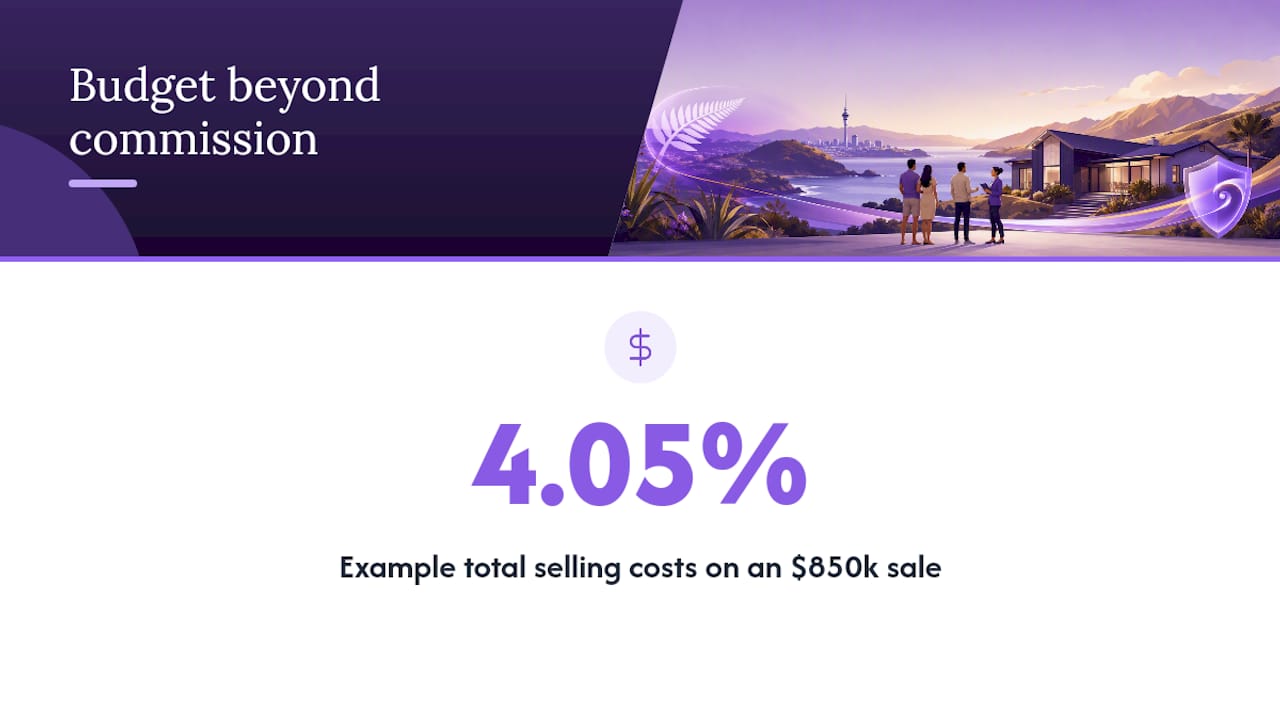
Statistic to note: Net proceeds modelling from Calculate.co.nz shows that on an $850,000 sale with a 2.9% commission rate plus typical extras, total selling costs worked out to roughly 4.05% of the sale price once GST, marketing, and other fees were included.
The cost that deserves the most attention is the one you can be liable for regardless of outcome. Marketing spend is frequently a sunk cost the moment the campaign runs, whether or not a buyer eventually signs. Before you commit to a marketing package, confirm in writing what happens to that money if the property is withdrawn from sale or doesn’t attract an offer.
What must your agent give you before you sign anything?
New Zealand’s Real Estate Authority sets out specific disclosure requirements agents must meet before you commit to a sale, and knowing them puts you in a much stronger position at the listing table.
- A written agency agreement that explains exactly how commission will be calculated, not just a verbal percentage mentioned in conversation.
- A written dollar estimate of commission, based on the agent’s appraisal of your property, so you can see the likely cost in real terms rather than an abstract percentage.
- Disclosure of any rebates or discounts the agent receives that could affect their advice or recommendations.
- A copy of the residential agency guide, which explains your rights and the sale process in plain terms.
- A signed copy of the agreement within 48 hours of you signing it. This is a hard deadline under the Code of Conduct, not a courtesy.
Appraisals also carry their own obligation. Under the Code of Conduct, agents must base appraisals on realistic market evidence and comparable sales. If no genuinely comparable sales exist, the agent has to explain that in writing rather than pulling a number out of thin air.
Before you sign anything, run through this checklist: does the agreement state the exact commission formula (flat or tiered)? Does it specify GST treatment? Are marketing costs included in the headline fee or itemised separately? What are the term and cancellation clauses if you want to switch agents partway through?
Pro Tip: Ask your agent to write the estimated total cost in dollars, GST included, right next to their signature on the agency agreement. A verbal percentage is easy to forget. A dollar figure in writing isn’t.
How do commission and GST affect your net sale proceeds?
The formula is simpler than most sellers expect, even if the arithmetic catches people out:
Net proceeds = Sale price − (Commission + GST on commission) − Marketing − Legal and discharge fees − Other costs
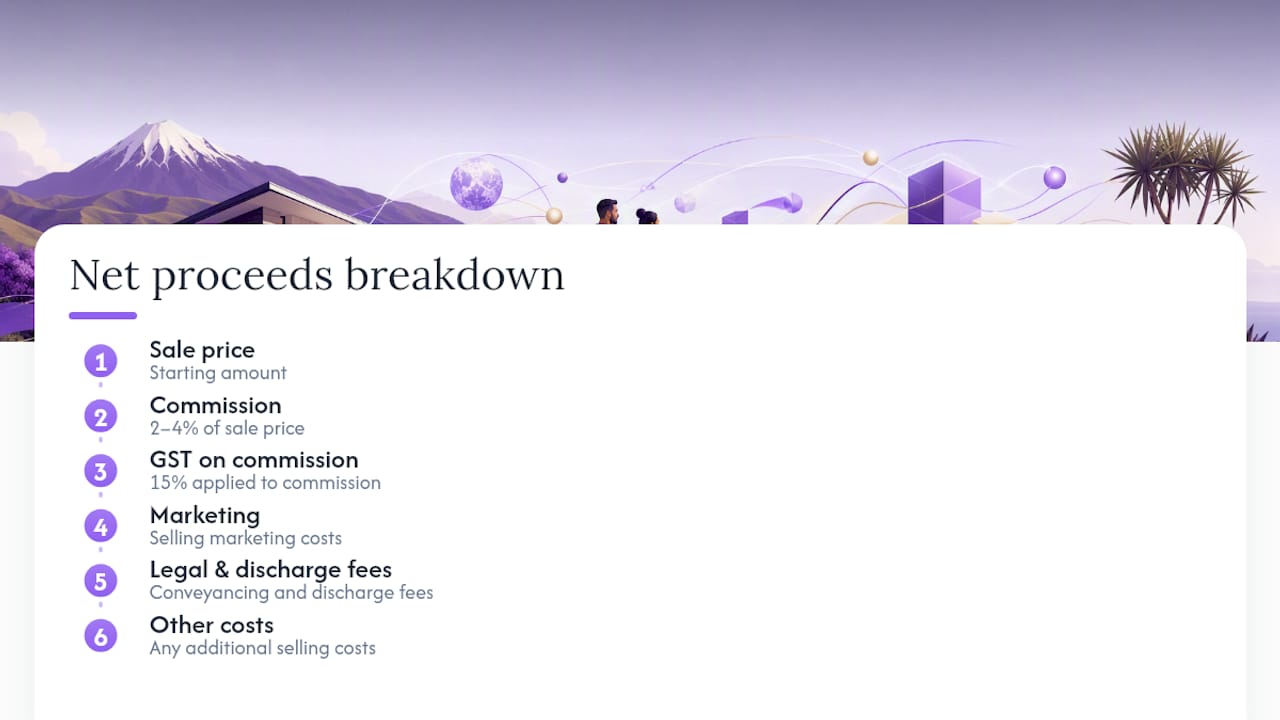
Those totals aren’t fixed figures. They’re a working model to show the scale of what stacks up once commission, GST, marketing, and legal costs are added together. Net proceeds calculators, including the one from Calculate.co.nz, model total selling costs at roughly 3% to 5% of sale price on typical residential transactions, which lines up closely with the worked examples above.
The step sellers miss most often is adding GST as a separate line rather than assuming it’s baked into the quoted percentage. Because some agencies quote GST-inclusive totals and others quote exclusive, comparing offers side by side only works if you convert everything to GST-inclusive dollars first. Ask your agent directly which way their quote is presented, and get it confirmed in writing before you compare it against another agency’s number.
Are realtor fees negotiable, and what should you ask?
Yes, and this is where most sellers leave money on the table simply by not asking. Commission isn’t set by regulation, so every number an agent gives you is a starting position, not a fixed price.
Your leverage is strongest when you’re comparing quotes from multiple agents, when market conditions favour sellers, and when you can point to solid comparable sales evidence supporting a strong appraisal. Agents know a well-informed seller who has done their homework is harder to overcharge.
What’s commonly negotiable:
- The headline commission percentage itself.
- Where tier boundaries sit, if the agency uses a tiered structure.
- Whether admin fees are charged separately or folded into the rate.
- Whether marketing costs are included in the commission or billed on top.
Rather than pushing purely for the lowest number, ask what the agent is likely to achieve for your property and whether that outcome justifies the fee, an approach recommended by Paul Sumich. A cheaper agent who undersells your home by $30,000 hasn’t saved you money. Structured negotiation tactics from experienced practitioners, including those covered in negotiation strategy guides, consistently point to preparation and comparable evidence as the real source of leverage, not aggressive haggling.
Pro Tip: Get at least two written appraisals with comparable sales evidence before you negotiate. An agent who can’t produce comparables to support their number hasn’t done the homework you’re paying them for.
Red flags to watch for: verbal-only fee promises, reluctance to put GST treatment in writing, and vague marketing inclusions that turn out to be extras once you’re locked into the agreement.
FSBO versus agent-assisted: how does commission differ?
Selling privately, without an agent, removes commission entirely. There’s no percentage fee, no tiered structure, and no admin charge tied to a listing agreement. That’s the entire appeal of the for sale by owner route, and it’s a real one on paper.
The trade-off is what you lose along with the fee. Agents bring buyer databases, negotiation experience, and marketing reach that most private sellers can’t replicate on their own. Selling privately usually means running your own marketing, fielding enquiries directly, negotiating without a buffer between you and the buyer, and handling paperwork that an agent would normally manage as part of their fee.
The financial comparison isn’t as simple as “save the commission.” A private sale that achieves a lower price, or takes considerably longer to settle, can end up costing more in opportunity cost than the commission it avoided. Conversely, a straightforward, well-presented property in a strong market can sell privately with minimal disadvantage.
The honest answer is that FSBO makes the most sense when you already understand the local market, have time to manage the process, and are selling a property that doesn’t need much convincing to attract buyers. Agent-assisted sales earn their fee in markets where negotiation, exposure, and buyer management genuinely move the final price.
How do full-service fees compare with discount brokerage models?
Discount or reduced-fee agencies have grown in this market alongside traditional full-service agents, and the trade-off is usually about what’s included rather than the headline rate alone.
A discount model might quote a lower percentage, sometimes structured as a flat fee, but include fewer inclusions: less marketing spend, fewer open homes, or less hands-on negotiation support. A full-service agency charging a higher rate typically bundles in more comprehensive marketing, professional photography, and a more active sales process.
The comparison that matters isn’t the percentage difference. It’s the total dollar cost against the likely sale outcome.
Ask any discount brokerage exactly what’s excluded from their lower fee, and get a written estimate of what those exclusions would cost if you added them back in. That’s the only way to genuinely compare a discount quote against a full-service one on equal terms.
How is commission split between listing and buyer agents?
In New Zealand’s market, it’s most common for a single agency to represent the seller, with the total commission paid by the vendor rather than split contractually between a separate “listing agent” and “buyer’s agent” the way some overseas markets structure things.
Where a buyer is represented by a different agency, arrangements for how any referral or co-operation fee is shared are typically handled between the agencies themselves, not added as an extra cost to the seller. As the seller, your written agency agreement should specify the total commission you’re paying and to whom, regardless of how that agency internally shares proceeds with any other party involved in the sale.
The practical takeaway: don’t assume a “buyer’s agent” fee is a separate line item you need to budget for on top of your listing agency’s commission. Ask your agent directly whether any other party receives a share of your commission, and get that answer in writing as part of your agency agreement.
What misconceptions trip sellers up most often?
The biggest one is assuming commission rates are fixed or regulated. They’re not. There’s no standard rate a seller is entitled to, which means the number you’re quoted first is rarely the final word.
The second is forgetting GST.
The third is assuming marketing is included in commission. It frequently isn’t, and marketing spend can be payable even when the sale falls through, which makes it one of the riskiest line items in the entire process if it isn’t confirmed in writing upfront.
The fourth is comparing agencies purely on headline percentage. Two agents quoting the same rate can produce very different total costs once admin fees, GST treatment, and marketing inclusions are accounted for. The only fair comparison is a full written breakdown in GST-inclusive dollars, not a verbal percentage exchanged at a listing meeting.
When does a commission-free direct sale make more sense?
A direct sale to a buyer, without an agent involved, removes commission and marketing costs entirely, which appeals to sellers who need speed and certainty over top-line price. It suits urgent situations: a property needing repairs you can’t fund, a probate sale with a tight timeline, or a seller who simply wants the process finished without months of open homes.
The trade-off is real. Direct buyers typically offer below what an agent-marketed campaign might achieve, because you’re trading market exposure for speed and simplicity. For a property in good condition with no time pressure, a traditional agent-assisted sale usually nets more once the dust settles.
The smart move either way is comparing net proceeds in writing across every option before deciding, not just the headline price. If you’re weighing up whether an agent’s commission structure genuinely earns its cost against your situation, that comparison is worth doing properly.
— Aaron
How does easySale.co.nz offer a genuine alternative to paying commission?
If the maths above has you wondering whether there’s a simpler route, there is. Easysale is the alternative to a traditional agent sale for Kiwi homeowners who want a fair cash offer without commission, marketing spend, or months of open homes eating into their proceeds.
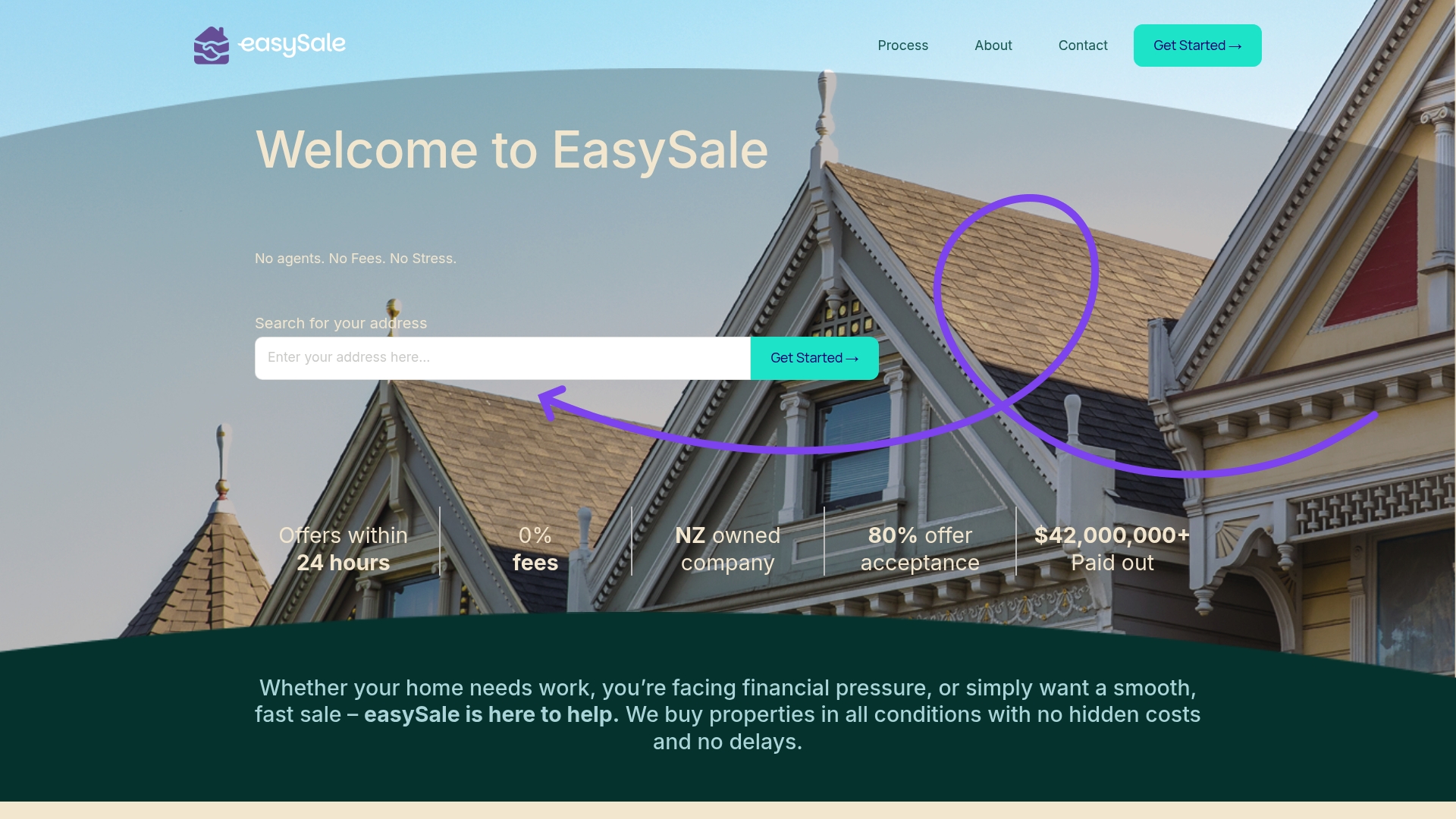
The process runs in three steps: you submit your property details, the service gives you a no-obligation cash offer, and you settle on a timeline that suits you, not one dictated by buyer finance or a drawn-out marketing campaign. Properties in any condition can be purchased, including homes that are damaged, unconsented, tenanted, or part of an estate, which makes it a practical option for sellers facing financial pressure, property issues, or a life change that demands a fast, private sale. There’s no commission, no agent fees, and no repairs required before you sell.
If your situation calls for certainty over chasing the highest possible headline price, it’s worth comparing a direct sale against a traditional listing before you commit either way. Head to the Easysale property page to submit your details and see what a no-obligation offer looks like for your home.
This article is general information, not a substitute for advice from a qualified financial advisor. Consult a qualified financial professional about your own circumstances before acting on anything here.
Sources
- How much does a real estate agent cost to sell a house in New Zealand (Paul Sumich)
- Agency agreements | The Real Estate Authority
- Real Estate Commission Comparison Calculator NZ 2026
Recommended
