
Off-market property sales explained for NZ homeowners

TL;DR:Off-market property sales in New Zealand offer homeowners a private, faster alternative to public listings, especially valuable during financial or property difficulties. While they limit buyer competition and may result in lower prices, they provide greater privacy, control, and reduced costs, making them ideal for distressed or damaged homes needing discreet negotiations. Proper legal guidance and clear agreements are essential to navigate the trade-offs and maximize the benefits of this confidential approach.
If you are facing financial pressure, dealing with a damaged home, or simply need to sell without the neighbourhood knowing, you have probably wondered about an off-market property sale. The term gets thrown around casually, and that often creates confusion about what it actually means and whether it is right for your situation. This article explains off-market sales in plain language, covers the key benefits and trade-offs, and walks you through practical steps specific to New Zealand homeowners who need a faster, more discreet path to selling.
Table of Contents
- Key takeaways
- Defining off-market property sales in New Zealand
- Why distressed sellers choose off-market sales
- Challenges and considerations to prepare for
- How to navigate an off-market sale in NZ
- Off-market vs public listing: which suits your situation?
- My perspective on off-market sales for distressed sellers
- How Easysale can help you sell quickly and discreetly
- FAQ
Key takeaways
| Point | Details |
|---|---|
| Off-market means private | Your property is sold without a public listing, keeping the process confidential and controlled. |
| Speed is a real advantage | Off-market sales typically close faster than public listings, which suits sellers under time pressure. |
| Trade-offs exist | A smaller buyer pool may affect the final price, so understanding your priorities matters before you commit. |
| Legal consent is required | Written seller consent is needed to comply with fair housing and brokerage obligations. |
| Expert guidance helps | Working with a specialist buyer or agent with a private network makes a significant difference to your outcome. |
Defining off-market property sales in New Zealand
An off-market property sale means your home is sold without being listed on public platforms such as Trade Me Property or real estate agency websites. Instead, the property is offered privately through direct buyer networks, word of mouth, or specialist property buyers. In the industry, you will also hear this type of sale referred to as a pocket listing or private listing. These terms describe the same core concept: the property changes hands without public advertising.
It is worth understanding the difference between a true off-market sale and a standard private sale. A private sale still often involves some form of public marketing, even without an agent. An off-market sale, by contrast, is kept confidential throughout, with the seller choosing exactly who knows the property is available.
Here is a quick comparison to clarify the distinctions:
| Sale type | Public listing | Agent required | Buyer pool | Privacy level |
|---|---|---|---|---|
| Traditional listing | Yes | Usually | Wide | Low |
| Private sale | Sometimes | Optional | Moderate | Medium |
| Off-market sale | No | Optional | Curated | High |
In New Zealand, there is no equivalent of the MLS (Multiple Listing Service) used in the United States, which actually makes off-market sales somewhat easier to arrange. However, agents here still have professional obligations around fair dealing and disclosure. If an agent is involved in your off-market sale, written consent is required from you as the seller before they can proceed under a private arrangement. This protects you legally and prevents miscommunication down the line.
One terminology point that trips people up: “off-market” and “pocket listing” are often used interchangeably, but pocket listings specifically refer to situations where an agent holds the listing within their network before it goes public. A true off-market sale may never go public at all.
Why distressed sellers choose off-market sales
For homeowners dealing with financial hardship, relationship breakdowns, or properties in poor condition, the appeal of an off-market sale goes beyond convenience. It addresses real, practical pressures that a traditional public listing simply does not handle well.
Here is why this path works well for many sellers in your situation:
- Speed of settlement. Off-market sales close in 45 to 90 days on average, compared to 90 to 180 days or more for public listings. When you are carrying mortgage repayments on a home you cannot afford or live in, weeks matter.
- No open homes or repairs. Public listings almost always require you to present the property well, which means cleaning, staging, and often fixing visible damage. Off-market buyers, particularly cash buyers, purchase properties as they are.
- Privacy and discretion. Avoiding public exposure means your neighbours, creditors, and family do not necessarily know the property is being sold. Confidentiality is a primary motivation for many sellers, particularly those managing tenant relationships or going through personal difficulties.
- Control over who sees your home. You choose which buyers are approached. This reduces the stress of strangers walking through your property and gives you far more say in the process.
- Reduced carrying costs. The longer a property sits on the market, the more you pay in rates, insurance, and maintenance. A faster off-market close cuts those costs significantly.
- No market stigma. Properties listed publicly and then withdrawn or price-reduced attract attention and scepticism. Sellers can test pricing confidentially without that kind of public scrutiny.
Pro Tip: If your property has significant damage or code compliance issues, disclose these clearly to your off-market buyer upfront. Transparency speeds up due diligence and prevents deals from collapsing at the last minute.
For many Kiwi homeowners managing uninhabitable homes, the off-market route removes the emotional burden of preparing a home for public display while also protecting their dignity during a difficult period.

Challenges and considerations to prepare for
Off-market property deals are not without trade-offs. Going in with realistic expectations protects you from disappointment and poor decisions.
- Smaller buyer pool. By keeping the sale private, you limit competition between buyers. Reduced buyer competition can mean a lower final sale price than you might achieve through a fully public campaign. This is the central trade-off: speed and privacy in exchange for potentially less competition driving up the price.
- Dual agency risks. Some off-market sales involve a single agent representing both buyer and seller. This creates a conflict of interest that requires disclosure and, in some cases, may not serve your interests fully. If this situation arises, consider seeking independent legal advice before signing anything.
- Written agreements matter. Any offer, agreed timeline, or special condition should be documented in writing. Verbal agreements in private sales create disputes. Your sale and purchase agreement should clearly state contingencies, settlement dates, and any conditions around property condition.
- Due diligence still applies. Even in a fast-moving off-market transaction, the buyer will likely want a building inspection, LIM report, and title search. Agreed due diligence timelines are critical speed levers. Without them being clearly set out, a fast close is not guaranteed just because the sale is private.
- Compliance with fair dealing obligations. In New Zealand, the Real Estate Agents Act 2008 and the Fair Trading Act apply to property transactions. Even in private sales, misrepresenting the condition of your property carries legal risk.
Pro Tip: Before agreeing to any off-market deal, ask a solicitor to review the sale and purchase agreement. The cost of an hour of legal advice is far lower than the cost of a disputed settlement.
How to navigate an off-market sale in NZ
Knowing why off-market sales work is one thing. Knowing how to run one well is another. A well-structured off-market sale moves through clear phases: engagement, pricing, buyer selection, confidential outreach, negotiation, and closing. Here is how to approach each stage.
- Engage the right buyer or agent. If you want a truly fast result, consider working directly with a specialist property buyer who purchases homes without agents. If you prefer an agent-led approach, look for one with a strong private buyer network and experience in off-market transactions.
- Set a realistic price from the start. Pricing too high in a private sale wastes time and alienates the limited pool of buyers you have access to. Get a registered valuation or market appraisal before settling on your asking price.
- Use confidentiality agreements where appropriate. For higher-value properties or situations involving sensitive personal circumstances, having buyers sign a non-disclosure agreement before viewing detailed information is a reasonable step.
- Vet your buyers early. Ask for proof of funds or pre-approval before sharing property details. This keeps the process efficient and protects your privacy from unqualified parties.
- Negotiate with clarity on contingencies. Be specific about what conditions you will and will not accept. Cash buyers with no finance or building inspection conditions offer the fastest and most certain path to settlement. For more detail on how this works, the private property sale NZ guide covers the process step by step.
- Know when to open up to the market. If your off-market approach does not produce an acceptable offer within 45 to 60 days, consider whether a public listing makes sense. You are not locked in permanently to the private route.
Here is a practical overview of typical timelines by approach:
| Stage | Off-market timeline | Public listing timeline |
|---|---|---|
| Marketing and buyer outreach | 1 to 2 weeks | 2 to 4 weeks |
| Offer and negotiation | 1 to 2 weeks | 2 to 6 weeks |
| Due diligence period | 1 to 2 weeks | 2 to 3 weeks |
| Settlement | 1 to 4 weeks | 2 to 6 weeks |
| Total typical range | 45 to 60 days | 90 to 180 days |
Off-market vs public listing: which suits your situation?
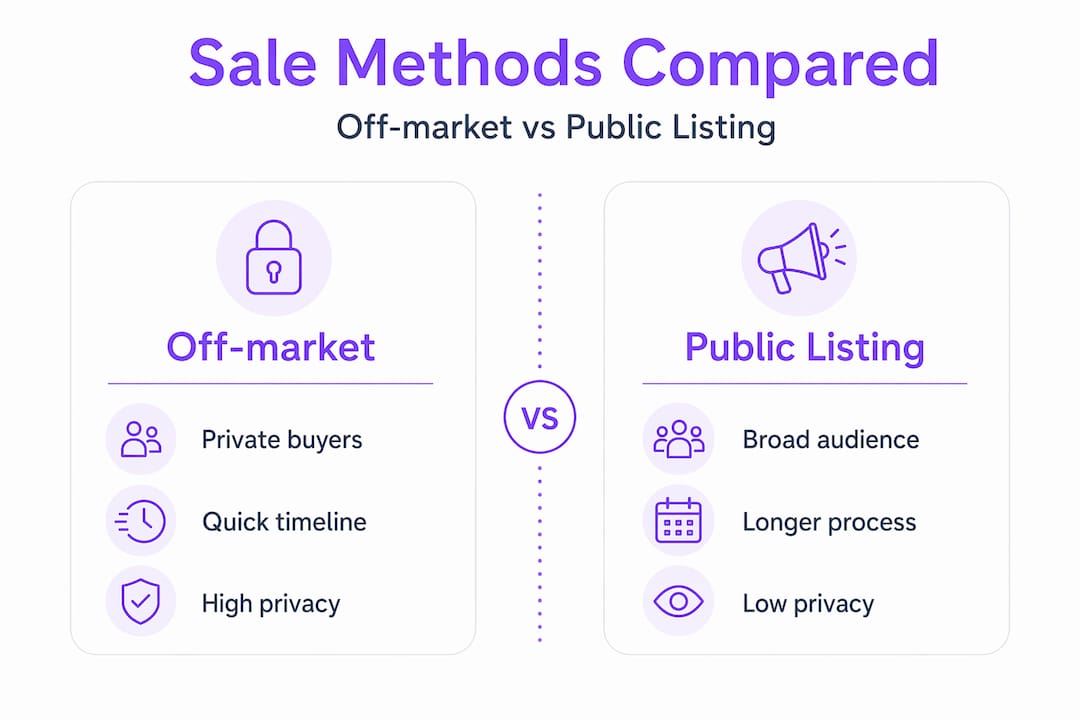
Choosing between the two approaches comes down to what you value most. Not every homeowner has the same priorities, and the right choice varies based on your specific circumstances.
| Factor | Off-market sale | Public listing |
|---|---|---|
| Speed to settlement | Faster, often 6 to 10 weeks | Slower, often 3 to 6 months |
| Privacy and discretion | High | Low |
| Buyer competition | Limited | Broad |
| Likely sale price | Can be lower without competing bids | Potentially higher with competition |
| Repairs or presentation required | Rarely, especially with cash buyers | Often expected |
| Agent commission costs | None if selling direct | Typically 2% to 4% of sale price |
For homeowners with uninhabitable or severely damaged properties, the public listing route carries real risks beyond just cost. A property that photographs poorly, requires disclosure of major defects, or sits empty while on the market for months attracts price reductions and sceptical buyers. The private route avoids that cycle entirely.
“Sellers can use off-market channels to retain full control of their narrative, testing pricing and strategy without exposing themselves to public listing drag or price stigma.”
If your property has tenants, off-market sales also protect those relationships. Avoiding public exposure of sale intent means tenants are not alarmed unnecessarily, and the process can be handled with care and respect for their situation.
My perspective on off-market sales for distressed sellers
I have worked alongside many homeowners in difficult situations, and one pattern comes up repeatedly: people assume off-market means settling for less. That is not always true. What it actually means is that you are trading broad competition for control, speed, and privacy.
The sellers who do best in off-market transactions are the ones who go in with clear priorities. If getting the absolute highest price is your top goal, a competitive public campaign gives you the best shot at achieving that. But if you need to sell quickly, cannot afford repairs, or simply cannot face the stress of open homes and months of uncertainty, the off-market path is genuinely worth considering.
What I have seen trip people up most is vague agreements. Buyers who promise fast settlements but leave contingencies open-ended will drag out the process just as long as a public sale. Clarity in your contract is what actually creates speed. That is the real insider tip no one talks about.
If you are weighing up your options, the advantages of no agent sale are worth understanding before you decide anything.
— Aaron
How Easysale can help you sell quickly and discreetly
If you own a damaged, uninhabitable, or financially distressed property in New Zealand, Easysale offers a direct, off-market path to a fast and fair outcome. There is no need to list publicly, arrange open homes, or spend money on repairs. Easysale buys damaged properties as-is, anywhere in New Zealand, with a straightforward three-step process: submit your property details, receive a no-obligation cash offer, and settle on a timeline that works for you. No agent commissions, no public exposure, no drawn-out negotiations. Whether you are dealing with structural damage, financial pressure, or a property you simply need to move on from, Easysale is built to make that process as simple and respectful as possible. Reach out today for a confidential, no-obligation conversation.
FAQ
What is an off-market property sale?
An off-market property sale means your home is sold without being publicly listed on real estate platforms. The transaction happens through private channels, preserving your confidentiality and often allowing a faster settlement.
Why would I choose an off-market sale for a damaged property?
Off-market buyers, particularly cash buyers, purchase properties in any condition without requiring repairs or staging. This makes the process much faster and less stressful for owners of uninhabitable or damaged homes.
Do off-market sales close faster than public listings?
Yes. Off-market sales typically close within 45 to 90 days, compared to 90 to 180 days or longer for public listings, making them well suited to sellers under time or financial pressure.
Are there legal requirements for off-market sales in New Zealand?
Yes. Written consent from the seller is required, and all parties must comply with the Real Estate Agents Act 2008 and the Fair Trading Act. A solicitor should review any sale and purchase agreement before you sign.
Can I switch to a public listing if the off-market approach does not work?
Yes. If you do not receive an acceptable offer within a set window, typically 45 to 60 days, you can transition to a public listing without having lost anything. The off-market approach tests the market confidentially while keeping your options open.
Recommended
