
How timeline flexibility helps urgent NZ sellers fast

TL;DR:Flexible property sales in New Zealand allow sellers to choose their settlement date, sometimes within 7 days.Cash buyer services offer quick, no-repair, as-is sale options, reducing stress and waiting times.Key factors like tenants, legal complexities, and documentation can still impact overall sale timing.
Selling a property in New Zealand does not have to mean months of open homes, agent negotiations, and nail-biting waits for finance approval. Many homeowners assume the process is always slow and rigid, but that is simply not true. Whether you are facing mortgage arrears, a sudden relocation, a relationship breakdown, or another urgent life change, flexible property sale options exist specifically for your situation. This article explains what timeline flexibility really means, who benefits most from it, and how you can use it to regain control and move forward with confidence.
Table of Contents
- What is property sale timeline flexibility?
- How flexible timelines compare to traditional sales
- Key factors that affect your sale timeline
- How to make the most of timeline flexibility
- Why timeline flexibility is a lifesaver in tough times
- Explore your fast and flexible property sale options
- Frequently asked questions
Key Takeaways
| Point | Details |
|---|---|
| Timeline flexibility defined | You can pick a settlement date that matches your situation, fast or slow. |
| Fastest options available | Cash buyers can give you a no-obligation offer within 48 hours and settle in a week. |
| Legal requirements matter | Tenanted or complex titles can slow any sale, so prepare documents early. |
| Weighing trade-offs | Flexible sales are usually below market value, but may be worth it for speed and certainty. |
What is property sale timeline flexibility?
Timeline flexibility in a property sale means you get to choose when settlement happens, how fast the process moves, and what conditions apply. It is the opposite of the traditional approach, where the buyer sets most of the terms and you wait for everything to fall into place.
In New Zealand, the most common situations where sellers urgently need flexibility include:
- Mortgage arrears or financial hardship: You need funds quickly to clear debt before it escalates.
- Divorce or separation: Both parties want a clean break without a drawn-out sale.
- Forced relocation: A new job or family emergency means you cannot wait three months.
- Inherited property: Managing an estate remotely is stressful, and a quick sale simplifies everything.
- Damaged or unmaintained property: You cannot afford repairs but still need to sell.
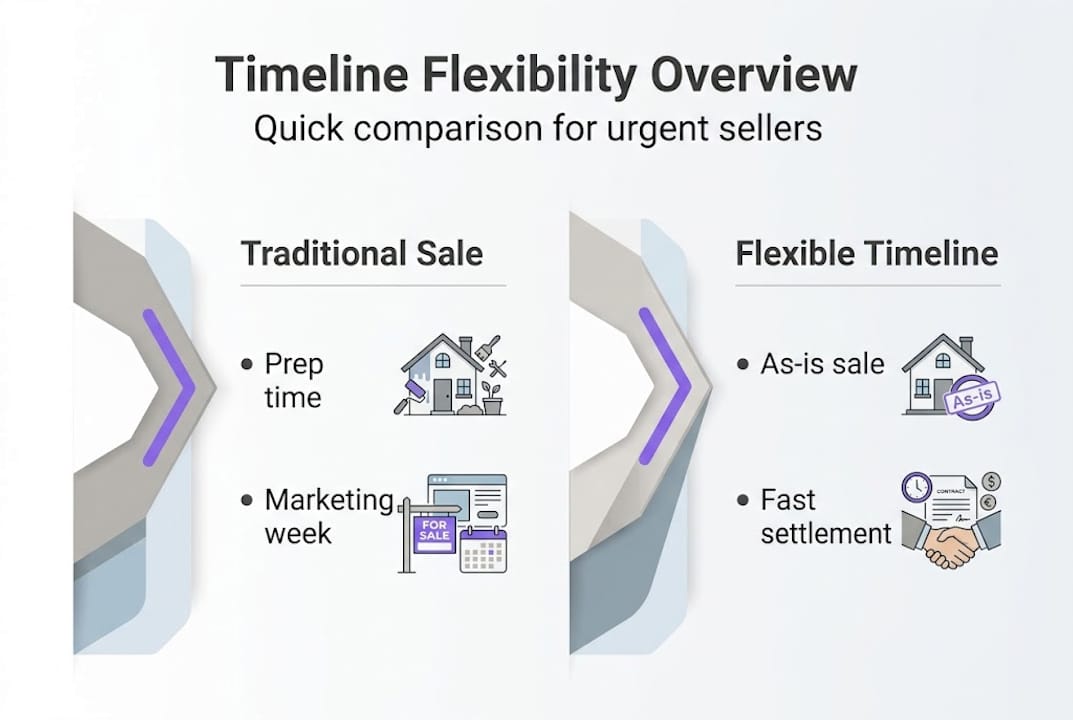
Traditional agent-led sales require you to prepare the property, list it, market it, hold open homes, wait for offers, and then navigate buyer conditions like finance and building reports. That process can stretch to 12 weeks or more. Flexible sales cut through most of that.
Quick sale options in NZ through cash buyer services offer something fundamentally different. As noted in property sale guidance, cash buyer services offer maximum timeline flexibility, with seller-chosen settlement as fast as 7 days or extended by request, making them ideal for urgent circumstances.
The key benefits of a flexible sale include:
- No forced timelines: You pick the settlement date that works for your circumstances.
- Faster access to funds: Cash is available within days, not months.
- Reduced stress: No open homes, no staging, no waiting on buyer finance approval.
- Certainty: Once an offer is accepted, the sale proceeds without the risk of a buyer pulling out.
Pro Tip: Flexible sales are often conducted on an as-is basis, meaning you do not need to repair, clean, or stage the property before selling. This alone can save you thousands of dollars and weeks of effort.
How flexible timelines compare to traditional sales
With the definition in mind, let us see how flexible timelines really stack up against the old way of selling.
According to REINZ December 2025 data, the median days to sell in New Zealand was 39 days in December 2025. But that figure only covers the time from listing to a signed agreement. Add preparation time, legal settlement, and the risk of a deal falling through, and the total seller timeline can reach 12 to 14 weeks. Auctions can be faster in some markets, while rural properties and apartments often take longer.
Here is a direct comparison to help you understand the difference:
| Step | Traditional sale | Flexible cash buyer |
|---|---|---|
| Preparation time | 2 to 4 weeks | None required |
| Time to receive an offer | 3 to 8 weeks | 24 to 48 hours |
| Conditions on offer | Finance, building report | Minimal or none |
| Settlement date | Buyer-driven | Seller-chosen |
| Fees and commissions | 2 to 4% agent commission | None |
| Risk of sale falling through | High | Very low |
| Total timeline | 12 to 14 weeks | As fast as 7 days |
The difference is significant. For someone who has time, patience, and a well-presented property, the traditional route may achieve a higher sale price. But for someone dealing with financial pressure or a time-sensitive life change, the cost of waiting is real. Delayed access to funds, ongoing mortgage repayments, and mounting stress all add up.

It is also worth noting that not every listing succeeds. A substantial portion of properties are withdrawn from the market without selling, which reflects the risk of inflexibility. You can read more about factors that slow or speed up sales to understand what influences your specific situation, and explore ways to fast-track your sale if time is critical.
Key factors that affect your sale timeline
So what holds up even the fastest and most flexible sales? Several legal, financial, and practical variables in New Zealand can affect how much control you have over your timing.
Here are the most common factors to be aware of:
- Tenanted properties: If your property has tenants, you are legally required to give notice before vacant possession can be granted. Tenant notice periods range from 42 to 90 days depending on the circumstances, and cross-lease or unit title properties can add a further one to two weeks to the process.
- Title structure: Cross-lease titles require consent from other owners on the same title. Unit titles involve body corporate documentation. Both add steps to the legal process.
- Documentation readiness: Missing or incomplete documents, such as a Land Information Memorandum (LIM) report, council consents, or title searches, can delay settlement significantly.
- Overpricing: Properties priced above market value sit longer, which defeats the purpose of a flexible sale.
- Legal complexity: Estates, trusts, or properties with caveats registered against the title require additional legal steps.
Here is a summary of how these factors affect timing:
| Factor | Potential delay |
|---|---|
| Tenanted property | 42 to 90 days |
| Cross-lease or unit title | 1 to 2 weeks |
| Missing documentation | 1 to 3 weeks |
| Finance conditions | 1 to 2 weeks |
| Legal complexity (estate, trust) | 2 to 4 weeks |
You can find practical tips for speeding up a sale and a detailed fast sale checklist to help you prepare.
Pro Tip: Have your LIM report, title documents, and a solicitor briefed before you approach a buyer. This preparation alone can shave one to two weeks off your settlement timeline.
How to make the most of timeline flexibility
Understanding what you can change is just the start. Here is how to act on it for the best result.
- Contact a flexible buyer service early. Do not wait until you are in crisis. The sooner you reach out, the more options you have. Most services respond within one business day.
- Provide accurate property details upfront. Be honest about the condition of the property, any tenancy arrangements, and the title type. This speeds up the assessment process.
- Receive and review your cash offer. Cash offers typically arrive within 24 to 48 hours. The offer is obligation-free, so you can take time to consider it without pressure.
- Choose your settlement date. This is the key advantage. You decide whether you need seven days or six weeks, based on your circumstances.
- Complete the legal process. Your solicitor handles the paperwork. With no buyer finance conditions or building reports to wait on, the legal process is straightforward.
One thing to be realistic about: cash buyer offers are typically 10 to 20 per cent below open market value. This is the trade-off for speed, certainty, and zero fees. For many sellers in urgent situations, that trade-off is entirely worthwhile. You save on agent commissions, marketing costs, staging, and repairs, and you avoid the financial and emotional cost of a prolonged sale.
“No repairs, no open homes, no waiting on buyer finance” is not just a marketing phrase. For someone facing repossession or a forced move, these are genuine, life-changing advantages.
For hassle-free property selling, timeline flexibility is especially powerful when you need to coordinate a simultaneous buy and sell, or when you simply need certainty to plan your next step.
Pro Tip: If you are buying another property at the same time, a seller-chosen settlement date lets you align both transactions and avoid the cost of bridging finance.
Why timeline flexibility is a lifesaver in tough times
Most property advice focuses on maximising sale price. That is sensible advice in normal circumstances. But it misses something important for sellers under real pressure.
When you are in arrears, going through a separation, or facing a forced relocation, the financial and emotional cost of a 14-week traditional sale is not just inconvenient. It can be genuinely damaging. Every extra week means more mortgage repayments, more stress, and less certainty about your future.
Flexible buyers provide genuine choices for those in arrears, divorce, or relocation situations, often with less stress and faster access to funds. That is not a minor benefit. For many people, it is the difference between managing a difficult situation and being overwhelmed by it.
The real question is not just “what price will I get?” It is “what outcome do I actually need?” If certainty, speed, and the ability to move forward matter more than squeezing out an extra $20,000 over three months, then a flexible sale is the smarter choice. Explore selling quickly in NZ to understand why more New Zealand homeowners are choosing this path.
Rethinking what “best outcome” means for your specific situation is the most important step you can take.
Explore your fast and flexible property sale options
If you have been reading this and recognising your own situation, you do not have to keep waiting for the right moment. The right moment is now.

EasySale NZ offers a straightforward, obligation-free process designed for exactly the situations described in this article. You submit your property details, receive a fair cash offer within 24 to 48 hours, and settle on a date that works for you. There are no agent fees, no commissions, and no need to repair or stage your home. Whether your property is damaged, tenanted, or simply needs a fast sale, as-is fair cash offers are available nationwide. Take the first step today and find out what your property is worth.
Frequently asked questions
What does property sale timeline flexibility actually mean?
It means you can choose a settlement date that suits your urgent needs, with options as fast as 7 days or extended by request if you need more time to plan.
How quickly can I sell my house if I use a flexible timeline option?
You could receive a cash offer within 24 to 48 hours and choose a settlement date as soon as seven days from acceptance in many cases.
Do I have to make repairs or clean before a flexible sale?
No. Most flexible buyer services purchase your property as-is with no repairs or staging required, saving you both time and money.
Are there any extra fees or commissions with flexible buyers?
No. Cash buyer services typically charge no fees or commissions, and there are no marketing or advertising costs involved.
What delays might I still face even with a flexible sale?
Tenanted properties require legal notice of 42 to 90 days, and title complexities such as cross-lease or unit titles can add further time to settlement.
Recommended
