
Property settlement NZ: secure a fast, stress-free sale

TL;DR:Property settlement in New Zealand involves a complex legal and financial process with multiple dependent steps.Urgent circumstances like damage or financial hardship may require alternative quick cash sale options.Cash buyers offer fast, no-repairs, as-is purchases with settlement possible within 7 to 30 days.
Property settlement is often misunderstood as simply “handover day” — the moment you hand over the keys and walk away. In reality, it is a layered legal and financial process that can unravel quickly when urgency, financial pressure, or property damage enters the picture. For many New Zealand homeowners, the standard settlement process works fine. But if you are facing debt, a damaged home, or a sudden need to relocate, the standard approach may not serve you well. This guide breaks down exactly how property settlement works in New Zealand, what can go wrong, and how to protect yourself with practical options that match your real circumstances.
Table of Contents
- Understanding property settlement in New Zealand
- Challenges and risks: Financial distress, damage, and urgent needs
- Quick cash buyers: How stress-free sales work in urgent situations
- Real-world scenarios: Property settlement outcomes for Kiwi homeowners
- Our perspective: Why speed and certainty matter more than price in property settlement
- Stress-free solutions for fast property settlement in NZ
- Frequently asked questions
Key Takeaways
| Point | Details |
|---|---|
| Settlement is more than key handover | It involves exchanging funds, legal title registration, and a pre-settlement property inspection. |
| Urgent or damaged sales need special solutions | Quick cash buyers offer fast, as-is settlements that help homeowners dealing with stress, damage, or financial pressure. |
| Speed trades off price | Rapid settlements may come with a lower sale price but deliver certainty, no agent fees, and stress-free transitions. |
| Legal protections exist for damaged properties | Buyers can cancel if a property is ‘untenantable’ at settlement, and sellers must maintain insurance cover until the transfer. |
Understanding property settlement in New Zealand
Now that you know why property settlement is more complex than it appears, let’s break down how it actually works in New Zealand.
Property settlement in New Zealand is the final transfer of ownership, funds, and keys. It is the moment legal title officially moves from seller to buyer. But behind that moment sits a chain of steps that must happen in the right order, or the whole process stalls.
Here is the typical sequence on settlement day:
- The buyer’s bank releases mortgage funds to their solicitor
- The buyer’s solicitor transfers funds to the seller’s solicitor
- The seller’s solicitor discharges any existing mortgage and pays out the net proceeds
- Title is registered with Land Information New Zealand (LINZ)
- Keys are handed over once funds are confirmed
Each step depends on the one before it. If the bank is slow, the title cannot register. If the title cannot register, the keys stay put.
“Settlement is not just a handshake. It is a carefully choreographed legal sequence that requires every party — banks, solicitors, and LINZ — to act on time.”
Settlement typically occurs 4 to 6 weeks after a contract goes unconditional for private sales, and around 3 to 4 weeks following an auction. These timelines give all parties room to arrange finance, conduct due diligence, and complete legal paperwork.
Same-day settlement is sometimes requested, particularly when sellers need rapid access to funds. However, this carries real risk. If any party in the chain is delayed, the buyer could take possession without confirmed payment, leaving the seller exposed.
Before settlement, buyers are entitled to a pre-settlement inspection to confirm the property is in the same condition as when the contract was signed. This is not an opportunity to negotiate price, but it can trigger serious complications if significant damage has occurred.
| Step | Who is responsible | Typical timing |
|---|---|---|
| Finance approval confirmed | Buyer and bank | Before unconditional date |
| Mortgage discharge arranged | Seller’s solicitor | Settlement week |
| Funds transferred | Buyer’s bank and solicitors | Settlement day |
| Title registered with LINZ | Both solicitors | Settlement day |
| Keys handed over | Seller | After funds confirmed |
Understanding this sequence is the first step to navigating NZ property sales with confidence, especially if your situation is time-sensitive or complicated.
Challenges and risks: Financial distress, damage, and urgent needs
Understanding these mechanics is vital, especially because not every settlement goes smoothly — some circumstances force tough decisions for struggling homeowners.
For sellers dealing with financial hardship, urgent relocation, or a property that has sustained damage, the standard settlement process can become a genuine obstacle. Banks may hesitate, buyers may panic, and legal clauses you have never heard of can suddenly define your options.
Common disruptions to settlement include:
- Job loss or mortgage default forcing an accelerated sale
- Storm, flood, or fire damage occurring between contract signing and settlement
- Failed pre-settlement inspections revealing new or worsening damage
- Bank delays on same-day settlements causing possession disputes
- Buyers exercising legal rights to cancel under damage clauses
One of the most important legal protections — and risks — is the ADLS clause 7, found in standard New Zealand sale and purchase agreements. Under this clause, if a property becomes ‘untenantable’ before settlement, the buyer may have grounds to cancel the contract. The 2025 High Court case Du v Youn confirmed this right, clarifying that “untenantable” is assessed based on whether the buyer can actually use the property for its intended purpose.
This puts sellers in a difficult spot. You remain responsible for insuring the property right up to settlement, even if damage has already occurred. A gap in coverage or a delayed insurance claim can leave you bearing costs alone.

Learn more about what happens during settlement after property damage to understand your rights before signing anything.
Cash buyers offer ‘as-is’ purchases with 7 to 30 day settlement for urgent or damaged properties, removing the need for inspections, repairs, or drawn-out negotiations. This is one of the most practical routes for sellers who cannot wait or cannot fix the problem.
| Scenario | Standard sale risk | Cash buyer advantage |
|---|---|---|
| Fire or flood damage | Buyer may cancel; repairs needed | Purchased as-is, no repairs |
| Financial distress | Bank may decline buyer finance | Immediate cash, no finance risk |
| Urgent relocation | Timeline may not align | Settlement in 7 to 30 days |
| Mortgage default threat | Settlement delay worsens debt | Fast payout reduces liability |
Exploring property cash buyer options and selling property fast in NZ can give you a clearer picture of what is realistically available to you.
Pro Tip: If your property has sustained damage between contract signing and settlement, contact your solicitor immediately. Do not wait for the buyer to raise it. Acting first gives you more control over the outcome.
Quick cash buyers: How stress-free sales work in urgent situations
For those who need a quick exit — whether from damage, debt, or sudden change — here is how fast, stress-free cash sales actually work.
A quick cash buyer is a company or investor that purchases residential properties directly, without agents, auctions, or open homes. The process is built for speed and simplicity, and it suits sellers who prioritise certainty over top dollar.
Here is how the process typically unfolds:
- Submit your property details online or by phone, including location, condition, and your preferred timeline
- Receive a no-obligation cash offer within 24 hours, based on current market conditions and property condition
- Review and accept the offer, or negotiate terms to suit your situation
- Legal paperwork is prepared by the buyer’s solicitor, with minimal burden on you
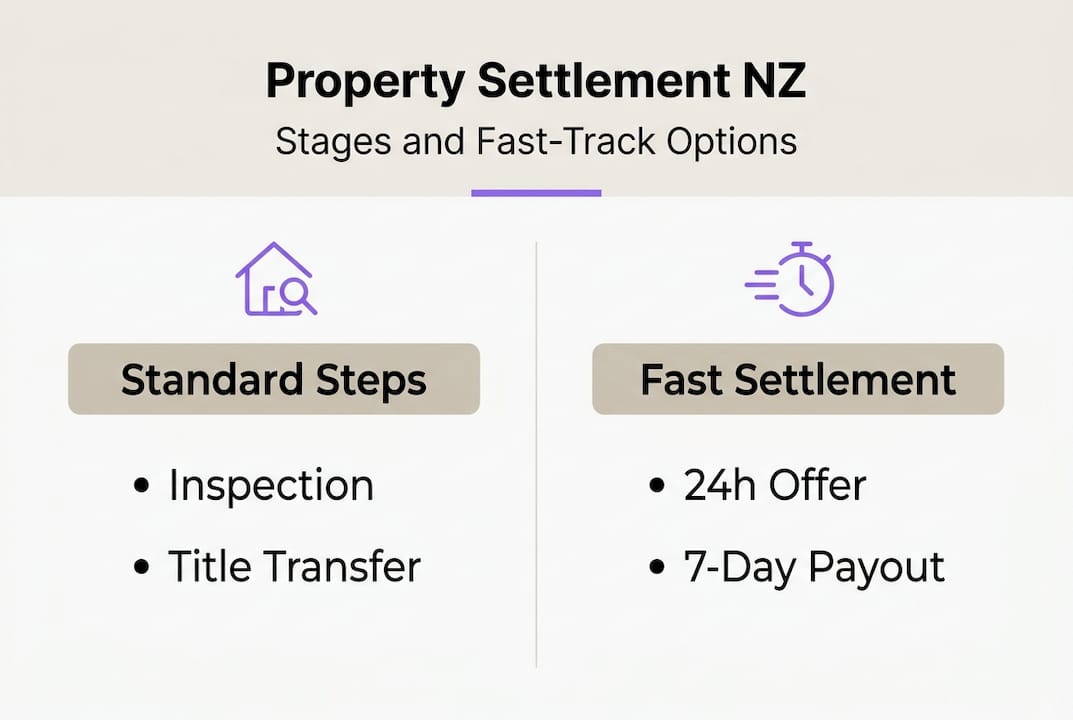
- Settlement is completed in as little as 7 to 18 days, with funds transferred directly
Quick cash offers within 24 hours and settlements in 7 to 18 days mean no agent fees or repairs are required. That is a genuinely different experience from the traditional market.
The financial trade-off is real but worth understanding. Quick sales save agent fees of $25,000 or more and avoid renovation costs, though the offer price may be 10 to 20 per cent below market value. For many homeowners under pressure, the certainty and speed outweigh the price difference.
Pro Tip: Before dismissing a cash offer as too low, calculate what you would actually net after agent commissions, marketing costs, and any required repairs. The gap is often smaller than you expect.
You can also review settlement risks and protections to understand what a conventional sale might expose you to before deciding.
For homeowners weighing their choices, resources on quick home sales NZ and quick sale options for sellers offer practical comparisons to help you decide.
When a cash buyer is the right choice:
- Your property has damage that makes traditional listing difficult
- You are facing mortgage default or financial hardship
- You need funds within weeks, not months
- You want to avoid agent fees, open homes, and uncertain timelines
Real-world scenarios: Property settlement outcomes for Kiwi homeowners
With the mechanics and options clear, it is valuable to see how settlement scenarios actually unfold, with numbers and outcomes that give context to your decisions.
Standard settlements go smoothly more than 90 per cent of the time. But quick sales trade a 10 to 20 per cent price discount for speed and certainty — a trade that makes excellent sense in the right circumstances.
Typical outcomes by scenario:
- Stable, well-maintained property: Standard sale with agent, 4 to 6 week settlement, full market price minus agent fees of roughly 2 to 4 per cent
- Urgent relocation needed: Cash buyer engaged, offer within 24 hours, settlement in 10 to 14 days, price 10 to 15 per cent below market but no agent or repair costs
- Property damaged by fire or flood: Traditional buyers likely to cancel or renegotiate; cash buyer purchases as-is, saving seller from costly repairs and extended delays
- Mortgage default imminent: Fast cash sale prevents default listing on credit record, provides immediate funds to clear debt
Settlements most often fail or stall when finance falls through at the last moment, when damage is discovered during the pre-settlement inspection, or when one party’s solicitor is slow to act. In these cases, sellers can lose weeks, and in some cases the deal entirely.
| Situation | Estimated timeline | Price outcome | Key risk |
|---|---|---|---|
| Standard private sale | 4 to 6 weeks | Full market value | Finance or inspection failure |
| Auction sale | 3 to 4 weeks post-auction | Competitive price | Unconditional obligation |
| Cash buyer sale | 7 to 18 days | 10 to 20% below market | Lower sale price |
| Damaged property standard sale | 8 to 16 weeks or failed | Heavily discounted or cancelled | Buyer cancellation risk |
For a deeper look at settlement timing NZ and how to benchmark your options, it pays to review the data before committing to any path. Understanding property offers NZ can also help you assess whether an offer you receive is genuinely fair for your circumstances. If you are ready to act, learning how to sell your house fast gives you a direct starting point.
Our perspective: Why speed and certainty matter more than price in property settlement
Stepping back, it is clear that buyers and sellers alike often miss the bigger picture when urgency or hardship strikes.
Conventional wisdom in real estate almost always pushes toward maximising price. List with an agent, wait for the right buyer, and hold firm on your asking price. That advice is sound for stable circumstances. It can be genuinely damaging when you are under financial pressure, dealing with a damaged property, or facing a hard deadline.
What experienced property professionals know — and rarely say loudly — is that certainty has a financial value of its own. A confirmed sale at 85 per cent of market value is worth more than a conditional offer at full price that falls apart on settlement day.
Experts note that “untenantable” is assessed for the buyer’s actual intended use, and that extensions and bridging finance can be used to manage delays. These tools exist, but most sellers do not know to ask for them.
For homeowners considering selling to investors, the real advantage is not just speed — it is the removal of uncertainty from a process that can otherwise feel completely outside your control. In distressed situations, that peace of mind is worth a great deal.
Stress-free solutions for fast property settlement in NZ
For those who need certainty in uncertain times, here is how to take action and avoid traditional settlement frustrations.
If you are dealing with a damaged home, financial hardship, or an urgent need to sell, the traditional real estate process may not give you what you need most: a clear outcome, quickly. That is exactly where a cash buyer service steps in.

EasySale NZ buys properties across New Zealand in any condition, with no agent fees, no open homes, and no drawn-out negotiations. You submit your details, receive a fair cash offer within 24 hours, and settle on your preferred timeline. If your property has sustained damage, you can request a damaged house cash offer and receive a no-obligation assessment with no pressure to proceed. It is a practical, respectful option for homeowners who need a reliable path forward.
Frequently asked questions
How long does property settlement take in New Zealand?
Settlement usually takes 4 to 6 weeks for private sales or 3 to 4 weeks after auctions, though quick cash buyers may settle in 7 to 18 days depending on the circumstances.
What happens if my property is damaged before settlement?
If your property becomes ‘untenantable’, buyers may cancel under ADLS clause 7 and you remain responsible for insuring the property right up until settlement is completed.
Can I settle a property sale on the same day?
Same-day settlement is possible but carries real risk; bank delays or failed inspections occur in roughly 1 to 5 per cent of cases and can derail the entire process.
What is a quick cash buyer and how does it help?
Quick cash buyers make offers within 24 hours and settle in 7 to 30 days, purchasing homes as-is and saving sellers from agent fees, repairs, and uncertain timelines.
Recommended
