
Cash home sales in NZ: pros, cons and what to expect

A cash home sale is a smart move when speed and certainty matter more than squeezing the last dollar from your property. For Kiwi sellers facing financial pressure, a tight relocation deadline, or a home that needs serious work, the pros and cons of cash home sales often tip firmly in favour of a fast exit. The core trade-off is straightforward: you typically accept a price 10–30% below open-market value in exchange for a settlement that can complete in as little as 7–14 days, no agent commission, and no repair bills.
- Speed: Cash offers often arrive within 24–48 hours; settlement can follow in 7–14 days.
- Price trade-off: Expect a discount of 10–30% on market value, though savings on agent fees (3–5%) and marketing costs ($1,500–$5,000) close that gap meaningfully.
- Legal essentials: Always verify proof of funds, use a solicitor, and check LINZ and IRD requirements before signing anything.
A cash sale removes the two biggest collapse points in any property transaction: finance approval and building inspection conditions. For sellers who need certainty, that removal is worth real money.
Key takeaways
Cash home sales suit sellers who prioritise speed and certainty over maximum price, and the net-proceeds gap is smaller than the headline discount suggests once agent fees and holding costs are removed.
| Point | Details |
|---|---|
| Speed and certainty | Cash offers arrive in 24–48 hours; settlement completes in as little as 7–14 days with no finance conditions. |
| Price trade-off | Expect a 10–30% discount on market value, but agent commission savings of 3–5% and avoided marketing costs of $1,500–$5,000 close the gap. |
| Best-fit situations | Mortgage arrears, urgent relocation, inherited property, and damaged homes are the scenarios where a cash sale consistently makes sense. |
| Due-diligence must-dos | Verify proof of funds, confirm the offer is unconditional, and involve a solicitor before signing any contract. |
| Easysale | Offers no-obligation cash offers within 24 hours for NZ properties in any condition, with no agent fees and flexible settlement dates. |
Table of Contents
- What you actually gain from a cash home sale
- The real trade-offs and risks you need to weigh
- How cash home sales work in New Zealand: steps and timelines
- When a cash sale is the smarter choice for you
- How to evaluate a cash offer: the due-diligence checklist
- Typical numbers and worked examples for NZ sellers
- Red flags to watch for and how to protect yourself
- Easysale: a straightforward cash offer for NZ homeowners
- An honest perspective on cash sales, from someone who has seen both sides
- Sources
What you actually gain from a cash home sale
Speed is the headline benefit, and the numbers back it up. Cash offers typically arrive within 24–48 hours of submitting your property details, and settlement can complete in as little as 7 days. Compare that with a traditional agent sale in New Zealand, where the average time from listing to unconditional agreement routinely stretches to 30–90 days, and you start to see why sellers under pressure choose the cash route.
The advantages of cash house sales go well beyond the calendar, though. Here is what sellers consistently gain:
- No agent commission. Traditional agents charge 3–5% of the sale price. On a $700,000 home, that is $21,000–$35,000 leaving your pocket before you even factor in GST on the commission.
- No marketing or staging costs. Direct home sales eliminate marketing and staging fees that commonly add $1,500–$5,000 to a traditional sale.
- Sell as-is. Cash buyers commonly purchase properties “as is”, which means no pre-sale repairs, no landscaping, and no open-home preparation. For a tired or damaged property, that saving can be substantial.
- Fewer inspections and less negotiation. A cash buyer typically does one assessment visit. There are no Saturday open homes, no competing buyer negotiations dragging on for weeks, and no last-minute requests to fix the hot water cylinder before settlement.
- Certainty of outcome. Once you accept a cash offer and sign an unconditional contract, the sale is generally expected to complete. There is no risk of a buyer’s finance falling through at the eleventh hour.
A quick worked example: Say your home is worth $700,000 on the open market. A cash buyer offers $630,000 (a 10% discount). After saving $28,000 in agent commission (4%) and $3,000 in marketing costs, your net position on the cash sale is roughly $661,000. A traditional sale at full price nets you $669,000 after those same costs. The gap is $8,000, not $70,000 — and that gap narrows further when you factor in holding costs during a longer campaign.
Pro Tip: Ask any cash buyer to confirm their offer in writing within 24 hours. A legitimate buyer will have no hesitation. If they stall or push for a verbal agreement first, treat that as a warning sign.
The real trade-offs and risks you need to weigh
The most significant disadvantage of a cash sale is the price. Cash buyers price in their risk, renovation margin, and profit expectation, which is why offers typically land 10–30% below open-market value. For a $700,000 home, that range represents $70,000–$210,000 less than what a competitive open-market campaign might achieve. If your property is in excellent condition and the market is active, a traditional sale will almost certainly return more.
Beyond price, there are transaction risks that sellers must take seriously:
- Unverified buyers. Not every person claiming to be a cash buyer actually has the funds. Some operate on the assumption they can on-sell your contract before settlement, which creates real risk if that deal falls through.
- Pressure tactics. Legitimate cash buyers do not pressure you to sign within hours or discourage you from involving a solicitor. Any buyer who does either of those things deserves immediate scepticism.
- Scams targeting distressed sellers. Sellers in financial difficulty are sometimes targeted by operators who collect a deposit or personal information under false pretences. Always verify a buyer’s identity and business registration independently.
- Opportunity cost. If your timeline is flexible and your property is in good shape, accepting a cash offer when you do not need to means leaving money on the table. The discount that makes sense for a seller in arrears makes much less sense for someone with six months to spare.
On the tax and legal side, the Bright-line test under New Zealand law may apply to your sale depending on when you purchased the property and whether it is your main home. The IRD’s guidance on property sales is the authoritative source here, and your solicitor should confirm your position before settlement.
Typical discount range: 10–30% below market value. That figure is the starting point for any honest assessment of whether a cash sale works for your situation.
Pro Tip: Before accepting any cash offer, get a registered valuation or at minimum two independent agent appraisals. Knowing your market value gives you a firm anchor for negotiating a better cash price and helps you decide whether the discount is acceptable.
How cash home sales work in New Zealand: steps and timelines
Understanding the mechanics makes the whole process far less daunting. Cash buyers in NZ include individual investors, direct property buyers, and developers, each with slightly different motivations. Investors typically want rental yield or a renovation flip. Developers look for land or properties with subdivision potential. Direct property buyers, like Easysale, focus on speed and simplicity for the seller regardless of condition.
Here is how the process typically unfolds:
- Submit your property details. You provide basic information about the property: address, condition, reason for selling, and your preferred timeline. This usually takes 10–15 minutes online or over the phone.
- Receive an initial offer (24–48 hours). The buyer assesses the property using market data and, in many cases, an in-person or virtual inspection. A written offer follows, typically within one to two business days.
- Inspection and due diligence (1–5 days). The buyer may arrange a brief property visit to confirm condition. This is not the same as a full building inspection — it is a condition check to confirm the offer stands.
- Proof of funds and contract (1–3 days). A credible cash buyer provides proof of funds before you sign anything. Your solicitor reviews the sale and purchase agreement, confirms it is unconditional, and advises on any conditions or clauses.
- Sign the unconditional agreement. An unconditional offer in NZ is legally binding once signed by both parties. It removes the standard “subject to finance” and “subject to building inspection” clauses that cause most traditional sales to collapse.
- Settlement (7–14 days from signing, or your preferred date). Funds transfer, title transfers via LINZ, and the sale completes. Your solicitor handles the title transfer and final mortgage discharge if applicable.
Key documents to have ready: Certificate of title, LIM report, building consent records, rates notices, and any tenancy agreements if the property is tenanted. Passing these to your solicitor early speeds up the process considerably. For a detailed walkthrough of each stage, the step-by-step cash sale guide covers the full process with practical timelines.
The critical distinction for NZ sellers: an unconditional offer is not the same as a buyer saying “I have finance pending.” If a buyer presents a conditional offer and calls it a cash sale, ask your solicitor to clarify before you proceed.
When a cash sale is the smarter choice for you
Not every seller needs a cash sale, but for certain situations it is clearly the better path. For homeowners in urgent situations, the certainty of a cash sale often outweighs the headline discount. Here are the scenarios where that logic holds most firmly:
Mortgage arrears or financial pressure. When you are behind on payments and the bank is applying pressure, a fast settlement stops the clock. A cash sale in 14 days beats a three-month agent campaign that may or may not succeed.
Urgent relocation. A job transfer, family emergency, or overseas move with a fixed departure date makes a long sale campaign impractical. Cash buyers work to your timeline, not the market’s.
Inherited property. Managing an estate is stressful enough without coordinating open homes and buyer negotiations. Many executors choose a cash sale to close the estate cleanly and distribute proceeds to beneficiaries without delay.

Damaged or hard-to-sell homes. Properties with structural issues, weather-tightness problems, or deferred maintenance are difficult to sell through traditional channels. Cash buyers purchasing “as is” removes the financial and emotional burden of preparing a home for market. If you need more detail on this, the guide to selling a property in any condition is worth reading.
Health or personal emergencies. Sometimes life simply does not allow for a drawn-out sale process. A cash sale gives you resolution and funds quickly so you can focus on what matters.
If you have time, a good property, and no pressing financial need, a traditional agent sale will almost always return a higher price. A cash sale earns its value when certainty and speed are worth more to you than the last dollar of market value.
When to stick with a traditional sale: Your property is in excellent condition, the local market is active, you have 60–90 days available, and you have no urgent financial pressure. In that scenario, the 10–30% discount a cash buyer requires is hard to justify.
How to evaluate a cash offer: the due-diligence checklist
Receiving a cash offer is exciting, but signing too quickly is one of the most common mistakes sellers make. Work through this checklist before you commit to anything:
- Verify proof of funds. Ask for a bank statement or solicitor’s letter confirming the buyer has the purchase amount available. Funds should be in a New Zealand account or clearly accessible. A buyer who cannot or will not provide this within 24 hours is not ready to buy.
- Confirm the offer is unconditional. Read the sale and purchase agreement carefully. An unconditional offer removes standard “subject to” clauses and is legally binding once signed. If the agreement still contains conditions, it is not a true cash offer.
- Check buyer identity. Verify the buyer’s name, business registration (if they are a company), and contact details independently. A quick search on the Companies Office register takes two minutes and confirms the entity is real.
- Involve a solicitor before signing. This is non-negotiable. Your solicitor reviews the contract, confirms the title is clear, checks for any caveats or encumbrances on the LINZ register, and advises on your obligations under NZ property law. Direct home sales require accurate legal documentation and full property disclosure to avoid buyer claims later.
- Confirm the settlement date and any remaining conditions. Even an unconditional offer will specify a settlement date. Make sure it aligns with your plans and that your mortgage lender has enough notice to arrange a discharge.
- Calculate your net proceeds. Use this formula: Cash offer price, minus legal fees, minus any outstanding mortgage balance, minus rates adjustments = your net cash at settlement. Compare that figure with the net proceeds from a traditional sale after agent commission, marketing, and holding costs.
Worked net-proceeds formula: Cash offer of $630,000, minus $2,000 legal fees, minus $400,000 mortgage balance = $228,000 net. Traditional sale at $700,000, minus $28,000 commission (4%), minus $3,000 marketing, minus $2,000 legal fees, minus $400,000 mortgage = $267,000 net. The gap is $39,000 — meaningful, but far smaller than the headline price difference suggests.
Before you sign, ask your solicitor to confirm the title is clear on the LINZ register and that there are no caveats, mortgagee notices, or encumbrances that could delay settlement. That check takes less than an hour and can save you weeks of complications.
Pro Tip: Always ask the buyer to cover your legal costs as part of the negotiation. Many cash buyers will agree to this, particularly if they are keen to move quickly. It is a reasonable ask and costs you nothing to try.
Typical numbers and worked examples for NZ sellers
The financial reality of a cash sale depends heavily on your specific property, location, and circumstances. These figures give you a realistic starting framework.
At a 10% cash discount, the real gap in net proceeds is around $34,800, not $70,000. If the cash discount is closer to 15%, the gap widens to roughly $70,000 after savings. That is the honest maths sellers need to do before deciding.
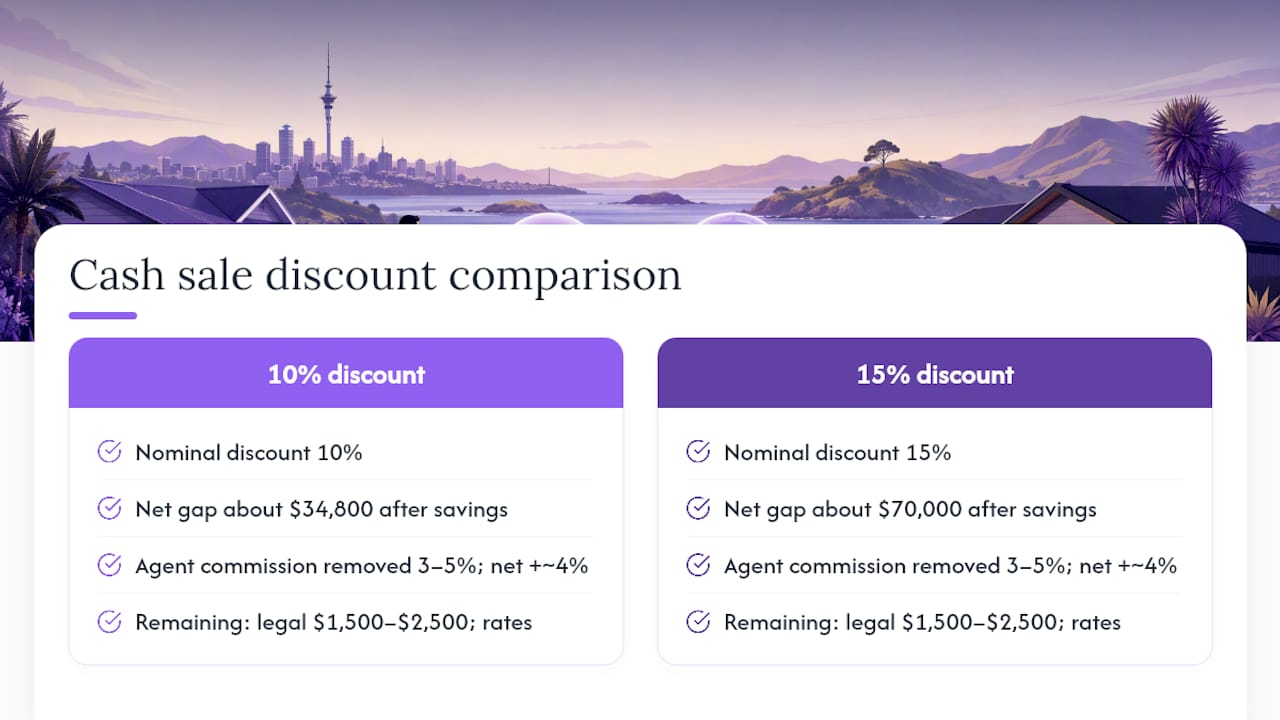
No-agent cash sales remove 3–5% agent commissions and can raise net proceeds by roughly 4% after accounting for saved costs. The holding cost figure assumes a multi-week traditional campaign with daily costs including mortgage interest, rates, and insurance on a typical property. Every week a traditional sale drags on adds to that figure.
Costs that remain in a cash sale: your legal fees (typically $1,500–$2,500 for a straightforward residential transaction), any outstanding mortgage balance, and rates adjustments to the settlement date. Costs that disappear entirely: agent commission, marketing, staging, open-home preparation, and holding costs beyond your chosen settlement date.
For properties with significant deferred maintenance, the savings on repairs can be substantial. How cash buyers assess property condition explains how buyers factor renovation costs into their offers, which helps sellers understand why the discount exists and how to negotiate around it.
Red flags to watch for and how to protect yourself
Most cash buyers operating in New Zealand are legitimate, but the sector does attract operators who prey on sellers under pressure. Knowing the warning signs protects you.
- No verifiable proof of funds. Any buyer who delays, deflects, or offers vague assurances instead of a bank statement or solicitor’s letter is not a confirmed cash buyer. Do not proceed until you have seen real documentation.
- Pressure to sign quickly. Urgency is a manipulation tactic. A genuine cash buyer understands that you need time to involve a solicitor and review the contract. If someone is pushing you to sign within hours, slow down.
- Refusal to use a solicitor. A buyer who discourages you from getting legal advice is a serious red flag. No legitimate transaction requires you to bypass independent legal counsel.
- Unusual payment requests. Settlement funds should transfer through standard banking channels to your solicitor’s trust account. Any request to receive payment in cash, cryptocurrency, or via an overseas transfer warrants immediate caution.
- Vague or unverifiable business identity. If the buyer is a company, check the Companies Office register at companiesoffice.govt.nz. If they are an individual, verify their identity with a government-issued ID before signing anything.
- Offers that seem too high. Paradoxically, an offer significantly above market value from an unknown buyer can signal a scam. Fraudulent operators sometimes use inflated offers to extract deposits or personal information before disappearing.
If you suspect fraud: Stop all communication, do not sign anything, and contact your solicitor immediately. You can also report suspected property fraud to the New Zealand Police or the Financial Markets Authority (FMA) at fma.govt.nz. LINZ maintains the official property title register and can confirm whether any suspicious caveats or dealings have been registered against your title.
For a practical guide on closing a home sale in 7 days for cash while protecting yourself, that external resource covers the verification steps in detail.
Easysale: a straightforward cash offer for NZ homeowners
If you have read this far and decided a cash sale fits your situation, Easysale offers a direct, no-agent path to settlement for New Zealand homeowners. The service is built for sellers who need speed, certainty, and a fair offer without the complexity of a traditional campaign.

Easysale buys properties across New Zealand in any condition, which means no repair bills, no staging, and no open homes. The process is simple: submit your property details online, receive a no-obligation cash offer within 24 hours, and settle on a timeline that works for you. There are no agent commissions and no hidden fees. For homeowners dealing with financial pressure, an inherited property, or a home that needs significant work, that combination of speed and simplicity is genuinely useful.
Get a fair cash offer within 24 hours by submitting your property details directly to the Easysale team. If your property has damage or deferred maintenance, the as-is buying service is worth exploring. There is no obligation to accept, and speaking with the team costs you nothing.
An honest perspective on cash sales, from someone who has seen both sides
The debate around cash home sales often gets framed as a simple choice between speed and money. The reality is more nuanced than that, and I think sellers deserve a clearer picture.
What most articles understate is how much the certainty of a cash sale is worth in emotional terms. A traditional sale that drags on for three months, falls over twice, and finally settles six months later does not just cost you holding fees. It costs you sleep, focus, and the ability to make decisions about the rest of your life. For sellers in genuine distress, that cost is real and it rarely appears in any net-proceeds calculation.
At the same time, I would caution against treating a cash sale as the default answer just because it feels simpler. If your property is in good shape and your timeline is flexible, the 10–30% discount is a significant concession. Get independent valuations, run the net-proceeds numbers honestly, and talk to a solicitor before you decide. The right answer depends entirely on your circumstances, not on what any buyer or article tells you is normal.
The sellers who get the best outcomes from cash sales are the ones who go in with clear numbers, verified buyers, and legal advice in hand. Certainty is worth paying for. Ignorance is not.
Sources
Before you make any decision, these authoritative sources and practical next steps will help you verify the facts and protect your interests.
- Conditional vs Unconditional Offer NZ: The 2026 Guide for Private Sellers - DEN - Real Estate Marketing
Recommended next steps: Get two independent agent appraisals to establish your market value. Request a cash offer from a verified buyer. Pass both figures to your solicitor alongside the sale and purchase agreement for review. Then decide with full information in hand.
Recommended
