
Quick sale workflow: your step-by-step guide for Kiwi homeowners


TL;DR:A quick sale workflow helps homeowners sell rapidly, often within weeks, by focusing on preparation and communication. Most delays stem from sellers’ slow responses and missing documents, so early document gathering and prompt replies are essential. Choosing the right sale route and treating the process as a project speed up closing times significantly.
A quick sale workflow is a structured series of steps that lets homeowners sell their property rapidly, often within weeks, by focusing on preparation, clear communication, and choosing the right sale method. For Kiwi homeowners facing financial pressure, a relationship breakdown, or a sudden relocation, this process cuts through the complexity of a traditional sale. Cash sales complete within 7 to 28 days, compared to roughly 79 days on the open market. That difference is significant when time is not on your side. Understanding the workflow from the start gives you the best chance of a fast, stress-free result.
What are the essential stages of the quick sale workflow?
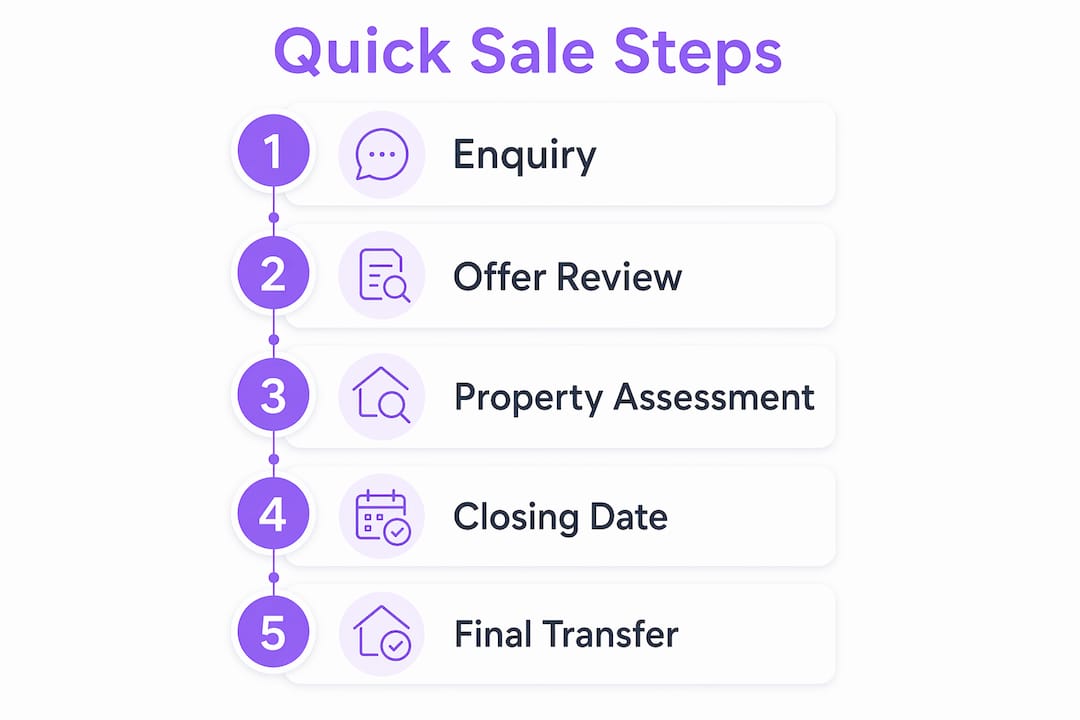
The five-stage fast sale process covers initial enquiry, offer review, property assessment, closing date selection, and final settlement. Each stage has a clear purpose, and skipping or rushing any one of them causes problems later.
Stage 1: Initial enquiry and online submission. You submit your property details to a cash buyer or buying service. This takes minutes and triggers the process. The more accurate your information at this point, the more reliable the preliminary offer will be.
Stage 2: Preliminary offer review. Most cash buyers provide a preliminary offer within 24–48 hours of receiving your details. This offer is indicative, not final, and it gives you a realistic starting point for your decision.
Stage 3: Property assessment or walkthrough. A buyer representative visits the property or requests photos and reports. This is where transparency matters most. Structural issues or tenancy complications discovered at this stage commonly cause revised offers and delays.
Stage 4: Selecting your closing date. Once you accept a formal offer, you agree on a settlement date. Closing dates typically fall between 14 and 60 days after acceptance. You choose the date that suits your circumstances.
Stage 5: Final closing and fund transfer. Your solicitor and the buyer’s legal team complete the conveyancing. Funds transfer to your account on the agreed date.
| Stage | Action | Typical timeframe |
|---|---|---|
| Initial enquiry | Submit property details online | Day 1 |
| Preliminary offer | Receive indicative cash offer | 24–48 hours |
| Property assessment | Walkthrough or photo review | Days 3–7 |
| Closing date selection | Agree settlement date with buyer | Days 7–10 |
| Final settlement | Conveyancing complete, funds transferred | 14–60 days post-acceptance |
Which documents do you need to speed up the sale?
Proactive preparation of title deeds, an Energy Performance Certificate (EPC), and lease or renovation documents ahead of offer acceptance can reduce closing times by several weeks. Gathering these before you even submit an enquiry puts you ahead of most sellers. Your solicitor cannot begin conveyancing without them, so delays here flow directly into delays at settlement.
The key documents to have ready include:
- Title deeds confirming your legal ownership of the property
- Energy Performance Certificate (EPC) showing the property’s energy rating
- Leasehold documents if applicable, including service charge records and ground rent details
- Renovation or building consent records for any work carried out on the property
- Boundary information and any relevant planning history
- Tenancy agreements if the property is currently tenanted, including notice periods
If your property has tenants, prepare a clear summary of their occupancy status and any outstanding lease terms. Buyers need this information to assess their risk, and unclear tenancy situations are one of the most common causes of delays.
Instructing an independent solicitor early prevents legal bottlenecks and accelerates conveyancing. Do not use a solicitor recommended by the buying company. An independent solicitor works for you, not the buyer, and that distinction protects your interests throughout the process.
Cash buyers typically cover the seller’s legal fees, but you still need your own legal representation. Confirm this arrangement in writing before you proceed.
Pro Tip: Scan and save all documents digitally before the process begins. When your solicitor requests something, you can send it within minutes rather than days. That single habit can shave a week off your closing time.
How do you choose the right sale route?
The three main sale routes are a direct cash sale, auction, and the open market. Each involves a different trade-off between speed, certainty, and final sale price.

The fastest route is a direct cash sale, completing in 7–28 days with no chain, but the offer will typically sit below full market value. For homeowners under financial pressure or facing a tight deadline, that trade-off is often worth it. Certainty and speed have real value when the alternative is months of uncertainty.
| Sale route | Typical timeframe | Price outcome | Best suited for |
|---|---|---|---|
| Cash buyer | 7–28 days | Below market value | Financial distress, urgent timelines |
| Auction | 4–8 weeks | Variable, can be competitive | Unique or hard-to-value properties |
| Open market | 10–16 weeks | Closest to full market value | Sellers with time and no chain pressure |
Auction suits properties that are hard to value or have unusual features that attract competitive bidding. The timeline is fixed, which gives you certainty on the date, but not on the price. Open market sales through a real estate agent take the longest and carry the most uncertainty, but they give you the best shot at full market value.
Pricing realistically, and slightly below market value, attracts early interest and competing offers. Overpricing leads to the property sitting on the market and eventual price reductions, which delays the sale and signals weakness to buyers. If speed is your priority, price for speed from day one.
You can read more about NZ quick sale options to compare these routes in detail before making your decision.
What causes delays in a quick sale, and how do you prevent them?
Most delays in quick sales are caused by sellers, not buyers. Missing documents, slow responses to enquiries, and unclear tenancy situations are the top bottlenecks. Recognising this shifts your mindset. You are not waiting on the buyer. The buyer is often waiting on you.
The most common seller-side delays include:
- Slow delivery of title deeds or EPC to the solicitor
- Failure to respond to solicitor enquiries within 24 hours
- Unclear or unresolved tenancy situations
- Renovation work carried out without proper consent documentation
- Boundary disputes or planning issues that were not disclosed upfront
Fast responses to solicitor enquiries, ideally same day, are the single most important seller action to keep the sale on schedule. Slow replies cause more delays than buyer or lender issues. Set a personal rule: if your solicitor contacts you, respond before the end of that business day.
Transparency about your property’s condition also matters. Structural issues or tenancy complications discovered during surveys frequently cause revised offers and renegotiations. Disclose known issues upfront. A buyer who knows the full picture from the start is far less likely to revise their offer mid-process.
Pro Tip: Nominate one point of contact for all communications during the sale. Whether that is you or a trusted family member, having a single person responsible for replies prevents messages from falling through the cracks.
Step-by-step checklist for a smooth quick sale
A clear checklist keeps you organised and reduces the chance of missing something critical. Use this as your reference from the moment you decide to sell.
- Gather all documents before submitting your enquiry. Title deeds, EPC, leasehold records, and renovation consents should be ready to send.
- Instruct an independent solicitor early. Brief them on your target timeline so they can prioritise your file.
- Submit your property details to a cash buyer or buying service. Be accurate and transparent about the property’s condition.
- Review the preliminary offer within 24–48 hours. Ask questions if anything is unclear before proceeding.
- Prepare for the property assessment. Be available for the walkthrough and have all relevant documents accessible.
- Set your target closing date at the time of offer acceptance. A clear date keeps all parties focused.
- Respond to all solicitor enquiries the same day. This is the single biggest factor in staying on schedule.
- Verify buyer credentials. Confirm the buyer has proof of funds before you commit to a closing date.
| Checklist item | Why it matters | When to complete |
|---|---|---|
| Documents gathered | Prevents legal bottlenecks | Before enquiry submission |
| Independent solicitor instructed | Protects your interests | Before offer acceptance |
| Closing date set | Keeps all parties aligned | At offer acceptance |
| Same-day enquiry responses | Avoids the most common delay | Throughout the process |
| Buyer credentials verified | Confirms sale certainty | Before final commitment |
For a more detailed fast sale checklist tailored to New Zealand sellers, Easysale has a practical guide worth bookmarking.
Key takeaways
A quick sale workflow succeeds when sellers prepare documents early, choose the right sale route, and respond to every enquiry the same day.
| Point | Details |
|---|---|
| Timeline expectations | Cash sales complete in 7–28 days versus roughly 79 days on the open market. |
| Document preparation | Gather title deeds, EPC, and leasehold records before submitting your enquiry. |
| Independent legal advice | Instruct your own solicitor early to protect your interests and speed up conveyancing. |
| Seller responsiveness | Same-day replies to solicitor enquiries are the most effective way to prevent delays. |
| Route selection | Choose your sale route based on your timeline and price expectations, not habit. |
What I have learned from watching sellers get in their own way
The most common mistake I see is sellers treating the quick sale process as something that happens to them, rather than something they drive. They submit their details, accept an offer, and then go quiet. They miss calls. They take three days to send a document their solicitor requested on a Monday morning. And then they are surprised when the closing date slips.
The sellers who close fastest are the ones who treat this like a project with a deadline. They have their documents scanned and ready before they even make an enquiry. They brief their solicitor on day one. They respond to every message the same day, without exception.
Pricing is the other area where I see sellers lose time. Holding out for full market value when you are under financial pressure is a false economy. A cash offer that is slightly below market value, settled in three weeks, is often worth more in real terms than a higher offer that takes four months and falls through twice.
My honest advice: be realistic about what you need, choose the route that matches that need, and then be the most organised person in the transaction. You will close faster than you expect.
— Aaron
How Easysale can help you sell quickly and with confidence
Easysale works with Kiwi homeowners who need to sell fast, without the stress of agents, open homes, or drawn-out negotiations. Whether your property needs work or you are facing a difficult personal situation, Easysale makes a fair cash offer based on your property’s actual condition.

Easysale buys damaged properties as-is across New Zealand, with no commission fees and no obligation to accept. You submit your details, receive a cash offer, and choose your own settlement date. The process follows the same efficient workflow outlined in this article, with Easysale’s team guiding you through each stage. If you are ready to move forward, getting a no-obligation quote takes only a few minutes.
FAQ
How long does a quick sale take in New Zealand?
A cash sale typically completes within 7 to 28 days from offer acceptance. Traditional open-market sales take considerably longer, often several months from listing to settlement.
Do I need a solicitor for a quick cash sale?
Yes. You should instruct an independent solicitor before accepting any offer. Independent legal advice protects your interests and prevents conflicts of interest, even if the buyer offers to cover your legal fees.
What documents do I need to prepare before selling?
Gather your title deeds, Energy Performance Certificate, leasehold documents if applicable, and any building consent records for renovation work. Having these ready before you accept an offer can cut weeks off your closing time.
Will I get full market value in a quick cash sale?
Cash buyers typically offer below full market value in exchange for speed, certainty, and a no-chain process. For homeowners who need to sell quickly, that trade-off is often the right one.
What causes the most delays in a quick sale?
Most delays come from the seller side, including missing documents and slow responses to solicitor enquiries. Preparing your paperwork early and replying to communications the same day removes the most common bottlenecks.


