
Sell your home fast for cash: a practical guide for Kiwis
A vetted cash buyer will typically deliver a genuine offer within 24–48 hours and settle in as little as 7–14 days. That speed is real, and for many New Zealand homeowners it changes everything. The trade-off is equally real: cash offers commonly sit below open-market value, often in the range of 10–30% depending on your property’s condition and how tight the local market is.
If that trade-off works for your situation, here is what you get in return:
- No agent commission to pay
- No marketing costs or open homes to manage
- Sell as-is, with no requirement to repair or renovate
- A clear, fixed timeline from offer to settlement
The rest of this guide walks you through every step, from how the process works to what to prepare, how to vet a buyer, and what the legal paperwork actually involves.
Key takeaways
Selling your home fast for cash in New Zealand is achievable in 7–14 days when you choose a vetted cash buyer, prepare your documents early, and instruct a lawyer before you accept an offer.
| Point | Details |
|---|---|
| Offer timeline | A reputable cash buyer delivers a written offer within 24–48 hours of your enquiry. |
| Price trade-off | Cash offers typically sit 10–30% below open-market value; factor this into your decision. |
| Legal step | Instruct a lawyer or conveyancer before accepting an offer to avoid settlement delays. |
| Vet your buyer | Ask for written proof of funds, a company registration number, and references before signing. |
| Easysale | Easysale buys NZ properties as-is with no agent fees, offering settlement in as little as 7 days. |
Table of Contents
- How does selling your home for cash work in New Zealand?
- Benefits and trade-offs: cash sale versus a traditional sale
- Which sellers are the best fit for a fast cash sale in New Zealand?
- What does a typical NZ cash sale timeline look like?
- What to prepare so your cash sale actually settles on time
- How to vet a cash buyer before you sign anything
- What the sale and purchase agreement actually covers in New Zealand
- How Easysale makes a fast, safe cash sale straightforward
- Why speed and safeguards belong together
- Sources
How does selling your home for cash work in New Zealand?
The cash-sale process moves faster than a traditional listing, but it still follows a clear sequence. Understanding each stage helps you avoid the delays that catch sellers off guard.
- Initial contact and property assessment. You submit your property details, either online or by phone. A reputable cash buyer will ask about the address, property type, condition, and your preferred settlement timeframe. Some buyers conduct a brief desktop appraisal using recent sales data and council records before making contact; others will request a short walk-through.
- Offer stage. Once the buyer has enough information, they present a written cash offer, usually within 24–48 hours. The offer will specify the price, any conditions, and a proposed settlement date.
- Negotiation and acceptance. You can accept, decline, or counter. An unconditional offer (no finance clause, no building inspection clause) is the fastest path to settlement. A conditional offer adds days or weeks depending on what the conditions require.
- Sale and purchase agreement. Once you accept, a written sale and purchase agreement is prepared. This is a legal requirement in New Zealand and sets the price, included chattels, settlement date, and any remaining conditions.
- Legal checks and settlement. Your lawyer or conveyancer reviews the contract, conducts title checks, and coordinates with the buyer’s solicitor. Settlement day involves the transfer of funds and the registration of the new ownership through Land Information New Zealand (LINZ).
Benefits and trade-offs: cash sale versus a traditional sale
Choosing between a cash sale and a traditional agent-led listing comes down to one question: what matters more to you right now, speed and certainty, or maximum price?
What a cash sale gives you:
- Settlement in 7–14 days rather than the months a traditional sale can take
- Certainty, because unconditional cash offers don’t fall through due to finance
- No agent commission, which typically runs 2–4% of the sale price in New Zealand
- No need to repair, stage, or present the property for multiple open homes
- A fixed timeline you can plan around
What you give up:
- Open-market competition, which is what drives prices up in a traditional sale
- The possibility of a higher offer from a buyer who needs time to arrange finance
- Full market exposure through a real estate listing
Cash offers typically sit 10–30% below open-market expectations, depending on property condition and local demand. That gap narrows when the market is slow, the property needs significant work, or a traditional sale would require costly repairs before listing.
Cosmetic improvements like fresh paint and decluttering can reduce a buyer’s discount, but overcapitalisation is a genuine risk. Spending $30,000 on a renovation to recover $15,000 in offer price is a poor trade. For a cash sale, focus on presentation, not renovation.

The scenarios where the trade-off tends to make sense: urgent relocation, mortgage arrears, an inherited property you don’t want to manage, or a home with structural issues that would require disclosure and negotiation in any traditional sale.
Which sellers are the best fit for a fast cash sale in New Zealand?
A cash sale suits a specific type of seller. If you recognise your situation in the list below, the speed and certainty of a cash offer will likely outweigh the price difference.
- Mortgage arrears or financial pressure. When holding costs are mounting and a delayed sale makes things worse, a fast settlement stops the bleeding.
- Urgent relocation. A job move, family situation, or overseas opportunity that can’t wait three months for a traditional sale to close.
- Inherited property. Managing an estate property from a distance, or among multiple beneficiaries, is often easier to resolve with a clean, fast sale.
- Damaged or as-is homes. Properties with deferred maintenance, fire or water damage, or unconsented work are harder to sell through traditional channels. Cash buyers who purchase as-is remove the need to remediate before listing.
- Separation or divorce. A fast, clean sale removes a shared asset from the equation quickly, which often matters more than squeezing out an extra few percent.
- Health reasons or downsizing. When a move to supported living or a smaller home is time-sensitive, a cash sale removes the uncertainty of a conditional offer chain.
A traditional sale is still the better choice when you have time, the property is in good condition, and maximising the sale price is the priority. If you’re not under time pressure, the open market will almost always return a higher figure.
If you do match one of the situations above, the immediate next step is to gather your property documents and contact a cash buyer to request a no-obligation offer.
What does a typical NZ cash sale timeline look like?
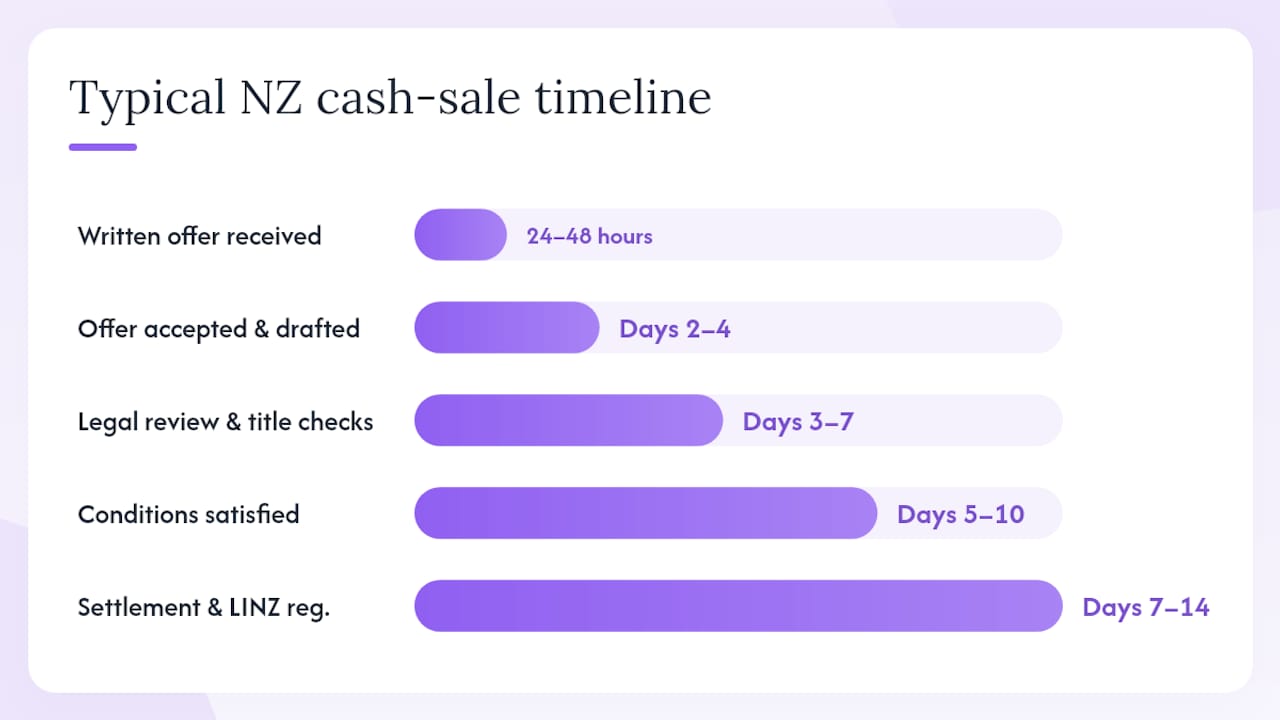
The timeline below reflects what’s achievable when both parties are prepared. Delays almost always come from incomplete documentation or late legal instruction, not from the cash-sale process itself.
| Stage | Realistic timeframe |
|---|---|
| Initial enquiry and property assessment | Day 1 |
| Written cash offer received | 24–48 hours |
| Offer accepted, agreement drafted | Days 2–4 |
| Legal review and title checks | Days 3–7 (if lawyer instructed early) |
| Conditions satisfied (if any) | Days 5–10 |
| Settlement and LINZ registration | Days 7–14 |
Settlement day is coordinated by your lawyer or conveyancer, who registers the ownership change through LINZ once funds are confirmed. Your role on that day is to deliver keys, remotes, and alarm codes, and to have vacated the property by the agreed time.
A signed contract alone doesn’t guarantee same-week settlement. If you have an existing mortgage to discharge, your bank needs notice. If there are tenants, their rights under the Residential Tenancies Act affect the timeline. These steps take time, and they need to start the moment the agreement is signed.
To hit a 7–14 day settlement, prepare the following before you accept an offer:
- Certificate of title (your lawyer can pull this)
- LIM report, if you have a recent one
- Building consent and code compliance records for any work done
- Tenancy agreements, if the property is tenanted
- Mortgage account details for discharge coordination
- Keys, remotes, and alarm codes ready for handover
Pro Tip: Instruct your lawyer or conveyancer before you accept an offer, not after. Early legal instruction is one of the most effective ways to shorten the time between signing and settlement.
What to prepare so your cash sale actually settles on time
Preparation is where most fast sales either succeed or stall. A buyer can move quickly; the paperwork often can’t.
Document checklist:
- Title information confirming ownership and any encumbrances
- LIM report (a recent one saves the buyer time and reduces their discount)
- Building consents and code compliance certificates for additions or alterations
- Tenancy details including lease agreements and bond lodgement records
- Body corporate records if the property is a unit or apartment
- Insurance details for the property
Beyond paperwork, a few low-cost presentation steps can reduce the discount a cash buyer applies. Decluttering, cleaning, and fixing visible minor faults improve buyer perception without requiring significant spend. A property that looks cared-for signals lower risk to a buyer, and lower perceived risk means a higher offer.
Disclosure matters too. Properties with flood risk, unconsented work, or defective titles are harder to sell and attract steeper discounts when issues surface late. Disclosing material issues upfront, before the offer is finalised, removes the risk of a buyer renegotiating or withdrawing after discovery. It also builds trust, which tends to make the rest of the process smoother.
For a detailed preparation checklist tailored to cash sales, coordinate access for any inspection or valuation the buyer requests as early as possible. A delayed inspection pushes every subsequent step back by the same number of days.
How to vet a cash buyer before you sign anything
Not every company that advertises “we buy houses for cash” is equally reliable. A few straightforward checks protect you without slowing the process significantly.
Questions to ask any cash buyer:
- Can you provide written proof of funds or a bank confirmation letter?
- Are you a registered New Zealand company? (Ask for the company number and check it on the Companies Register.)
- How many properties have you purchased in the past 12 months?
- Can you provide references from recent sellers?
- How is the deposit held, and what happens to it if the sale doesn’t proceed?
- How flexible is your settlement timeline if my circumstances change?
Red flags to watch for:
- Reluctance to provide proof of funds in writing
- Pressure to sign the agreement immediately, before you’ve had legal advice
- No written offer, only a verbal or email commitment
- Vague company details, no physical address, or offshore bank routing for the deposit
- Requests to sign documents you haven’t had reviewed by a lawyer
Comparing cash offers on headline price alone is a mistake. A higher price with a longer conditional period can be riskier and slower than a slightly lower unconditional offer. When you compare multiple cash offers, weigh proof of funds, deposit terms, settlement timeline, and contract conditions together to find the best net outcome, not just the biggest number.
You can verify a company’s registration at the New Zealand Companies Register (companiesoffice.govt.nz). For questions about a buyer’s conduct or your rights, the Real Estate Authority (REA) is the relevant regulatory body, though note that direct cash buyers operating outside a licensed agency may fall outside REA jurisdiction. In that case, your lawyer is your primary protection. Review the terms and disclaimers typical of cash buyer transactions so you understand what standard contract language looks like before you sign.
What the sale and purchase agreement actually covers in New Zealand
The sale and purchase agreement (S&P) is the legal foundation of every property sale in New Zealand. For a cash sale, it’s also the document that locks in your timeline.
The agreement is a legally binding contract that must be read and understood before signing. It sets out the sale price, which chattels are included, any conditions, and the settlement date. Sellers should seek independent legal advice before signing, and a reputable cash buyer will not object to that.
What the S&P must cover:
- Sale price and deposit amount
- Chattels included in the sale (appliances, light fittings, curtains)
- Settlement date
- Any conditions (building inspection, title check, finance — though a true cash offer should have none or minimal conditions)
- Vacant possession requirements or tenancy details
Your obligations on settlement day:
- Vacate the property by the agreed time
- Deliver all keys, remotes, garage openers, and alarm codes to your lawyer
- Confirm with your lawyer that the mortgage discharge has been processed
- Ensure the property is in the condition agreed in the contract (no chattels removed that were included)
Your conveyancer manages the fund transfer and registers the change of ownership through LINZ once settlement is confirmed. You don’t need to be present at the LINZ registration, but you do need to have completed your handover obligations.
Conditional offers add time. Each condition has a satisfaction date, and if a condition isn’t met, the buyer can cancel. An unconditional cash offer removes that risk entirely, which is why it’s the fastest and most certain path to settlement.
Instruct your solicitor or conveyancer as early as possible. Waiting until after you’ve accepted an offer adds days to the process. A lawyer who is already familiar with your title and property details can turn around a review in hours rather than days.
How Easysale makes a fast, safe cash sale straightforward
Selling your home quickly doesn’t have to mean cutting corners on the process. Easysale offers New Zealand homeowners a direct cash-buying service that removes agents, commissions, and open homes from the equation entirely.

The process runs in three steps: submit your property details online, receive a no-obligation cash offer within 24–48 hours, and choose a settlement timeline that works for you. Easysale buys properties across New Zealand in any condition, so there’s no requirement to repair, stage, or renovate before you sell. There are no agent fees and no marketing costs.
For sellers who need to move quickly, whether due to financial pressure, an inherited property, or a life change that won’t wait, Easysale provides the certainty of a confirmed cash offer and a settlement timeline you control. Independent legal advice is always recommended before signing, and Easysale supports that step rather than discouraging it.
Get a no-obligation cash offer from Easysale and find out what your property is worth without committing to anything.
Why speed and safeguards belong together
There’s a version of the “sell fast for cash” conversation that treats legal steps as obstacles to work around. That framing is wrong, and it costs sellers.
The sellers who reach settlement in 7 days aren’t the ones who skipped legal review. They’re the ones who instructed their lawyer on day one, had their documents ready before the offer arrived, and chose a buyer they’d actually verified. Speed in a property sale comes from preparation, not from cutting the steps that protect you.
The cash-sale route is genuinely useful for Kiwi homeowners in the right circumstances. A below-market offer that settles in ten days can be worth more, in practical terms, than a higher offer that takes four months and carries the risk of falling through. But that calculation only holds when the buyer is credible and the contract is sound.
My advice: treat the legal step as part of the fast route, not a detour from it. Get your lawyer involved early, read the agreement before you sign, and ask for proof of funds before you commit. Those three steps add very little time and remove most of the risk.
This article is general information, not a substitute for advice from a qualified lawyer. Consult a qualified legal professional about your own circumstances before acting on anything here.
Sources
These are the primary sources for the legal and process claims in this article. Each one is worth bookmarking if you’re preparing for a fast property sale.
- Selling your house | New Zealand Government
- Settled
- Buying or selling your property? (REA sale and purchase guide)
Recommended
