
Top house sale solutions for Kiwi sellers in 2026

For most New Zealand sellers who need speed, the four most reliable routes are auction, tender or deadline sale, private negotiation, and a direct cash buyer. Auction suits a well-presented home in a competitive suburb. Tender or deadline sale works when pricing is uncertain. Private negotiation gives you control. A cash buyer, like Easysale, trades some price certainty for near-certain, fast settlement.
The REINZ 2025 year in review recorded national sales counts up 10.3% to 80,655, with inventory rising 5.9%. More listings meant buyers grew selective, so pricing and presentation became the deciding factors for a fast sale. REINZ December 2025 data confirmed buyer activity lifted in certain regions toward year-end, with first-home buyers and owner-occupiers driving much of that momentum.
Your single next step today: get a registered valuation or comparable sales report, then call a conveyancer. Everything else follows from those two actions.
Key takeaways
Choosing the right sale method from day one is the single most effective way to shorten your time on market and avoid costly delays.
| Point | Details |
|---|---|
| Match method to your timeline | Auction and tender suit sellers with 3–5 weeks; cash buyer suits those needing settlement in days. |
| Price to create urgency | With NZ inventory up 5.9% in 2025, overpriced listings sit longer and lose buyer confidence. |
| Get legal help early | Engage a conveyancer before signing any agreement to avoid contract cancellations or costly clause errors. |
| Presentation pays | Depersonalise, repair the visible, and invest in professional photography before anything else. |
| Easysale for speed and certainty | Easysale provides unconditional cash offers with no agent fees, settling on your preferred timeline. |
Table of Contents
- Which fast-sale method works best for your NZ property?
- Which sale route matches your situation?
- Your week-by-week checklist from listing to settlement
- Pricing and presentation tactics that produce fast offers
- NZ legal steps, costs, and tax points you need to know
- When a fast cash buyer is the pragmatic choice
- Red flags and questions to ask before you sign
- What sellers often get wrong about timing
- Easysale: fast, fair cash offers with no agent fees
- Sources
Which fast-sale method works best for your NZ property?
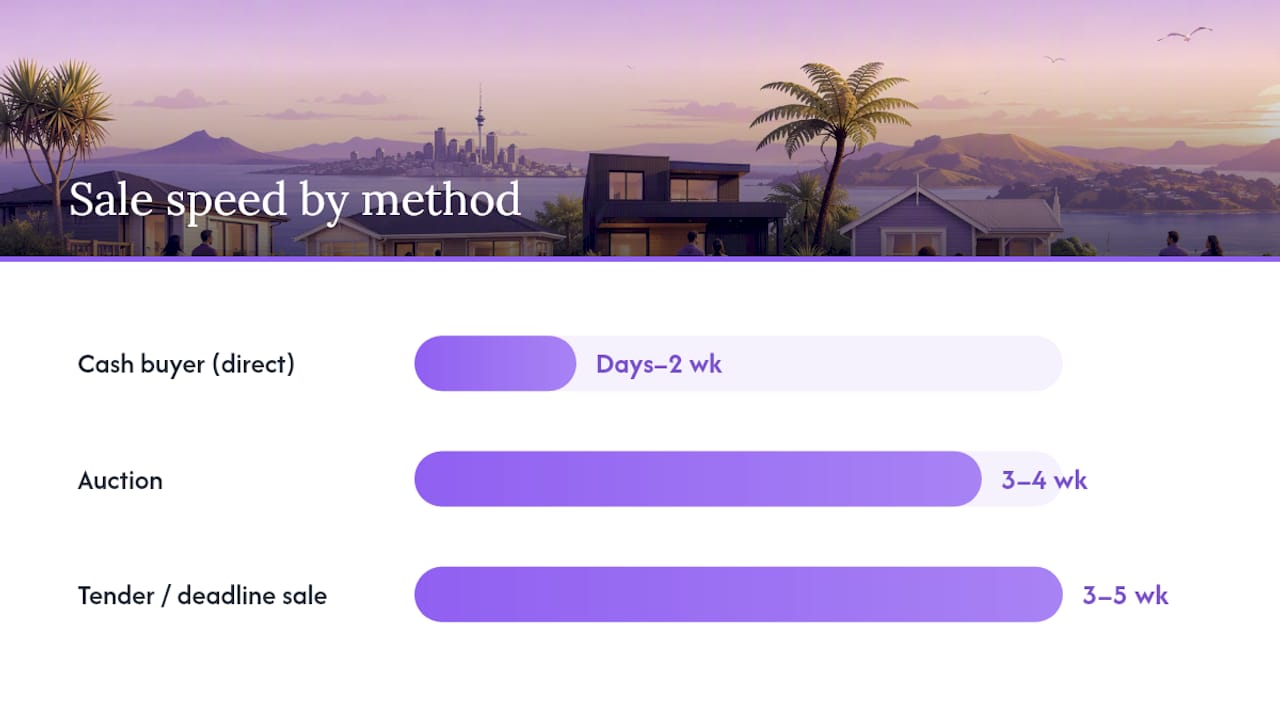
OneRoof’s home sellers guide identifies four main methods used in New Zealand: negotiation, auction, tender, and deadline sale. Here is what each looks like in practice.
| Method | Typical timeline | Certainty | Likely net price | Privacy | Seller effort |
|---|---|---|---|---|---|
| Auction | 3–4 weeks to auction day | Unconditional on the fall of the hammer | At or above reserve if competition is strong | Low (public) | High: staging, open homes |
| Tender / deadline sale | 3–5 weeks | Conditional until satisfied | Competitive, especially with multiple tenders | Medium | Moderate |
| Private negotiation | Varies widely | Usually conditional | Market-dependent | High | Moderate |
| Cash buyer (direct) | Days to 2 weeks | Unconditional from offer | Below market value | Very high | Very low |
Auction creates genuine urgency because buyers compete openly and the sale becomes unconditional the moment the hammer falls. Tender and deadline sale are useful when you are unsure of the right asking price, since sealed bids reveal what the market will actually pay. Private negotiation suits sellers who want to control the process but requires patience. A direct cash buyer removes almost all uncertainty at the cost of a lower sale price.
Pro Tip: Reserve auction for renovated, standalone homes in locations with proven buyer competition. A tired property in a slow suburb rarely benefits from auction pressure and can pass in, which damages perception and costs you time.
For a broader look at quick home sale trends in 2025 and how buyer behaviour shifted across the year, the Easysale blog has a useful summary.
Which sale route matches your situation?
The core decision rule is simple: your required timeframe determines your method, not the other way around. Once you know how fast you genuinely need to settle, the choice narrows quickly.
Work through these steps:
- Set your hard deadline. Do you need settlement in under two weeks, within a month, or are you flexible? A hard deadline under two weeks points directly to a cash buyer.
- Decide your price floor. Are you willing to accept below market value for speed and certainty? If not, auction or tender is more appropriate.
- Assess your property’s condition. A property needing significant repairs is harder to auction competitively. A cash buyer will purchase in any condition.
- Consider your privacy needs. Auction is public. Private sale and cash buyer routes are not.
- Check your tolerance for conditional offers. If a conditional offer falling through would create financial or logistical problems, prioritise unconditional routes.
Three common seller profiles map onto this framework clearly:
- Urgent relocation or financial pressure: cash buyer or deadline sale. Speed and certainty outweigh price.
- Wanting market value with some flexibility: auction or tender, with a realistic reserve and strong presentation.
- Uncertain on pricing, wanting privacy: tender or private negotiation, supported by a registered valuer’s opinion.
For sellers weighing up private house sale in New Zealand specifically, there are distinct advantages and risks worth understanding before committing.
Your week-by-week checklist from listing to settlement
Getting the sequence right saves you from costly delays at the contract stage.

| Timeframe | Action |
|---|---|
| Days 1–7 | Order a LIM report from your council; engage a lawyer or conveyancer; get a registered valuation or comparable sales analysis; complete minor repairs and clean thoroughly; arrange professional photography |
| Week 2 | List on Trade Me Property and realestate.co.nz; schedule open homes; brief your agent on your timeline and minimum acceptable terms |
| Offer stage | Review all conditions carefully with your lawyer before signing; confirm deposit handling goes to a solicitor’s trust account; check settlement date aligns with your next move |
| Pre-settlement | Complete a pre-settlement inspection with the buyer; confirm all chattels listed in the agreement are present; ensure your conveyancer has all disclosure documents ready |
Most sale and purchase agreements include conditions such as finance approval, a building report, and a satisfactory LIM. The deal only becomes unconditional once those conditions are met, so managing that timing carefully avoids double-moving costs or bridging finance stress.
Pro Tip: Instruct your conveyancer before you accept any offer, not after. Having them review the sale and purchase agreement before you sign is far cheaper than unwinding a problematic clause later.
The property sale checklist for 2025 on the Easysale blog expands on each of these steps with NZ-specific detail.
Pricing and presentation tactics that produce fast offers
Price to create urgency, not to leave room for negotiation. In a market where inventory rose 5.9% across 2025, buyers had genuine alternatives. A property priced even slightly above comparable sales sat longer, which compounded the problem.
Residential valuers noted demand was bifurcated in late 2025: renovated standalone homes in sought-after locations held buyer interest, while other segments softened. Base your asking price on objective comparable sales from the past 90 days, not on what you paid or what a neighbour sold for two years ago. A registered valuer’s report costs a few hundred dollars and removes the guesswork.
On presentation, the highest-return fixes are almost always the cheapest:
- Depersonalise every room. Remove family photos, personal collections, and excess furniture. Buyers need to picture themselves living there.
- Clean and repair the visible. Fresh paint on scuffed walls, clean grout, working light fittings, and tidy gardens cost little but shift buyer perception significantly.
- Stage the key rooms. Living room, master bedroom, and kitchen. You do not need a professional stager for every room.
- Prioritise kerb appeal. The first photo online and the first impression at an open home are the same moment. Mow, edge, and tidy the front.
Pro Tip: When time and budget are tight, spend on photography before anything else. Poor listing photos cut your buyer pool before anyone walks through the door.
NZ legal steps, costs, and tax points you need to know
Govt is the clearest starting point for understanding your legal obligations as a seller. The must-do items before signing anything are:
- Order a LIM report (Land Information Memorandum) from your local council. The NZ Law Society warns that failing to disclose unconsented works or weathertightness issues can allow a buyer to cancel after the agreement is signed.
- For unit titles, pre-contract disclosure documents are legally required before a buyer can sign.
- Have a lawyer or conveyancer review the sale and purchase agreement before you sign. The REA guides for buyers and sellers explain agency obligations and what the standard agreement covers.
Typical costs to budget for:
- Agent commission: generally 2–4% of the sale price, negotiable.
- Conveyancing: roughly $1,500–$2,500 depending on complexity.
- Marketing: $1,000–$3,000 for professional photography, online listings, and signage.
- LIM report: $200–$400 depending on your council.
Sellers should also check their tax position with the IRD’s property tax decision tool before listing. The bright-line test applies to many residential properties sold within a set period of acquisition, and the rules changed in recent years. Confirming your position early avoids surprises at settlement.
When a fast cash buyer is the pragmatic choice
Sellers who choose a fast cash sale typically do so because speed and certainty matter more than extracting every dollar from the market. Common scenarios include mortgage pressure, urgent relocation, relationship breakdown, or a property in poor condition that would struggle at auction.
Easysale’s process is straightforward: submit your property details online, receive a no-obligation cash offer, then settle on a timeline that suits you. There are no agent fees, no open homes, and no conditional clauses to manage.
| Factor | Cash buyer (Easysale) | Auction / negotiation |
|---|---|---|
| Speed to unconditional | Days to 2 weeks | 3 weeks or longer |
| Price outcome | Below market value | At or near market value |
| Conditions | None | Finance, building, LIM |
| Seller effort | Very low | High |
| Privacy | High | Low to medium |
Before accepting any cash offer, ask these questions of any buyer:
- Can you provide proof of funds or a bank confirmation letter?
- How is the deposit held, and by whom?
- What is the exact settlement date, and is it fixed?
- Are there any conditions attached to the offer?
Red flags and questions to ask before you sign
Spotting a risky offer early saves you from a collapsed sale or a legal dispute.
Clear red flags:
- A buyer or agent who discourages you from getting a LIM or building inspection.
- Vague or verbal settlement terms with nothing confirmed in writing.
- Pressure to sign quickly without time to have a lawyer review the agreement.
- A deposit that is not going into a solicitor’s trust account.
- An agent who cannot confirm their REA licence number on request.
Questions to ask your agent:
- What is your strategy for achieving a fast, unconditional sale on this property?
- How many properties have you sold in this suburb in the past six months?
- What are your full commission and marketing costs, in writing?
Questions to ask any buyer or cash buyer:
- Is your offer unconditional, and can you confirm that in writing today?
- What is your proof of funds, and can I see it before I sign?
- Who holds the deposit, and under what terms?
Verify any agent’s licence at REA’s public register before signing an agency agreement. For property sale negotiation tips and how to handle multiple offers, the Easysale blog covers the key scenarios.
What sellers often get wrong about timing
The sellers who struggle most in a market like 2025 are those who price emotionally and wait for a better offer that does not come. With inventory up and buyers selective, a property that sits for six weeks loses perceived value. Buyers assume something is wrong with it, even when nothing is.
The smarter move is to price accurately from day one, present the property well, and choose the sale method that matches your actual timeline. If you genuinely need to be out in two weeks, do not list at auction and hope for the best. If you have time and a well-presented home, do not accept the first cash offer out of anxiety.
One thing most sellers underestimate: the cost of a slow sale is not just financial. The stress of managing open homes, conditional offers, and uncertain timelines while trying to plan your next move is real. Getting the method right from the start reduces that cost significantly.
Easysale: fast, fair cash offers with no agent fees
If speed and certainty are your priorities, Easysale offers a direct alternative to the traditional agent-led process. There are no commissions, no open homes, and no waiting on conditional buyers. Easysale buys properties across New Zealand in any condition, which makes it a practical option when a property needs work, when time is short, or when the process itself needs to be simple.

The process takes three steps: submit your property details, receive a no-obligation cash offer within 24 hours, and settle on a date that works for you. Sellers facing mortgage pressure, urgent relocation, or a property that would be difficult to auction have found this route removes the uncertainty that traditional sales carry.
To get a no-obligation offer, visit Easysale’s private sale page and submit your details today.
Sources
- Home sellers guide: What are the different ways to sell a house?, All things property, under OneRoof
- REINZ 2025 year in review
- Selling your house | New Zealand Government
- Guides for buyers and sellers | REA
- Buying and selling a property | New Zealand Law Society
- The process of selling a house in 2025 | MyTopAgent
Recommended
