
What is rapid property liquidation: NZ guide for homeowners

Rapid property liquidation is the voluntary, fast conversion of your home into cash through a direct sale to a cash buyer. It has nothing to do with company insolvency. For a Kiwi homeowner, it simply means selling quickly without a real estate agent, often settling in days or weeks rather than months. If you need to move fast, here are your first three steps:
- Check whether you have an active agency agreement with any real estate agent. If one exists, selling privately could still expose you to a commission claim of 3–4% plus GST.
- Gather your title copy, LIM report, and mortgage details before you contact any buyer.
- Instruct a lawyer or conveyancer early, then request a no-obligation cash offer from Easysale.
Table of Contents
- How does rapid property liquidation work in New Zealand?
- What are the practical steps from first enquiry to settlement?
- Who buys properties quickly in New Zealand?
- What will a rapid cash sale actually cost you?
- What legal checks must you clear before accepting a fast offer?
- What documents should you have ready before you sell?
- What red flags should you watch for, and what should you ask?
- What are your alternatives if a fast cash sale is not the right fit?
- Key takeaways
- When is rapid liquidation the right call for a Kiwi homeowner?
- How Easysale makes a fast NZ cash offer simple
- Useful NZ sources for sellers
How does rapid property liquidation work in New Zealand?
The mechanics are straightforward. You accept a cash offer, your lawyer prepares the Sale and Purchase Agreement, the buyer’s deposit goes into a lawyer’s trust account, and both parties work through any conditions before settling on an agreed date.
One distinction worth knowing: company liquidation is a formal insolvency process governed by the Companies Act 1993. A private property sale is entirely separate. You are not insolvent. You are simply choosing to convert an asset to cash quickly.
Realistic timelines in NZ look roughly like this. A cash offer can come within 24–48 hours of submitting your property details. Legal checks, including title verification, LIM review, and AML/CFT identity confirmation, typically take 3–7 working days. Settlement can then occur within 7–21 days, depending on your mortgage discharge and the agreed date. Delays usually come from three sources: an undisclosed agency agreement, missing documents, or a buyer who turns out to need conditional finance after all.
What are the practical steps from first enquiry to settlement?
Walking through the process removes the guesswork. Here is what a typical fast sale looks like from your side:
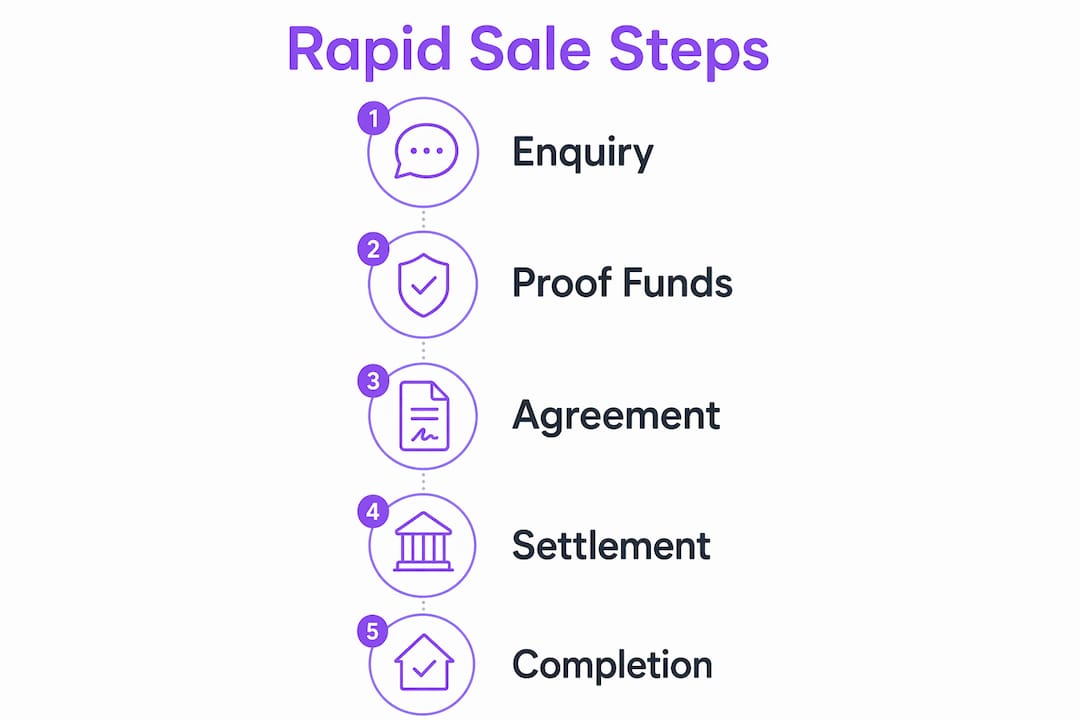
- Submit your property details. A cash buyer needs your address, a description of the property’s condition, and your preferred settlement timeframe. The more detail you provide upfront, the faster a firm offer follows.
- Receive and review the formal offer. A reputable cash buyer will present a written, no-obligation offer. Your lawyer reviews the Sale and Purchase Agreement before you sign anything. The buyer’s deposit must be held in your lawyer’s trust account until the sale goes unconditional.
- Complete legal and identity checks. Your lawyer handles AML/CFT identity verification, which is a legal requirement under the Anti-Money Laundering and Countering Financing of Terrorism Act 2009. Skipping this step is not an option. Leaving it until settlement day is a frequent cause of last-minute delays.
- Settle on your chosen date. Once conditions are satisfied and the agreement is unconditional, settlement proceeds. Your lawyer manages the transfer of title and release of funds.
Before signing, ask the buyer for proof of funds and clarify whether they intend to hold the property or on-sell it. A buyer planning to on-sell may negotiate differently and could push for a longer settlement window. Have your title copy, LIM, and ID documents ready from day one to shorten due diligence considerably.
Who buys properties quickly in New Zealand?
Cash buyers in NZ generally fall into a few clear categories. Experienced property investors hold funds ready to deploy and can settle without bank finance, which removes the most common source of delay. Buy-as-is specialists purchase homes regardless of condition, so a damaged or dated property is not a barrier. Private cash purchasers are individuals with liquid funds who prefer a direct transaction. Company investors operate similarly to institutional buyers, often with established legal teams that can move quickly.

What separates a capable fast buyer from one who will waste your time is funding certainty. A genuine cash buyer can provide a statement of funds on request. If they hesitate or offer vague reassurances instead, that is a signal worth taking seriously. Buyer intent also matters: a buyer who plans to hold the property tends to have simpler contract requirements than one who intends to on-sell immediately.
What will a rapid cash sale actually cost you?
The financial trade-off is real and worth calculating before you commit. Skipping an agent saves commission in the typical 3–4% commission range plus GST on the sale price. On a $750,000 home, that is $22,500–$30,000 before GST. Cash buyers typically offer below the open-market price in exchange for speed and certainty, so the net outcome depends on how large that discount is.
The typical NZ agent commission range is several percent plus GST. On a typical sale, this represents a substantial amount before GST saved by selling directly.
Other costs you still face regardless of how you sell:
- Lawyer or conveyancer fees (commonly in the low thousands of dollars for a standard residential sale)
- Mortgage discharge fee charged by your lender
- Any outstanding rates or body corporate levies settled at the time of sale
| Item | Traditional agent sale | Rapid cash sale |
|---|---|---|
| Sale price (example) | A representative market price | A price below market |
| Agent commission (commission rate plus GST) | Significant | — |
| Legal fees | low thousands of dollars | low thousands of dollars |
The gap in this example is around $19,000. Whether that difference is worth the speed, certainty, and reduced stress depends entirely on your situation.
What legal checks must you clear before accepting a fast offer?
New Zealand law creates specific obligations for sellers, and a rapid sale does not reduce them.
- Agency agreements: Check whether you have a current or recently cancelled agreement with any agent. Under Real Estate Authority guidance, an agent who introduced the buyer may still be entitled to commission even if you later sell privately.
- Full disclosure: You must provide accurate pre-contract and pre-settlement disclosure. Failure to do so gives the buyer the right to cancel or delay settlement.
- Sale and Purchase Agreement: Always use a lawyer to prepare or review this document. Never sign a buyer-drafted agreement without independent legal review.
- Deposit trust: The buyer’s deposit must sit in a lawyer’s trust account, not paid directly to you, until the sale is unconditional.
- AML/CFT identity checks: Both parties must complete identity verification under the Anti-Money Laundering and Countering Financing of Terrorism Act 2009. Your lawyer manages this.
Pro Tip: Instruct your lawyer at the very start of the process, not after you have accepted an offer. Early engagement means AML/CFT checks, title review, and the Sale and Purchase Agreement are all ready to go the moment you need them.
What documents should you have ready before you sell?
Preparation directly shortens the time between offer and settlement. Buyers who receive complete documentation can make firm offers faster and with fewer conditions.
Documents to gather now:
- Certificate of title (or a copy from Land Information New Zealand)
- LIM report (Land Information Memorandum from your local council)
- Recent rates notices
- Mortgage details, including your lender’s contact and the outstanding balance
- Building report (if you have one)
- Resource and building consent files for any additions or alterations
- Photo ID and a second form of identification for AML/CFT
Property preparation that saves time:
- Clear access to all areas of the property for inspection
- Note any known defects in writing for disclosure purposes
- Basic cleaning and tidy-up to allow accurate condition assessment
Pro Tip: Supplying your LIM and title copies at the point of first enquiry can cut a buyer’s due diligence period by several days. It signals you are serious and removes one of the most common reasons for conditional offers.
What red flags should you watch for, and what should you ask?
Not every fast buyer is a good buyer. These questions protect you:
- Can you provide written proof of funds before I sign anything?
- What is your intended settlement date, and is that date firm?
- Do you plan to hold the property or on-sell it?
- Who covers legal fees on your side?
- Will you use a lawyer to hold the deposit in trust?
Clear red flags to walk away from:
- No proof of funds, or vague answers about funding sources
- Pressure to sign immediately without legal review
- Requests to pay the deposit directly to the buyer or a third party rather than a trust account
- Unusually vague buyer identity or a reluctance to confirm who the purchasing entity is
- Promises of an unrealistically high price with no written offer to back it up
If you spot any of these, pause. Seek independent legal advice before proceeding, and ask for written confirmation of any verbal claim. A legitimate cash buyer will not object to reasonable due diligence on your part.
What are your alternatives if a fast cash sale is not the right fit?
| Route | Typical timeline | Likely net price | Seller effort |
|---|---|---|---|
| Fast cash buyer | 7–21 days | Below market (varies) | Low |
| Private sale | 4 weeks | Closer to market | High |
| Auction | 4 weeks | Market or above | Medium |
| Agent listing | 6 weeks | Market rate | Low to medium |
The decision rule is fairly clear. If you have equity to spare, time available, and a property in good condition, a full agent listing or auction will likely return more. If you are facing a tight deadline, financial pressure, a damaged property, or a life event that demands certainty over price, a fast cash sale removes the variables that make traditional sales stressful.
Key takeaways
Rapid property liquidation is a voluntary, private cash sale. It is not insolvency, and it can be done safely with the right legal support.
| Point | Details |
|---|---|
| Definition | A rapid cash sale is a voluntary private transaction, not a company insolvency process. |
| Agency agreement risk | Check for any active or recent agent agreement before accepting a cash offer to avoid a commission claim. |
| Legal must-dos | Instruct a lawyer early for AML/CFT checks, Sale and Purchase Agreement review, and deposit trust. |
| Money trade-off | You save 3–4% plus GST in agent commission but typically accept a below-market price for speed. |
| Next step with Easysale | Request a no-obligation cash offer at easySale.co.nz and have your title, LIM, and ID ready. |
When is rapid liquidation the right call for a Kiwi homeowner?
There is a version of this conversation that gets overlooked in most property guides. People focus on the price discount and stop there, as if every homeowner is in the same position. They are not.
A rapid cash sale makes clear sense when the cost of waiting outweighs the cost of the discount. Urgent relocation, separation, a property that needs significant work, or genuine financial pressure are all situations where certainty has real monetary value. Waiting three months for a higher offer is not free. There are mortgage payments, rates, insurance, and the emotional weight of an unresolved situation.
What reassures me about the NZ framework is that this is a well-understood, legally sound process. It is not a grey area. Sellers have clear rights, lawyers have clear obligations, and the Real Estate Authority provides accessible guidance. The risk is not in the process itself. The risk is in skipping legal steps or choosing a buyer without proper vetting.
If you are unsure whether a fast sale is right for your situation, get an independent valuation first. Then request a no-obligation offer. The gap between the two numbers will tell you what speed is actually costing you, and you can make a clear-eyed decision from there.
How Easysale makes a fast NZ cash offer simple
Selling your home without an agent does not have to mean doing everything yourself. Easysale buys residential properties across New Zealand directly, in any condition, with no commission and no drawn-out negotiations.
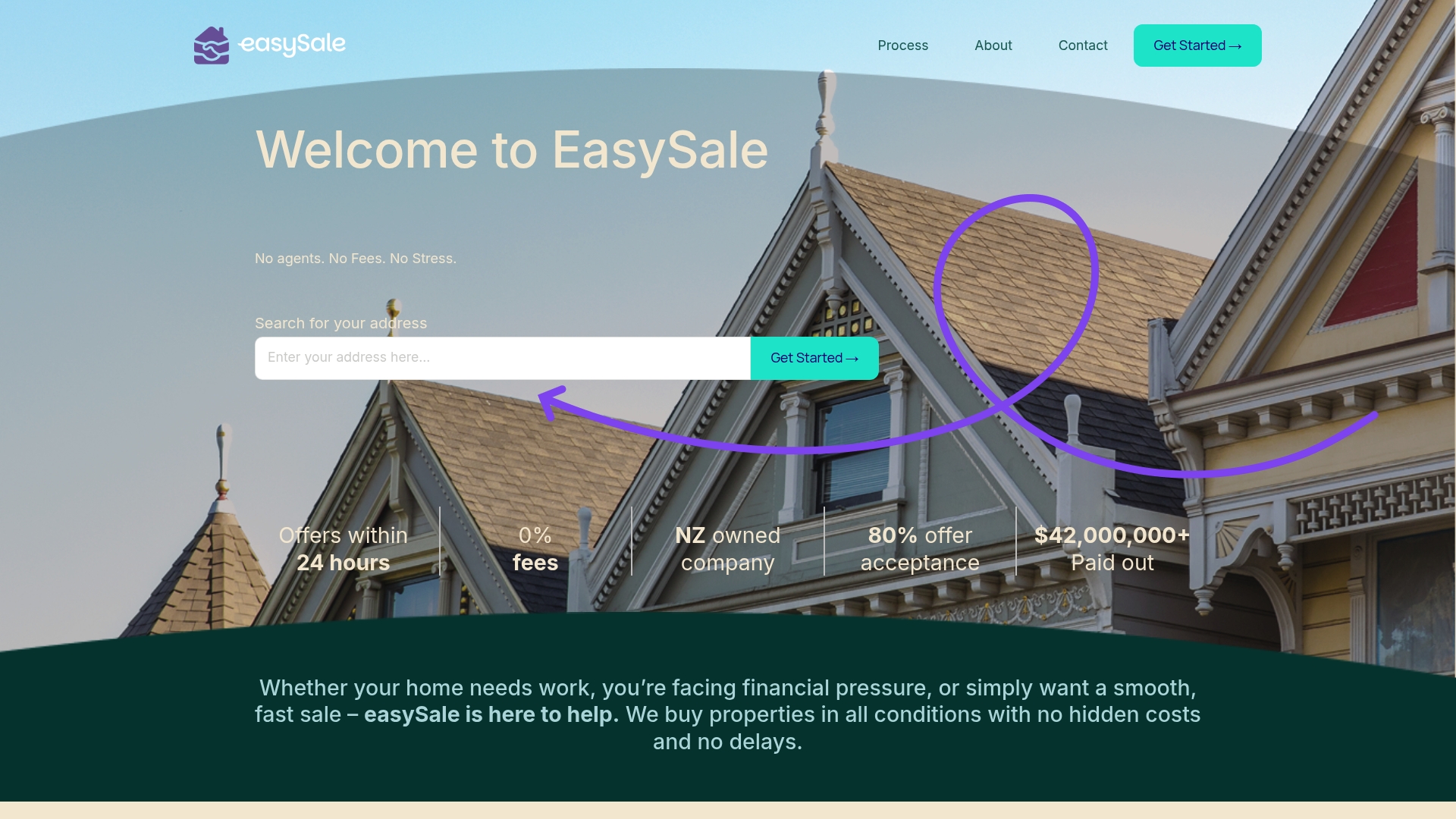
The process has three steps. You submit your property details online. Easysale comes back with a no-obligation cash offer. You choose the settlement date that works for you, whether that is seven days or a few weeks away. There are no open homes, no agent fees, and no uncertainty about whether the deal will fall over at the last minute.
Easysale works with properties in any condition, including damaged homes that would be difficult to list through a traditional agency. If your situation involves separation or an urgent timeline, the team handles those circumstances with discretion and care.
To get started, visit easySale.co.nz, submit your property details, and have your title copy, LIM, and ID ready to speed things along.
Useful NZ sources for sellers
- Settled.govt.nz — Selling privately: covers Sale and Purchase Agreements, disclosure obligations, and deposit handling.
- Real Estate Authority — Agency agreements: explains when an agent can still claim commission after a listing ends.
- Settled.govt.nz — Deciding to sell with an agent or privately: practical comparison of private and agent-assisted sales.
- SoloSale — How to sell your house privately in NZ: cost comparisons and common pitfalls for private sellers.
- Easysale blog — Fast property sale checklist: a compliance and AML/CFT checklist tailored to rapid NZ sales.
This article is general information only, not legal or financial advice. Confirm current rules and your specific obligations with a qualified lawyer or conveyancer before proceeding with any property sale.
Recommended
