
NZ Sellers: 4 Reasons Your Home Isn't Selling and How to Fix Them

Most unsold homes come down to one of four things: the price doesn’t match what buyers are actually paying for similar properties, the presentation isn’t earning its first impression, the marketing or agent process has gone flat, or the wider market has slowed. Start by pulling your agent’s campaign numbers and comparing your price against genuine recent sales, not last year’s expectations. That single check usually points straight at the fix.
TL;DR:Overpriced homes with comparable recent sales do not attract offers, especially when the curb appeal or presentation is lacking.Poor listing quality, such as bad photos or no floor plan, makes properties nearly invisible in competitive markets.A stalled campaign nearly always relates to price, presentation, or marketing issues, which can be identified within the first two weeks.Legal issues like unconsented renovations or boundary disputes can silently prevent sales and should be addressed early.Private cash offers can be a practical solution when the property needs repairs, or a quick, discreet sale is required.
EasysaleA Simpler Way to SellEasysale helps New Zealand homeowners sell properties in any condition through a straightforward cash offer and flexible settlement timeline.Explore Easysale
Table of Contents
- Why is my home not selling? The common reasons and how to fix them
- Step-by-step: an evidence-led plan to relaunch, reprice or pause
- When to consider alternatives: cost, as-is sales and private offers
- Agent follow-up, buyer feedback and your agency agreement
- Legal and title issues that quietly stall a sale
- Common buyer objections and how to handle them
- How a building inspection can make or break a sale
- Understanding buyer financing challenges
- A practical view on why sellers get stuck
- A straightforward alternative if you need a fast, as-is sale
- Where to check the current market data
- Sources
- FAQ
Why is my home not selling? The common reasons and how to fix them
If your campaign has gone quiet, the cause is almost always one of a handful of things. Here’s how to diagnose each one and what to actually do about it.
Price: the most common culprit
Buyers don’t care what you paid, what you spent on the kitchen, or what your neighbour sold for in 2021. They care about what’s selling right now, in your suburb, in this condition. If your home has had more than a handful of viewings with no offers, price is the first place to look.
Pull up recent comparable sales within your suburb from the last three months, not the last year. If three similar homes sold for less than your asking price, buyers already know that, even if you don’t want to. Settled recommends starting with an honest conversation with your agent, reviewing the written price estimate against what’s actually landed, and checking the buyer feedback your agent has been collecting.
Watch for these signals that price is the issue:
- Plenty of online views but very few actual viewings booked.
- Viewings happening but no follow-up questions or second visits.
- Feedback that repeatedly mentions “similar homes nearby” or “seen better for less.”
- An open home with light foot traffic compared to neighbouring campaigns.
Pro Tip: Ask your agent for the exact addresses of comparable sales, not just a summary. If they can’t produce three genuine comparables from the last 90 days, that’s a red flag on their homework, not just your price.
Presentation: the silent deal-breaker
A cluttered hallway, dim lighting, or a lingering pet smell can cost you tens of thousands of dollars before a buyer even reaches the kitchen. Presentation problems are cheap to fix and expensive to ignore.
Run through this before your next open home:
- Declutter every surface, including wardrobes buyers will open.
- Fix the small stuff: leaking taps, cracked tiles, a sticking door.
- Get the lighting right, natural where possible, warm globes everywhere else.
- Deal with smells at the source, not with air freshener over the top.
- Consider light staging in the lounge and main bedroom if the home feels empty or dated.
None of this needs a full renovation. A weekend of maintenance and a professional clean often shifts buyer confidence more than a $20,000 kitchen refresh ever would.
Marketing and listing quality
A listing with poor photos, no floor plan, and a generic description is invisible in a crowded market. 1News points out that strong marketing and realistic pricing go hand in hand. One without the other rarely works.
Check that your listing includes professional daytime photography, a floor plan, and copy that describes the lifestyle, not just the square metreage — for more tips, see Promote Your Listing | Forward Financial Group, Loans Powered by Barrett Financial Group, LLC. If your listing has been live for weeks with the same six photos and no video walkthrough, ask your agent why.
Agent performance and campaign process
Your agent should be able to tell you, without hesitation, how many online views your listing has had, how many people have saved it, how many booked a viewing, and what themes are showing up in feedback. If they can’t answer those questions clearly, the process itself may be the problem.
Reasonable questions to ask:
- How many enquiries has the listing generated each week?
- What specific objections come up in feedback?
- How does open-home turnout compare with similar listings they’ve run recently?
- What’s the plan for the next two weeks if nothing changes?
Location and buyer pool limits
Some locations simply have a smaller pool of buyers, whether that’s a busy road, a small rural catchment, or a niche property type. You can’t fix location, but you can adjust messaging to target the buyers who genuinely want what you’re offering, rather than hoping a broad audience changes its mind.
Market timing
REINZ’s July 2026 data shows the median Days to Sell around 50 days, with sales volumes down compared with the previous year. That’s a genuine shift in pace, not just a run of bad luck on your particular street. Stuff reported similar findings, with rising inventory giving buyers more choice and more time to decide. Patience matters, but patience without action is how homes sit for six months instead of six weeks.
Step-by-step: an evidence-led plan to relaunch, reprice or pause
Rather than guessing, treat the first fortnight of any campaign as a diagnostic test. Here’s the sequence to follow.
Statistic to keep in mind: the Ants agency’s guidance notes that a stalled campaign nearly always comes back to price, presentation, or positioning, and that the first one to two weeks of a campaign act as a genuine signal. If viewings and feedback are light or repeating the same objection in that window, the campaign needs to change, not simply run longer.
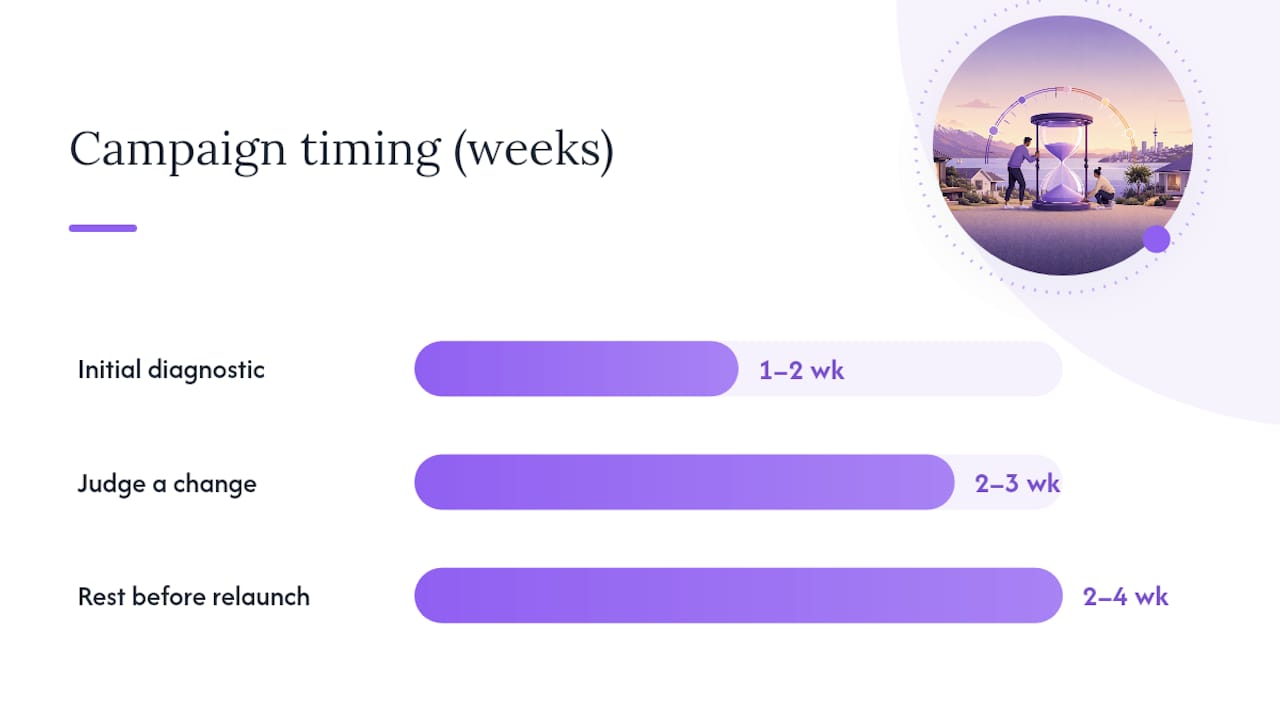
- Week 1 to 2: review the numbers. Ask your agent for online views, saves, enquiry count, open-home attendance, and a summary of feedback themes. Compare against what’s typical for your suburb and price bracket.
- Assess the signal. If interest is strong but offers aren’t coming, price is probably the issue. If interest itself is weak, presentation or marketing needs attention first.
- Refresh the assets before touching price. New hero photo, a sharpened headline, and an honest price guide can reset how buyers see the listing without conceding on value. Local commentary suggests this kind of relaunch often works better than a string of small price cuts.
- Adjust price only with evidence. If comparable sales confirm you’re overpriced, make one meaningful adjustment rather than several small, drawn-out ones. Buyers notice repeated tiny cuts and read them as desperation.
- Consider a change of sale method. If auction hasn’t generated urgency, a set-price or negotiation campaign might suit better, and vice versa.
- Decide whether to rest and relaunch. Pulling a listing for two to four weeks and coming back with new photos and a fresh listing date can shake off “stale listing” syndrome, where buyers assume something’s wrong because it’s been sitting too long.
Give each change roughly two to three weeks before judging its impact. Anything shorter doesn’t give buyers enough time to notice, and anything longer risks wasting a slow market’s limited attention span.
If you’re considering changing agents, check your agency agreement first. Settled.govt.nz advises confirming the exclusive period and expiry date in writing, and asking any new agent for evidence of recent local sales before signing on. Paying commission to two agents because of an overlapping contract is an entirely avoidable mistake.
For more on the practical side of running a campaign, selling your property in New Zealand covers agent selection and timelines in more depth.
When to consider alternatives: cost, as-is sales and private offers
Not every fix is worth the money. A $3,000 lick of paint that lifts buyer perception is usually worth it. A $40,000 renovation chasing a $20,000 price gain almost never is. Weigh the cost of any improvement against the price movement it’s realistically likely to produce, and be honest about whether you’re fixing the house or avoiding the harder conversation about price.
A private or cash sale suits particular situations better than the open market:
- You’re on a genuine deadline, such as a job relocation or a settlement date already locked in elsewhere.
- The property needs repairs that would cost more than they’d return in sale price.
- The home is tenanted, unconsented, or tied up in probate and a straightforward buyer is preferable to a drawn-out campaign.
- You’d rather avoid open homes and public marketing for privacy or family reasons.
Before accepting any cash offer, check the fee structure is transparent, confirm the settlement timeline actually suits you, and ask whether the arrangement can stay confidential if that matters to you.
Pro Tip: Get any cash offer in writing before you commit to anything, and compare it against what a repaired, well-presented listing might realistically achieve on the open market. A fast sale is only a good deal if the gap between the two numbers makes sense for your situation.
Agent follow-up, buyer feedback and your agency agreement
A campaign only works if someone’s actually managing it. That means your agent following up every viewing within a day or two, not waiting for buyers to call back, and reporting that feedback to you honestly, even when it’s not flattering.
Ask specifically what buyers said, not just whether they liked it. “Loved the kitchen, thought it was overpriced” tells you something. “Went well” tells you nothing.
Your agency agreement matters more than most sellers realise. Check the exclusivity period, the expiry date, and what happens if you want to pause or switch agents mid-campaign. Settled.govt.nz is worth reading properly here, because the small print is exactly where sellers get caught paying two commissions for one sale.
Legal and title issues that quietly stall a sale
Sometimes the problem isn’t the listing at all. Unconsented renovations, boundary discrepancies, unresolved cross-lease issues, or a title with unusual covenants can all stop a sale in its tracks, often at the point a buyer’s lawyer starts due diligence.
Get a Land Information Memorandum and title search done early, before you list, not after an offer falls through. If your home has any unconsented work, whether that’s a deck, a garage conversion, or an internal wall moved without approval, disclose it upfront. Buyers who discover it themselves during due diligence tend to walk, or renegotiate hard. Sellers who disclose it early and price accordingly usually keep the deal together.
Common buyer objections and how to handle them
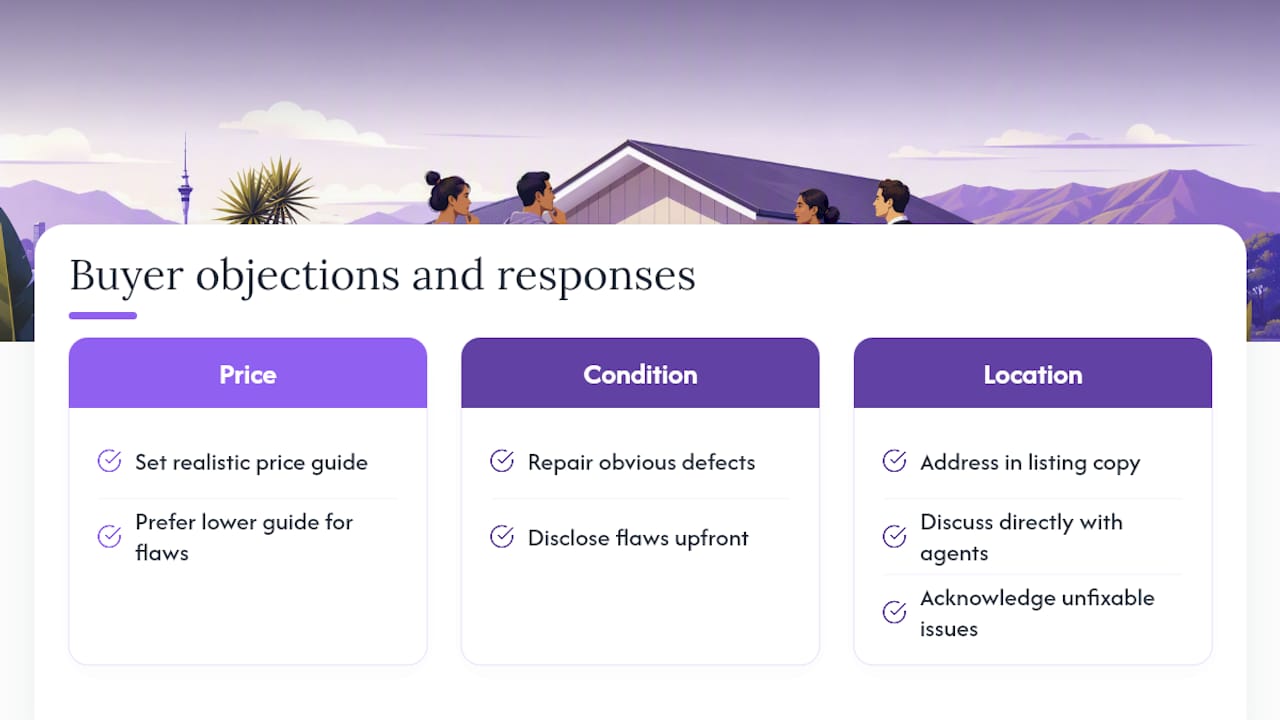
Buyers rarely say “no” outright. They say “we’re still looking,” which usually masks a specific concern. The most common ones are price, condition, and location, but a few others come up often enough to plan for.
Traffic noise, proximity to power lines, or an awkward floor plan are objections you can’t erase, but you can address them directly in your listing copy and agent conversations rather than hoping buyers won’t notice. A slightly lower price guide that reflects a genuine flaw often converts better than a higher price defended with excuses.
How a building inspection can make or break a sale
A poor building inspection report is one of the fastest ways to lose a buyer who was otherwise ready to commit. Moisture issues, roof problems, or foundation concerns discovered after an offer is accepted often lead to renegotiation, delay, or the deal falling through entirely.
Consider commissioning your own inspection before listing. It costs a few hundred dollars and gives you the chance to fix minor issues or price realistically around bigger ones, rather than being ambushed mid-negotiation.
Understanding buyer financing challenges
Some stalled sales have nothing to do with your home at all. Buyers with finance approval that falls through, or pre-approval that doesn’t stretch as far as they expected once a bank’s final valuation comes in, can quietly derail a sale that looked certain.
Ask your agent whether buyers making offers have finance sorted, not just pre-approval in principle. A conditional offer that hinges on finance is weaker than it looks, and building in a realistic timeframe for that condition avoids nasty surprises close to settlement.
A practical view on why sellers get stuck
The biggest mistake I see isn’t a bad agent or a tough market. It’s sellers making decisions with their heart instead of the evidence in front of them. Clinging to a 2021 valuation, ignoring three weeks of consistent feedback, or delaying a relaunch because it feels like giving up, these choices cost far more than they save.
The sellers who move fastest are the ones who treat feedback as data, not criticism. A few patterns show up again and again: ignoring what buyers are actually saying, anchoring to a price from a different market cycle, and waiting too long to relaunch once the evidence says it’s needed. Many sellers experience this, often with time-sensitive circumstances or properties requiring consideration beyond what many buyers prefer. A pragmatic mindset, evidence over emotion, tends to be what actually gets a stuck listing moving again.
— Aaron
A straightforward alternative if you need a fast, as-is sale
Using a direct sale service can be an alternative to running another lengthy campaign when time, cost, or property condition make the open market the wrong tool for your situation. If your home needs repairs that cost more than they’d return, or you’re working against a genuine deadline, a fair cash offer without agent fees, commissions, or repair obligations can solve the problem the open market can’t.

The process is deliberately simple: you submit your property details, receive a no-obligation cash offer, and choose a settlement timeline that actually suits you. It commonly suits sellers dealing with damaged or unconsented properties, those needing to sell within seven days, and situations involving separation or an estate sale where a straightforward buyer beats a drawn-out campaign.
Before accepting any cash offer, check the fee structure is clear, confirm the settlement date can flex to your circumstances, and ask whether the sale can stay confidential. Some services buy properties in any condition, as-is, so there’s no repair list to work through first. If a fast, private sale sounds like the right fit, check the FAQ for details on how offers are calculated, or head straight to the site to submit your property details and see what’s on offer.
Where to check the current market data
For up-to-date figures and process guidance beyond this article, these New Zealand sources are worth bookmarking:
- REINZ market updates for national and regional days-to-sell figures.
- Settled for checklists and official guidance on selling in New Zealand.
- Stuff’s property coverage for current market speed and inventory trends.
This article is general information, not a substitute for advice from a qualified financial advisor. Consult a qualified financial professional about your own circumstances before acting on anything here.
Sources
- What to do when your house isn’t selling | Settled
- Prices remain steady as properties take longer to sell | REINZ
- Housing market slows to a crawl as sales hit near-35-year low | Stuff
- Home slow to sell? How to be a smart seller in a buyer’s market | 1News
- What to do if your home is not selling | Ants
FAQ
What is the most common reason a property fails to sell?
Price mismatched against genuine recent sales is the single most common cause. Presentation and weak marketing are close behind, and Settled.govt.nz recommends checking your written price estimate against actual feedback before making any other change.
What’s the worst time of year to sell a house?
Winter months typically see fewer active buyers and slower foot traffic at open homes, though this varies by region and the wider market cycle. In a slower national market, like the one reflected in REINZ’s July 2026 figures showing a median 50 days to sell, timing matters less than pricing and presentation.
What devalues a house the most?
Clutter, poor maintenance, strong odours, and outdated presentation do more damage to buyer perception than most sellers expect, often more than structural issues that are clearly disclosed and priced around. Unresolved legal or title issues, such as unconsented work, can devalue a property sharply once discovered during due diligence.
What happens if my property doesn’t sell?
You can relaunch with refreshed photos and copy, adjust the price based on comparable sales, change your sale method, or take the property off the market for a short rest before trying again. If time or condition make another campaign impractical, a direct cash sale through a service like Easysale is worth considering as a faster, as-is alternative.
Recommended
