
Why use property auctions: a 2026 seller's guide

TL;DR:Property auctions offer a faster, transparent, and legally secure way to sell homes, often achieving higher prices. They typically settle in about 28 days, with binding contracts and non-refundable deposits, reducing buyer risk and increasing certainty. Proper preparation, legal documentation, and understanding costs are essential for successful auction outcomes.
Property auctions are a public sale method where a property is sold to the highest bidder on a fixed date, giving sellers speed, transparency, and legal certainty that private treaty sales rarely match. For Kiwi homeowners weighing up their property sale options, understanding why use property auctions as a strategy can mean the difference between a drawn-out, uncertain process and a clean, decisive result. The auction format has shifted well beyond distressed or damaged properties. Standard residential homes across New Zealand are increasingly going under the hammer, and sellers are finding the outcomes rewarding.
Why use property auctions to sell your home faster
The single biggest reason sellers choose auctions is speed. Auction sales complete in an average of 28 days from instruction to settlement, compared to the 2–3 months typical of a private treaty sale. That is a significant difference if you are managing a life change, a financial deadline, or simply want certainty on your timeline.

The advantages of property auctions go beyond just moving quickly. The entire process is structured around a fixed date, which creates urgency for buyers and removes the back-and-forth that drags out private negotiations. You know when the sale will happen. Buyers know too. That shared clarity changes the dynamic in your favour as a seller.
The view that auctions suit only “doer-uppers” is outdated. Traditional sellers increasingly value auction transparency and speed for standard residential properties. This shift reflects a broader change in how Kiwi homeowners think about getting the best outcome, not just the fastest one.
How do property auctions create competitive pricing advantages?
Open bidding is the core mechanism that sets auctions apart from private sales. When multiple buyers compete publicly for your property, the price is set by the market in real time, not by a negotiation between one buyer and one seller behind closed doors. Competitive bidding shifts price-setting from subjective negotiation to objective market discovery, which consistently produces better results for sellers.
The data backs this up. A matched analysis of 14,651 sales found that auction-sold properties achieved a 4.8% average price premium over private sales, closing in 19 days compared to 26 days for private negotiations. That premium represents real money on a typical New Zealand home.
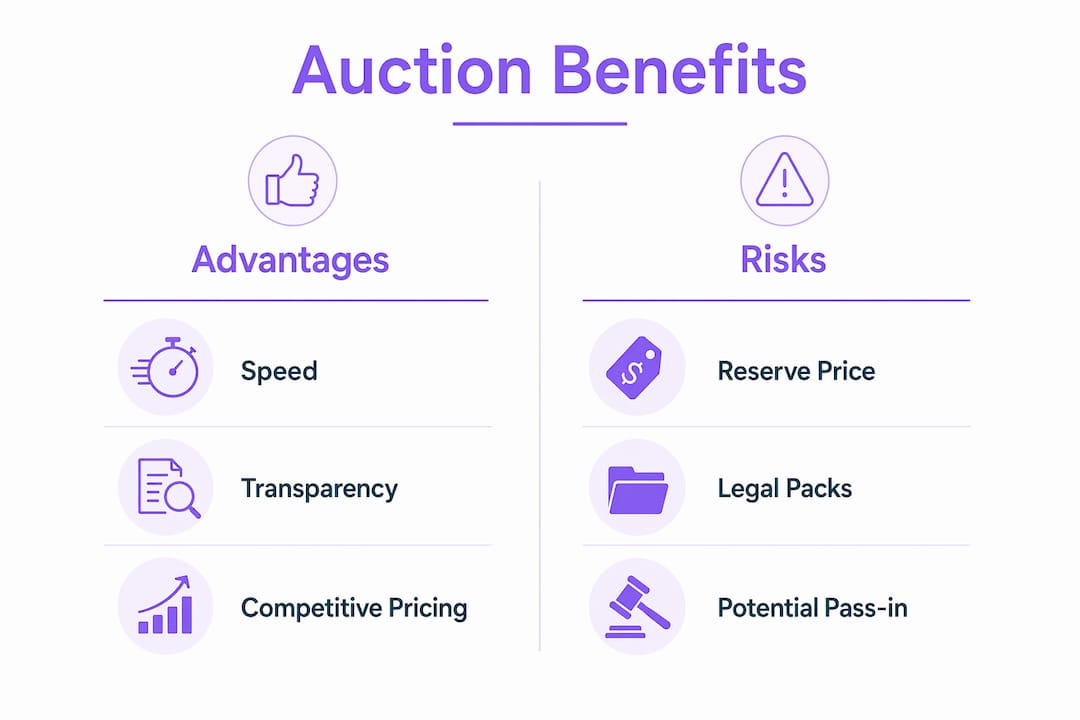
It is worth understanding how guide prices work in this context. Auctioneers often set conservative guide prices to stimulate early bidding interest. Once the marketing effect is stripped away, the real auction premium sits at around 2–3% above market expectations. That is still a meaningful gain over private sale outcomes.
Key pricing advantages of the auction format include:
- Public competition drives bids above what a single-buyer negotiation would produce
- Market discovery happens in minutes, not weeks of back-and-forth
- Buyer urgency created by the fixed date prevents low-ball offers from stalling the process
- No price ceiling applies once bidding starts, unlike a listed asking price that anchors expectations
Pro Tip: Set your reserve price slightly above your minimum acceptable figure. This gives you a buffer if bidding stalls just below your target, without pricing out serious buyers.
What makes auctions faster and more certain than traditional sales?
The legal structure of an auction is what makes it genuinely certain, not just fast. When the hammer falls, contracts are exchanged immediately. The buyer pays a non-refundable 10% deposit on the day, and the sale is legally binding from that moment. There is no cooling-off period, no subject-to-finance clause, and no risk of the buyer walking away weeks later.
This removes two of the biggest risks in private sales: gazundering (where a buyer drops their offer at the last minute) and financing fall-through. Cash-ready buyers such as investors and developers make up a significant portion of auction attendees, which further reduces chain risk and speeds up settlement.
Here is how the two methods compare on the key factors that matter most to sellers:
| Factor | Property Auction | Private Treaty Sale |
|---|---|---|
| Average timeline | 28 days to settlement | 2–3 months |
| Contract certainty | Binding at hammer fall | Subject to conditions |
| Buyer withdrawal risk | Very low | Moderate to high |
| Deposit paid | 10% non-refundable on day | Varies, often later |
| Buyer type | Investors, cash buyers | Broad mix |
Pro Tip: Ask your auctioneer about the typical buyer profile at their auctions. Knowing whether investors or owner-occupiers dominate can help you time your auction and set expectations on price.
Understanding how speed impacts your sale is not just about convenience. Every extra month a property sits on the market costs you in holding costs, rates, insurance, and opportunity. Auctions cut that exposure sharply.
What are the costs, legal requirements, and risks of property auctions?
Auctions are not free, and understanding the costs upfront prevents surprises. Auctioneer fees average around 2% plus GST, which is broadly comparable to a traditional real estate agent commission. The key difference is that auction fees are typically payable only when the sale completes, which aligns the auctioneer’s incentive with yours.
Beyond the commission, you will need to budget for:
- Legal pack preparation: Title deeds, local searches, land registry documents, planning records, and conditions of sale must all be assembled before the auction date
- Marketing costs: Professional photography, virtual tours, and auction catalogue listings are usually charged separately
- Entry or lot fees: Some auctioneers charge a fixed fee to list your property, regardless of the outcome
The legal pack is not optional. Properties are sold as seen at auction, meaning buyers accept the property in its current condition with no post-auction renegotiation. A thorough legal pack protects you and gives buyers the confidence to bid strongly.
| Cost Item | Typical Range | Notes |
|---|---|---|
| Auctioneer commission | ~2% + GST | Payable on successful sale |
| Legal pack preparation | Varies by solicitor | Required before auction |
| Marketing and photography | Fixed fee | Charged upfront |
| Entry or catalogue fee | Fixed fee | Charged regardless of outcome |
The risks are real and worth naming directly. If bidding does not reach your reserve price, the property passes in and you may need to relist or negotiate privately. The buyer pool at auction is also smaller than the general market, which can limit competition on certain property types. Sellers of unique or niche properties should weigh this carefully before committing to the auction route.
How should sellers prepare for a successful property auction?
Preparation is where auction outcomes are won or lost. A well-prepared seller attracts confident buyers, and confident buyers bid higher. Follow these steps to give your auction the best possible chance:
- Assemble your legal pack early. Your solicitor needs time to gather title deeds, local searches, and conditions of sale. Delays here can push back your auction date or reduce buyer confidence.
- Be transparent about the property’s condition. Buyers rely heavily on the pre-auction legal pack and inspection visits. Clear condition disclosures reduce the risk of post-auction disputes and build bidder trust.
- Invest in quality marketing. Professional photography and virtual tours are critical during the limited inspection window before auction day. Buyers who cannot visit in person need to feel confident from what they see online.
- Set a realistic reserve price. A confidential reserve price protects you from selling below your minimum, but setting it too high can cause the property to pass in. Work with your auctioneer to find the right level based on comparable sales.
- Choose the right auctioneer. Not all auctioneers attract the same buyer pool. Look for one with a strong track record in your property type and suburb, and ask about their average clearance rate before signing up.
Pro Tip: Schedule at least two open home sessions before the auction date. Buyers who have physically walked through a property bid more confidently than those relying solely on photos.
If you are weighing up the advantages of selling without an agent, it is worth comparing the auction route against a direct cash sale, particularly if your property has condition issues that might limit bidder interest.
Key takeaways
Property auctions deliver faster, legally certain sales with genuine price premiums, provided sellers prepare thoroughly and understand the associated costs and risks.
| Point | Details |
|---|---|
| Speed advantage | Auctions settle in an average of 28 days, compared to 2–3 months for private sales. |
| Price premium | Auction-sold properties achieve around 4.8% above private sale prices on matched comparisons. |
| Legal certainty | Contracts are binding at hammer fall with a non-refundable 10% deposit paid on the day. |
| Preparation matters | A thorough legal pack, transparent disclosures, and quality marketing directly affect bidder confidence. |
| Know your costs | Auctioneer fees average 2% plus GST, with additional costs for legal packs and marketing. |
Auctions are a tool, not a default: my honest assessment
I have watched a lot of Kiwi homeowners approach auctions with either too much confidence or too much fear, and both extremes lead to poor outcomes. The sellers who do best are the ones who treat the auction as a deliberate strategic choice, not a default because their agent suggested it.
Auctions genuinely outperform private sales when you have a property with broad appeal, a competitive local market, and the time to prepare properly. The certainty of a binding contract on auction day is worth a great deal, particularly in a market where buyers are cautious and conditions can fall through at the last minute.
Where I see auctions struggle is with properties that have significant condition issues or are in areas with thin buyer demand. A small bidder pool means less competition, and less competition means the price premium disappears. In those cases, a direct cash offer or a pre-auction sale can actually deliver a better net result once you factor in the costs and the risk of passing in.
My advice is straightforward. Get a realistic appraisal, talk to an auctioneer with a strong local track record, and be honest about your property’s appeal. If the numbers stack up and you can prepare properly, auctions are one of the most effective ways to sell. If they do not, there are better paths worth exploring before you commit.
— Aaron
How Easysale can help you move forward quickly
If you are considering your options and want a faster path than a traditional auction allows, Easysale is worth a conversation. Easysale buys residential properties across New Zealand directly, with no agent commissions, no open homes, and no waiting on auction day.
For homeowners with properties in any condition, including those that might struggle to attract strong auction bidding, Easysale’s fair cash offers on damaged properties provide a clear, stress-free alternative. The process is straightforward: submit your property details, receive a no-obligation offer, and settle on a timeline that works for you. If you want to understand why selling before auction might deliver a better outcome for your situation, Easysale can walk you through the numbers.
FAQ
What is a property auction and how does it work?
A property auction is a public sale where a property is sold to the highest bidder on a fixed date. Contracts are exchanged immediately at hammer fall, with the buyer paying a non-refundable 10% deposit on the day.
Is buying at auction worth it for sellers?
For most sellers with well-presented properties in competitive markets, yes. Auction-sold properties achieve an average 4.8% price premium over private sales and settle in around 28 days.
What are the main costs of selling at auction?
Auctioneer fees average around 2% plus GST, payable on a successful sale. Additional costs include legal pack preparation, marketing, and in some cases an entry or catalogue fee charged upfront.
What happens if my property does not sell at auction?
If bidding does not reach your reserve price, the property passes in and no sale occurs. You can then negotiate privately with the highest bidder or relist through another method.
Do i need a legal pack before the auction?
Yes. A legal pack containing title deeds, local searches, planning documents, and conditions of sale must be prepared before the auction date. Properties are sold as seen, so buyers rely on this pack to make informed bids.
Recommended
