
Cash offer vs. mortgage sale: what sellers need to know

TL;DR:A cash offer involves the buyer paying the full property price without borrowing, leading to faster settlement.Mortgage sales require bank financing, involve more steps, and carry higher risks of delays or collapse.
A cash offer means the buyer pays the full property price without borrowing from a lender, while a mortgage sale means the buyer finances the purchase through a bank loan. Explaining cash offer vs. mortgage sale is something every Kiwi homeowner should understand before listing their property. The difference between these two paths affects how quickly you settle, how certain the deal is, and how much you ultimately walk away with. Easysale works with New Zealand homeowners every day who face exactly this choice, and the right answer depends entirely on your priorities.
What are the key benefits and drawbacks of cash offers?
A cash offer is the faster, simpler path to settlement. Because no lender is involved, cash transactions avoid the underwriting and mortgage approval steps that typically add weeks to a sale. Cash deals often complete within two weeks, compared to 30–60 days for mortgage sales. That speed alone makes cash offers attractive when you need to move quickly.

The advantages of cash offers go beyond timing. Closing costs are generally lower for cash sales because there are fewer lender fees and less paperwork involved. Cash offers also come with fewer contingencies. They may still include an inspection clause, but they typically drop the financing and appraisal conditions that create uncertainty in mortgage sales. Fewer conditions means fewer ways for a deal to fall apart.
The main trade-off is price. Cash buyers often offer less than the market peak because they are paying for convenience and speed. Mortgage buyers, competing in an open market, sometimes push prices higher through competitive bidding. If maximising your sale price is the top priority, a cash offer may not deliver the highest number.
Key cash offer benefits at a glance:
- Settlement in as little as two weeks
- No risk of the buyer’s finance falling through
- Fewer contingencies and simpler paperwork
- Lower closing costs for both parties
- Greater certainty from offer to settlement
Key cash offer drawbacks:
- Offer price may be below market value
- Less competitive bidding pressure
- Fewer buyers in the cash pool
Pro Tip: Always ask a cash buyer for written proof of funds before accepting any offer. Verifying this document protects you from wasted time if the buyer cannot actually complete the purchase.
How do mortgage sales affect the selling process?
A mortgage sale introduces more steps, more parties, and more potential delays. The buyer must secure formal loan approval, which involves underwriting, a property appraisal, and often a building inspection. Each of these steps adds time and creates a point where the deal can stall or collapse entirely.
Mortgage sales typically include contingencies such as financing approval, appraisal, and inspection clauses. These conditions protect the buyer but add uncertainty for you as the seller. If the bank’s appraisal comes in below the agreed price, the buyer may renegotiate or walk away. If the lender declines the loan at the last minute, you are back to square one.
On the positive side, mortgage buyers often pay more. Competitive bidding among financed buyers can push your sale price above what a cash buyer would offer. If your property is in good condition and the market is active, a mortgage sale through an open listing can attract multiple offers and drive the price up.
What to expect in a mortgage sale process:
- Buyer applies for formal loan approval after signing the agreement
- Lender orders an independent property appraisal
- Underwriting review can take several weeks
- Building inspection may be required by the lender
- Settlement occurs only after all conditions are satisfied
The timeline for a mortgage sale is rarely predictable. A buyer with a responsive lender and a clean application can move quickly, but delays are common. A mortgage sale’s timeline improves significantly when the buyer is preapproved and working with a lender known for fast processing. Preapproval is not the same as full approval, but it signals a serious, prepared buyer.
When does a cash offer suit you better than a mortgage sale?
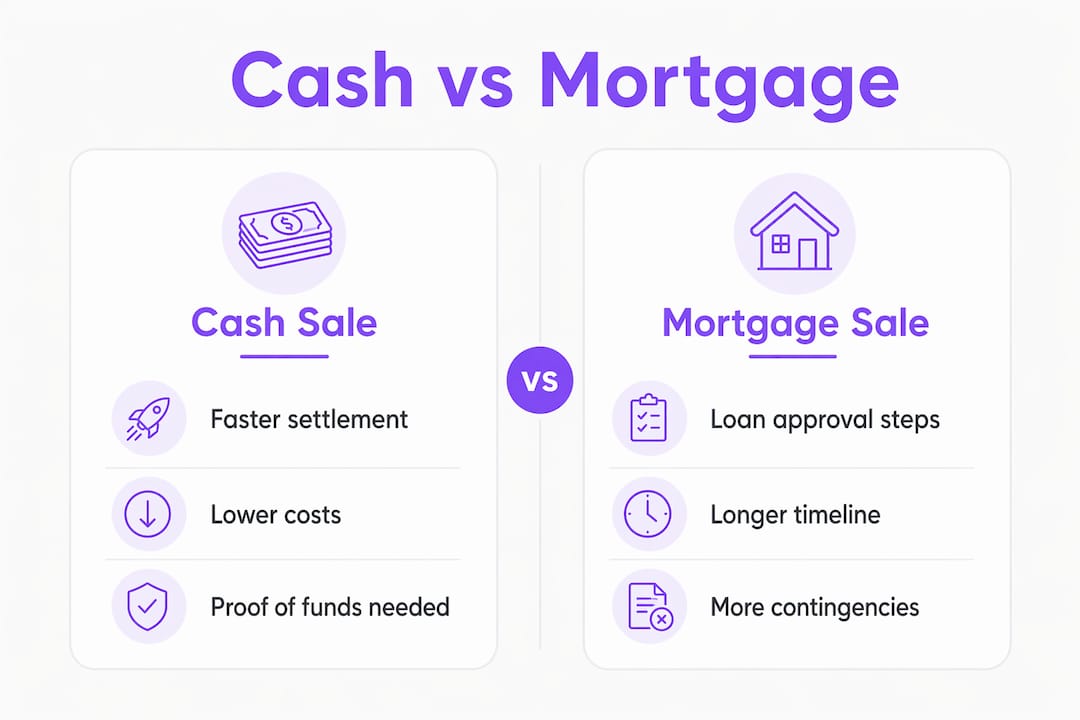
The right choice depends on what you value most. Speed and certainty favour cash. Price and competition favour mortgage sales. Most sellers sit somewhere in between, which is why understanding both helps you negotiate from a position of knowledge.
A cash offer suits you best when:
- You need to settle quickly due to financial pressure, a relationship change, or a job relocation
- Your property has condition issues that may not pass a lender’s appraisal
- You want to avoid the risk of a deal falling through at the last minute
- You are selling a deceased estate and the beneficiaries want a fast resolution
A mortgage sale may suit you better when:
- Your property is in excellent condition and likely to appraise well
- The market is competitive and multiple buyers are likely to bid
- You have time to wait through a longer settlement process
- Maximising the final sale price is more important than speed
| Situation | Better option |
|---|---|
| Urgent sale needed within weeks | Cash offer |
| Property in poor or damaged condition | Cash offer |
| Strong market with multiple interested buyers | Mortgage sale |
| Seller has flexible timeline and wants top price | Mortgage sale |
| Buyer’s finance reliability is uncertain | Cash offer |
| Property likely to appraise at or above sale price | Mortgage sale |
Experienced financed buyers with responsive lenders can sometimes perform as reliably as cash buyers. This challenges the assumption that cash always wins. A well-prepared mortgage offer from a preapproved buyer with a fast lender can be just as dependable as a cash deal, particularly if you are not in a rush.
What practical steps help you evaluate and negotiate offers?
Evaluating any offer starts with looking beyond the headline price. A high mortgage offer with shaky finance is worth less than a lower cash offer that will definitely settle. You need to assess the full picture before deciding which offer to accept.
- Verify proof of funds or preapproval. Ask cash buyers for a bank statement or letter confirming available funds. Ask mortgage buyers for a preapproval letter from their lender. Verifying proof of funds is the single most effective step to reduce the risk of a failed sale.
- Read every contingency carefully. Count the conditions attached to each offer. Fewer conditions mean less risk. A cash offer with an inspection clause is still cleaner than a mortgage offer with financing, appraisal, and inspection conditions stacked together.
- Compare settlement timelines. Ask each buyer when they can realistically settle. A cash buyer who can settle in 14 days may be more valuable than a mortgage buyer promising 45 days, especially if you have carrying costs or another purchase waiting.
- Negotiate based on your priorities. If speed matters most, counter a mortgage offer with a shorter settlement deadline. If price matters most, use competing offers to push the number higher. Know your bottom line before negotiations start.
- Get legal advice before signing. A property lawyer or conveyancer can review the sale and purchase agreement and flag any conditions that create risk. This step costs relatively little and can save you from a costly mistake.
Pro Tip: If you receive both a cash offer and a mortgage offer at the same time, ask your lawyer to compare the net proceeds after costs, not just the headline prices. Closing costs, agent fees, and holding costs can shift which offer is actually worth more.
Sellers often prefer cash offers mainly for speed and reduced friction, but a well-prepared mortgage offer can be equally appealing if it fits your priorities. The key is knowing what you need from the sale before you start comparing numbers.
Key takeaways
Cash offers deliver speed and certainty, while mortgage sales can yield higher prices but carry more risk of delays and failed deals.
| Point | Details |
|---|---|
| Cash offers settle faster | Cash deals typically complete in two weeks versus 30–60 days for mortgage sales. |
| Fewer contingencies reduce risk | Cash offers drop financing and appraisal conditions, making deals simpler and more reliable. |
| Mortgage sales may fetch more | Competitive bidding among financed buyers can push your sale price above a cash offer. |
| Verify funds before accepting | Always confirm a cash buyer’s proof of funds to avoid wasted time on a deal that cannot settle. |
| Match the offer type to your situation | Urgency and property condition favour cash; time and market strength favour mortgage sales. |
Aaron’s take on the cash vs. mortgage decision
Most sellers I speak with assume cash is always better. That instinct is understandable, but it is not always correct. The real question is not which offer type is superior. The real question is which offer type fits your situation right now.
I have seen sellers turn down solid cash offers chasing a higher mortgage price, only to have the financed deal collapse during underwriting. I have also seen sellers accept low cash offers out of panic when they had time to wait for a better outcome. Both mistakes come from the same place: not being clear on your own priorities before the offers arrive.
The detail most sellers overlook is the contingency stack. A mortgage offer with three or four conditions attached is not just slower. It is genuinely riskier. Each condition is a door the buyer can walk through to exit the deal. A cash offer with one inspection clause gives you far more certainty, even if the price is lower.
My honest advice: decide what matters most to you before you list. Write it down. Speed, price, certainty, or flexibility. Once you know your priority, evaluating offers becomes much simpler. You stop comparing apples with oranges and start comparing offers against your actual needs.
— Aaron
Selling your property with Easysale
If speed and certainty matter most to you, Easysale offers a direct path to a fast cash offer on your New Zealand property. There are no real estate agents, no commission fees, and no drawn-out negotiations. You submit your property details, receive a no-obligation offer typically within 24 hours, and settle on a timeline that suits you.
Easysale buys properties in any condition across New Zealand, which makes it a practical option if your home needs work or would struggle to pass a lender’s appraisal. Whether you are facing financial pressure, a life change, or simply want to avoid the uncertainty of a traditional sale, Easysale’s process is built around your needs. You can also learn more about cash sale advantages specific to the New Zealand market before making your decision.
FAQ
What is the main difference between a cash offer and a mortgage sale?
A cash offer means the buyer pays the full purchase price without borrowing from a bank, while a mortgage sale means the buyer finances the purchase through a lender. Cash offers settle faster and carry fewer conditions, while mortgage sales can attract higher prices but involve more steps and risk.
How quickly does a cash sale settle compared to a mortgage sale?
Cash transactions typically complete within two weeks, while mortgage sales generally take 30–60 days due to lender underwriting and approval requirements.
Can a mortgage offer ever be as reliable as a cash offer?
Yes. A well-prepared mortgage buyer who is preapproved and working with a responsive lender can be nearly as reliable as a cash buyer, particularly if the property is in good condition and likely to appraise well.
Should I always accept the highest offer?
Not necessarily. A higher mortgage offer with multiple contingencies carries more risk than a lower cash offer with no financing conditions. Compare net proceeds after costs and assess the reliability of each buyer before deciding.
What does proof of funds mean in a cash sale?
Proof of funds is a document, usually a bank statement or letter from a financial institution, confirming the buyer has enough money available to complete the purchase. Requesting this document before accepting a cash offer protects you from deals that cannot settle.
Recommended
