
Fair market value in NZ: What urgent sellers must know

TL;DR:Fair market value (FMV) reflects the price a property would achieve in an open market between willing buyers and sellers with no undue pressure.In urgent sales, offers are typically 10-20% below FMV due to reduced competition, speed premiums, and condition factors, making them inherently different from market value estimates.
When you need to sell your home quickly, it’s easy to assume that any agreed price is a fair one. But there’s a significant difference between what your property is truly worth on the open market and what you’ll realistically receive in an urgent or distressed sale. Fair market value (FMV) is the estimated price a property would sell for between a willing buyer and seller, both with reasonable knowledge and no undue pressure. For homeowners facing financial hardship, a relationship breakdown, or other urgent circumstances, that pressure changes everything about the final price.
Table of Contents
- What is fair market value in NZ property sales?
- How fair market value is determined for your home
- FMV vs urgent sales: Why fast cash offers are always lower
- How to estimate your home’s fair market value before selling
- The uncomfortable truth about FMV in urgent property sales
- Need a fast, fair offer? Know your options
- Frequently asked questions
Key Takeaways
| Point | Details |
|---|---|
| FMV defined | Fair market value is the open market price between an informed buyer and seller with no pressure to act. |
| Urgent sale impact | If you need a quick sale, expect offers below FMV because buyers price in speed and certainty. |
| Estimate before selling | Use similar sales, agent advice and formal valuations to know your FMV before you negotiate. |
| Mind the discount | Accepting a fast cash offer means trading value for immediate resolution—be prepared for a 10-20% discount. |
| Stay realistic | Your pricing expectations should depend on your timeline and motivation to sell, not just theoretical values. |
What is fair market value in NZ property sales?
Now that you can see how confusion arises around pricing, let’s define what FMV really means for sellers in New Zealand.
Fair market value is a legal and financial term used across property, taxation, and insurance contexts. It represents the price your property would achieve if it were exposed to the open market for a reasonable period, with both the buyer and seller acting knowledgeably, willingly, and without compulsion. According to the FMV definition used in New Zealand’s property and accounting sector, the key condition is that neither party is under pressure to complete the transaction.
This distinction matters enormously in practice. A property’s FMV is not simply what you want for it, nor is it the first offer you receive. It is a figure derived from evidence, market conditions, and informed judgment.
FMV is the price a property would sell for on the open market between a willing buyer and a willing seller, both with reasonable knowledge and no undue pressure. This condition of “no pressure” is what makes FMV different from the price you’ll see in many urgent or distressed sales.
Valuers, real estate agents, and banks all use FMV as a reference point. Registered valuers assess it using formal methodology. Agents estimate it through appraisals based on recent local sales. Banks rely on it to confirm that a lending amount is appropriate relative to the property’s true worth. Understanding these industry terms in NZ property sales helps you approach any sale with realistic expectations.
Key factors that shape FMV
| Factor | Why it matters |
|---|---|
| Recent comparable sales | Sets the baseline for what buyers will pay |
| Market conditions | Rising or falling demand shifts FMV up or down |
| Property condition | Damage or deferred maintenance reduces FMV |
| Location and zoning | Proximity to schools, transport, and amenities adds value |
| Information symmetry | Both parties must understand the property and market |
When any of these factors is distorted, such as when a seller is under financial pressure or a buyer has more market knowledge than the seller, the resulting price can deviate significantly from true FMV.
How fair market value is determined for your home
Once you’ve grasped what FMV means, you’ll want to know exactly how it’s determined for your own home.
The most common method valuers and agents use is comparable sales analysis, often called “comps.” This involves identifying recently sold properties in your area that closely match yours in size, age, construction type, and condition. If a three-bedroom home on a similar block sold for $750,000 two months ago, that sale becomes a reference point for estimating your FMV. The more comps available, the more reliable the estimate.
However, comps are only the starting point. Your property’s individual features can push the final figure higher or lower. A freshly renovated kitchen, a second bathroom, or off-street parking adds value. Structural issues, an older roof, or a poorly configured floor plan can reduce it. The property appraisal process involves weighing all of these factors systematically, not just picking a number that sounds reasonable.
Factors commonly used to assess FMV for your home:
- Recent comparable sales within a 2 km radius (or similar local area)
- Current active listings, which reveal what competing sellers are asking
- The property’s physical condition and any known defects
- Land size, orientation, and any easements or covenants
- Local infrastructure changes, such as new developments or transport links
- Broader market trends, such as whether you’re in a buyer’s market in NZ
Pro Tip: Never rely on a single agent appraisal as your definitive FMV. Agents can be optimistic to win your listing. Compare at least two appraisals and cross-reference with recent local sales data from sources like OneRoof or the Real Estate Institute of New Zealand.

Formal valuations vs. real market offers
| Method | Accuracy | Cost | Best for |
|---|---|---|---|
| Online tools (e.g. HomesEstimate) | Low to moderate | Free | Quick ballpark only |
| Agent appraisal | Moderate | Free | Pre-sale planning |
| Registered valuer report | High | $700-$1,200+ | Legal, banking, disputes |
| Actual market offer | Definitive | None (but has conditions) | What buyers will actually pay |
A formal registered valuation is the most accurate method, but it reflects a snapshot in time. Market conditions can shift within weeks, particularly in areas experiencing high activity or economic uncertainty. This is why why NZ properties sell below market value is such a common outcome, even when sellers have done their homework on pricing.
FMV vs urgent sales: Why fast cash offers are always lower
Knowing how FMV is calculated sets up the big question: what happens when you need to sell quickly?
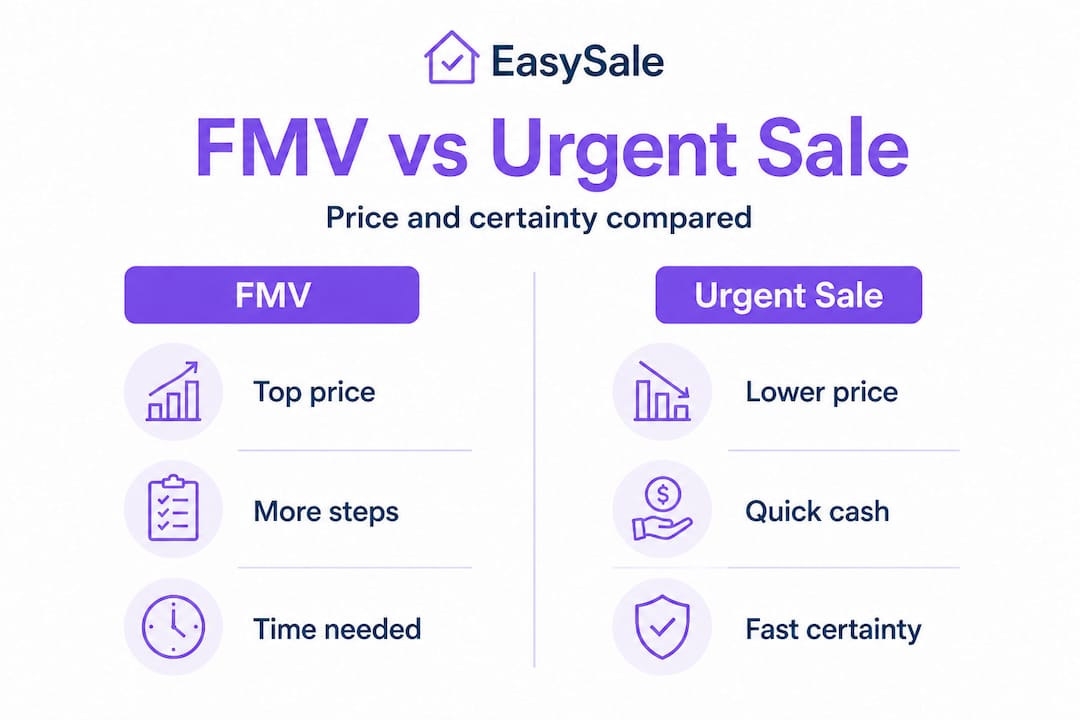
The honest answer is that urgent sales and FMV rarely align. The very definition of FMV requires both parties to have no undue pressure and full market exposure. When you need to sell within days or weeks, those conditions simply do not exist. As noted in the FMV context for urgent sales, quick sales to cash buyers yield below-FMV offers because urgency fundamentally changes the transaction.
Here’s what drives that discount:
- No open-market competition. On the open market, multiple buyers compete and push prices up. In a direct or urgent sale, you’re typically dealing with one buyer.
- Speed premium. The buyer accepts risk and offers certainty in return for a lower price. You receive funds faster, but you give up some value to get there.
- As-is condition. Cash buyers and direct purchasers often buy properties without requiring you to complete repairs, and they factor estimated repair costs into their offer.
- No contingencies. Unlike a standard sale where a buyer may take weeks to arrange finance, a cash offer is firm. That certainty has a cost.
- Buyer’s risk margin. Investors who make urgent offers build in a margin for holding costs, market risk, and eventual resale or rental.
Statistic to know: Cash buyers and direct sale offers in urgent property transactions typically sit 10 to 20% below the property’s fair market value. This is not exploitation. It is the cost of speed, certainty, and convenience.
This trade-off is real, and there is no strategy that fully eliminates it. The factors affecting sale speed include your property’s condition, local demand, and how quickly you need funds. All of these influence how large the gap between FMV and your actual offer will be.
Pro Tip: Before accepting any urgent sale offer, calculate the difference between the cash offer and your estimated FMV. Then factor in the costs of a traditional sale: agent commissions (typically 2.5 to 3.5% plus GST), legal fees, staging, and holding costs during a longer campaign. Sometimes the gap is smaller than it first appears.
How to estimate your home’s fair market value before selling
With this context, smart sellers want to know: how can I estimate FMV myself before considering offers?
You don’t need to hire a valuer immediately to get a working sense of your property’s worth. There are practical steps you can take to build a reasonable estimate before entering any negotiation.
Step-by-step guide to estimating your FMV:
- Research recent sales. Use free tools like OneRoof, Homes.co.nz, or Realestate.co.nz to look at sold prices for similar properties in your suburb over the past three to six months. Focus on sales, not current listings.
- Match your property carefully. Look for homes with similar bedrooms, bathrooms, land size, and construction era. A renovated 1990s weatherboard home is not comparable to an unrenovated 1970s brick and tile.
- Adjust for condition. If your property needs significant work, subtract an estimated repair cost from comparable sale prices. If yours is in better condition, you may be able to add value.
- Get at least two agent appraisals. These are free and give you a professional’s view of the current market. Be aware that agents sometimes inflate appraisals to win listings, so compare critically.
- Check property selling trends for your area. A suburb experiencing declining sales volumes or longer days on market will likely support a lower FMV than one with strong buyer demand.
- Consider a formal registered valuation if you’re entering a dispute, have a complex property type, or need a defensible figure for legal or banking purposes. This is the most reliable approach, as outlined in these property valuation tips.
The FMV benchmark assumes both parties are reasonably knowledgeable. If you walk into a negotiation without a working estimate of your property’s value, you place yourself at a disadvantage.
Pro Tip: Avoid over-relying on automated online valuation tools as your sole reference. These tools use algorithm-based estimates and often miss key local factors, recent renovations, or property-specific conditions that a trained appraiser would catch.
Red flags to watch for when estimating FMV:
- An agent who quotes significantly higher than others without clear comparable evidence
- Online tools that haven’t been updated with sales from the past six months
- Relying on your purchase price or local gossip rather than verified sold data
- Confusing your property’s rateable value (RV or CV) with its market value. These are often well out of date and unreliable as pricing guides.
The uncomfortable truth about FMV in urgent property sales
After all these practical steps, here’s what most property guides still won’t say.
The majority of homeowners in urgent or financially distressed situations will not achieve fair market value, no matter how well they negotiate. This is not because they lack skill or information. It is because the conditions required for FMV to exist, specifically no pressure, open market exposure, and equal knowledge, are fundamentally incompatible with urgency.
We see this pattern clearly. A homeowner facing mortgage arrears, an unexpected job loss, or a health crisis does not have six to twelve weeks to run an open-market auction campaign. They need a resolution now. And the moment you accept that timeline, you accept a price below FMV. That’s not a failure. That’s the honest trade-off.
What investors understand that most vendors don’t is that price and certainty are always in tension. Investors who buy urgently are not doing you a disservice by offering below FMV. They are pricing in their own risk, their costs, and the service they provide. The real lesson is to stop measuring a quick sale against an open-market FMV benchmark, because that comparison was never valid.
As confirmed by the FMV definition for urgent sales, cash buyers offering quick settlements work in a fundamentally different context from open-market FMV through agents or auction.
The practical wisdom here is to shift your frame. Instead of asking “Am I getting FMV?” ask “Is this the best available outcome given my actual circumstances?” Review what properties sell below market value so you understand the full picture. For some homeowners, a below-FMV cash sale is genuinely the best outcome when all costs, risks, and timelines are considered honestly.
Need a fast, fair offer? Know your options
If you’ve read this far, you already know more about fair market value than most homeowners facing an urgent sale. That knowledge puts you in a stronger position when evaluating your options.

At easySale.co.nz, we work with homeowners across New Zealand who need to sell quickly without the cost and uncertainty of a traditional campaign. Our process is straightforward: submit your property details, receive a no-obligation cash offer, and settle on a timeline that works for you. There are no agent commissions, no open homes, and no waiting months for the right buyer. Whether your home needs work or you’re facing a time-sensitive situation, we buy properties in any condition. If you want to understand your options clearly and without pressure, get in touch with our team today.
Frequently asked questions
Is fair market value always the sale price I get for my home?
No. Fair market value is the theoretical price between willing parties without urgent pressure, but real sale prices, especially in urgent situations, can be noticeably lower than this benchmark.
Why do cash buyer offers seem well below fair market value?
Cash buyers factor in speed, risk, and certainty when pricing their offers, applying a discount below FMV for the convenience they provide. This reflects FMV conditions not being met when urgency or financial pressure is involved.
How do I find my home’s true fair market value?
Check recent local sales for comparable properties, collect at least two agent appraisals, and consider a formal written valuation from a registered valuer for the most defensible and accurate result.
Are online home value tools reliable for FMV?
Online valuation tools provide a useful starting point but often lack context for urgent, as-is, or off-market sales, so they should not be your only reference when making decisions about selling price.
Recommended
