
How speed impacts home sales: Key benefits for NZ homeowners

TL;DR:Selling quickly can prevent repossession, reduce costs, and provide emotional certainty.Fast sales may offer slightly lower prices but save on agent fees and holding costs.Strategies include direct cash buyers, private sales, and careful preparation for quick, safe transactions.
Most New Zealand homeowners assume that selling quickly means accepting a poor deal. That belief stops many people from acting when they most need to. The truth is more nuanced. Speed can protect you from mounting losses, prevent repossession, and give you back control during some of life’s most stressful moments. Whether you’re facing financial hardship, a relationship breakdown, or a sudden job relocation, understanding how sale speed works can change the decisions you make. This guide walks you through the real benefits, the honest trade-offs, and the practical steps you can take to sell your home quickly and safely in New Zealand.
Table of Contents
- Why sale speed matters: Core benefits for NZ homeowners
- Understanding the trade-offs: Speed versus price and certainty
- Practical situations for a fast home sale in New Zealand
- Strategies to sell quickly and safely without an agent
- What most guides don’t tell you about selling quickly in New Zealand
- How to get a fast, fair cash offer on your property
- Frequently asked questions
Key Takeaways
| Point | Details |
|---|---|
| Speed stops mounting losses | Selling fast helps avoid extra interest, maintenance, and council rates that add up over time. |
| Certainty saves stress | Quick sales offer control, reducing the risk of deals falling through at the last minute. |
| Price trade-off isn’t always negative | Choosing speed can sometimes save more in costs and stress than a slightly higher final price. |
| Acting fast fits urgent needs | Life changes like job moves, separation, or debt need clear, accelerated options to protect your future. |
| You can sell privately | Kiwis can act directly without agents, using private sale or as-is cash offers for convenience and speed. |
Why sale speed matters: Core benefits for NZ homeowners
Now that you understand why sale speed challenges common assumptions, let’s look at the direct benefits it provides New Zealand homeowners.
When people think about selling a home, they often focus on the final sale price. But price is only one part of the equation. How long a property sits on the market has a direct impact on your financial position, your stress levels, and your future options. Understanding speed impacts property sales in ways that go well beyond the number on the contract.
Here are the core benefits of acting quickly:
- Prevents mortgage arrears and repossession. Every month your property sits unsold, you’re still responsible for mortgage payments. If you’re already struggling, those payments can push you into arrears and trigger repossession proceedings.
- Reduces holding costs. Holding costs include mortgage repayments, council rates, insurance, and maintenance. These accumulate fast. A property sitting on the market for six months can cost tens of thousands of dollars in holding costs alone.
- Provides certainty. Traditional sales can fall through at any stage. Buyers pull out, finance falls over, or chains collapse. A fast sale removes that uncertainty.
- Reduces emotional strain. Living in limbo while waiting for offers is exhausting. A quick resolution lets you move forward.
Pro Tip: Many sellers underestimate how much emotional energy a drawn-out sale consumes. Resolving your situation quickly often means better decision-making in every other area of your life.
“A fast sale prevents repossession, reduces holding costs including mortgage, rates, and maintenance, and provides certainty by avoiding chains and failed sales.”
For anyone weighing up their options, reviewing the pros and cons of fast sales gives a clearer picture of what you’re actually choosing between.
The key insight here is this: the longer a sale takes, the more it costs you. That cost is not always visible in the final price comparison, but it is very real.
Understanding the trade-offs: Speed versus price and certainty
While speed brings clear benefits, it’s important to weigh those against what you might give up. Here’s how the trade-offs stack up.
The most common concern about fast home sales is price. Will you receive less money? Sometimes, yes. But the full picture is more complicated than that.

International review platforms show that quick sale services are frequently praised for their speed and certainty, but occasionally criticised for offering below-market prices. Importantly, there are no New Zealand-specific empirical benchmarks that clearly quantify how much less a fast sale achieves compared to a traditional sale. That gap in local data means you need to assess your own situation carefully.
Here’s a straightforward comparison to help you think it through:
| Factor | Traditional sale | Fast or cash sale |
|---|---|---|
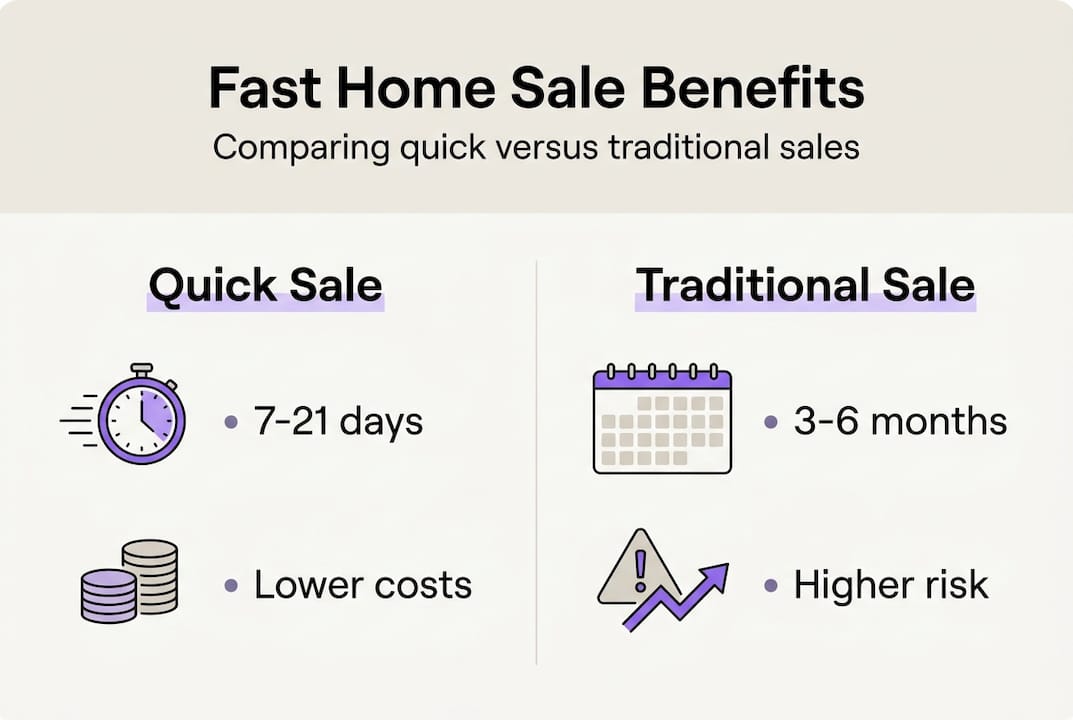
| Timeframe | 3 to 6 months or more | 7 to 21 days |
| Sale price | Potentially higher | Possibly lower |
| Certainty | Lower (chains, finance) | High |
| Agent fees | 2% to 4% of sale price | None |
| Holding costs | Accumulate over months | Minimal |
| Emotional load | High | Low |
For understanding property offers in this context, it helps to factor in what you save on agent commissions and holding costs. A fast offer that looks smaller on paper can actually deliver more money in your pocket once those costs are removed.
Situations where speed makes the most sense include:
- Urgent financial hardship where mortgage arrears are building
- Job relocation requiring you to move within weeks
- Relationship separation where both parties need a clean resolution
- Risk avoidance in a declining or uncertain property market
If you’re unsure why accept a fast offer applies to your situation, consider what happens if you wait. In a cooling market, a longer sale period can mean a lower eventual price anyway, with all the holding costs added on top. Exploring a private sale in NZ is another avenue worth considering alongside direct cash buyers.
Practical situations for a fast home sale in New Zealand
With the main trade-offs in mind, it’s helpful to see when a rapid home sale makes the most sense.
Life rarely gives you warning before a financial or personal crisis hits. Knowing which situations call for a fast sale helps you act with confidence rather than hesitation.
Here are the most common triggers for a quick home sale in New Zealand:
- Financial hardship. Missed mortgage payments, rising debt, or sudden income loss make speed critical to avoiding repossession.
- Pending repossession. If your lender has issued a notice, time is extremely limited. A fast sale gives you control over the outcome.
- Job relocation. Accepting a role in another city or country often means you need to settle your property within weeks, not months.
- Separation or divorce. Both parties often need a clean financial break. A drawn-out sale prolongs stress and legal costs.
- Inherited property. Managing an estate is complicated. Selling quickly removes ongoing obligations and simplifies the process.
- Declining market conditions. If values are falling in your area, waiting longer can cost you more than accepting a fast offer today.
Pro Tip: People under financial pressure often overlook ongoing holding costs like rates, insurance, and maintenance. These can add up to thousands of dollars per month, making speed even more valuable than it first appears.
To understand when to sell fast versus waiting, it helps to look at the numbers honestly. Consider what factors affecting sale speed apply to your property and location.
Here’s a simplified comparison of two scenarios:
| Scenario | Traditional sale (5 months) | Fast cash sale (3 weeks) |
|---|---|---|
| Sale price | $650,000 | $610,000 |
| Agent commission (3%) | $19,500 | $0 |
| Holding costs (5 months) | $12,000 | $1,500 |
| Net proceeds | $618,500 | $608,500 |
The gap narrows considerably once real costs are factored in. As noted in the cash home buying NZ process, cash sales prioritise certainty and speed over maximum price, while traditional sales suit patient sellers in strong markets. If you want to fast-track your sale, the numbers often support moving sooner rather than later.
Strategies to sell quickly and safely without an agent
If you’re considering a fast sale, here’s how to move quickly while protecting your interests.
Selling without a real estate agent is entirely possible in New Zealand, and it can save you thousands in commission fees. The key is knowing how to do it safely.
Here are the safest pathways, ranked from most to least common:
- Direct cash buyer or property buying service. Companies like easySale.co.nz buy properties directly, with no agent involved. You receive an offer quickly and settle on your timeline.
- Private sale. You list and market the property yourself, negotiate directly with buyers, and manage the legal process with a solicitor.
- Auction or tender. These can move quickly but require preparation and carry no guarantee of a sale.
Once you’ve chosen your pathway, follow these steps:
- Gather your property documents. Title deed, council rates notices, LIM report, and any existing tenancy agreements.
- Assess your property’s condition honestly. Buyers will inspect. Knowing your property’s strengths and issues upfront helps you set realistic expectations.
- Screen buyers carefully. Ask for proof of funds or pre-approval before entering negotiations.
- Use a solicitor. Even in a private or direct sale, a solicitor protects you through the settlement process.
Before accepting any offer from a direct buyer, ask these questions:
- Are you purchasing with cash or subject to finance?
- What is your proposed settlement date?
- Are there any conditions attached to your offer?
- Can you provide written proof of funds?
- What happens if you need to withdraw?
As highlighted in how to sell your house fast, acting quickly reduces holding costs and prevents the financial damage of a prolonged sale. If you own a rental or selling investment property quickly is your goal, the same principles apply with some additional tax considerations worth discussing with your accountant.
What most guides don’t tell you about selling quickly in New Zealand
Taking a step back, it’s worth challenging a few major myths about quick sales in New Zealand.
The loudest myth is that fast offers are always low-ball offers. That’s not accurate. A reputable direct buyer with strong local market knowledge will price fairly, factoring in what you save on agent fees, marketing costs, and months of holding costs. The net result is often closer to a traditional sale than most people expect.
The second myth is that choosing speed means you’ve failed somehow. We’ve seen this belief hold people back from making genuinely smart decisions. Controlling the timing of your sale is a form of power, not weakness. You’re choosing certainty over speculation.
Tracking quick home sale trends shows that more New Zealand homeowners are choosing speed deliberately, not reluctantly. They’re doing it because they understand the full cost of waiting. Fear of underselling keeps some owners stuck in situations that cost them far more over time. Speed, used wisely, is a lever you control.
How to get a fast, fair cash offer on your property
If you’re ready to take action, here’s how you can get support tailored to your situation.
When you need to sell quickly, the last thing you want is more complexity. easySale.co.nz offers a straightforward process designed specifically for New Zealand homeowners facing urgent property decisions.
You can get a fair cash offer on your property regardless of its condition, with no agent fees, no open homes, and no drawn-out negotiations. The process is confidential, respectful, and designed around your timeline. Whether you’re dealing with financial hardship, a life change, or simply want a faster outcome, quick home sale help is available right now. Submit your property details and receive a no-obligation offer. You stay in control from start to finish.
Frequently asked questions
Will I definitely get less money by selling fast in New Zealand?
Not always. While some quick sales accept lower offers, the savings on holding costs, agent fees, and risk often offset the difference. International reviews show mixed results, with speed praised but offers occasionally criticised, and no clear NZ-specific data confirms a fixed price gap.
How quickly can a home really sell if I skip a real estate agent?
Private and direct cash sales can settle in as little as 7 to 21 days, far quicker than the traditional open market process. As outlined in guidance on selling your house fast, avoiding agents removes delays tied to marketing, open homes, and drawn-out negotiations.
Which situations make a fast sale the best option?
Urgency matters most with financial hardship, repossession risk, job relocations, or needing to settle estates quickly. The cash home buying process confirms that cash sales prioritise certainty and speed, making them ideal when waiting carries significant financial or personal risk.
Can a fast home sale really prevent repossession or bankruptcy?
Yes. Selling quickly provides cash before missed mortgage payments escalate into repossession or forced sales. Acting before your lender takes control means you choose the outcome, the price, and the timeline rather than having those decisions made for you.
Recommended
