
How to handle tenants before sale: NZ landlord guide

Selling a tenanted property in New Zealand requires more than just listing it. You must notify your tenants in writing as soon as you decide to sell, get their permission before entering for photos or viewings, and respect their right to quiet enjoyment throughout the process. The tenancy agreement continues unless you or the buyer takes specific steps to end it. Get these fundamentals right and the sale process becomes far less stressful for everyone involved.
Here is a quick summary of what you need to do:
- Notify tenants in writing the moment you decide to sell
- Get written permission before entering for photos, valuations, or inspections
- Respect tenants’ rights to set conditions on access times and days
- Agree on a signed access schedule with all parties
- Advise tenants of the new owner’s details after settlement
- Complete a change of landlord form with Tenancy Services
- Transfer the bond formally to the new owner before settlement
Table of Contents
- What are your legal obligations when notifying tenants about a sale?
- What rights do tenants have during the sale process?
- What happens to the tenancy agreement when the property is sold?
- Practical tips for managing tenant relationships before you sell
- Selling a tenanted property without the usual stress
- Key takeaways
What are your legal obligations when notifying tenants about a sale?
The law is clear: landlords must notify tenants in writing as soon as practicable once the decision to sell is made. Sending a real estate agent to the door unannounced is not just poor form. It can damage the tenant relationship before the campaign even starts.
Delivering the written notice in person is worth the extra effort. It gives you a chance to discuss the sale face to face, answer questions, and start negotiating access arrangements before they become a point of conflict.
Key legal steps at the notification stage:
- Provide written notice of the intended sale promptly
- Discuss access needs for photography, valuations, and inspections at the same meeting
- Supply the new owner’s name and contact details to the tenant after settlement
- Complete and submit the change of landlord form to Tenancy Services after the sale
The Residential Tenancies Amendment Act 2024 updated several notice periods from 30 January 2025. If the buyer wants vacant possession and you need to end a periodic tenancy, you must give at least 90 days’ written notice. For specific grounds such as the owner or a family member moving in, the notice period has been reduced to 42 days. Tenants can end a periodic tenancy by giving 21 days’ written notice.
| Situation | Notice required |
|---|---|
| Buyer wants vacant possession (periodic tenancy) | 90 days’ written notice |
| Owner or family member moving in | 42 days’ written notice |
| Tenant ending a periodic tenancy | 21 days’ written notice |
| Fixed-term tenancy during sale | Tenancy continues; buyer becomes landlord |
| Change of landlord form | Submit to Tenancy Services after settlement |
Rent payments continue as normal until settlement day. If your tenant has paid rent in advance, you must pass that amount on to the buyer.
What rights do tenants have during the sale process?
Tenants hold more power during a sale than many landlords expect. You cannot simply give notice and expect open access. Every entry for sale purposes requires the tenant’s permission, and they can attach reasonable conditions to that permission.
Tenants cannot unreasonably refuse access for sale activities, but the word “unreasonably” carries real weight here. They can limit access to specific days and times, insist on appointment-only viewings, and refuse open homes or auctions entirely. They also have the right to be present at every viewing, including open homes if you have negotiated one.

Tenants can also refuse photographs of their personal possessions. This often catches landlords off guard during the marketing phase, particularly when a photographer arrives expecting a clear run through the property. Negotiate photo permissions before the shoot is booked.
Summary of tenant rights during the sale:
- Refuse or set conditions on entry for photos, inspections, and viewings
- Refuse open homes and auctions without penalty
- Insist on appointment-only access
- Be present at all viewings, including open homes
- Request a temporary rent reduction in exchange for increased access (landlord is not obliged to agree)
- Refuse photographs of personal possessions
Pro Tip: Put every agreed access arrangement in writing and have all parties sign it, including your real estate agent. A signed schedule prevents disputes and gives everyone clarity on what was agreed.
What happens to the tenancy agreement when the property is sold?
The tenancy does not end automatically when you sell. If the buyer agrees to keep the tenant, the existing tenancy agreement continues unchanged and the buyer steps into your role as landlord. This applies to both periodic and fixed-term tenancies.
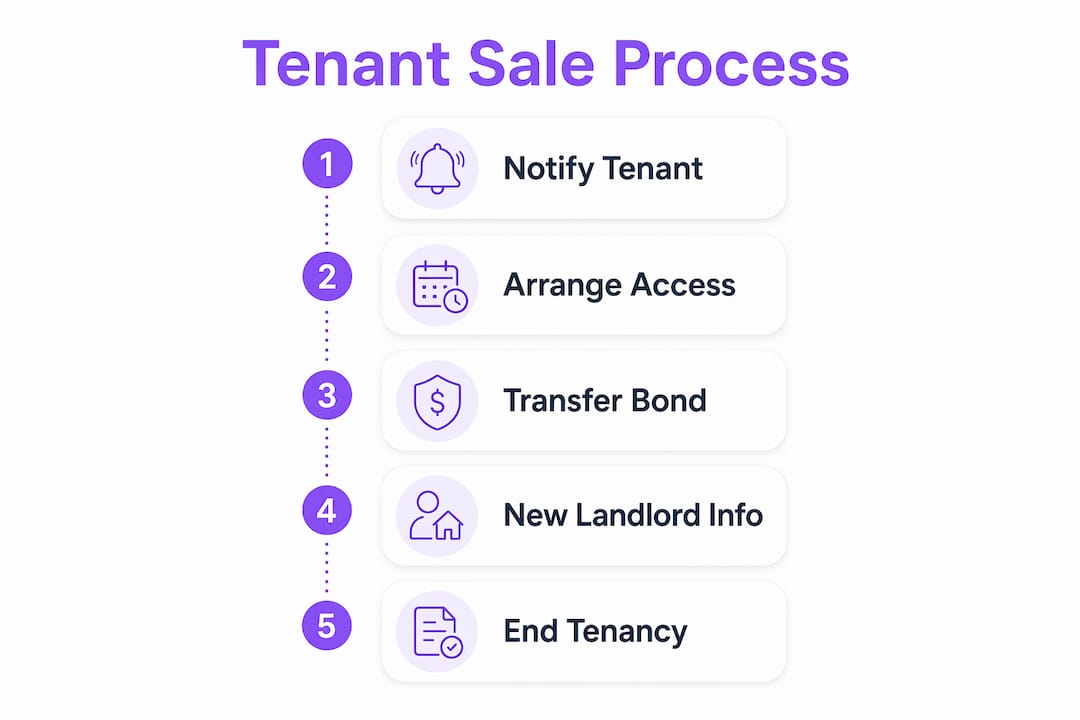
The new owner must tell the tenant their name, contact details, a physical address for service, and how to pay rent going forward. You must also provide the buyer with a copy of the tenancy agreement before settlement.
| Scenario | What happens |
|---|---|
| Buyer keeps the tenant | Tenancy continues; buyer becomes new landlord |
| Fixed-term tenancy during sale | Buyer takes over as landlord for the remaining term |
| Buyer wants vacant possession | Landlord gives 90 days’ notice to end periodic tenancy |
| Fixed-term, buyer wants vacant | Tenant must agree in writing to end the term early |
| Tenant ends periodic tenancy | Tenant gives 21 days’ written notice |
| Bond transfer | Landlord and buyer complete Tenancy Services change of landlord form |
The bond transfer step is one that landlords frequently overlook. If the bond is not formally transferred to the new owner via Tenancy Services before settlement, the previous landlord loses the right to make any claim on the property after that date. Complete the change of landlord form with both signatures and submit it to Tenancy Services promptly.
For selling investment property in NZ, understanding whether your tenancy is periodic or fixed-term before listing is one of the most practical things you can do. It shapes your timeline, your notice obligations, and what you can offer a buyer.
Practical tips for managing tenant relationships before you sell
The landlords who get the smoothest sales are almost always the ones who treat tenants as partners rather than obstacles. That is not just good advice. It reflects what actually happens when a tenant feels respected versus when they feel ambushed.

Start the conversation early, before the property goes on the market. Explain what the sale process will look like, what access you will need, and what the likely outcome is for their tenancy. Tenants who understand the situation are far more likely to keep the property tidy, accommodate viewings, and cooperate with photographers.
Practical strategies that work:
- Contact tenants before listing, not after
- Offer a temporary rent reduction as a goodwill gesture for increased access
- Schedule viewings around the tenant’s routine where possible
- Respond to tenant concerns quickly and professionally
- Keep tenants updated at each stage of the campaign
- Avoid unexpected visits, which erode trust fast
Unhappy tenants can affect a sale in ways that are hard to recover from. A tenant who is present at viewings and visibly unhappy, or a property that is not presented well because the tenant has withdrawn cooperation, can discourage buyers. The right to quiet enjoyment is not just a legal protection. Respecting it is also your best practical tool for keeping the campaign on track.
Considering your exit options before listing is also worth the time. Understanding real estate exit strategies can help you decide whether selling with tenants in place, negotiating an early exit, or pursuing a cash sale better suits your timeline and goals.
Pro Tip: Offer to cover professional cleaning costs at the end of the tenancy as an incentive for cooperation. It costs relatively little and removes a common point of friction.
Selling a tenanted property without the usual stress
Managing tenants, navigating notice periods, and coordinating access during a sale campaign is a lot to handle. For landlords who want to skip that process entirely, Easysale offers a direct cash purchase with no agents, no commissions, and no open homes to negotiate around.
Easysale buys properties across New Zealand in any condition, including tenanted ones, and works around your timeline. There is no need to give tenants notice for marketing access or manage a drawn-out campaign. You agree on a settlement date that suits you, and Easysale handles the rest. If you are dealing with a difficult tenancy situation, a tight timeline, or simply want certainty without the complexity, this is a practical path forward.
Get a no-obligation cash offer for your tenanted property in NZ and find out what your property is worth without the usual process.
Key takeaways
Handling tenants correctly before a sale protects your legal position, maintains the tenant relationship, and gives the sale the best chance of proceeding smoothly under the Residential Tenancies Act.
| Point | Details |
|---|---|
| Notify tenants in writing | Written notice is legally required as soon as you decide to sell. |
| Get permission for every entry | Photos, inspections, and viewings all require tenant consent. |
| Respect tenant access rights | Tenants can refuse open homes and set conditions on access times. |
| Bond transfer is mandatory | Submit the change of landlord form to Tenancy Services before settlement. |
| Easysale skips the campaign | Easysale buys tenanted properties directly, with no open homes or agent fees. |
Recommended
