
Property covenants explained: what NZ homeowners must know


TL;DR:Property covenants are private legal restrictions registered on a property’s title that control land use and development. They transfer with the land and can be enforced by neighboring owners, often overriding council zoning rules. Removing or changing covenants can be complex, expensive, and uncertain, so understanding them before purchasing is crucial.
Property covenants are private legal restrictions registered on a property’s title that control how an owner can use, build on, or modify their land. Unlike council zoning rules, which are public and government controlled, covenants are private obligations that bind every current and future owner of the land. They run with the land itself, not with the person who signed them. Understanding property covenants before you buy or renovate is one of the most practical things you can do to protect your investment and avoid costly surprises down the track.
What are property covenants and how do they work?
A property covenant is a private legal obligation registered against a property’s title that restricts or requires certain actions by the owner. The key word here is “registered.” Because covenants appear on the title, they transfer automatically to every new owner when the property is sold. You do not need to sign anything new. You inherit the restriction the moment settlement completes.
Covenants are governed primarily by the Property Law Act 2007 in New Zealand. They typically originate from a developer who, when subdividing land, imposes conditions to protect the character and value of the neighbourhood. A developer might require all homes to use brick cladding, maintain a minimum floor area, or prohibit any commercial activity on the site. Once registered, these conditions remain in force indefinitely unless formally removed.
The practical effect is significant. A covenant can prevent you from building a sleepout, adding a second dwelling, or even painting your house a colour the original developer did not approve. These are not suggestions. They carry legal weight and can be enforced by other property owners in the subdivision.
What kinds of restrictions do property covenants commonly impose?
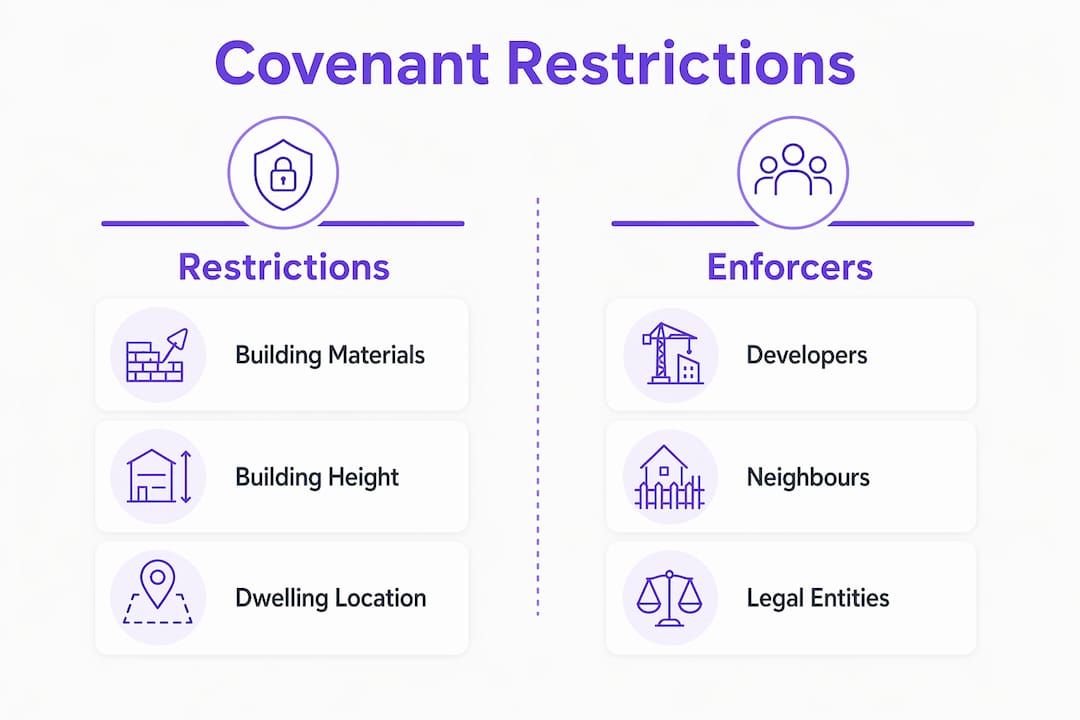
Property covenants in New Zealand cover a wide range of restrictions. The most common categories include:
- Building size and height. Covenants often set minimum floor areas or cap building heights below what council zoning would otherwise allow.
- Building materials and appearance. Restrictions on cladding type, roof colour, and exterior finishes are common in newer subdivisions.
- Secondary dwellings and subdivision. Many covenants prohibit granny flats, minor dwellings, or further subdivision of the section.
- Land use. Some covenants ban commercial activity, keeping animals, or operating a business from the property.
- Architectural approval. Certain covenants require a third party, often the original developer or a residents’ association, to approve building plans before construction begins.
| Covenant type | Typical restriction | Who can enforce |
|---|---|---|
| Building materials | Brick or weatherboard only | Neighbouring owners |
| Minimum floor area | No dwelling under 150m² | Subdivision residents |
| Secondary dwellings | No granny flats or minor units | Neighbouring owners |
| Colour scheme | Approved palette only | Residents’ association |
| Land use | Residential use only | Any benefited owner |
A critical point many homeowners miss: neighbours within a subdivision can enforce covenant conditions even after the original developer has long since disappeared. Enforcement rights often remain with other property owners in the area, not just the developer who created the covenant.
Pro Tip: If you are buying in a newer subdivision, ask your solicitor to identify who holds the benefit of each covenant. Knowing who can enforce a restriction tells you exactly how much risk you carry.
How do covenants differ from council zoning and easements?
Covenants, zoning rules, and easements are three separate legal tools. Mixing them up leads to real mistakes during property purchases and renovations.

Council zoning is a public, statutory control set by local government under the Resource Management Act 1991. It governs what activities are permitted on land across an entire zone, such as residential, commercial, or rural. Zoning rules apply to everyone in that zone equally and are enforced by the council.
Covenants are private agreements registered on individual titles. They sit alongside zoning rules and can be far more restrictive. The rule is straightforward: when restrictions conflict, the more restrictive one applies. If council zoning allows a building height of 10 metres but your covenant caps it at 8 metres, you must comply with the 8 metre limit. The council’s more generous allowance is irrelevant.
Easements work differently again. An easement grants a positive right to use part of your land, such as a neighbour’s right to run a drainage pipe across your section or access a shared driveway. Covenants, by contrast, are almost always restrictive. They tell you what you cannot do rather than granting anyone a right to use your land.
Other title restrictions you may encounter include:
- Consent notices. Conditions attached by a council to a resource consent, registered on title.
- Caveats. A claim by a third party asserting an interest in the property, which can block a sale until resolved.
- Encumbrances. Charges or obligations registered against the title, such as a mortgage.
Pro Tip: Before signing a sale and purchase agreement or lodging a building consent, check both the district plan and the property title. Missing either one can mean discovering a restriction only after you are legally committed.
How do you find and read the covenants on your title?
Finding the covenants on a property title is a straightforward process, but you need to know which documents to order.
- Order a Record of Title with Diagram. This document costs around $42.90 NZD and lists all registered interests on the title, including covenants, easements, and mortgages. It tells you that a covenant exists but rarely gives you the full legal text.
- Order the Instrument document. The Instrument is the actual legal document containing the full covenant terms. It costs around $39.90 NZD and is where you find the specific restrictions, conditions, and any approval requirements. Never rely on the title summary alone.
- Read the covenant clauses carefully. Look for what is prohibited, what requires approval, and who holds the benefit. Pay attention to any clauses requiring third-party sign-off before building.
- Identify the beneficiary. The beneficiary is the party who can enforce the covenant. This might be a neighbouring lot, a residents’ association, or in some cases an entity that no longer exists.
- Assess practical impact. Consider how each restriction affects your plans, whether that is a renovation, a new build, or a future sale.
Title summaries often omit critical covenant details. Some covenants require approval from a third party that may no longer be operating, which creates a genuine legal problem if you need that approval to proceed with building work.
Pro Tip: If the covenant language is technical or unclear, pay for an hour of a solicitor’s time to interpret it. That cost is trivial compared to the expense of breaching a covenant unknowingly.
What are your options for modifying or removing a covenant?
Removing or changing a covenant is possible, but it is rarely quick or cheap. You have two main pathways.
Negotiating with the beneficiary is the first and often most practical route. If you can identify who holds the benefit of the covenant, you can approach them directly and negotiate a formal release or variation. This requires the agreement to be registered on the title to take effect. The process is relatively straightforward when the beneficiary is willing and easy to locate. It becomes complicated when the beneficiary is a group of neighbouring owners, all of whom must agree.
Applying to the court under section 317 of the Property Law Act 2007 is the second pathway. This is a formal legal process where you ask a judge to modify or extinguish the covenant. The grounds you must demonstrate include:
- The covenant’s original purpose no longer applies due to changes in the neighbourhood.
- The covenant is obsolete or causes unreasonable hardship without providing practical benefit to the beneficiary.
- Modification would not substantially injure anyone who benefits from the covenant.
Recent court decisions, including Synlait Milk Ltd v New Zealand Industrial Park Ltd, show that courts are willing to take a flexible approach when neighbourhood character has genuinely changed. However, the process remains complex, expensive, and uncertain. Legal fees, court costs, and the time involved mean that many owners find adapting their plans to work within covenant limits is a more practical solution than pursuing removal.
Alternatives worth considering before going to court include redesigning your project to comply with the covenant, seeking a formal variation rather than full removal, or in some cases simply accepting the restriction and adjusting your expectations for the property.
Pro Tip: Do your covenant due diligence before you buy, not after. Discovering a restrictive covenant post-settlement means you have already inherited the problem. Checking the title before signing a sale agreement costs almost nothing compared to the legal fees of a court application.
What are the real-world implications for buyers, sellers, and renovators?
Covenants have direct financial and practical consequences at every stage of property ownership.
For buyers, the risk is clear. Solicitors warn that once a sale and purchase agreement becomes unconditional, you have purchased the restrictions along with the land. Reviewing title restrictions before signing is not optional. It is the single most effective way to avoid inheriting a problem you did not know existed.
For sellers, undisclosed covenants can derail a sale or reduce the price a buyer is willing to pay. A buyer who discovers a restrictive covenant during due diligence may renegotiate or walk away entirely.
For renovators, the process of obtaining building consent adds an extra layer when covenants are involved. Councils generally do not verify covenant compliance during the building consent process. The responsibility sits with you. You may need to obtain a covenant compliance certificate from a surveyor, architect, or solicitor before the council will process your consent application.
Key risks to watch for include:
- Renovations that breach covenant conditions, exposing you to legal action from neighbours.
- Resale difficulties when a property carries covenants that limit its development potential.
- Approval requirements tied to entities that no longer exist, making compliance technically impossible.
- Neighbour disputes arising from covenant breaches, which can be costly and damaging to relationships.
Understanding legal considerations when selling a property with title restrictions is part of responsible ownership. Getting this right protects your investment and keeps transactions clean.
Key takeaways
Property covenants are private, registered title restrictions that bind every owner of the land and override more generous council zoning rules when the two conflict.
| Point | Details |
|---|---|
| Covenants bind all future owners | Restrictions transfer automatically at settlement; you inherit them whether you know about them or not. |
| Always order the Instrument document | The title summary rarely contains full covenant terms; the Instrument document reveals the actual legal conditions. |
| Stricter rule always applies | When a covenant and council zoning conflict, the more restrictive of the two governs what you can do. |
| Neighbours can enforce covenants | Enforcement rights often remain with neighbouring owners long after the original developer has gone. |
| Removal is costly and uncertain | Court applications under section 317 of the Property Law Act 2007 are complex; adapting plans is often more practical. |
Covenants are not the obstacle most people think they are
Most homeowners I speak with either have no idea their property carries a covenant or assume it is unenforceable because the developer who created it is long gone. Both assumptions cause real problems.
The enforcement point is the one that catches people out most often. Property law specialists consistently note that neighbouring owners retain the right to enforce covenant conditions to protect community standards, even decades after a subdivision was created. I have seen buyers renovate confidently, only to receive a letter from a neighbour asserting their rights under a covenant the buyer never read.
My honest view is that covenants are not the obstacle people fear once you understand them. The real risk is ignorance. A thorough title search before purchase costs under $100 and takes an afternoon. That investment eliminates the most common and expensive covenant mistakes. If you find a restrictive covenant on a property you want to buy, do not panic. Assess whether it actually affects your plans. Many covenants restrict things you were never going to do anyway.
Where I do urge caution is around court applications for removal. The recent trend toward judicial flexibility is real, but “flexible” does not mean “easy.” These applications take time, cost significant legal fees, and carry no guarantee of success. If you are buying a property specifically because you plan to develop it in a way that a covenant currently prohibits, get legal advice before you sign anything.
— Aaron
Selling a property with covenants? Easysale makes it straightforward
Covenants on a title can complicate a traditional property sale, especially when buyers get nervous about restrictions they do not fully understand. Easysale works differently.

Easysale buys properties across New Zealand directly, in any condition, and with full awareness of title complexities including covenants, easements, and other registered restrictions. There are no real estate agents, no commission fees, and no drawn-out negotiations. You submit your property details, receive a fair cash offer, and settle on a timeline that suits you. If your property carries a covenant and you want a clean, straightforward sale, get a cash offer from Easysale today and see how simple selling can be.
FAQ
What is a property covenant in New Zealand?
A property covenant is a private legal restriction registered on a property’s title that controls how the land can be used or developed. It binds all current and future owners automatically and remains in force until formally removed.
Can a neighbour enforce a covenant against me?
Yes. Neighbouring owners within a subdivision often hold the right to enforce covenant conditions, even if the original developer no longer exists. Enforcement rights run with the benefited land, not with the individual who created the covenant.
How do I find out if my property has a covenant?
Order a Record of Title with Diagram from Land Information New Zealand, then purchase the full Instrument document to read the exact covenant terms. Both documents together cost around $82.80 NZD.
Can I remove a covenant from my property title?
Removal is possible either by negotiating a release with the covenant’s beneficiary or by applying to the court under section 317 of the Property Law Act 2007. Court applications require evidence of significant neighbourhood change and are expensive and legally complex.
Do I need council approval to comply with a covenant?
Councils do not check covenant compliance during the building consent process. You are responsible for obtaining a covenant compliance certificate from a qualified professional, such as a surveyor or architect, before proceeding with development.


