
Understanding NZ sale agreements: a homeowner's guide

TL;DR:Most NZ property buyers overlook the legal significance of sale agreements, risking deposits and legal disputes. The Sale and Purchase Agreement is a binding contract that includes conditions protecting buyers from issues like finance approval and property defects. Reviewing and negotiating key clauses with legal advice is essential to avoid costly mistakes and ensure a smooth transaction.
Most homeowners assume a property sale agreement is simply a formality you sign and hand to a solicitor. That assumption is exactly how costly mistakes happen. Understanding NZ sale agreements, or more precisely, the Sale and Purchase Agreement (SPA), is the difference between a smooth property transaction and one that ends in lost deposits, legal disputes, or a deal that collapses at the worst possible moment. This guide walks you through what the SPA actually means, how conditions work, and what to check before you commit.
Table of Contents
- Key takeaways
- Understanding NZ sale agreements and what they actually are
- Conditional vs unconditional: what it really means
- Key conditions in NZ property contracts explained
- How to review and negotiate your sale agreement
- My honest take on NZ sale agreements
- Sell your property without the contract complexity
- FAQ
Key takeaways
| Point | Details |
|---|---|
| SPAs are legally binding | Once unconditional, a Sale and Purchase Agreement is a firm commitment with serious consequences for default. |
| Conditions protect you | Finance, building, and LIM conditions give you legitimate exit paths if due diligence reveals problems. |
| Deadlines are non-negotiable | Missing a condition deadline can strip away your protections, even if the condition itself is valid. |
| Get legal advice early | A solicitor review before signing can cost as little as NZ$200 and could save you thousands. |
| Chattels need precision | Disputes over what is included in a sale are common; always confirm what stays and what goes in writing. |
Understanding NZ sale agreements and what they actually are
The Sale and Purchase Agreement is the cornerstone document in any New Zealand property transaction. It is not just paperwork. It is a legally binding contract that sets out every key term of the deal between buyer and seller. Once it becomes unconditional, both parties are committed.
Most people focus on the purchase price when they look at an SPA. That is understandable, but the price is just one piece. A well-drafted agreement also covers:
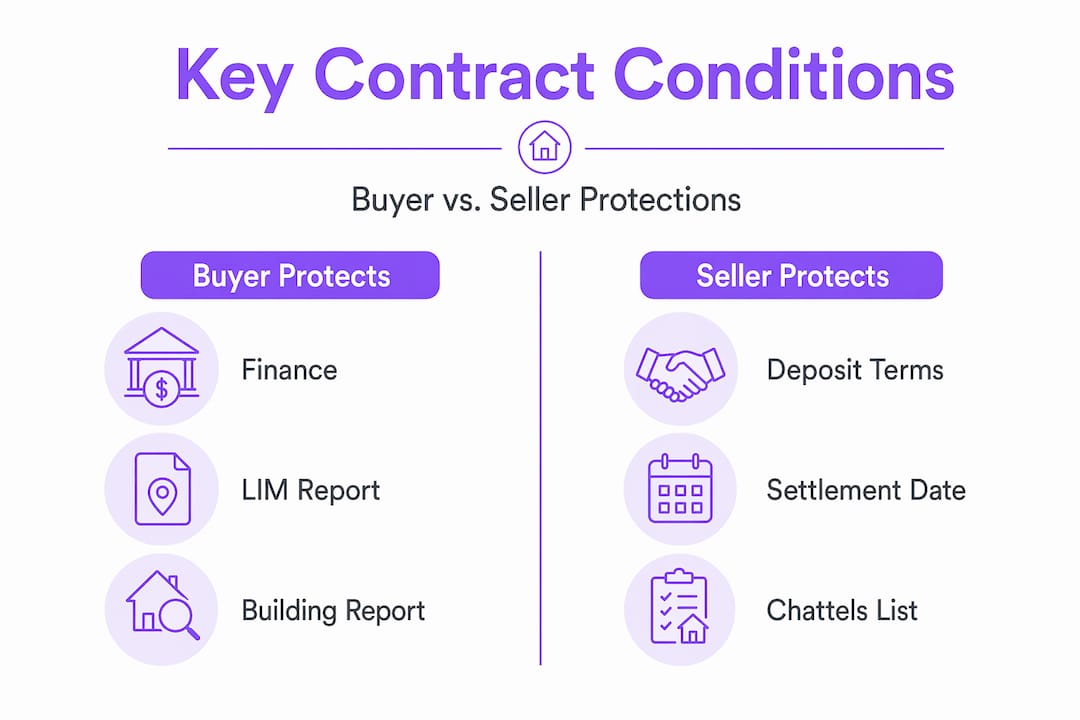
- Purchase price and how it is to be paid
- Deposit amount and who holds it (often a real estate agent or solicitor in trust)
- Settlement date, which is when ownership formally transfers
- Conditions that must be satisfied before the agreement becomes binding
- Chattels, meaning items like whiteware, curtains, and light fittings that are included in the sale
- Special clauses that address unique circumstances of the property or sale
Many buyer issues come from signing without fully understanding contract conditions, timing, settlement dates, or special clauses. The result is unexpected obligations that catch people completely off guard. Understanding property agreements in NZ starts with recognising that every single clause has a legal consequence.
Pro Tip: Before you even read the price on an SPA, flip to the conditions page and the chattels schedule first. These two sections generate the most disputes.
Conditional vs unconditional: what it really means
This is where most buyers get into trouble. An SPA starts out as a conditional agreement, meaning it contains one or more conditions that must be satisfied within agreed timeframes before the deal becomes binding. Once all conditions are waived or satisfied, the agreement becomes unconditional. That shift is enormous.
Conditional periods allow buyers to complete due diligence and exit legally if something goes wrong. Once you go unconditional, you are locked in. Failing to settle after that point risks forfeiture of your deposit, legal action from the vendor, and potential liability for vendor losses. There is no easy way out.
Common conditions you will see in NZ sale contracts include:
- Finance condition: gives you time to confirm your mortgage or loan approval
- Building inspection condition: allows a licensed inspector to assess the property’s condition
- LIM report condition: lets you review the Land Information Memorandum from your local council
- Solicitor’s approval condition: gives your lawyer time to review the title and agreement terms
- Title condition: allows review of any easements, covenants, or restrictions on the title
The window for satisfying each condition is specified in the contract. Missing condition deadlines risks losing the benefit of that condition entirely. In some cases, it can mean the agreement is treated as unconditional even if you never intended that. This is not a grey area. Timing is everything.
Pro Tip: Set calendar reminders for every condition deadline the moment you sign an agreement. Do not rely on memory or informal communication. Written notification to the vendor within the deadline is what counts legally.
Key conditions in NZ property contracts explained
Understanding the specifics of each common condition helps you use them correctly and avoid the misconceptions that cost buyers dearly.
- Finance condition. This gives you time, typically five to fifteen working days, to obtain formal loan approval from your bank or lender. It does not mean pre-approval is enough. You need written, formal confirmation. If your finance falls through within this period and you notify the vendor correctly, you can exit the agreement without penalty.
- Building inspection condition. You have the right to arrange an independent building inspection during this window. However, this condition is narrower than most buyers realise. Misuse of building report clauses is one of the most common errors buyers make. The condition is based on objective, material building risk. Cosmetic issues like scuffed paint or dated fixtures do not legally entitle you to walk away or demand repairs. Trying to use a cosmetic defect as grounds for cancellation could leave you without an exit right and potentially facing a damages claim.
- LIM report condition. A LIM report costs roughly NZ$250 to NZ$400 and takes around ten working days to process. That processing time is critical. If your condition window is only ten working days and you order the LIM on day two, you may have very little time left to review it properly before your deadline expires. Order it immediately.
- Solicitor’s approval condition. Your lawyer uses this window to review the title for encumbrances, easements, covenants, or anything that could restrict your use of the property. Solicitor review fees typically range from NZ$200 to NZ$400 and are money well spent. This condition also lets your solicitor flag any unusual special clauses before you are committed.
The table below summarises each condition and what it protects you from.
| Condition | What it protects | Common misunderstanding |
|---|---|---|
| Finance | Loan not approved | Pre-approval is not the same as formal approval |
| Building inspection | Material structural defects | Does not cover cosmetic or minor issues |
| LIM report | Council-recorded issues or liabilities | Takes up to 10 working days; order it immediately |
| Solicitor’s approval | Title defects or unusual legal clauses | Often underused; always worth including |
Pro Tip: Tracking SPA steps precisely, including deposit payment, condition completion, and cancellation notifications, is crucial to avoid premature unconditional status and the risks that follow.
How to review and negotiate your sale agreement
Knowing how to read NZ sale agreements is a skill that pays off immediately. You do not need to be a lawyer to do a first pass, but you do need to know where to focus your attention.
Start with the money and timing pages. Small wording differences in conditions or chattels can affect protections or obligations significantly. Disputes over what is included in a sale are surprisingly frequent. The chattels schedule needs to be precisely drafted because the line between what is a fixture (stays with the property) and what is a chattel (can be taken by the seller) is not always obvious.
Key things to check when reviewing your SPA:
- Is the purchase price exactly as agreed, including any GST implications if relevant?
- What is the deposit amount, when is it due, and who holds it in trust?
- Does the chattels schedule list everything you expect to stay, including heat pumps, curtains, dishwasher, and whiteware?
- Are the condition windows realistic? Ten working days for a LIM is tight. Fifteen is more comfortable.
- Is the settlement date workable for your circumstances?
- Are there any special conditions or clauses you do not fully understand?
Your solicitor’s role goes beyond reading the fine print. They clarify your commitments, identify risks, and help you decide whether to proceed, renegotiate, or walk away before you are locked in. Do not skip this step. The cost of legal advice at this stage is a fraction of the cost of a dispute later.
When negotiating, you can push for longer condition windows if the standard timeframe feels tight. Vendors may agree, particularly in a slower market. You can also negotiate what chattels are included. Get every agreed change recorded in writing on the agreement itself, not just via text or email.
My honest take on NZ sale agreements
In my experience, the biggest mistake people make is treating the SPA like a rubber stamp rather than a document that deserves real scrutiny. I’ve seen buyers lose their deposit not because anything was structurally wrong with the property, but because they missed a condition notification deadline by a single day. That kind of outcome is completely avoidable.
What I’ve learned is that the wording of your building report condition matters far more than most people appreciate. Buyers commonly assume this condition gives them broad renegotiation rights. It doesn’t. Disputes often hinge not on the existence of conditions, but on whether the buyer precisely met the procedural requirements and timing.
My honest advice: get a solicitor involved before you sign, not after. The mindset of “I’ll review it once it’s signed” is backwards. A good solicitor will often spot a clause that changes your obligations entirely, and you want to know that before you commit.
Approach NZ sale contracts with care, curiosity, and a bit of healthy scepticism. Ask questions. Push back on tight condition windows if you need more time. And never assume the other party’s interpretation of a clause matches yours. Get clarity in writing, every time.
— Aaron
Sell your property without the contract complexity
If you are selling your property and the thought of managing a complex SPA process feels like too much, Easysale offers a genuinely different path.
Easysale buys residential properties across New Zealand in any condition, including damaged or complicated properties, without requiring you to deal with real estate agents, open homes, or drawn-out negotiations. You submit your property details, receive a fair cash offer, and settle on a timeline that suits you. There are no commission fees and no surprises. If you want a fast, straightforward sale where you know exactly where you stand, get a private cash offer from Easysale today.
FAQ
What is a Sale and Purchase Agreement in NZ?
A Sale and Purchase Agreement (SPA) is a legally binding contract between a buyer and seller in a New Zealand property transaction. It outlines the purchase price, deposit, settlement date, conditions, and chattels included in the sale.
What happens if I miss a condition deadline?
Missing a condition deadline can cause you to lose the protections that condition provided, and the agreement may be treated as unconditional. Strict adherence to timing and procedural rules is critical to preserve your exit rights.
Can I use the building inspection condition to get repairs?
No. The building inspection condition is based on objective material building risk, not cosmetic issues. It gives you the right to exit if there are serious structural problems, not to negotiate free repairs for minor defects.
How long does a LIM report take in NZ?
A LIM report typically takes around ten working days and costs between NZ$250 and NZ$400. You should order it immediately after signing a conditional agreement to give yourself enough time to review it within your condition window.
Do I need a solicitor to review my sale agreement?
Yes. A solicitor can clarify your obligations, identify risks, and help you decide whether to proceed before you are locked in. Solicitor review fees typically range from NZ$200 to NZ$400 and are well worth the investment.
Recommended
