
Sale and purchase agreement in NZ: what you need to know

TL;DR:A sale and purchase agreement in New Zealand is a legally binding contract signed by both parties that transfers property rights. It details key terms, conditions, and obligations, with strict deadlines influencing the transaction’s success. Understanding and careful legal review of this agreement are essential to avoid costly mistakes.
A sale and purchase agreement is the legally binding contract that sets out everything agreed between a buyer and seller in a New Zealand property transaction. The moment both parties sign, that contract creates real legal obligations, regardless of whether any conditions have been met. Most residential sales in New Zealand use the ADLS/REINZ 11th Edition standard form, which covers the purchase price, deposit, settlement date, chattels, and buyer conditions. Understanding what this contract contains, and what it commits you to, is the most practical thing you can do before you buy or sell a home.
What is a sale and purchase agreement in New Zealand?
A sale and purchase agreement (commonly called an S&P agreement) is the formal contract that transfers the right to purchase a property from a seller to a buyer. It is not a letter of intent or a handshake deal. Once signed by both parties, it is legally enforceable from signature, even if conditions are still outstanding.
The ADLS/REINZ standard form is the most widely used residential S&P agreement in New Zealand. It is produced jointly by the Auckland District Law Society and the Real Estate Institute of New Zealand. While the form provides a solid starting point, every transaction is different, and amendments are common. Those amendments must be carefully worded to hold up legally, which is why a solicitor’s involvement matters from the outset.
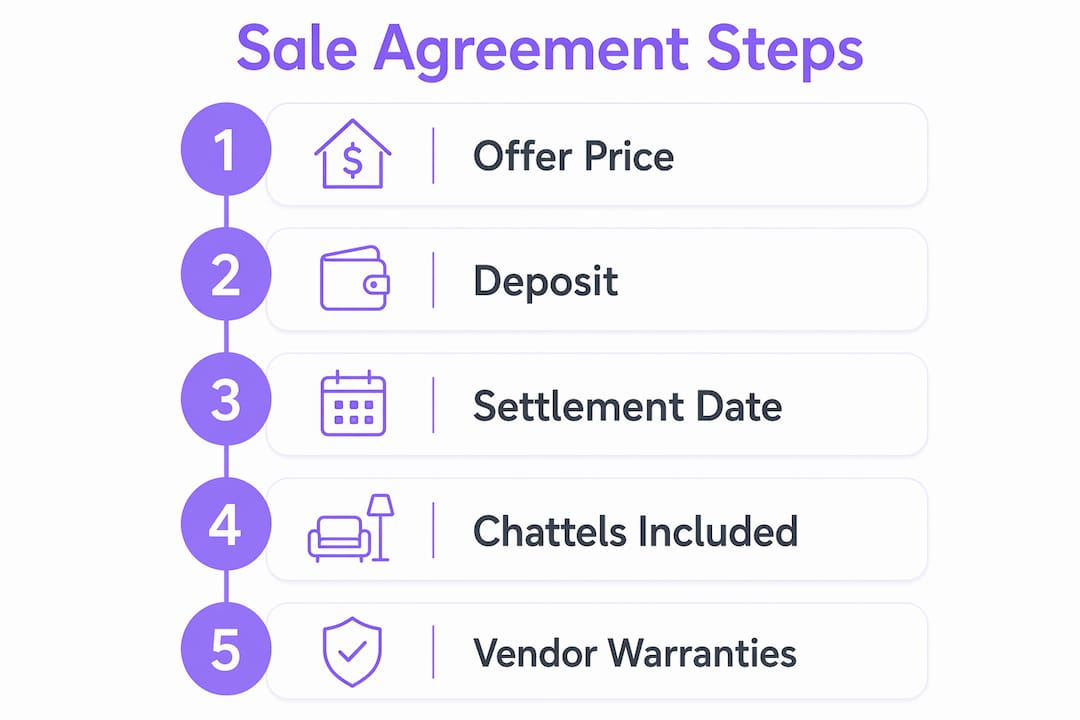
The agreement covers far more than just the price. It records the deposit amount and when it is due, the settlement date, which chattels stay with the property, and any conditions the buyer or seller must satisfy before the sale proceeds. Getting each of these details right protects both sides.
What are the essential elements of a sale and purchase agreement?

The core components of any S&P agreement determine your rights and obligations throughout the sale process. Missing or misunderstanding any one of them can create real problems at settlement.
Purchase price and deposit
The purchase price is the agreed amount the buyer will pay. The standard deposit is typically 10% of the purchase price, payable within 2–3 working days of the agreement going unconditional. The deposit is held in a trust account until settlement, not released to the seller immediately.
Settlement date
The settlement date is the day ownership legally transfers and the buyer pays the balance of the purchase price. It is usually agreed at the time of signing and can range from a few weeks to several months away, depending on what suits both parties.
Chattels
Chattels are the moveable items included in the sale, such as whiteware, curtains, light fittings, and heat pumps. The agreement lists these specifically. If an item is not listed, the seller is entitled to take it. Buyers should check this list carefully before signing.
Buyer conditions
Conditions are the requirements a buyer must satisfy before the sale becomes unconditional. Common conditions include:
- Finance approval: the buyer’s lender confirms the mortgage will proceed
- LIM report: a Land Information Memorandum from the local council, confirming rates, consents, and any known issues with the property
- Building inspection: an independent assessment of the property’s physical condition
- Valuation: a registered valuation confirming the property’s market value for lending purposes
Vendor warranties
The seller makes a series of warranties in the agreement, including that they have the legal right to sell, that the property will be in the same condition at settlement as when the agreement was signed, and that all outgoings are paid up to date. Breaching a warranty can expose the seller to a legal claim.
How do conditions in the agreement work?
Conditions are the clauses that give a buyer time to confirm key facts before committing fully to the purchase. A conditional agreement is still legally binding. The conditions simply give the buyer a defined window to withdraw if specific requirements are not met.
Buyers typically have 5–15 working days to satisfy conditions such as finance approval or a building inspection. Settlement then usually occurs 1–8 weeks after the agreement goes unconditional. These timeframes are negotiated at the time of signing, so they can vary.
Here is how the condition process works in practice:
- Signing the agreement: both parties sign, and the agreement becomes immediately binding, subject to the stated conditions.
- Due diligence period: the buyer arranges finance, orders a LIM report, and books a building inspection within the agreed timeframe.
- Satisfying or waiving conditions: if the buyer is satisfied, they notify the seller in writing that conditions are met. If a condition cannot be met, the buyer can withdraw and recover their deposit. A buyer can also choose to waive a condition, accepting the risk themselves.
- Going unconditional: once all conditions are satisfied or waived, the agreement becomes unconditional. From this point, neither party can withdraw without serious legal consequences.
- Settlement: the buyer pays the balance, and ownership transfers on the agreed settlement date.
Missing a condition deadline is a significant risk. Tight deadlines without agreed extensions can cause buyers to lose their right to cancel, leaving them locked into a purchase they may not be able to complete. Always record any extensions in writing, signed by both parties.
Pro Tip: If you need more time to satisfy a condition, contact the other party’s solicitor before the deadline, not after. An agreed written extension takes minutes to arrange and avoids a dispute that could take months to resolve.
Understanding the difference between conditional and unconditional agreements is also useful when selling your house for cash, where the process often skips the conditional period entirely.
What happens between signing and settlement?
The period between signing and settlement is when most of the practical and legal work takes place. Both buyers and sellers have specific obligations during this time.
- Deposit payment: once the agreement goes unconditional, the buyer pays the deposit into the agent’s or solicitor’s trust account within the agreed timeframe, typically 2–3 working days.
- Title and legal checks: your solicitor searches the property title, confirms there are no caveats or encumbrances, and prepares the transfer documents. This is not optional. Title issues discovered late can delay or derail settlement.
- Due diligence: during the conditional period, the buyer reviews the LIM report, building inspection results, and any other reports ordered. If something concerning comes up, this is the time to negotiate, not after going unconditional.
- Pre-settlement inspection: buyers have a legal right under Clause 3.2(1) to inspect the property by 5pm on the last working day before settlement. This inspection confirms the property and chattels are in the agreed condition. It is not an opportunity to raise new defects or demand repairs for issues that existed before signing.
- Settlement day: your solicitor transfers the purchase funds to the seller’s solicitor. Once confirmed, the keys are released and ownership transfers. The buyer becomes the legal owner from this moment.
Pro Tip: Book your pre-settlement inspection as early as possible on the day before settlement. If you find a genuine issue, such as a listed chattel missing or damage that was not there at signing, your solicitor needs time to raise it with the other side before settlement proceeds.
The property sale process in NZ involves several moving parts, and staying on top of each step keeps settlement on track.
What legal pitfalls should buyers and sellers avoid?
The S&P agreement is a legal document, and treating it as a formality is one of the most common and costly mistakes made in New Zealand property transactions.
- Assuming a conditional agreement is not binding: any signed agreement is legally enforceable from the moment of signing. Conditions give you an exit route, but only if you follow the correct process within the agreed timeframe.
- Skipping legal review: agents can facilitate the agreement, but solicitors must draft or review any special conditions or amendments. An unenforceable clause discovered at settlement can cause the entire deal to collapse.
- Incorrect GST declarations: sellers must accurately declare their GST registration status in the agreement. Incorrect GST warranty declarations can create significant liability, including having to reimburse the buyer for lost tax credits. This is particularly relevant for commercial or mixed-use properties.
- Sunset clause risks: if you are buying off the plans or purchasing developing land, be aware that sunset clauses allow a seller to cancel the agreement if the development is not completed by a set date. Legislation is currently being updated to restrict unilateral cancellations and require advance notice and reasons. Get legal advice before signing any agreement with a sunset clause.
- Missing condition deadlines: failing to satisfy or waive a condition by the agreed date, without a written extension, can strip the buyer of their right to cancel. This leaves them exposed to a purchase they may not be able to complete.
The legal considerations when selling property in New Zealand are specific and consequential. Professional advice before signing is not an added cost. It is protection.
Key takeaways
A sale and purchase agreement in New Zealand is a legally binding contract from the moment of signing, and understanding its key elements, conditions, and obligations is the most effective way to protect yourself in any property transaction.
| Point | Details |
|---|---|
| Legally binding from signature | Even conditional agreements create enforceable obligations the moment both parties sign. |
| Standard form with room for changes | The ADLS/REINZ 11th Edition is the common starting point, but amendments must be reviewed by a solicitor. |
| Conditions have strict deadlines | Buyers typically have 5–15 working days to satisfy conditions; missing deadlines can remove the right to cancel. |
| Pre-settlement inspection is limited | Clause 3.2(1) gives buyers the right to inspect, but only to confirm agreed condition, not to raise new defects. |
| GST declarations carry real risk | Sellers must declare GST status accurately; errors can result in significant financial liability. |
My honest view on sale and purchase agreements
I have seen buyers sign an S&P agreement thinking the conditions give them a safety net with no real consequences if things fall through. That misunderstanding is dangerous. The conditions are an exit mechanism, not a pause button. The moment you sign, you are in a legal relationship with the other party, and every deadline in that document matters.
The part that surprises people most is how little room there is for renegotiation once you are unconditional. If your building inspection turns up something alarming and you have already gone unconditional, you have very limited options. The time to negotiate is during the conditional period, not after. I have seen buyers waive conditions to be competitive in a hot market, only to discover issues they had no legal recourse to address.
My strongest advice is this: never sign an S&P agreement without having a solicitor review it first, even if the agent tells you it is standard. The standard form is a starting point, not a guarantee that every clause suits your situation. A one-hour legal review can save you from a dispute that costs far more in time, money, and stress.
— Aaron
Selling your property without the paperwork stress
If the complexity of sale and purchase agreements feels like a lot to manage, Easysale offers a simpler path for New Zealand homeowners who want to sell quickly and without the usual process.

Easysale buys residential properties across New Zealand directly, with no real estate agents, no commission fees, and no drawn-out conditional periods. You submit your property details, receive a fair cash offer, and settle on a timeline that suits you. The process is built for homeowners who need certainty, whether you are facing a life change, financial pressure, or simply want a fast, straightforward sale. Find out how Easysale can help you move forward without the complexity.
FAQ
What is a sale and purchase agreement in New Zealand?
A sale and purchase agreement is the legally binding contract used in New Zealand property transactions. It records the purchase price, deposit, settlement date, chattels, and any conditions the buyer must satisfy before the sale proceeds.
Is a conditional agreement legally binding?
Yes. A conditional agreement is legally binding from the moment both parties sign. The conditions provide a defined exit route, but only if the buyer follows the correct process within the agreed timeframe.
What is the standard deposit amount in NZ?
The standard deposit is typically 10% of the purchase price, payable within 2–3 working days of the agreement going unconditional. It is held in a trust account until settlement.
Can a buyer pull out after going unconditional?
Withdrawing after going unconditional exposes the buyer to serious legal consequences, including losing the deposit and facing a damages claim from the seller. Legal advice is essential before taking any such step.
What does a pre-settlement inspection cover?
The pre-settlement inspection under Clause 3.2(1) confirms the property and chattels are in the condition agreed at signing. It does not give the buyer the right to raise new defects or demand repairs for issues that existed before the agreement was signed.
Recommended
