
Streamline your quick property sale: workflow and tips

TL;DR:Selling your home quickly in New Zealand often involves a cash sale that allows settlement within weeks, especially during financial distress or urgent situations.Preparation, legal compliance, and honest defect disclosure are essential to maximize benefits and minimize risks in a fast sale process.
Selling your home under pressure is one of the most stressful experiences a Kiwi homeowner can face. Whether you’re dealing with financial difficulty, a sudden job relocation, a relationship breakdown, or a property that needs significant repairs, the urgency to sell quickly can feel overwhelming. The good news is that a well-mapped process can significantly reduce that stress and get you to settlement faster than you might expect. This guide walks you through every step of a quick property sale in New Zealand, from understanding your options to avoiding the most common and costly mistakes.
Table of Contents
- Understanding quick property sales in New Zealand
- What you need before starting: Legal and preparation essentials
- Step-by-step workflow for a fast property sale
- Troubleshooting and common mistakes in quick sales
- Why speed matters—but so does preparation: Our perspective
- Ready for a hassle-free property sale?
- Frequently asked questions
Key Takeaways
| Point | Details |
|---|---|
| Speed trades for certainty | Quick cash sales are ideal for urgent situations but usually offer less than open market value. |
| Preparation is critical | Getting paperwork and legal support ready upfront makes the fast-sale workflow smooth and safe. |
| Legal compliance required | Even in urgent sales, NZ law requires full defects disclosure and properly signed agreements. |
| Independent lawyer advice | Review every agreement with your own lawyer before signing to avoid costly mistakes or undue pressure. |
Understanding quick property sales in New Zealand
When people talk about a “quick property sale,” they typically mean completing the sale process in a matter of days or weeks rather than the months a traditional real estate campaign can take. In New Zealand, several situations commonly drive homeowners toward this route.
Common reasons for needing a quick sale include:
- Financial stress, mortgage arrears, or the risk of mortgagee sale
- Inherited properties that require urgent decisions
- Relationship separations requiring asset division
- Relocations for work or family, often with tight timelines
- Properties with significant damage or deferred maintenance
- Health challenges that make managing a lengthy sale campaign difficult
Understanding why sell for cash in these situations can help you make a more informed decision before you act.
Cash sale versus traditional sale: What’s the real difference?
The two main routes for selling in New Zealand are a traditional sale (via a real estate agent using auction, tender, or asking price) and a direct cash sale to a buyer or property purchasing company. These two options serve very different needs.
| Feature | Traditional sale | Cash sale |
|---|---|---|
| Typical timeframe | 4 to 12 weeks or longer | 7 days to 4 weeks |
| Price achieved | Closest to market value | Typically 80-85% of market value |
| Condition required | Usually presentable | As-is, any condition |
| Finance risk | High (buyer finance can fall through) | None (no bank approval needed) |
| Agent commission | Yes, typically 2-4% | No commission |
| Certainty of sale | Moderate | Very high |
As noted in this cash offer meaning guide, cash sales offer certainty and speed that traditional sales simply cannot match when your circumstances demand it.
The key trade-off is price. Cash sale benchmarks show that offers typically arrive within 24 to 48 hours, with settlement achievable in as little as 7 days and usually no longer than 4 weeks. This makes cash sales ideal for properties with damage, financial distress situations, or any scenario where time is more valuable than squeezing out the last dollar.
“Traditional sales maximise price potential through auctions and tenders, but they carry risks including finance fall-throughs and failed inspections. Cash sales trade some price for speed and certainty, making them the better choice for distress situations rather than profit-motivated sales.” See the full breakdown in this property sale options comparison.
It is worth being honest with yourself about your priorities. If your primary goal is to move quickly, resolve financial pressure, or offload a difficult property without costly repairs, a cash sale is almost certainly your best path forward.
What you need before starting: Legal and preparation essentials
With a clear sense of your needs and the pros and cons, the next step is ensuring you’re legally ready and have all your paperwork in order. Many sellers underestimate how much smoother and faster the sale process becomes when documentation is prepared in advance.
Essential documents to gather before you start:
- Government-issued ID (passport or driver’s licence)
- Proof of ownership (certificate of title, available through Land Information New Zealand, or LINZ)
- Council rates information and any outstanding balances
- Insurance documents for the property
- Any relevant building reports, LIM reports, or resource consents (these are optional for distressed sales but can support your disclosure obligations)
- Details of any tenancy agreements if the property is tenanted
A LIM report (Land Information Memorandum) is a council document that summarises all the property information held by the local council, including consents, drainage, and hazard information. While not legally required in a cash sale, having one ready can speed up due diligence for the buyer.
The professionals you need
You will need an independent lawyer or conveyancer regardless of whether you are selling through a real estate agent or directly to a cash buyer. Conveyancing is the legal process of transferring property ownership from one party to another, and it involves specific obligations under New Zealand law.
According to New Zealand Government guidance, legal requirements remain in place for all property sales. You must use a lawyer or conveyancer, use the latest REA-approved Sale and Purchase Agreement, disclose all known defects, and complete the LINZ transfer for ownership to formally change hands. These obligations apply whether you are selling to a neighbour, a real estate investor, or a cash property buying service.
Pro Tip: Contact your lawyer before you accept any offer, not after. Having your legal contact ready in advance means you can get fast advice the moment an offer lands on your table, rather than scrambling to find representation under time pressure.
Reviewing the full selling process steps before you start can help you understand exactly where lawyers, disclosures, and documents fit into the sequence. Understanding the role of cash buyers in NZ also clarifies what to expect from the other side of the transaction.

Disclosure obligations: What must you tell the buyer?
Defect disclosure is one of the most important legal obligations in any property sale. You are legally required to disclose all known defects in the property, meaning issues you are already aware of that could affect the buyer’s decision or the property’s value.
Common defects that must be disclosed include weather-tightness or leaky building issues, structural problems, flooding or drainage history, pest infestations, fire damage, and unpermitted building work. Failing to disclose known defects can expose you to legal action after settlement, even in a quick or as-is sale.
Step-by-step workflow for a fast property sale
Once you are prepared, here is the streamlined sequence most quick cash sales in New Zealand follow. Familiarising yourself with each stage in advance helps you move confidently when the time comes.
- Contact reputable cash buyers or property purchasing services. Research companies with a verifiable New Zealand presence, positive reviews, and a transparent process. Submit your property details, including address, condition, and your preferred timeline.
- Receive your no-obligation offer. As confirmed by cash sale benchmarks, offers typically arrive within 24 to 48 hours of your initial enquiry. A no-obligation offer means you are free to decline without any pressure or cost.
- Review the offer carefully with your lawyer. Do not sign anything before your lawyer has reviewed the Sale and Purchase Agreement. This step protects you from unfavourable conditions and ensures the contract is legally sound. As noted by the REA on Sale and Purchase agreements, cash offers typically reflect 80 to 85% of market value, and sellers should always obtain independent legal advice before signing to avoid pressure-signing.
- Disclose known defects and negotiate if needed. Once you have disclosed all known defects, the buyer may adjust their offer accordingly. This is normal and expected in an as-is sale. Honest disclosure up front prevents disputes later.
- Sign the Sale and Purchase Agreement. Once both parties are satisfied, sign the agreement with your lawyer present or at minimum after receiving their written advice.
- Complete the LINZ transfer and settle. Your lawyer handles the LINZ title transfer and coordinates the financial settlement. In a fast cash sale, this step can be completed within 7 days to 4 weeks of the agreement being signed.
Pro Tip: Before contacting cash buyers, write down your ideal settlement date and your minimum acceptable price. Having these two numbers clear in your mind makes negotiations much faster and prevents you from agreeing to something you later regret.
This fast cash sale steps guide goes into further detail on each stage. If you are working against a tight deadline, the urgent sale workflow and the broader quick home sales guide are also practical resources to keep on hand.
Troubleshooting and common mistakes in quick sales
To avoid unnecessary setbacks, it is worth knowing where sellers most often trip up in the fast-sale process. Understanding these pitfalls in advance can save you both time and money.
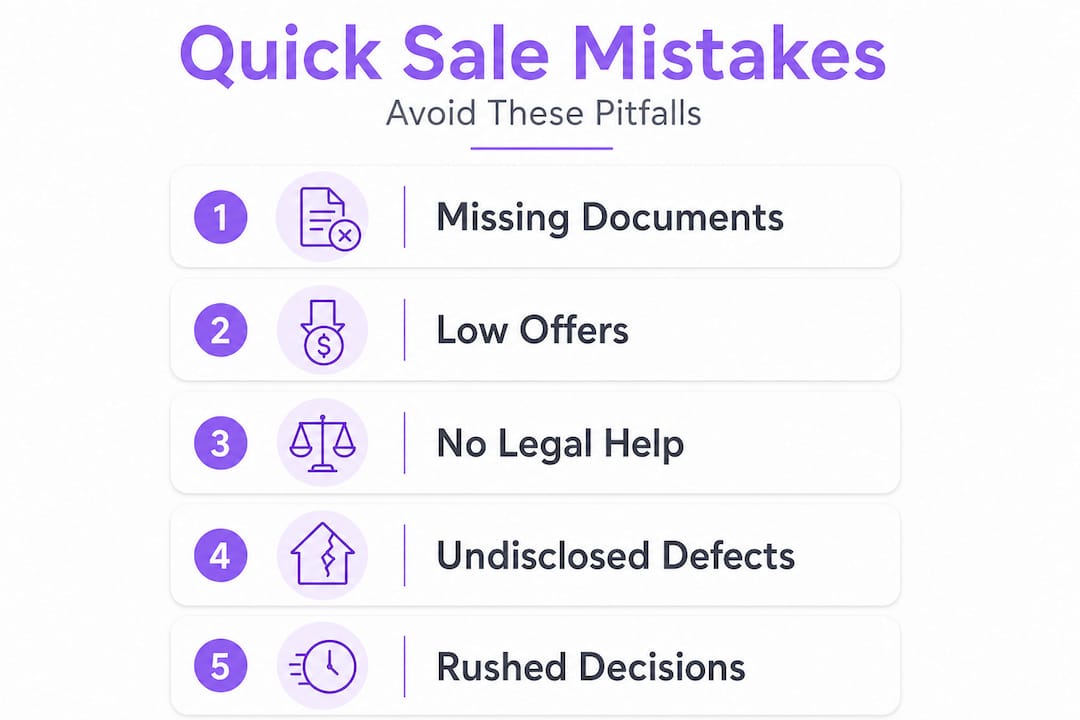
The most common mistakes sellers make:
- Skipping independent legal advice. This is the single most avoidable and costly mistake. Some sellers, eager to finalise quickly, sign a Sale and Purchase Agreement without having a lawyer review it first. Contracts may contain conditions that are unfavourable, such as extended settlement periods that benefit only the buyer, or clauses that limit your rights if something goes wrong.
- Underestimating how disclosed defects affect price. Sellers sometimes expect an offer based on the property’s potential rather than its current state. Being realistic about how known issues, such as a leaky roof, unpermitted renovations, or code compliance problems, will reduce an offer helps you approach negotiations with accurate expectations.
- Accepting offers well below benchmark. REA guidance confirms that cash offers at 80 to 85% of market value are standard, and sellers should be cautious of offers significantly below this range. While some reduction is expected for a fast, as-is sale, offers far below this benchmark may signal an unreliable buyer.
- Falling for pressure tactics. Reputable cash buyers do not pressure you to sign immediately. If a buyer insists on a same-day signature or discourages you from seeking legal advice, treat this as a serious warning sign.
- Missing or incomplete paperwork. Delays due to missing title documents, unresolved rates arrears, or incomplete disclosure can push back your settlement date significantly, even in a fast sale.
“Always get independent legal advice before signing, and never allow yourself to be pressured into a decision. A legitimate cash buyer will give you reasonable time to review the agreement with your own professional.”
Reviewing the full cash home buying process and understanding common cash house buyer pitfalls will put you in a much stronger position before you begin.
Pro Tip: Request a written record of every conversation or agreement with the buyer before the formal contract is signed. This creates a clear trail and prevents misunderstandings about what was agreed verbally.
Why speed matters—but so does preparation: Our perspective
Having walked through the technical steps, here is our candid view on what actually makes a quick sale work well for homeowners under real pressure.
Speed is valuable, but only when the underlying process is sound. We see sellers who focus entirely on how fast they can get to settlement, and in doing so, they skip the steps that protect them legally and financially. The result is often a sale that closes quickly but leaves the seller with regrets, either because the price was lower than it needed to be, or because an unfavourable contract clause caused problems after settlement.
The homeowners who come out of a quick sale feeling genuinely satisfied are almost always the ones who prepared thoroughly before they approached any buyer. They had their documents ready. They had already spoken to a lawyer. They knew their bottom-line price and their ideal settlement date. This preparation did not slow them down. It actually accelerated the process because there were no stressful delays scrambling for paperwork or waiting to find legal advice at the last minute.
There is also an important truth about disclosure that many sellers avoid confronting. Disclosing defects honestly feels counterintuitive when you want the best possible offer. But transparent disclosure protects you legally and builds trust with the buyer, which makes the transaction run more smoothly. Concealing known defects in hopes of a higher offer is not just ethically questionable. It can expose you to legal action long after you have moved on with your life.
Our perspective, shaped by working with many Kiwi homeowners in difficult situations, is this: preparation turns a fast sale into a smart sale. You can find useful context on this in our guide to selling as-is property tips, which covers how to approach condition-related challenges honestly and effectively.
Ready for a hassle-free property sale?
If you have been working through the steps in this guide and you are ready to take action, easySale.co.nz exists to make the process as smooth as possible for New Zealand homeowners. Whether your property needs work, your timeline is tight, or you simply want to avoid the lengthy traditional sales process, we can help.

At easySale.co.nz, we provide fair, fast cash offers with no real estate agent fees and no commission costs. Our simple three-step process starts with submitting your property details, moves to receiving a no-obligation cash offer within 24 to 48 hours, and finishes at settlement on a timeline that works for you. Our team understands the legal and practical steps outlined in this guide, so you can move forward with confidence and genuine peace of mind. Reach out today for a free, no-obligation assessment of your property.
Frequently asked questions
How long does a quick property sale usually take in New Zealand?
With a cash buyer, you can expect an offer within 24 to 48 hours, with settlement completing anywhere from 7 days to 4 weeks after the agreement is signed.
What documents are required for a quick property sale?
You will need government-issued ID, proof of ownership, current rates details, and a Sale and Purchase Agreement reviewed by your lawyer, as outlined in NZ Government guidance on selling property.
Do you have to disclose defects when selling quickly?
Yes. All known defects must be disclosed in every NZ property sale, including fast and as-is sales, to remain compliant with your legal obligations.
Will a quick cash sale fetch full market value?
Not usually. Cash offers typically reflect 80 to 85% of market value, which is the recognised trade-off for the speed, certainty, and convenience a cash buyer provides.
Recommended
